Alabanda
Sacred city of Zeus of the Golden Sword, where two temples stood in formally inviolable Carian ground
Understand sacred places, explore living traditions, and learn how to engage respectfully with Pilgrim Map.
Access has not been verified. Check current local guidance before planning a visit.
Aydın, Turkey
Read the sources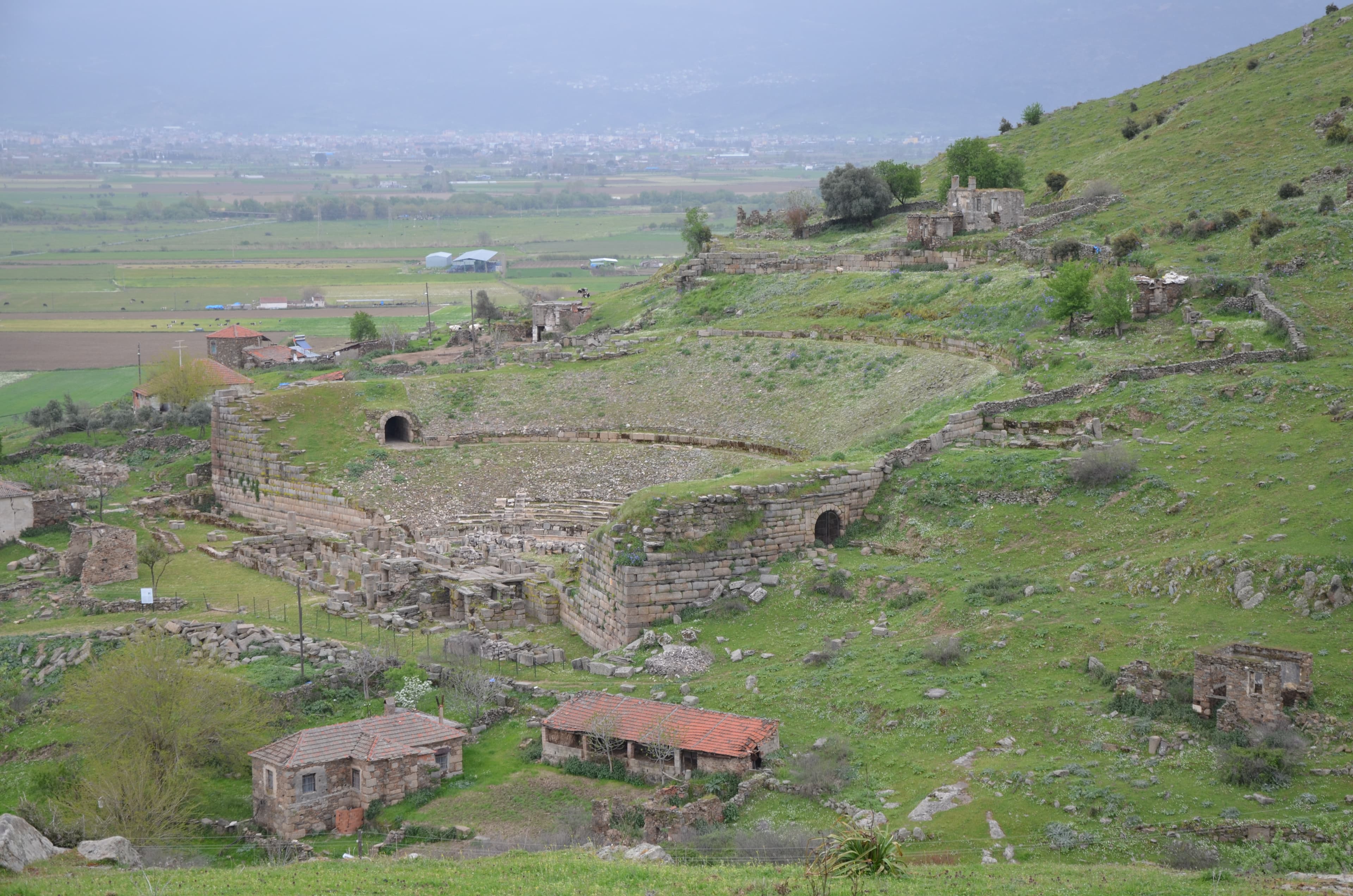
Image of Alabanda. Image source
Visit essentials
A quick read before you go
- Duration
- 1–2 hours for a careful visit; extend to a half-day if you also stop at the Aydın Museum in the…
- Access
- Located near Doğanyurt village in the Çine district of Aydın Province, approximately 10 km from…
Overview
Alabanda occupies the meeting of two ridges above the fertile Çine Çayı valley. Its theatre follows the hillside; the foundations of a Doric temple, an Ionic temple, and the rectangular bouleuterion remain legible, while most of the city still lies unexcavated.
The city was one of very few formally declared inviolable by the Chrysaorian League, the religious-political federation of Carian city-states. Its leading deity, Zeus Chrysaoreus—Zeus of the Golden Sword—had his most important sanctuary here. Sacred inviolability was both legal and spiritual, placing the land under a divine claim above ordinary political power.
Archaeologists have recovered labrys symbols associated with the Zeus temple, evidence of an older layer beneath the Hellenistic cult: the double-headed axe belongs to pre-Greek Anatolia rather than the Greek mainland. Whatever preceded the Hellenistic temples was something older and Carian, whose name was absorbed into Zeus but not entirely erased. Alabanda remains a place still being uncovered and understood.
Why this place is sacred
Alabanda's claim to sacred ground was not metaphorical but legal. The Amphictyonic Council of the Chrysaorian League formally designated the city as asylos — inviolable territory — dedicated to Zeus Chrysaoreus, Zeus of the Golden Sword. In the ancient world, this status placed the city under divine protection and made any violation of its grounds a sacrilege.
The sword in the epithet is thought to refer to the Carian labrys, the double-headed axe recovered in the Zeus sanctuary, which belongs to Anatolian religious grammar that predates Greek colonization by centuries. Apollo Isotimos — Apollo the Equal in Honor — shared the sacred precinct, embodying the process by which the Hellenistic world ordered and rationalized indigenous Anatolian cults into recognizable Olympian forms without fully suppressing them.
Alabanda thus held two divine presences whose names were Greek but whose roots ran into Carian soil: one carrying a golden sword, one equal in honor to Olympian Apollo. The formal inviolability of the ground, the ritual assemblies of the Chrysaorian League held here, and the double-temple layout all point to a city understood in antiquity as a genuine axis of sacred authority.
Center of the Chrysaorian League's religious and political life; sanctuary of Zeus Chrysaoreus and Apollo Isotimos; inviolable sacred territory by formal declaration.
From pre-Greek Carian sacred site with labrys symbolism, through Hellenistic dual-temple complex and Chrysaorian League assemblies, through Roman civic life, to Byzantine occupation, and finally to the largely unexcavated archaeological field that exists today.
Experience and orientation
Alabanda does not announce itself. The road from Çine passes through olive and fig country before the terrain steepens toward the ruins at Doğanyurt village. Approach the site on foot from the access track: the hillside opens slowly, and the first clear structure is the curve of the theatre, its cavea cut into the slope in the manner of Anatolian theatres that married human architecture to the land's own geometry. Move through it unhurriedly.
The acoustics reward a pause — say something quietly and hear the way sound distributes in the stone. From the theatre, the ground levels into the civic plateau where the bouleuterion's rectangular outline and the two temple foundations sit within range of each other.
The Doric temple of Zeus Chrysaoreus predates the Ionic Apollo temple by about a century; both are fragmentary now, but the scale of the column spacing is legible if you look for the foundation courses and align yourself with the axis. The city around them is mostly unexcavated hillside, which means the ground you walk on contains what has not yet been found.
That quality of latency — of being on the surface of something incompletely known — is one of Alabanda's genuine gifts to the careful visitor. The comparative solitude is another. Most days, you will have the site to yourself.
Enter from the village road; move first to the theatre, then cross to the temple precinct. The bouleuterion foundation is east of the temples. Allow 90 minutes at minimum to let the site's quiet work on you.
Context and lineage
The city takes its name from Alabandus, a legendary Carian hero said to have founded the settlement after winning a horse race. The name itself preserves Carian language: ala meaning horse, banda meaning victory. Alabandus was later venerated as a founding deity — the kind of cult hero whose mythological biography fuses human, divine, and civic origins into a founding narrative that bound a community to its landscape.
The twin heights on which the city was built, converging above the valley of the Çine plain, suggest the site was chosen for the kind of topographic reason that ancient founders instinctively recognized: defensibility, visibility, and the sense of being gathered between earth and sky.
Pre-Greek Carian sacred site with labrys cult → Hellenistic city under Seleucid rule, dual-temple complex (3rd–2nd century BCE) → Roman civic center → Byzantine occupation → Ottoman period abandonment → archaeological excavation from 1905, systematic research from 1999 by Aydın Museum.
Traditions and practice
The Chrysaorian League — a federation of Carian cities bound by their common veneration of Zeus Chrysaoreus — held its regular assemblies at Alabanda. These were simultaneously political events and religious occasions: decisions were made in the presence of the god, and the assemblies began with sacrifices at the Zeus Chrysaoreus temple. Civic religious festivals tied the calendar of the city to the divine year.
The declaration of Alabanda as asylos meant that fugitives and suppliants who reached its boundaries held a sacred claim to protection.
No active religious practice. Ongoing archaeological excavation by the Aydın Museum, with research programs active since 1999. The site is freely accessible.
Move through the site at a pace slower than you would ordinarily allow yourself. At the theatre: stand in the orchestra, look up through the arc of the cavea to the sky, and notice the relationship between the human scale of the seating and the mountain horizon behind it. At the temple foundations: identify the axis of each building by locating the surviving foundation courses.
The Doric Zeus temple is the older and slightly more fragmentary; the Ionic Apollo temple shows the white marble characteristic of second-century Hellenistic construction. At the bouleuterion: the 36x36 meter footprint was where the Chrysaorian League met — sit on the ground inside it if it is quiet enough and let the square shape of deliberative space hold you for a few minutes. The unexcavated city around you contains what the next generation of archaeologists will find.
You are walking on the surface of that unknown.
Carian Religion
HistoricalAlabanda was sacred to Zeus Chrysaoreus — the Carian adaptation of Zeus associated with the golden sword and the labrys — and was formally declared inviolable territory by the Chrysaorian League, a federation of Carian cities.
Animal sacrifice at the Temple of Zeus Chrysaoreus; Chrysaorian League assemblies with religious and political functions; civic festivals in the divine calendar.
Greek Polytheism
HistoricalAfter Hellenization, Alabanda hosted a full Greek religious complex with the Ionic Temple of Apollo Isotimos (2nd century BCE) standing alongside the earlier Zeus temple.
Temple worship, religious festivals, civic sacrifices at both temples.
Archaeological Heritage
ActiveOngoing excavation since 1999 by the Aydın Museum continues to recover evidence of Hellenistic and Roman civic life; the site is important for understanding Carian religious syncretism.
Annual academic excavation; site visits; cultural heritage research.
Perspectives and open questions
Alabanda occupies a distinctive place in Carian religious history as the formally declared sacred center of the Chrysaorian League — a status that generated interpretive interest across academic, indigenous, and alternative frameworks.
Scholarly perspective
Scholars recognize Alabanda as a significant Carian city-state whose dual temple complex — Doric Zeus Chrysaoreus (3rd century BCE) and Ionic Apollo Isotimos (2nd century BCE) — reflects the characteristic Hellenistic process of overlaying indigenous Anatolian cults with Olympian forms. The recovery of labrys symbols in the Zeus sanctuary is regarded as evidence of genuine pre-Greek religious continuity. The Chrysaorian League, centered here, was a functioning theocratic-political entity whose assemblies constituted both religious observance and political governance.
Ongoing excavation since 1999 continues to clarify the urban plan.
Living and traditional perspectives
The Carian founding mythology of Alabandus — the horse-race hero whose name encodes the Carian words for horse and victory — represents an indigenous origin narrative that predates Greek cultural influence. The labrys recovered in the Zeus precinct belongs to Anatolian religious symbology that significantly predates the Greek colonization of Caria. The formal designation of the city as inviolable sacred territory suggests the Chrysaorian League maintained a genuine theological understanding of the site as divinely bounded ground.
Alternative interpretations
The double masculine divine presence at Alabanda — Zeus of the Golden Sword and Apollo of Equal Honor — has been read in some esoteric traditions as a site of dual solar-masculine sacred energy within the Anatolian landscape. The labrys symbol, associated elsewhere in Anatolia with goddess traditions, introduces a more complex interpretive layer beneath the masculine surface.
Open questions
The majority of Alabanda remains unexcavated. The full extent of the sacred precinct, the precise nature of Chrysaorian League rituals, and the relationship between the pre-Greek labrys cult and the later Zeus Chrysaoreus temple are all incompletely understood. What lies beneath the unturned earth of this hillside city is, in the most literal sense, still unknown.
Plan your visit
Access and arrival
Located near Doğanyurt village in the Çine district of Aydın Province, approximately 10 km from Çine by car. No public transport runs directly to the site; a car is necessary. The road is passable but unpaved on the final approach.
Çine (10 km) has modest hotels and guest houses. Aydın city (30 km) has a fuller range of accommodation and the Aydın Museum, which houses Alabanda excavation finds.
Respectful visit
No formal requirements. Practical outdoor clothing and sturdy footwear are recommended; the terrain is uneven.
Permitted throughout the site.
Not applicable for this archaeological site.
Do not remove any artifacts, stones, or pottery fragments. Respect any fenced excavation areas.
Do not remove any material from the site. The site has no entrance facilities; carry water, especially in summer.
Location
Map loads as you approach this section.
Pilgrim reflections
A portrait of encounter, not a score
Pilgrims describe what they felt, how present they could become, and whether the place would shape a journey. There are no stars and no ranking of traditions.
No reviewed reflections yet
The first pilgrims can help describe the character of being here.
Share a reflection
Available after an account-backed “Been there.” Every reflection is reviewed before publication.
Nearby sacred places
Explore other sacred places in the region. Proximity does not establish access or travel time; check each place’s guidance.


References
Sources consulted for this page. Source categories describe the publication, not a guarantee that every claim is verified. Traditional accounts and outside interpretations may differ.
- 01Top 10 Archaeological Sites in Caria, Turkey — World History EncyclopediaacademicAcademic overview placing Alabanda in Carian context
- 02The Princeton Encyclopedia of Classical Sites, ALABANDA (Araphisar) Caria, Turkey — Perseus Digital LibraryacademicAuthoritative classical reference
- 03Aydın Alabanda Archeological Site — Turkish MuseumsofficialOfficial Turkish Museums information
- 04Alabanda - Wikipedia — Wikipedia contributorsencyclopediaGood overview of history and archaeology
- 05Alabanda | Archiqoo — ArchiqooguideSite guide with structural details
- 06Alabanda Exploring the Ancient City of Horse Races and Luxury — Destinations.com.trguideTravel guide with local context
- 07Alabanda: Significance and symbolism — WisdomLibSource contextSymbolic and mythological significance
- 08ALABANDA ANCIENT SITE — Slow Travel GuideguidePractical visitor information
Share a photo
Help visitors recognize Alabanda. Every submission is reviewed before publication.