St Edith's Well, Kemsing
A roadside well marking the traditional birthplace of Saint Edith of Wilton
Understand sacred places, explore living traditions, and learn how to engage respectfully with Pilgrim Map.
Access has not been verified. Check current local guidance before planning a visit.
Kemsing, England, United Kingdom
Read the sources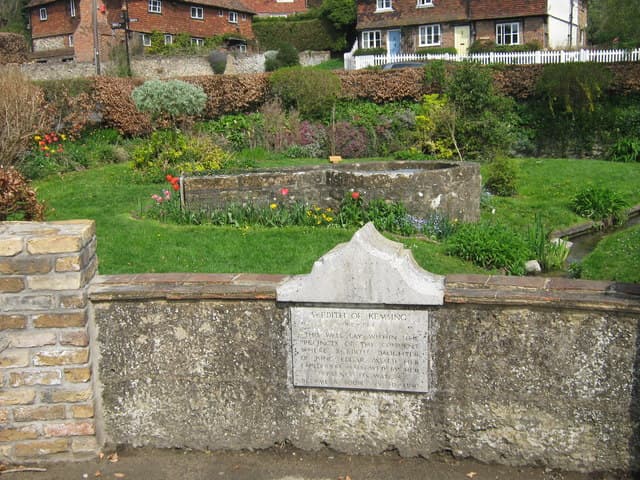
Image of St Edith's Well, Kemsing. Image source
Visit essentials
A quick read before you go
- Duration
- A brief stop of 10-15 minutes; typically visited as part of a longer walk along the Pilgrims'…
- Access
- Located on the High Street at the junction with St Edith's Road, opposite The Bell public house,…
Overview
St Edith's Well stands at an unassuming triangular junction on Kemsing's High Street beside the village war memorial: a modest stone-enclosed well behind a metal grille. Its significance comes from a person rather than the landscape. Tradition holds that Edith, daughter of King Edgar of England, was conceived and born here around 961. Her mother Wulfthryth returned with the infant to Wilton Abbey, where Edith lived her short life and died in 984.
The water was said to carry her sanctity by association and was particularly valued for eye complaints. Today's stonework is generally described as medieval, but no published archaeological dating confirms a specific date for the enclosure or the grille that prevents anyone from touching the water.
Just east of Otford, Kemsing is also where the London/Southwark and Winchester branches of the Pilgrims' Way converge, making the well both a devotional site and a waypoint for modern walkers.
Why this place is sacred
What makes St Edith's Well sacred is almost entirely narrative rather than material. The physical structure - a low stone enclosure with a metal grille - is unremarkable to look at, and the sources consulted are consistent in hedging its age: the stonework is generally described as medieval, but no archaeological excavation report or published dating has been located to confirm when the current enclosure, or the grille itself, was actually built.
What is not in doubt, historically, is the underlying claim the well makes: this is the traditional birthplace of Edith of Wilton, a genuine late Anglo-Saxon royal figure whose cult developed within about a decade of her death in 984.
The well borrows its sanctity from her by association - water from the place where a saint was reputedly born was believed, in the pattern common to many English holy wells, to carry curative power, particularly for eye ailments and, in some accounts, for ensuring a good harvest.
Because the grille prevents physical contact with the water, that folk-healing layer of the tradition is now entirely historical rather than practiced; what continues is the well's role as a focus for the annual observance of Edith's feast day rather than as a site of individual therapeutic use.
A holy well marking the traditional birthplace of Saint Edith of Wilton, its water valued in folk tradition for healing properties, particularly for eye complaints.
The well tradition dates in principle to the late tenth century, following Edith's death in 984, though the physical stonework visitors see is only generally described as medieval - no confirmed date exists for either the stone enclosure or the metal grille that now covers it. A possible medieval chapel dedicated to 'St Edith the Virgin,' recorded in 1419, may once have stood nearby, but its location and fate are undocumented.
In 2011, the parish of St Mary the Virgin introduced well-dressing - floral decoration of the well - as part of the annual feast-day observance, adding a modern ritual layer to the older tradition.
Experience and orientation
St Edith's Well rewards low expectations. Pilgrim-bloggers and walkers describe arriving at a roadside triangle beside Kemsing's war memorial and finding a well-kept, grassy little enclosure rather than anything monumental - and then finding that the metal grille means the water itself stays out of reach, a detail several visitor accounts note as a small letdown against the older tradition of drawing water for eye ailments.
What the well does offer is context: standing here, at the point where the London/Southwark and Winchester branches of the Pilgrims' Way converge, a walker can register Kemsing's role as a junction rather than simply a stop, with St Mary the Virgin church a short walk away holding stained-glass windows of the saint the well is named for.
The felt quality of the place is closer to a village pause than a destination in itself - brief, quiet, and dependent on carrying the birth legend into it rather than encountering drama in the stone.
The well sits on Kemsing High Street at its junction with St Edith's Road, opposite The Bell public house, in the village centre; St Mary the Virgin church is a short walk away, and the well marks the point where the Winchester and London/Southwark branches of the Pilgrims' Way converge.
Context and lineage
According to the tradition recorded in later hagiography, King Edgar of England took Wulfthryth, a novice of Wilton Abbey, to his manor at Kemsing, where Edith was conceived and born around 961; accounts differ on whether this followed a formal, if short-lived, marriage or a more coercive abduction, and Wikipedia's treatment of the episode is notably more cautious than some devotional sources.
Wulfthryth returned with the infant Edith to Wilton Abbey, where both remained for the rest of their lives; Edith died there in 984 at about twenty-three. Her cult developed quickly - within roughly a decade, by most scholarly accounts - and later chroniclers, including William of Malmesbury, recorded that when King Cnut ordered her tomb opened to test claims of her sanctity, her corpse sat up and struck him, after which he endowed her shrine.
These narrative details, including the birth story itself, are treated by historians as hagiographic embellishment transmitted mainly through Goscelin's Vita Edithae (c.1080) rather than as verified fact, even as Edith herself is accepted as a genuine historical figure of the late Anglo-Saxon royal house.
The well's tradition belongs to the broader English pattern of holy wells Christianized by association with a local saint; Edith's own religious life was spent within the Wilton Abbey community, distinct from Kemsing, which claims her only as birthplace rather than as the site of her adult vocation.
Traditions and practice
Medieval and later pilgrims reportedly drew and applied the well's water for eye complaints and, in some accounts, to help ensure a good harvest - a common pattern among English holy wells attributed to a local saint's sanctity.
An annual procession from the parish church of St Mary the Virgin to the well takes place on or around 16 September, St Edith's feast day, followed by devotions and prayers; well-dressing, the floral decoration of the well, has been part of this observance since 2011.
Visit around the feast day if the timing allows, to see the well decorated and the procession in progress; otherwise, pair a quiet look at the grilled well with a stop at St Mary the Virgin to see the stained-glass windows of Edith before continuing along the Pilgrims' Way toward Otford or onward toward Canterbury.
Christianity (Anglican, historically Catholic) - veneration of St Edith of Wilton
ActiveSt Edith is commemorated as Kemsing's birthplace saint; the well and the adjacent Church of St Mary the Virgin, which holds stained-glass windows depicting her, anchor the annual observance of her feast day.
Annual procession from St Mary the Virgin to the well on or around 16 September, followed by devotions and prayers, with well-dressing added to the observance in 2011.
Folk healing-well tradition
HistoricalWater from the well was historically believed to cure eye ailments and, in some accounts, to help ensure a good harvest, following a pattern common among English holy wells associated with a local saint.
Historic drawing and application of well water for eye complaints; no longer possible since the well was grilled.
Perspectives and open questions
St Edith's Well holds two things in tension: a genuine, well-attested historical saint, and a physical well whose own age and authenticity are considerably less certain than the legend built around it.
Scholarly perspective
Historians treat Edith of Wilton as a real figure of the late Anglo-Saxon royal house whose cult developed quickly after her 984 death, but regard many specific narrative details - the exact circumstances of her conception and birth at Kemsing, the abduction framing of her mother's story, and miracle accounts such as the Cnut tomb-opening episode - as hagiographic embellishment transmitted mainly through Goscelin's Vita Edithae rather than verified fact.
On the well itself, no formal statutory listing or archaeological excavation report was located; the stonework is generally described as medieval, but this description has not been confirmed by any published dating study, and the well should not be presented as a securely dated medieval structure.
Living and traditional perspectives
The parish of St Mary the Virgin and the British Pilgrimage Trust treat the well as Kemsing's central devotional landmark, anchoring the annual 16 September procession and well-dressing to Edith's feast day and framing the well as continuous with her sanctity by virtue of birthplace.
Alternative interpretations
Some holy-well enthusiast and pagan-leaning accounts situate the well within a broader English tradition of pre-Christian sacred springs later Christianized by dedication to a saint; no source consulted, however, provides specific evidence of pre-Christian use at this particular well, and this framing should be read as a general pattern applied here rather than a documented local fact.
Open questions
The exact date of the well's current stone enclosure and grille is not recorded in any source located; nor is the precise location or fate of the chapel of 'St Edith the Virgin' recorded in 1419.
Most fundamentally, there is no published archaeological dating of the well or its stonework - the 'probably medieval' description in circulation is a reasonable inference from style and record, not a confirmed finding, and should be treated as such rather than as an established date.
Plan your visit
Access and arrival
Located on the High Street at the junction with St Edith's Road, opposite The Bell public house, in the centre of Kemsing, Kent (TN15 6NB), roughly three miles from Sevenoaks; freely accessible on foot at any time with no entry fee. The nearest railway station is approximately a 25-minute walk away.
Respectful visit
No restrictions identified; the well is a public monument in open village space.
No ongoing individual offering practice is documented; the well-dressing (floral decoration) that occurs annually around the feast day is a collective, church-organized observance rather than something individual visitors are expected to contribute to.
Physical access to the water itself is blocked by a metal grille; visitors can view the well but not touch or draw water from it.
The water cannot be drawn or touched; visitors should not attempt to remove the grille or otherwise interfere with the well structure.
Location
Map loads as you approach this section.
Pilgrim reflections
A portrait of encounter, not a score
Pilgrims describe what they felt, how present they could become, and whether the place would shape a journey. There are no stars and no ranking of traditions.
No reviewed reflections yet
The first pilgrims can help describe the character of being here.
Share a reflection
Available after an account-backed “Been there.” Every reflection is reviewed before publication.
Nearby sacred places
Explore other sacred places in the region. Proximity does not establish access or travel time; check each place’s guidance.


References
Sources consulted for this page. Source categories describe the publication, not a guarantee that every claim is verified. Traditional accounts and outside interpretations may differ.
- 01Edith of Wilton - Wikipedia — Wikipedia contributorsacademicWell-cited biographical article; confirms birth in Kemsing c.961, parentage, life at Wilton Abbey, death c.984, canonization circumstances, and feast day of 16 September.
- 02Kemsing - Wikipedia — Wikipedia contributorsacademicConfirms Kemsing as St Edith's birthplace and the well's dedication and location in the village.
- 03St Edith's Well, Kemsing — British Pilgrimage TrustSource contextPilgrimage organization; confirms location, access restriction (metal grille), healing tradition, procession date, and role at the convergence of the London and Winchester branches of the Pilgrims' Way.
- 04Eve of St Edith at Kemsing's well / St Edith's Well at Kemsing — Walking The Pilgrims' WaySource contextPilgrims'-Way walking blog run by route enthusiasts; confirms Kemsing's status as a stage on the Pilgrims' Way just after the Southwark and Winchester routes converge at Otford, and details the annual procession from St Mary's Church to the well on/around 16 September.
- 05Saint Edith of Wilton — CatholicSaints.InfospiritualHagiographic account within the Catholic tradition; corroborates the King Cnut/tomb-opening legend and general hagiography, framed as traditional belief rather than verified history.
- 06St Edith's Well, Kemsing, Kent — The Journal of AntiquitiesSource contextEnthusiast heritage blog; used for physical description of the well structure (modern enclosure walls, probable medieval well lining, metal grille) and note of a possible chapel of 'St Edith the Virgin' recorded in 1419. Cross-checked against megalithic.co.uk.
- 07St Edith's Well (Kemsing) Holy Well or Sacred Spring — The Megalithic Portal contributorsSource contextCrowd-sourced heritage/folklore database; corroborates physical description and healing-water claims (eye ailments).
- 08Pilgrimage To... St Edith's Holy Well, Kent — Megan Manson, PatheosSource contextPersonal pilgrimage-blog account (Pagan perspective); used only for visitor-experience texture, not as a factual authority.
Share a photo
Help visitors recognize St Edith's Well, Kemsing. Every submission is reviewed before publication.