St Martha-on-the-Hill
A working parish church on a hilltop of contested martyrs and seven counties of view
Understand sacred places, explore living traditions, and learn how to engage respectfully with Pilgrim Map.
Access has not been verified. Check current local guidance before planning a visit.
Guildford, England, United Kingdom
Read the sources
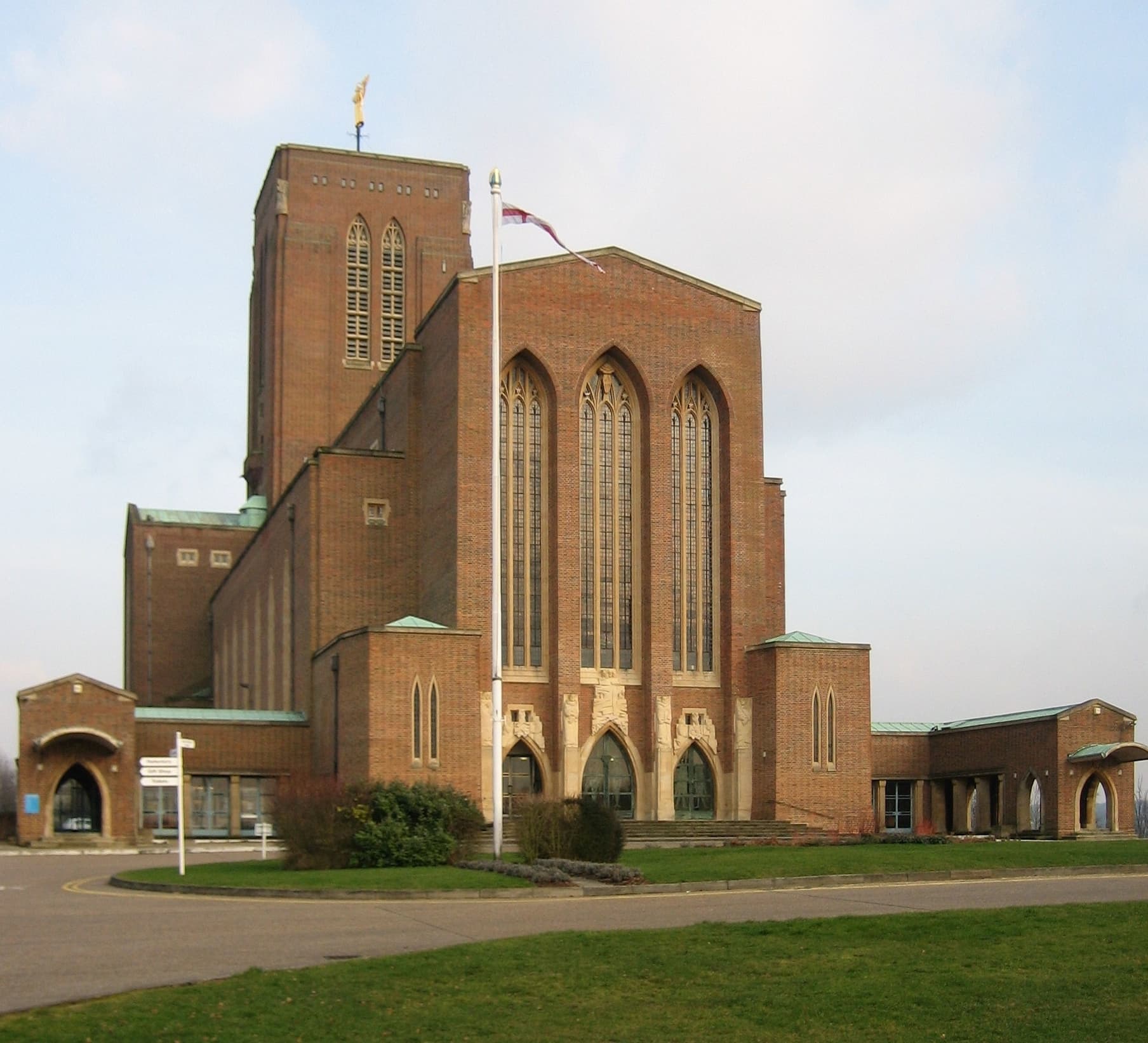
Image of St Martha-on-the-Hill. Image source
Visit essentials
A quick read before you go
- Duration
- A visit to the church itself takes 15-30 minutes; most visitors combine it with a longer…
- Access
- Foot access only — no public road reaches the summit.
Overview
St Martha's is unusual on the Winchester-Canterbury road: neither ruin nor relic, but a functioning church climbed to rather than driven to, where a congregation gathers most Sundays. The hill shows use since the Neolithic and Bronze Age, before any summit chapel.
Its name remains genuinely unresolved. “Martha” may corrupt “Martyr,” referring either to Christians killed here around 600 AD while resisting Augustine's mission or to Thomas Becket, murdered in 1170; it may simply honor Martha of Bethany. No source settles the question, and the church takes no official position.
The Norman building begun around 1189-1204 was largely ruined by the eighteenth century; a local account blames an explosion at the gunpowder mills below. Henry Woodyer rebuilt it in Norman style between 1848 and 1850 with substantial funding from the Duke of Northumberland. Held for centuries by Newark Priory's Augustinian canons, the Grade II-listed working parish is now a scenic North Downs Way high point, with a tower theorized to have guided medieval travelers across the ridge below.
Why this place is sacred
A 1463 document refers to 'the chapel of St. Martha the Virgin and all the holy Martyrs,' which is close to the entire problem in miniature: even in the medieval record, the site's name sits between a saint and a plural, unnamed group of martyrs.
One local tradition holds that early Christians were killed here around 600 AD during pagan resistance to St Augustine's mission to England; another holds that 'Martyr's Hill' commemorates Thomas Becket, murdered in 1170, and that the name was later softened into 'Martha.' A third possibility, favored by no particular evidence over the others, is that the dedication to Martha of Bethany came first and the martyr etymology is a folk invention working backward from the sound of the word.
None of these accounts can be verified archaeologically — no physical trace of a Saxon chapel has ever been found on the summit, despite documented Neolithic and Bronze Age activity on the hill more broadly, including a 1953 excavation of a Bronze Age barrow.
What the record does support with more confidence is the site's long institutional life: a Norman church built between 1189 and 1204, held from 1262 by the Augustinian canons of Newark Priory, standing until sometime in the eighteenth century when it fell into ruin — the Parish of Chilworth's own history attributes the destruction specifically to an 1745 explosion at the gunpowder works in the valley below, though other accounts describe a more general, gradual decay.
The Victorian rebuild by Henry Woodyer, completed in 1850 and funded largely by the 6th Duke of Northumberland, is the building that stands today: a careful re-creation of Norman form using genuine period elements, on a site whose deeper history the building itself cannot fully explain.
A hilltop church, possibly with an earlier Saxon predecessor, built in Norman style between 1189 and 1204 and held by Augustinian canons from 1262; its precise relationship to any martyr event or to the later Pilgrims' Way pilgrimage tradition is asserted by local legend but not established by the documentary or archaeological record.
Possible Neolithic and Bronze Age ritual use of the hill, evidenced by earthworks and a 1953 barrow excavation; a Saxon chapel is traditionally claimed but archaeologically unattested; Norman church built 1189-1204; monastic oversight by Newark Priory's Augustinian canons from 1262; ruin by the 18th century, attributed by parish history to an 1745 gunpowder-works explosion in the valley below; rebuild in Norman style by Henry Woodyer, 1848-1850, funded by the 6th Duke of Northumberland; continuous active Anglican parish life since, including 20th-century additions such as Christmas floodlighting (from 1935) and a WWII-era camouflage of the tower.
Experience and orientation
There is no road to St Martha's, and that absence shapes the entire visit before you arrive. Whether the approach begins in Chilworth, Guildford, or Newlands Corner, the walk climbs through wooded slopes of the Surrey Hills before the path opens onto sandy, heather-edged ground near the summit — the steep sections can be slick after rain, a detail worth taking seriously rather than treating as incidental.
The church appears first as a silhouette against sky rather than as a destination approached frontally, and its isolation registers physically: no visitor car park at the door, no adjoining village, just the building and the view. On a clear day walkers report seeing across as many as seven counties, and the sense of remoteness sits oddly close to Guildford's rooftops, visible not far below.
Inside, the Woodyer rebuild reads as careful rather than grand — a small cruciform Norman-revival interior holding a genuine twelfth-century font, incised historic graffiti worked into the older stonework, and a stillness that owes as much to the effort of the climb as to the architecture itself.
The parish's own language describes the church as 'a great place to encounter God'; for the many visitors who arrive mid-ramble rather than mid-pilgrimage, the more commonly reported experience is one of physical accomplishment meeting an unexpectedly wide horizon, with the building's long, unresolved history adding weight without needing to be fully understood to be felt.
At Christmas the floodlit tower becomes visible for miles across the valley, a tradition unbroken since 1935 and one of the few times the church announces itself rather than waiting to be found.
Foot access only, via marked paths from Chilworth, Guildford, or Newlands Corner car parks; the church sits directly on the North Downs Way National Trail where it coincides with the historic Pilgrims' Way. Vehicle access to the summit is restricted to weddings and funerals.
Context and lineage
The documented history begins with a Norman church constructed between 1189 and 1204, its builders unrecorded but likely working under local or monastic patronage. From 1262 the church was held by the Augustinian canons of Newark Priory (Newark Abbey), placing it within a specific monastic administrative lineage rather than leaving it as an independent parish.
Local tradition, unverifiable archaeologically, holds that a Saxon chapel preceded the Norman building, and that the hill's older name, 'Martyr's Hill' (recorded as 'Marterhill' in a 1463 document), refers either to early Christians killed here around 600 AD during resistance to St Augustine's mission or to Thomas Becket after 1170; over time 'Martyr' is believed to have been reinterpreted as 'Martha,' attaching the church's present dedication to Martha of Bethany.
By the eighteenth century the building had fallen into ruin — the Parish of Chilworth's history attributes the destruction of the tower and fabric specifically to an 1745 explosion at the Chilworth gunpowder works in the valley below, though this is not the only account of the ruin's cause.
The church was not rebuilt until the Victorian era: Henry Woodyer designed a careful Norman-revival reconstruction, funded substantially by the 6th Duke of Northumberland, and the rebuilt church reopened on 15 May 1850.
St Martha's sits within the wider Surrey chapter of the Pilgrims' Way and North Downs Way, in the same monastic orbit as Newark Priory (its Augustinian overseer from 1262, now ruined near Ripley), and within the Diocese of Guildford's Cranleigh Deanery alongside its paired parish church, St Thomas', Chilworth.
The Augustinian canons of Newark Priory
Held oversight of St Martha's from 1262, placing the church within a specific monastic lineage for centuries
Henry Woodyer
Victorian architect who designed the 1848-1850 Norman-revival rebuild that stands today, following the church's earlier ruin
The 6th Duke of Northumberland
Funded substantially the 1848-1850 reconstruction of the church
The Parish of Chilworth
Present-day custodian of the church's history and active worship, and the source for the 1745 gunpowder-explosion account of the building's ruin
Traditions and practice
Nineteenth-century sources describe Good Friday gatherings on the hill that combined religious observance with music and dancing, an unusual blending of solemn and festive practice on the same ground. A Horseman's Service historically drew many riders to the hill, reportedly still notable into the 1960s, though its contemporary continuation is not fully confirmed in available sources.
The church's possible earlier role as a beacon or wayfinding landmark for travelers on the ridge below is theorized but not documented as a formal ritual practice.
Weekly Sunday worship alternates between Mattins and Holy Communion, drawing the active Anglican parish community. Weddings and funerals are held at the church, the only occasions on which vehicle access to the summit is permitted. The tower has been floodlit each Christmas since 1935, a tradition that turns the church into a visible landmark across the valley during the season. Long-distance walkers on the North Downs Way and Pilgrims' Way commonly pause at the church mid-route.
Make the climb itself the practice rather than a means to an end: notice where the wooded slope gives way to open, sandy ground, and register the shift in light and exposure that marks the approach to the summit. Once at the church, resist the urge to resolve its name.
Sit with the fact that 'Martyr's Hill' may commemorate Becket, or unnamed Saxon-era Christians, or nothing at all beyond a linguistic drift toward 'Martha' — the uncertainty is itself close to the honest condition of most inherited sacred history, and holding it open is more faithful to the record than picking a favorite version. If visiting at Christmas, return after dark to see the floodlit tower from lower ground, a different vantage on the same building.
Christianity (Church of England / Anglican)
ActiveActive parish church of the Diocese of Guildford, dedicated to St Martha of Bethany, hosting regular worship, weddings, funerals, and diocesan parish life alongside St Thomas', Chilworth.
Sunday services alternating between Mattins and Holy Communion using both Book of Common Prayer and contemporary forms, weddings, funerals, seasonal services including the Christmas floodlighting tradition, and the historic Horseman's Service.
Medieval pilgrimage to Canterbury (Becket cult)
HistoricalThe church sits on the Pilgrims' Way, the route popularly associated with medieval pilgrims travelling from Winchester to Thomas Becket's shrine at Canterbury after his 1170 murder; local tradition holds the hill's 'Martyr's' name references Becket, and that the church may have served as a beacon or landmark to guide travelers.
Historically, walking pilgrimage along the ridge route; the church's prominent tower is theorized to have served as a wayfinding landmark, though this function is not documented as a formal historical practice.
Recreational and heritage walking pilgrimage (North Downs Way)
ActiveThe church is a signature high point and scenic waypoint on the modern North Downs Way National Trail, which coincides with the historic Pilgrims' Way for short stretches including the climb to St Martha's Hill.
Walking, rambling, and occasional contemplative visits by long-distance trail walkers, many of whom encounter the church mid-route rather than as a planned destination.
Perspectives and open questions
St Martha's supports at least four distinct readings held simultaneously: a Victorian heritage asset built on genuine Norman and prehistoric foundations, a living Anglican parish, a symbolically resonant pilgrim waypoint of contested origin, and, at the margins, a site claimed by ley-line theorists as part of a wider esoteric landscape.
Scholarly perspective
Historians and Historic England's listing treat the church as a Grade II heritage asset of primarily Victorian fabric, designed by Henry Woodyer between 1848 and 1850, incorporating genuine twelfth- and thirteenth-century Norman remnants, on a site with earlier Saxon-era claims that remain unproven and prehistoric, Neolithic and Bronze Age, significance that is archaeologically attested through earthworks and the 1953 barrow excavation.
Scholars generally treat the popular branding of 'the Pilgrims' Way' itself with caution, noting it is substantially a Victorian-era naming convention applied to a much older prehistoric trackway, with limited direct evidence of large-scale medieval pilgrim traffic along this specific route.
Living and traditional perspectives
Local parish and folk history carries the Martyr's Hill and Martha's Hill name-origin legends, alongside community memory of the nineteenth-century Good Friday hilltop customs, the 1745 gunpowder-works explosion, and the church's camouflage during the Second World War. The Parish of Chilworth's own account preserves these as living local tradition rather than settled academic fact.
Alternative interpretations
Some fringe or alternative-history sources, particularly within the ley-line research tradition, associate St Martha's Hill with lines connecting it to other regional sacred sites such as St Catherine's Hill and Guildford Castle. These claims are not supported by mainstream archaeology or history and are included here for completeness rather than endorsed as historically or archaeologically established.
Open questions
The true origin of the 'Martyr's' or 'Martha' name and the identity of any martyrs referenced remain unresolved and likely unresolvable given the absence of corroborating Saxon-era records. Whether a Saxon chapel truly existed on the summit prior to the Norman church cannot be confirmed archaeologically, as no physical trace has been found.
The precise cause of the church's post-medieval ruin is also not fully reconciled across sources, with the 1745 gunpowder-explosion account sitting alongside a more general account of gradual eighteenth-century decay.
Plan your visit
Access and arrival
Foot access only — no public road reaches the summit. Nearest parking is at Chilworth, Guildford, or Newlands Corner, from which marked footpaths, including the North Downs Way National Trail and the historic Pilgrims' Way, lead to the church. Vehicle access to the immediate church grounds is permitted solely for weddings and funerals; anyone planning one of those events should contact the Parish of Chilworth directly for current arrangements.
Mobile phone signal on the hill was not confirmed in available sources; walkers should treat coverage as potentially unreliable on the more wooded lower slopes and plan accordingly, noting that Chilworth and Guildford, at the foot of the hill, have reliable signal for emergencies. No specific seasonal closure dates were found in available sources for the church or the hilltop paths; check the achurchnearyou.com listing or the Parish of Chilworth website for current service times and any notices before visiting.
No accommodation exists at the summit itself given the foot-only access. Guildford and Chilworth, both within walking distance of the hill's base, offer a full range of hotels, guesthouses, and B&Bs suited to walkers on the North Downs Way or Pilgrims' Way.
Respectful visit
No special dress code beyond ordinary respectful attire customary for an active English parish church; hikers commonly visit in outdoor or walking gear given the foot-only access, and this is broadly accepted given the site's dual function.
No restrictions documented; the church and hilltop are a popular subject for landscape and wedding photography, with commercial photographers regularly advertising sessions there. Standard courtesy during active services applies, as at any church.
No specific ritual offering practice is documented; as an active parish church, donation boxes for upkeep are typical, though no distinct offering custom is confirmed in sources for this particular site.
Vehicle access to the church is restricted to weddings and funerals only; all other visitors and walkers must approach on foot via the marked paths from Chilworth, Guildford, or Newlands Corner.
The steep sandy paths to the summit can be slippery in wet weather; sturdy footwear is advisable. Vehicle access is restricted to weddings and funerals, so all other visits require the foot approach regardless of mobility considerations — no accessible vehicle route exists to the church.
Location
Map loads as you approach this section.
Pilgrim reflections
A portrait of encounter, not a score
Pilgrims describe what they felt, how present they could become, and whether the place would shape a journey. There are no stars and no ranking of traditions.
No reviewed reflections yet
The first pilgrims can help describe the character of being here.
Share a reflection
Available after an account-backed “Been there.” Every reflection is reviewed before publication.
Nearby sacred places
Explore other sacred places in the region. Proximity does not establish access or travel time; check each place’s guidance.


References
Sources consulted for this page. Source categories describe the publication, not a guarantee that every claim is verified. Traditional accounts and outside interpretations may differ.
- 01St Martha's Hill — Wikipedia — Wikipedia contributorsacademicDetailed overview of the hill, church history, Woodyer rebuild, geology, SSSI status, archaeological finds, and cultural references (A Canterbury Tale).
- 02St Martha, Surrey — Wikipedia — Wikipedia contributorsacademicCivil parish page covering the ecclesiastical parish, church as sole amenity, wedding-venue role.
- 03Parishes: St Martha's or Chilworth — A History of the County of Surrey: Volume 3 — Victoria County History / British History OnlineacademicScholarly county history entry; used to corroborate medieval and monastic ownership details.
- 04Church of St Martha on the Hill, St. Martha — List Entry 1029553 — Historic EnglandofficialStatutory Grade II listing (listed 14 June 1967). Direct fetch returned HTTP 403; details corroborated via search-result excerpts and the britishlistedbuildings.co.uk mirror describing Bargate stone construction, cruciform plan, 12th-century font, and Norman-style Woodyer rebuild.
- 05Church of St Martha on the Hill, St. Martha, Surrey — britishlistedbuildings.co.uk (mirrors Historic England data)officialMirrors official Historic England listing text; used as fallback given direct-site 403.
- 06St Martha-on-the-Hill — A Church Near You — Church of England (Diocese of Guildford, Cranleigh Deanery)officialOfficial Church of England directory entry confirming active parish status, address, and diocesan placement.
- 07St Martha's Church — Surrey Hills National Landscape — Surrey Hills National Landscape (AONB management body)officialOfficial AONB body description of the site's landscape and visitor context.
- 08St Martha's Hill visitor information — Surrey County CouncilofficialLocal authority visitor/access information, including the North Downs Way National Trail connection.
- 09Full history — St Martha's and St Thomas', Chilworth — Parish of Chilworth (Church of England)Source contextParish-authored narrative history; rich on local tradition (1745 gunpowder explosion, Duke of Northumberland's 1850 rebuild funding, WWII camouflage, Christmas floodlighting since 1935, Horseman's Service, wooden 1942 statue of St Martha). Treated as traditional/institutional narrative rather than independently peer-reviewed history.
- 10St Martha's Hill, Surrey walk — Countryfile.comSource contextReputable travel/outdoors publication describing the walk, views, and church.
Share a photo
Help visitors recognize St Martha-on-the-Hill. Every submission is reviewed before publication.