Simena
Where Lycian tombs stand in the sea and three faiths shared one roof — a village outside of time
Understand sacred places, explore living traditions, and learn how to engage respectfully with Pilgrim Map.
Access has not been verified. Check current local guidance before planning a visit.
Antalya, Turkey
Read the sources
Visit essentials
A quick read before you go
- Duration
- Half day minimum; ideally a full day or overnight in one of the small village pansiyons to…
- Access
- By boat from Kaş (approximately 1 hour by gulet) or Üçağız (approximately 15 minutes by water…
Overview
Kaleköy—ancient Simena—sits above a bay on Turkey's Lycian coast with no road, reachable only by water or on foot along the Lycian Way. The small village has cats, fishing boats, and a few pansiyons. Above it, a medieval castle built by the Knights of Rhodes on a Lycian acropolis frames views of Kekova Island.
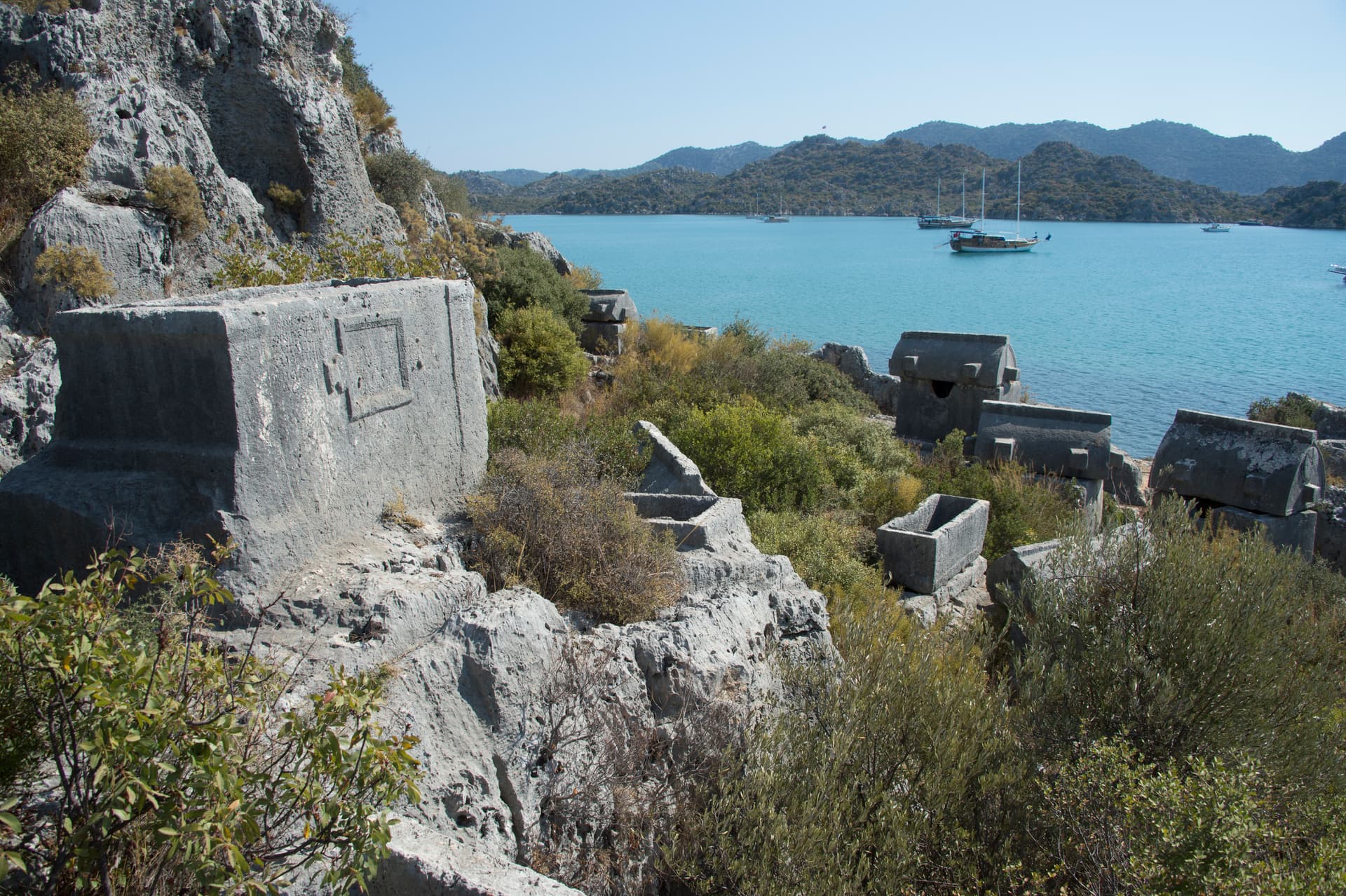
Below, rock-cut tomb facades mark cliffs, freestanding sarcophagi stand in undergrowth, and several sarcophagi have lower courses submerged at the land-sea threshold. In the 4th century BC they may have been placed there deliberately. For Lycian communities the sea was a sacred boundary, and threshold burials expressed beliefs about the dead's destination and the living's relationship with them.
A 2nd-century-AD earthquake pushed parts of the coast underwater. The sunken ruins of Dolichiste, visible as shadows and shapes through clear Kekova Bay, extend that liminality. Within the castle, one building successively served as pagan temple, Byzantine church, and Ottoman mosque: three faiths in one structure, recognizing one place as holy across sixteen centuries.
Why this place is sacred
Simena concentrates several of the qualities that mark a place as thin in the phenomenological sense — not merely old, but layered in a way that makes the present feel permeable. Begin with the sarcophagi at the waterline. Lycian tomb placement was not arbitrary.
The positioning of several sarcophagi so that their bases enter the sea at high tide reflects a specific cosmological understanding: the sea was the threshold through which the dead passed, and to be buried at its edge was to be placed at the crossing point. These are not tombs that have been partially submerged by accident — they were positioned with the sea in view and in mind.
That the earthquake of the 2nd century AD subsequently raised the effective sea level along this coast, further submerging what was once a shoreline, adds an unintended dimension to the original gesture. Then there is the building inside the castle walls.
No single structure in Turkey concentrates the sweep of the region's sacred history so economically: the same walls and likely the same orientation that once housed pagan ritual became a Byzantine church and then a mosque, each tradition recognizing the place as one worth keeping sacred.
This is not syncretism in the theological sense but something more straightforward — a community repeatedly deciding that a particular spot on the Kekova acropolis held a quality that no change in faith could dissolve. The third layer is the water. Kekova Bay, between Kaleköy and Kekova Island, is one of the clearest bodies of water on the Turkish coast.
From a boat or from the shore on a still day, the ancient rooms and walls of Dolichiste — submerged when the earthquake dropped the island below the waterline — are visible below the surface. The world under the water is continuous with the world above. At Simena, the threshold between the living and the lost is a water surface, and on the right day, you can see through it.
A Lycian harbor settlement and member city of the Kekova sympoliteia; later a Byzantine Christian and then Ottoman/medieval military outpost.
From Lycian coastal settlement (4th century BC) through Roman provincial incorporation, Byzantine Christian occupation, medieval fortification by the Knights of Rhodes, to the present-day living village and heritage tourism site.
Experience and orientation
Step onto the dock or shore at Kaleköy and stand still for a moment before moving anywhere. The village occupies the lower slopes immediately; the castle rises above. The quality of the place begins to make itself apparent before you have walked ten meters — the absence of vehicles, the sound of the sea, the cats, the sense that nothing is in a hurry here. Walk uphill toward the castle.
On the way, you will pass or encounter sarcophagi in various states: some intact with inscribed lids, some tilted, some with shrubs growing through them. Do not rush past them. The smallest Lycian theatre in the known world is cut into the rock near the castle — seven rows, capacity roughly 300, its intimate scale suggesting a community that gathered closely for performance and deliberation.
Inside the castle walls, find the building that served in turn as temple, church, and mosque. Stand in it without trying to resolve which version of it feels most present. All three are there simultaneously. From the castle's upper walls, the panorama arranges itself: the village below, the bay between the mainland and Kekova Island, the sunken ruins of Dolichiste visible from a boat on the water.
On a still morning, before the tour boats arrive, this view approaches the quality of stillness that this landscape has been offering to people for roughly 2,400 years. Walk down slowly, choosing a different path than you took up. The lower necropolis and waterline sarcophagi are best seen at the level of the sea — stand beside them rather than above them, and see the relationship between stone and water that their builders intended.
The village of Kaleköy is compact and navigable on foot. The castle is a short but steep climb from the dock. The Lycian Way trail from Üçağız arrives on the south side of the village. Allow time to both climb to the castle and walk the waterline.
Context and lineage
Simena was established as a Lycian settlement in the 4th century BC, one of four small coastal communities — with Aperlai, Isinda, and Apollonia — that formed a sympoliteia, sharing a collective single vote in the Lycian League. This arrangement reflected their individual smallness rather than political weakness; the sympoliteia was a recognized form of communal representation within the League's federal structure.
The Roman period brought new construction: a bath complex dedicated to Emperor Titus around 79 AD is among the documented additions, reflecting the city's integration into the imperial network. The earthquake of the 2nd century AD altered the coastline significantly, submerging much of the neighboring island of Dolichiste and raising effective sea levels along the Kekova shore. Byzantine occupation followed, with Christian communities maintaining the site through the medieval period.
The castle presently visible was built by the Knights of Rhodes on the existing Lycian acropolis at a date not precisely established in current scholarship.
Lycian (4th century BC); Roman provincial (1st–3rd century AD); Byzantine Christian (4th–12th century AD); medieval military outpost (Knights of Rhodes); Ottoman and modern village.
Emperor Titus
Roman emperor in whose honor the Simena baths were dedicated around 79 AD
Knights of Rhodes
Medieval military order that built the castle on the existing Lycian acropolis; date of construction not precisely established
Traditions and practice
The Lycian funerary practice at Simena expressed a specific relationship between death and the sea. Sarcophagi positioned at the land-sea threshold were not a consequence of later flooding but an original placement expressing the belief that the sea marked the passage between the living world and the world of the dead. The placement was deliberate and the water was intentional.
The single building within the castle that served as temple, church, and mosque reflects a successive tradition of recognizing a particular spot as worthy of sacred use — each tradition inheriting the claim of the previous one, even when repudiating its theology.
No active religious ceremonies are associated with Simena or Kaleköy today. The site is a living village with ongoing community life. Heritage tourism (boat tours from Kaş, Demre, and Kekova operators) brings regular visitors. Lycian Way trekkers pass through on the long-distance trail connecting the coast. The Kekova Special Environmental Protection Area prohibits diving near the sunken ruins on the Kekova Island side.
If possible, arrive by Lycian Way on foot from Üçağız rather than by boat — the approach through the landscape aligns with how people moved through this territory for millennia. If arriving by boat, come in the early morning before the tour groups. Climb to the castle first, when the light is low and the bay is still. Sit with the view of Kekova Island and the visible underwater ruins for as long as the pace of the morning allows.
On the way down, move slowly past the waterline sarcophagi. Stand beside them, not above them. The seven-row theatre near the castle deserves a moment of attention for what it implies about the scale and intimacy of civic life in this place. Stay for a meal in the village if possible — the pace of Kaleköy village life is part of the site's character.
Lycian Ancestor Veneration
HistoricalNumerous Lycian rock-cut tombs and sarcophagi cover the hillsides and waterline of Simena, several of them positioned with their bases entering the sea — expressing the Lycian belief that the sea marked the threshold between the living world and the world of the dead. These tomb placements are among the most spatially expressive examples of Lycian funerary theology in the region.
Construction of monumental rock-cut tombs and freestanding sarcophagi; symbolic placement at the land-sea threshold; ongoing community relationship with the spiritual presence of the dead.
Multi-faith Sacred Space
HistoricalA single building within the castle walls served sequentially as a pagan temple, a Byzantine church, and a mosque — a rare tripartite sacred continuity spanning over 1,500 years on a single site.
Pagan sacrifice and civic ritual (Lycian/Roman period); Christian liturgy (Byzantine period); Islamic prayer (Ottoman/medieval period).
Archaeological and Scholarly Heritage
ActiveSimena is registered as a 1st-degree archaeological site in Turkey and is part of ongoing heritage management within the Kekova Special Environmental Protection Area (260 km²). The site is central to the region's UNESCO World Heritage tentative nomination.
Surface survey, heritage monitoring, architectural documentation, environmental protection compliance.
Perspectives and open questions
Simena is small enough to be encompassed in a single visit but complex enough to carry several centuries of competing and converging interpretations. Its significance is not concentrated in one monument but distributed across the entire landscape.
Scholarly perspective
Simena was a minor member of the Kekova Lycian sympoliteia — not a major political or religious center but a window into the daily and funerary life of small Lycian coastal communities. The site is best understood in relation to its neighbors: Aperlai (the federation's dominant city), Dolichiste (now submerged), and Üçağız (Teimiussa). The Roman baths dedicated to Titus (c. 79 AD), the smallest known Lycian theatre (seven rows), and the sequential temple-church-mosque building are the site's most studied features.
The earthquake submersion of Dolichiste ca. 2nd century AD is well-documented geologically.
Living and traditional perspectives
For Lycian communities, the placement of sarcophagi at the literal boundary between land and sea was not accidental but cosmologically intentional. The sea was a spiritual boundary — the passage through which the dead traveled — and to be buried at its edge was to be positioned at the crossing point. This understanding, implicit in the tomb placements at Simena, makes the shoreline here a different kind of space than it would be in a culture without that cosmological framework.
Alternative interpretations
The multi-faith building — temple, church, mosque — is cited in spiritual tourism contexts as evidence of what some call a 'perennial sacred site': a location that successive traditions recognized as inherently holy, regardless of theological difference. Whether the recognition was cosmological, practical (reuse of existing structures), or a combination cannot be determined from the evidence.
The argument for perennial holiness is more suggestive than demonstrable, but the accumulation of three faiths in one small building across sixteen centuries is at least striking.
Open questions
The full extent of pre-Lycian occupation at Simena has not been established. The spiritual significance of sea-threshold tomb placement in Lycian belief — while evident from the material record — is not fully explained in surviving texts. The precise date of the Knights of Rhodes castle is not established in current published sources.
Plan your visit
Access and arrival
By boat from Kaş (approximately 1 hour by gulet) or Üçağız (approximately 15 minutes by water taxi). On foot via Lycian Way from Üçağız (approximately 40 minutes). No road access to Kaleköy. Boat tours from Kaş, Demre, and Kekova operators visit regularly. Mobile signal is unreliable at Kaleköy; the nearest consistently reliable signal is at Üçağız or Kaş.
For any emergency requiring medical attention, transport to Kaş by boat is the primary option — inform your boat operator or pansiyon of any medical needs before arrival.
Kaleköy has a small number of family-run pansiyons offering basic but atmospheric accommodation. Booking ahead in peak season is essential given limited capacity. Overnight stays allow access to the early morning and evening qualities of the site that day-trippers miss. Üçağız (water taxi distance) has additional small pansiyons. Kaş is the nearest town with a full range of accommodation.
Respectful visit
Modest attire appropriate for a small village. Sun protection essential given exposure and the time spent walking. Swimming attire is appropriate near the dock and village waterfront but not within the ruins.
Permitted throughout the village and ruins. No photography of underwater Kekova ruins from diving positions — diving is prohibited. Residents appreciate not being photographed without acknowledgment.
Not applicable to contemporary visit.
No diving or swimming near the sunken ruins of Kekova Island. Do not remove or disturb any artifacts, including sarcophagus fragments. Respect the active village — residents live here year-round and the tourism season is concentrated but intense. Do not climb on fragile tomb structures.
No swimming or diving near the Kekova Island sunken ruins — this is prohibited by Turkish law within the Special Protection Area. The castle climb is steep on uneven ground; appropriate footwear matters. The village is a living community — respect the privacy and daily life of residents. There are no medical facilities at Kaleköy; the nearest hospital is in Kaş.
Location
Map loads as you approach this section.
Pilgrim reflections
A portrait of encounter, not a score
Pilgrims describe what they felt, how present they could become, and whether the place would shape a journey. There are no stars and no ranking of traditions.
No reviewed reflections yet
The first pilgrims can help describe the character of being here.
Share a reflection
Available after an account-backed “Been there.” Every reflection is reviewed before publication.
Nearby sacred places
Explore other sacred places in the region. Proximity does not establish access or travel time; check each place’s guidance.
References
Sources consulted for this page. Source categories describe the publication, not a guarantee that every claim is verified. Traditional accounts and outside interpretations may differ.
- 01Antalya Simena Archeological Site – Turkish MuseumsofficialOfficial Turkish government museum registry entry
- 02Kekova – Wikipedia — Wikipedia contributorsencyclopediaGood regional and historical overview including Simena
- 03Simena – History HitacademicConcise scholarly overview
- 04Kekova Turkey Guide 2026: Sunken City & Simena Castle | Ancient TravelguidePractical and historical overview of Simena within the Kekova region
- 05Kaleköy and Simena – Alaturka.InfoguideDetailed description of site features including temple-church-mosque sequence
- 06Kekova Island Sunken Ruins – Atlas ObscuraSource contextPopular culture reference with visitor experience details
- 07Simena (Kaleköy): Your Ultimate Guide to Turkey's Enchanting Seaside Castle – Peninsula GardensguideDetailed visitor guide with architectural and cultural details
Share a photo
Help visitors recognize Simena. Every submission is reviewed before publication.