Cyaneae
A hilltop city of oracular springs and three hundred tombs overlooking the Lycian coast
Understand sacred places, explore living traditions, and learn how to engage respectfully with Pilgrim Map.
Access has not been verified. Check current local guidance before planning a visit.
Antalya, Turkey
Read the sources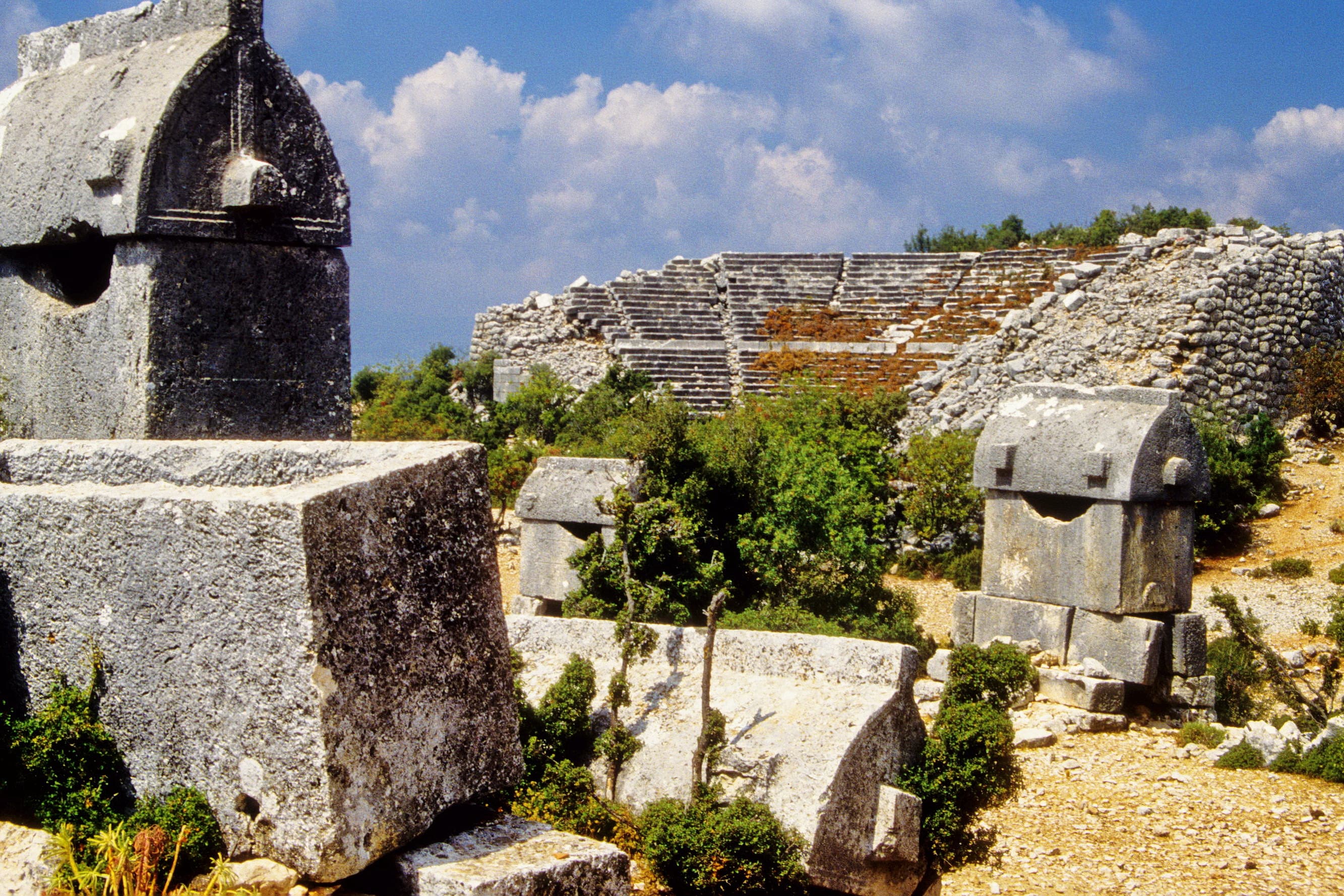
Image of Cyaneae. Image source
Visit essentials
A quick read before you go
- Duration
- 2–3 hours to explore the theatre, dynastic tombs, sarcophagus fields, and the oracle spring…
- Access
- Ruins are above the village of Yavu, on the highway between Kaş and Demre, Antalya Province.
Overview
Some Lycian ruins attract crowds; Cyaneae maintains its distance. On a limestone ridge above Yavu, between Kaş and Demre on the southwest Anatolian coast, Kyaneai holds more sarcophagi than any other Lycian city—over three hundred by scholarly estimate. They line ancient streets, cut into the hillside, and stand in fields with lids askew or fallen.
Pausanias records an oracle here of Apollo Thyrxeus: not nearby Sura's fish oracle, but a spring into which petitioners gazed and saw things they desired or feared. The local epithet remains unexplained. Frank Kolb's University of Tübingen survey of 1989–2001 documented a theatre, monumental dynastic tombs, and occupation from the 6th century BCE through the Byzantine period, when Cyaneae became a bishopric and its oracle had long been silent. The surviving city gives death and vision equal weight.
Why this place is sacred
Two religious preoccupations defined Cyaneae's sacred character, and they are not unrelated. The oracle of Apollo Thyrxeus operated through a spring that revealed what Pausanias called 'all the things that he wants to behold' to whoever gazed into it. This is hydromancy — divination through water — in a form that makes the petitioner an active visionary rather than a passive recipient of someone else's prophecy. The oracle did not speak through an interpreter.
It offered a surface and asked the visitor to look.
The density of funerary monuments surrounding the city speaks to the same orientation. More than three hundred sarcophagi, plus an array of dynastic rock-cut tombs oriented toward the sea and the horizon, suggest a community for whom the relationship between the living and the dead was not a private grief but a public architecture. The dead were not removed from the city; they were its most visible residents, their monuments lining the paths that the living walked.
A place that organizes its public space around oracular vision and monumental death is a place oriented toward what lies beyond ordinary perception. The thinness of Cyaneae is not dramatic or numinous in the way of a towering sanctuary; it is the thinness of a landscape that has been persistently arranged to face the question of what exists on the other side of the visible.
Lycian polis with an oracle of Apollo Thyrxeus (water-vision spring); extensive funerary cult expressed in dynastic tombs and sarcophagi.
Active from at least the 6th century BCE through the Byzantine period; bishopric from the 7th century CE. Now archaeological ruin; still listed as a Catholic titular see. No active religious use.
Experience and orientation
The approach to Cyaneae begins in the village of Yavu, from which a footpath ascends the limestone ridge to the ruins. The climb is moderate — perhaps twenty to thirty minutes — and the path is clear enough that a guide is not required, though the rewards of having one who knows the inscription locations are real.
The sea becomes visible from partway up; by the time the first sarcophagi appear along the path, the Lycian coast is a blue distance below.
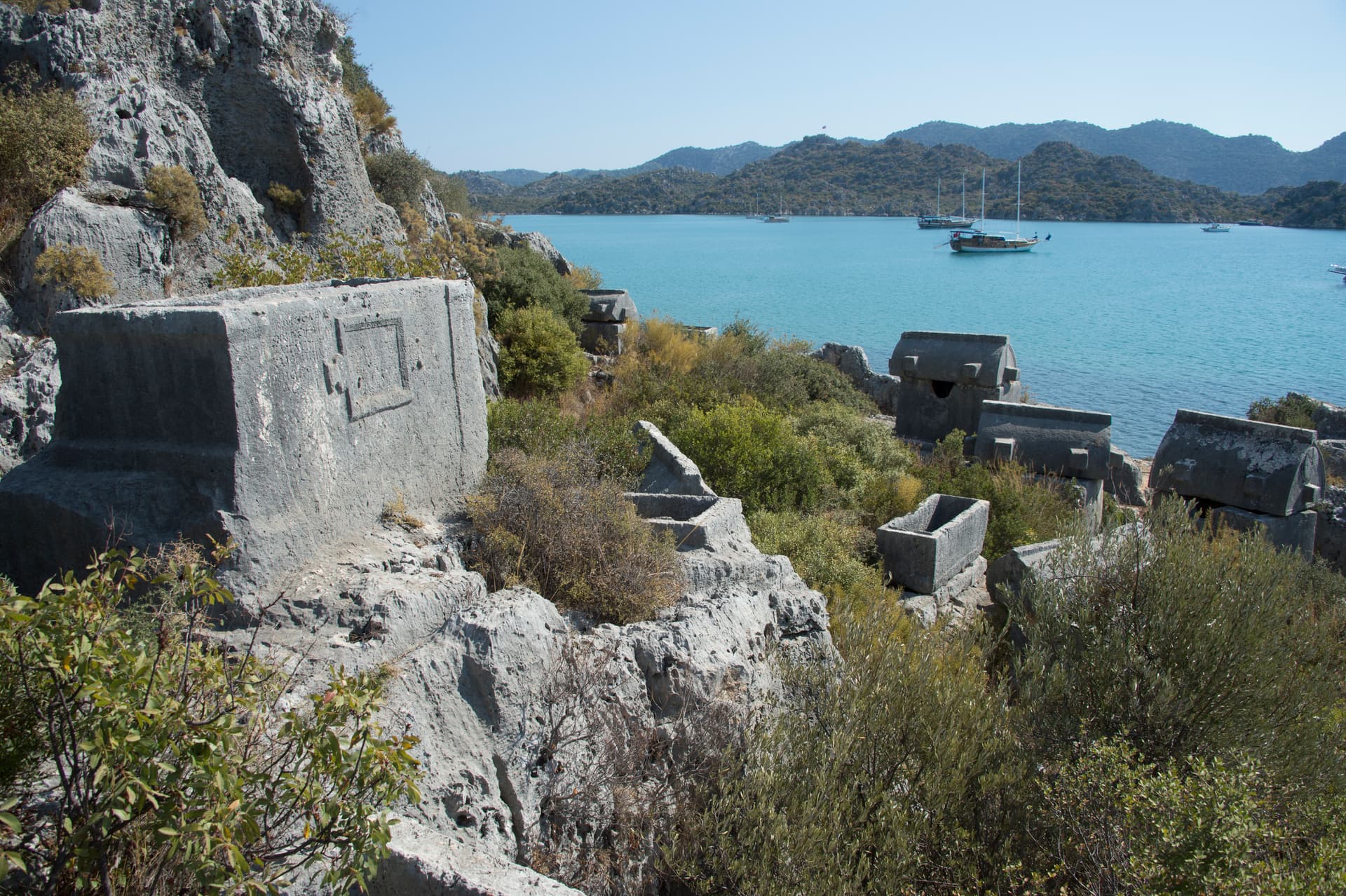
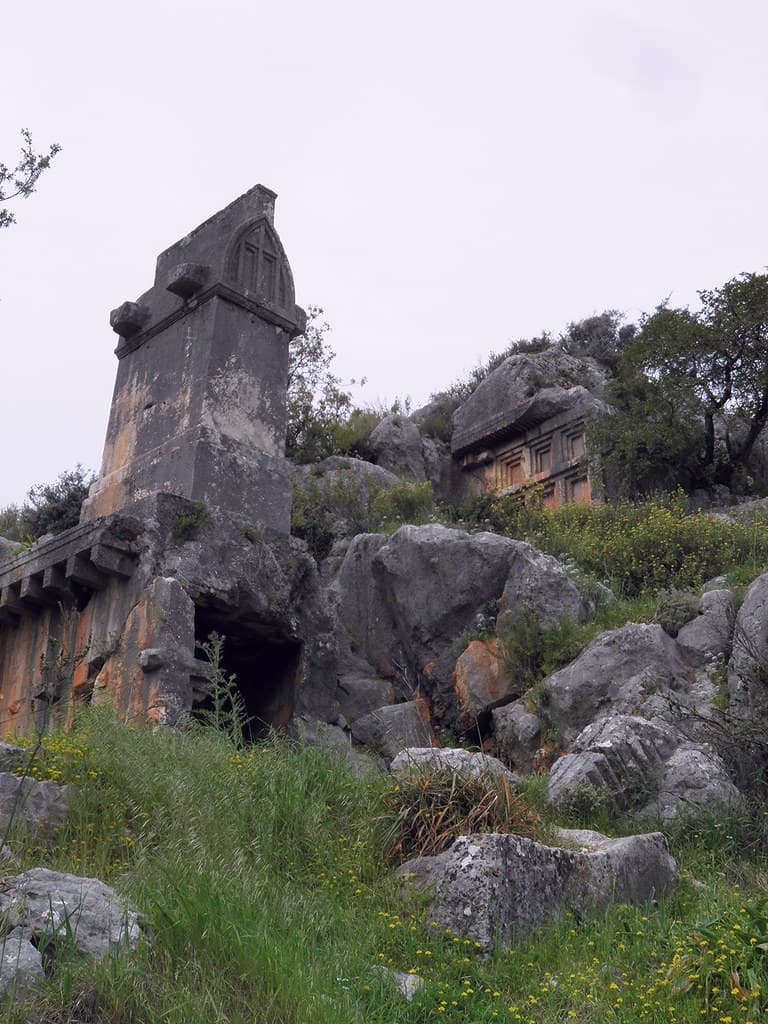
What strikes visitors consistently is the sheer quantity of tombs. Sarcophagi appear in clusters, singly, at angles, righted and collapsed. Many still bear carved reliefs — human figures, mythological scenes, geometric ornament. Rock-cut tombs are cut into the hillside in the dynastic Lycian style, their facades sometimes still legible despite centuries of exposure. The effect is not of a cemetery as we understand cemeteries but of a city whose dead remained among its structures, visible and addressed.
The theatre occupies a natural hollow on the hillside; its seating tiers are heavily overgrown but structurally present. The city's urban fabric — streets, collapsed walls, what were once public buildings — is readable enough to give a sense of the settlement's layout. At the appropriate season, the site of the oracle spring may still hold water.
Whether it does or not, the orientation of the place — its persistent facing-outward toward the sea, toward the horizon, toward the below — is legible in the physical arrangement of its monuments.
Access from Yavu village, which lies on the main road between Kaş and Demre. Park in the village and take the footpath to the hilltop. Allow 2–3 hours. Bring water; there are no facilities. The sarcophagi begin appearing before you reach the summit.
Context and lineage
Cyaneae's origin is not attributed to any mythological founding event in surviving ancient sources. Its earliest archaeological evidence dates to the 6th century BCE, placing it within the formative period of Lycian urban culture. The city's name appears in ancient geographical texts alongside records of its oracle.
Pausanias' account of the Thyrxeus oracle is the most specific surviving description: 'Close to Kyaneai by Lykia, where there is an oracle of Apollon Thyrxeus, the water shows to him who looks into the spring all the things that he wants to behold.'
The city developed a substantial urban fabric through the Hellenistic and Roman periods and was significant enough to become a bishopric in the 7th century CE — a measure of its continued regional importance even as the oracle had long since gone silent.
Lycian polytheism → Apollo Thyrxeus oracle cult → Roman period civic religion → Early Christianity (bishopric from 7th century CE) → Catholic titular see (nominal, present). The city is one of only a handful of Lycian sites with comprehensive archaeological survey data.
Traditions and practice
The oracle of Apollo Thyrxeus operated through a sacred spring: consultants gazed into the water and the spring showed visions of what they sought to know. This form of hydromancy placed the visionary act directly with the petitioner rather than mediated through a specialized prophet. Alongside the oracle, funerary cult was prominently expressed through the construction and maintenance of monumental rock-cut tombs and sarcophagi; the density of this funerary provision suggests ancestor veneration as a sustained civic practice.
None. The site is an unmanaged archaeological ruin with no active religious or ceremonial use.
Cyaneae is a site that rewards a different tempo than the major Lycian ruins. Rather than moving efficiently through a sequence of monuments, consider spending extended time with individual sarcophagi — examining their carved reliefs, noting their orientation, sitting near them long enough to feel what it means to have this many monuments to the dead lining a city's streets. The oracle tradition was about looking into water for what you wanted to see.
Find a still surface — even a depression in rock that has collected rainwater — and practice the oracle's logic: what do you actually want to see? What are you afraid of? The oracle's genius was in making the question explicit before the answer could matter.
Ancient Greek / Lycian
HistoricalCyaneae was home to an oracle of Apollo Thyrxeus where the sacred spring revealed visions to those who gazed into it. Its extraordinary concentration of funerary monuments — over 300 sarcophagi — reflects a city organized around ancestor veneration and an architecture of the relationship between the living and the dead.
Hydromantic oracle: gazing into the sacred spring for visions; elaborate funerary construction and ancestor veneration expressed in dynastic tombs and sarcophagi.
Early Christian / Byzantine
HistoricalCyaneae became a bishopric from the 7th century CE and remains listed as a titular see of the Catholic Church, a formal acknowledgment of its historical ecclesiastical status.
Episcopal administration and church construction within the ruined city.
Perspectives and open questions
Cyaneae is approached through archaeological survey data, through the single ancient text that preserves its oracle, and through the experiential record of visitors confronted by its unusual tomb density.
Scholarly perspective
Frank Kolb's 1989–2001 survey established Cyaneae as the second-largest city in central Lycia after Myra and documented multi-period occupation from the 6th century BCE through the Byzantine period. The survey confirmed the exceptional density of sarcophagi — estimated at over 300, the highest of any Lycian city — and mapped the urban layout including the theatre, public buildings, and necropolis zones.
The Thyrxeus epithet of Apollo remains without a definitive etymology; its interpretation is an open question in Lycian religious studies.
Living and traditional perspectives
Lycian culture expressed intense investment in elaborate funerary monuments as the primary visible testament to family status and civic identity. The sarcophagi of Cyaneae represent one of the most concentrated expressions of this tradition anywhere in the Lycian world. The oracle served as a point of contact between the living and the knowledge that ordinarily lay beyond them — a complement to the funerary preoccupation that organized the city's public space.
Alternative interpretations
The oracle of Apollo Thyrxeus — a spring that showed visions — belongs to a widespread ancient tradition of hydromancy, the use of still water as a reflective medium for inner seeing. This tradition appears across cultures and periods, from the Greek world to the Celtic spring sanctuaries of northern Europe. Cyaneae represents a rare named and located instance of this practice in the ancient Mediterranean.
Open questions
The Thyrxeus epithet of Apollo is without a clear etymology or known parallel in other oracular sites. The precise location of the oracle spring within the ruins has not been formally identified. The relationship between the three component settlements (Yarvu, Tousa, and Ghiouristan) that ancient and medieval sources seem to associate with the Cyaneae region is not fully resolved.
The mechanics of the hydromantic practice — how long one gazed, what preparation was required, how visions were interpreted — are entirely unrecorded.
Plan your visit
Access and arrival
Ruins are above the village of Yavu, on the highway between Kaş and Demre, Antalya Province. Drive to Yavu, park in the village, take the footpath uphill to the ruins. No formal entrance gate. GPS coordinates approximately 36.2454°N, 29.8151°E.
Kaş, approximately 20 km west, is the nearest town with a range of accommodation. Demre/Kale, approximately 15 km east, has simpler options.
Respectful visit
No formal requirements. Sturdy footwear is necessary for the rocky footpath and hillside terrain.
Photography is permitted throughout the site with no known restrictions.
No contemporary offering practice is established or appropriate.
Do not climb on or disturb sarcophagi, rock-cut tomb facades, or carved reliefs. Do not remove any material. The site has been the subject of illegal looting; treat its integrity as something to protect.
The hilltop is exposed to sun and wind; sun protection and water are essential. Footwear needs to be sturdy for rocky paths. Do not disturb or climb on sarcophagi or carved tomb facades.
Location
Map loads as you approach this section.
Pilgrim reflections
A portrait of encounter, not a score
Pilgrims describe what they felt, how present they could become, and whether the place would shape a journey. There are no stars and no ranking of traditions.
No reviewed reflections yet
The first pilgrims can help describe the character of being here.
Share a reflection
Available after an account-backed “Been there.” Every reflection is reviewed before publication.
Nearby sacred places
Explore other sacred places in the region. Proximity does not establish access or travel time; check each place’s guidance.


References
Sources consulted for this page. Source categories describe the publication, not a guarantee that every claim is verified. Traditional accounts and outside interpretations may differ.
- 01Cyaneae - Wikipedia — Wikipedia contributorsencyclopediaGeneral overview; cites Pausanias for Apollo Thyrxeus oracle
- 02Kyaneai - Lycian Monuments — Lycian MonumentsguideDetailed site documentation with monument descriptions
- 03Kyaneai Ancient City — Antalya Guide — antalya.tcofficialProvincial tourism authority description
- 04KYANEAI (Ancient city) Turkey — Greek Travel Pages — Greek Travel PagesencyclopediaNotes monuments reported by ancient authors
- 05Cyaneae (Kyaneai) Ancient City, Turkey — Holidify — HolidifyguideTourism overview with location details
- 06Cyaneae — Archiqoo — ArchiqooguideArchitectural and archaeological summary
- 07Cyaneae Map — Mapcarta — MapcartaSource contextGeographic coordinates: 36.24539°N, 29.81507°E
Share a photo
Help visitors recognize Cyaneae. Every submission is reviewed before publication.