Andriake
The port where Paul changed ships — a Lycian harbour holding synagogue, six churches, and the granary that fed Rome
Understand sacred places, explore living traditions, and learn how to engage respectfully with Pilgrim Map.
Access has not been verified. Check current local guidance before planning a visit.
Antalya, Turkey
Read the sources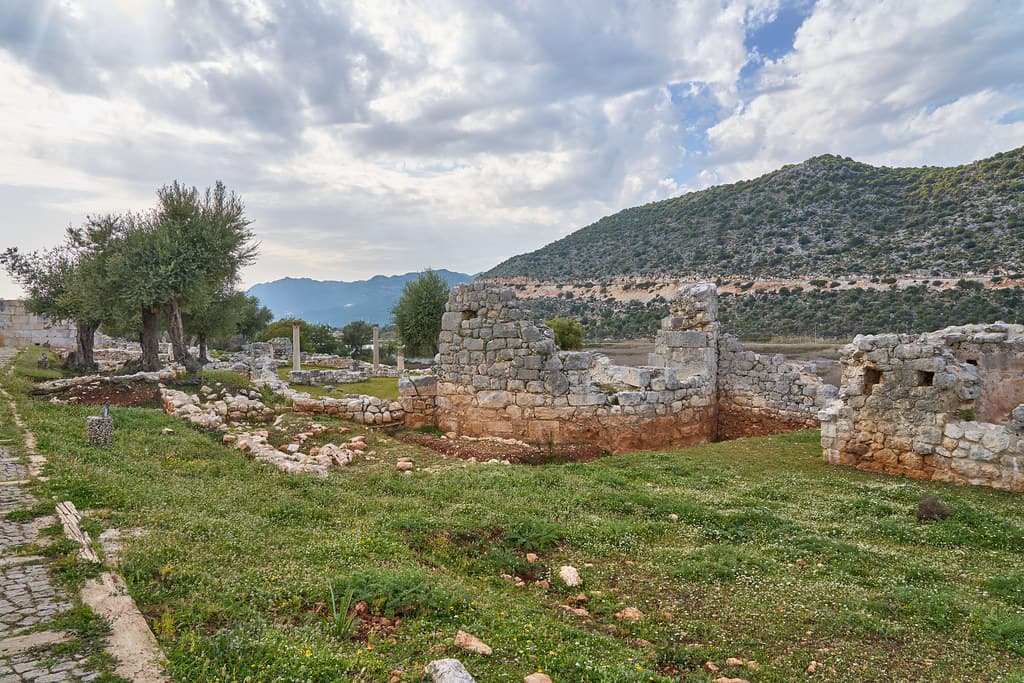
Image of Andriake. Image source
Visit essentials
A quick read before you go
- Duration
- 1.5 to 2.5 hours for the museum and ruins.
- Access
- Located 5 km southwest of Demre town centre on the road to Çayağzı.
Overview
The grain that fed Rome passed through Andriake, where Acts records Saint Paul changing ships as a prisoner bound for Rome. Nero’s authority appears in a detailed 58 AD customs inscription; Hadrian funded a seven-room, nearly 2,400-square-metre granarium in 129–130 AD for Egyptian grain. The cosmopolitan port also held six Byzantine churches and the first synagogue discovered in Mediterranean Anatolia.
Its 2009 excavation yielded 282 artefacts, including three menorah panels, a marble tablet with shofar and bugle, and a 4th-century lamp. Murex workshops produced Tyrian purple beside a cistern, fountain, and harbour mole. The restored, 1,900-year-old granary now houses Turkey’s only museum devoted entirely to Lycian civilization, preserving the material culture of a people without direct descendants.
Why this place is sacred
Harbours in the ancient world were places of encounter. They were where the foreign arrived and where the local went to meet the wider world. The religious geography of Andriake — synagogue, six Byzantine churches, earlier Lycian harbour cult spaces — reflects this function directly. The Jewish community that built their synagogue here were merchants and traders whose lives were oriented toward the sea routes that connected the Mediterranean's religious and commercial networks.
The synagogue is not merely a historical curiosity. It is evidence that a Jewish community chose to live permanently in this Lycian harbour town, to build a permanent place of worship, to inscribe the menorah on stone and on lamps. This is a claim on place, not a passing through. The harbour was home.
Saint Paul's passage through Andriake (Acts 27:5–6) carries a different kind of sacred weight. Paul was in chains, en route to trial in Rome. The ship stopped at Andriake to provision and change vessels. This is not a pilgrimage; it is a forced transit. Yet the apostolic tradition marked it anyway, because the trajectory of Paul's journey — toward Rome, toward martyrdom, toward the eventual Christianisation of the empire — invested every stopping point with retrospective significance.
The Hadrianic granary is sacred in a different register: it was built to sustain the imperial capital, to ensure that Rome did not go hungry. The scale of the operation — ships arriving from Egypt, grain offloaded and stored, redistributed toward the capital — represents a form of organised care for a population of millions.
That the building now holds the material culture of the Lycian people gives it an additional resonance: the infrastructure of imperial power repurposed as a place of memory.
Primary harbour and commercial port for Myra and the surrounding Lycian region; strategic node on the Egypt-to-Rome grain supply route; point of customs collection under Roman authority.
Hellenistic harbour (3rd century BC) → major Roman development including Hadrian's granary (129–130 AD), Nero's customs inscription (58 AD), murex dye workshops → multi-faith community (synagogue, six Byzantine churches) → Arab raids and subsequent decline → modern rediscovery and excavation (2009–present) → Museum of Lycian Civilizations opened in restored granary
Experience and orientation
The approach to Andriake follows the road southwest from Demre along the delta of the Myros river, passing through flat agricultural land before the granary comes into view — a long, low building of dark Roman brick, its seven rooms arranged in a line behind a broad façade. It is unmistakably Roman in its proportions: functional, massive, built to last.
The Museum of Lycian Civilizations occupies the granary's seven rooms. The progression through the rooms follows chronological and thematic logic: the Lycian Bronze Age, the Lycian League period, the funerary culture (rock-cut tombs represented by casts and originals), the coinage, the inscriptions, and then — in a room that requires adjustment — the synagogue finds. The menorah panels are here: carved stone reliefs in which the seven-branched lampstand is the primary image, flanked by ritual objects.
The marble tablet with its shofar and bugle inscription is here. The 4th-century oil lamp is here. These objects were made to serve an ongoing community's religious life; they ended in the ground.
Outside the granary, the harbour ruins extend around the museum. The synagogue foundations are visible; the Byzantine church remains are scattered through the site. The harbour mole extends into what was once open water and is now silted, the coastline having shifted over two millennia. Walking the perimeter of the site gives a sense of how much remains to be excavated — only a fraction of the ancient harbour has been uncovered.
The combination of the museum's coherence and the site's rawness creates an unusual experience: the past is both beautifully presented and visibly incomplete.
Begin with the museum to establish context, then walk the surrounding ruins. Allow at least 90 minutes for the museum alone; add 45 minutes to walk the site. Usually combined with Myra (5 km) and optionally a boat trip to Kekova (15 km) for a full day.
Context and lineage
Andriake served Myra's harbour needs from at least the Hellenistic period. Its position at the mouth of the Myros river, with a natural harbour protected by a mole, made it the natural outlet for the productive Lycian hinterland and a logical stop on the coastal route between Alexandria and Rome.
Under Roman administration, the harbour was developed significantly: Nero's customs inscription (58 AD) established detailed trade regulations; Hadrian funded the granary (129–130 AD) as part of a broader programme of grain supply infrastructure across the eastern empire.
The grain stored at Andriake arrived from Egypt — the empire's primary grain supplier — and was held here before redistribution to Rome. The logistics were imperial-scale: regular grain ships, systematic customs collection, standardised storage. The inscription that recorded Nero's customs regulations is one of the most detailed Roman trade documents to survive, specifying exemptions, penalties, and administrative procedures across multiple commodity categories.
The Jewish community that established itself at Andriake represented a pattern common to major Mediterranean harbours: Jewish merchants participated in the grain trade and settled at nodes along the routes. Their synagogue, built in the 5th century AD, demonstrates a settled community rather than a transient one. Six Byzantine churches in the same small harbour town demonstrate a similar pattern of settled Christian community life.
Hellenistic harbour (3rd century BC) → Roman strategic development (1st–2nd century AD) → multi-faith cosmopolitan community (synagogue, churches, 4th–6th century AD) → Byzantine decline → Arab raid disruption → harbour silting → Ottoman period neglect → modern excavation (2009–present) → Museum of Lycian Civilizations (opened in restored granary)
Traditions and practice
The synagogue at Andriake served an active Jewish community whose religious life would have centred on the Sabbath gathering, Torah study, and the Jewish liturgical calendar. The three menorah panels discovered in the excavations — substantial stone reliefs, not portable objects — indicate a community that invested permanently in its place of worship. The shofar and bugle carved on the marble tablet are ritual instruments whose depiction signals a community maintaining full Jewish practice in a Lycian harbour town.
The six Byzantine churches reflect a Christian community of similar permanence. Saint Paul's passage through Andriake added apostolic significance to the harbour that the Byzantine community would have understood and valued: their city had been a stop on the foundational journey of the apostle to the Gentiles. The proximity to Myra — where Saint Nicholas served — embedded Andriake in a broader sacred landscape of early Christian Anatolia.
The Museum of Lycian Civilizations is open to visitors and is the primary contemporary use of the site. Archaeological excavations continue. No active religious practices take place at the site.
Move through the museum slowly, particularly in the room containing the synagogue finds. The menorah panels reward sustained attention: the carving quality is high, and the iconographic programme — menorah, shofar, bugle — is dense with liturgical significance. Allow yourself to sit with the question of the community that made these objects: their origins, their daily life in this harbour, their fate.
After the museum, walk east along the harbour mole toward the open delta. The view back toward the granary from the mole captures the building's full scale in its landscape — low, long, brick-red against the delta vegetation and mountains. The harbour is silted now and the mole ends in marsh grass; the coastline has moved since antiquity.
Standing at the mole's end, you are in approximately the position from which the grain ships were watched as they arrived from Alexandria.
If combining with Myra (5 km), visit the cliff tombs and theatre first, then the Church of Saint Nicholas, then Andriake. The sequence moves from the Lycian dead through the Christian saint to the cosmopolitan harbour — three registers of the same coastal world.
Jewish Community Heritage
HistoricalThe Andriake synagogue (5th century AD) is the first synagogue discovered in the Mediterranean region of Anatolia, demonstrating a settled Jewish mercantile community at one of the Roman Empire's most strategically important grain ports. The 282 artefacts recovered include three menorah panels and a shofar/bugle marble tablet.
Jewish Sabbath worship; liturgical calendar observance; mercantile community life in the harbour district.
Early Christianity / Biblical Heritage
HistoricalSaint Paul changed ships at Andriake on his way to Rome as a prisoner (Acts 27:5–6), embedding the harbour in the Christian apostolic itinerary. Six Byzantine churches indicate deep and sustained Christianisation of the port community.
Christian community worship; six church buildings built across the Byzantine period; the harbour's inclusion in Christian pilgrimage geography tied to the nearby Myra and Church of Saint Nicholas.
Archaeological / Scholarly
ActiveOngoing excavations since 2009 have revealed Hadrian's granary (now the Museum of Lycian Civilizations), the synagogue, harbour infrastructure, and evidence of murex dye production. The museum is the only institution in Turkey dedicated entirely to Lycian civilization.
Annual excavation seasons; ongoing restoration of harbour structures; museum curation and education.
Perspectives and open questions
Andriake is read differently through Roman imperial infrastructure studies, Jewish diaspora archaeology, early Christian history, and Lycian maritime culture — each lens revealing a different layer of a harbour town that accumulated remarkable religious diversity.
Scholarly perspective
Andriake was among the most strategically important ports of the Roman Empire's grain supply network. Hadrian's granary is an exceptional survival — one of only three Roman granaria of this scale known to survive in the world. The customs inscription from Nero's reign provides uniquely detailed evidence of Roman provincial trade administration. The synagogue discovery fundamentally extended the known geographic range of Jewish communities in Roman-era Anatolia; prior to 2009, no synagogue had been documented in Turkey's Mediterranean coastal region.
The six Byzantine churches indicate a substantial and settled Christian population.
Living and traditional perspectives
For Christian tradition, Andriake carries the weight of Acts 27:5–6 — Paul's stop here is a documented station on his journey toward martyrdom and the ultimate expansion of Christianity into the Roman heartland. The Byzantine churches built here reflect a community that understood their harbour as part of this apostolic geography.
For Jewish tradition, the synagogue represents a tangible survival of diaspora community life on the Lycian coast: people who chose to be in this specific place, who built permanently, and whose material culture has endured.
Alternative interpretations
The convergence of Jewish, early Christian, and Lycian communities at Andriake has drawn attention from scholars interested in how religious traditions developed through commercial interaction in ancient harbours. Some propose that the openness of maritime communities to religious plurality was a structural feature of ancient trade networks rather than an exception — Andriake being one of several harbour sites where this pattern is archaeologically visible.
Open questions
The full extent of the Jewish community at Andriake — its origins, population, commercial networks, and eventual fate — is almost entirely unknown. The six Byzantine churches have been identified but not all excavated; the community they served and its relationship to the nearby episcopal see at Myra is unclear. The murex dye workshops and their connection to the broader Mediterranean luxury textile trade have not been fully studied. The harbour's subsurface remains extend significantly beyond the current excavation area.
Plan your visit
Access and arrival
Located 5 km southwest of Demre town centre on the road to Çayağzı. Signposted from central Demre. Accessible by private car or taxi from Demre; no regular public transport. Combined with Myra, this is a half-day minimum. Museum entrance fee applies.
Demre (5 km) has simple to mid-range hotels. The Kekova area (15 km) has boutique options in a quieter setting. Kaş (30 km) offers a wider range of boutique accommodation. Antalya (140 km) for full urban range.
Respectful visit
No dress code requirement beyond standard museum courtesy — nothing above the knees inside the museum is unusual but not formally required.
Permitted at the site and inside the museum; no flash near artefacts or sensitive display items.
None expected.
No touching of artefacts inside the museum. No removal of any materials from the site. Observe any fencing around active excavation or restoration areas.
The site has ongoing restoration works; some areas may be fenced or restricted. No flash photography near artefacts inside the museum. The delta area around the harbour mole can be marshy — appropriate footwear recommended.
Location
Map loads as you approach this section.
Pilgrim reflections
A portrait of encounter, not a score
Pilgrims describe what they felt, how present they could become, and whether the place would shape a journey. There are no stars and no ranking of traditions.
No reviewed reflections yet
The first pilgrims can help describe the character of being here.
Share a reflection
Available after an account-backed “Been there.” Every reflection is reviewed before publication.
Nearby sacred places
Explore other sacred places in the region. Proximity does not establish access or travel time; check each place’s guidance.

References
Sources consulted for this page. Source categories describe the publication, not a guarantee that every claim is verified. Traditional accounts and outside interpretations may differ.
- 01The Ancient Synagogue Uncovered at Andriake, Port of Myra – the First in the Mediterranean Region of Anatolia — Nevzat Çevik et al.academicPeer-reviewed academic paper; primary source for the synagogue discovery
- 021900-year-old Customs Inscription from the Lycian civilization reveals Anatolia's strategic importance in maritime trade — ArkeonewsacademicDetails the Nero-era customs inscription found at Andriake
- 03Andriake - Wikipedia — Wikipedia contributorsencyclopediaGood overview; cites academic sources on the granary and synagogue
- 04Andriake Synagogue - Wikipedia — Wikipedia contributorsencyclopediaDetailed entry on the synagogue discovery and artefacts
- 05Hadrian's Granary in the Forgotten Port of Andriake — La Brújula VerdeguideDetailed description of Hadrian's granary and its conversion to the museum
- 06Ancient Andriake port set for restoration milestones in Türkiye — Daily SabahofficialReports on ongoing restoration programme
- 07Ancient Lycian City of Andriake — Lycian MonumentsguideSpecialist Lycian heritage site; detailed monument descriptions
- 08Museum of Lycian Civilizations and Andriake Ancient City — Kekova TravelguidePractical visitor information about the museum and site
Share a photo
Help visitors recognize Andriake. Every submission is reviewed before publication.