Sura
Where fish spoke the will of Apollo at the edge of the Lycian sea
Understand sacred places, explore living traditions, and learn how to engage respectfully with Pilgrim Map.
Access has not been verified. Check current local guidance before planning a visit.
Antalya, Turkey
Read the sources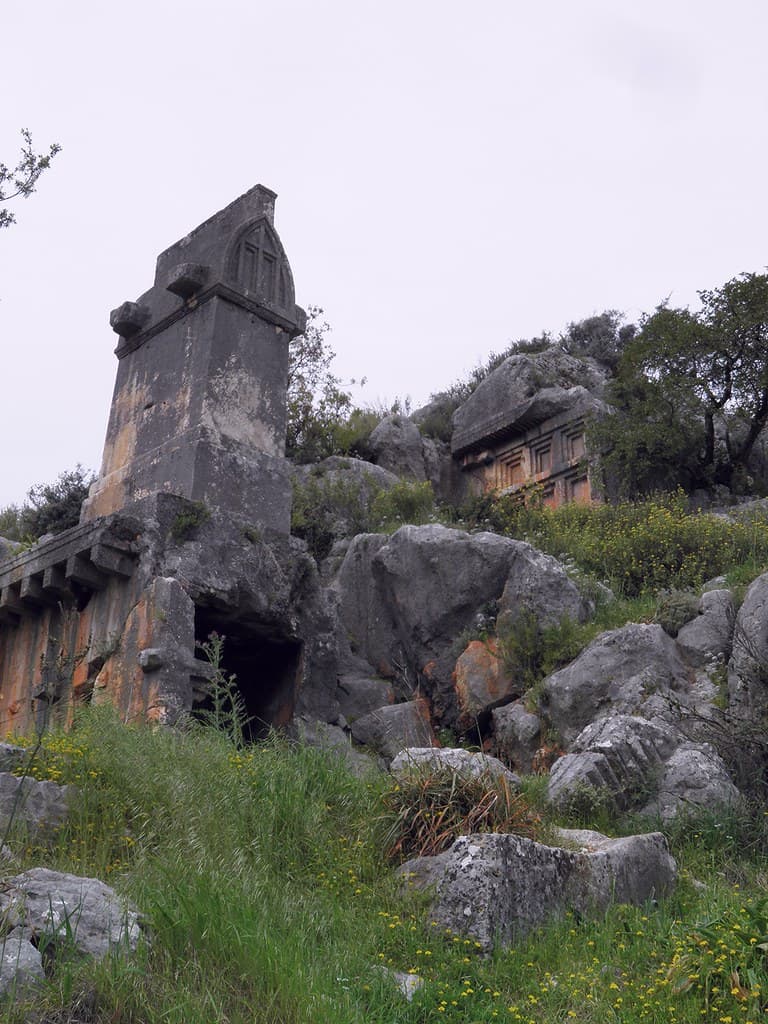
Image of Sura. Image source
Visit essentials
A quick read before you go
- Duration
- 1–2 hours for a full exploration of the temple, tombs, stelai, and marsh area.
- Access
- Located approximately 4–6 km southwest of Demre (ancient Myra / modern Kale), near the village…
Overview
Sura had no acropolis, region-shaping agora, or Anatolian stadium. Instead it held one of the ancient world's most idiosyncratic oracles: sacred fish moved through a sea-fed coastal spring, and priests of Apollo Surios interpreted their patterns as divine speech. Plinius the Elder, Plutarchos, Polycharmos, and Artemidorus recorded the practice with something between curiosity and reverence. Consultants came from across the Mediterranean not for a priestess in trance or an ambiguous verse, but to watch fish.
The Hellenistic Temple of Apollo Surios still rises approximately eight metres, unexpectedly tall at a site never formally excavated. Lycian rock-cut tombs mark the cliffs; stelai name the Prostatae of Apollo Surius in Lycian and Greek; sarcophagi lie in varied collapse. The ruins meet land and sea, fresh spring and salt inlet—an inherently liminal zone where the ancient world imagined mortal and divine could transact.
Sura remained a dependency of Myra rather than an independent city; the oracle was its purpose. When the oracle ceased after Christianization, the settlement lost its reason to persist. Its marshy Lycian inlet remains unhurried, uncommercialised, and marked by the quiet specificity of what happened here.
Why this place is sacred
The sanctity of Sura rested on a precise topographic accident: a freshwater spring that met the sea. In Lycian and Greek religious thinking, such threshold zones — where salt and fresh water mingled, where land gave way to marsh, where the surface of still water reflected both sky and depth — were natural sites of contact between realms. Fish rising from the darkness of a coastal spring could be understood as emissaries from below the world's floor, bearing messages upward.
Apollo Surios — the 'Surian Apollo,' an epithet specific to this place — was not a distant Olympian deity here but a local presence whose communication was wet, immediate, and embodied in creatures that belonged to neither land nor sky. The oracle asked its consultants to participate in the interpretive act: bringing an offering of meat, watching what the water returned. Divination here was not about clever language. It was about attention to the non-human world.
That quality of attentive waiting in a liminal zone is not something that requires belief in Apollo to understand. The spring is still there, the marsh is still there, the standing temple columns still mark the spot.
What Sura offers a contemporary visitor is not the comfort of a well-managed shrine but the specific discomfort of a place that has held the same question for two and a half thousand years: what do you see when you really look into the water?
Oracle sanctuary of Apollo Surios; the sacred spring where fish movements were interpreted as divine prophecy.
Active oracle site from at least the 4th century BCE through the Roman period; cult declined after Christianization of the region. No formal religious use since late antiquity. The site remains unexcavated and unmanaged.
Experience and orientation
Sura is not easy to reach in the conventional sense: there is no entrance gate, no paved path, no sign announcing that you have arrived at one of antiquity's most famous oracles. The approach from Demre (ancient Myra) takes you through farmland and eventually into terrain that is seasonally marshy — in spring particularly, the ground near the ancient spring site is wet enough to require attention underfoot. This is not a deficiency of the place.
It is continuous with what Sura has always been: a site that asks something of those who come to it.
The Temple of Apollo Surios comes into view before the path becomes clear. The standing walls — still reaching roughly eight metres — are disproportionately imposing for an unexcavated site. Their scale is unexpected. Around and beyond the temple, Lycian rock tombs cut into the hillside hold inscriptions in both Lycian and Greek; some of the stelai still bear the carved names of the Prostatae of Apollo Surius, the officials who administered the oracle.
Sarcophagi, some intact, some collapsed, mark what was once a settlement dense enough to require elaborate funerary provision.
The marsh at the edge of the site is the location — approximate, since no formal excavation has fixed it — of the ancient sacred spring. In spring and early summer, it holds standing water. In the right light and season, it is not difficult to understand why a coastal inlet where fresh water met the sea, attended by fish that rose and dove unpredictably, was read as a place of divine address.
Approach from Demre (ancient Myra), 4–6 km southwest by car then on foot. Wear clothing that can handle marsh. The temple is visible early and serves as orientation. Move slowly; the tombs and inscriptions reward patience.
Context and lineage
Ancient sources place the oracle's operation in a coastal spring from which fish emerged when priests cast skewers of meat into the water. Plinius the Elder documented the practice, as did Plutarchos and Polycharmos. The oracle was understood as a direct manifestation of Apollo Surios — a local epithet indicating the god's specific presence at this place rather than a generic invocation of the Olympian Apollo. The mechanics of interpretation involved reading the fish's movement, their species, and their numbers.
The founding of the sanctuary is not attributed to any named historical figure; the oracle appears to have been a pre-Hellenistic Lycian religious practice that was subsequently articulated in Greek religious language.
Lycian polytheism → Apollo Surios oracle cult → Roman-period continuation → cessation after Christianization. Site remained part of the Myra ecclesiastical zone in the Byzantine period. No active tradition continues.
Traditions and practice
Priests of Apollo Surios cast skewers of meat into the sacred spring near the Temple of Apollo. Fish emerged from the depths of the coastal spring, and their movements — the species that appeared, their direction, their clustering or dispersal — were interpreted as Apollo's response to the consultants' questions. The oracle was consulted on personal and communal matters by visitors from across the Mediterranean.
Alongside the oracle, votive offerings were made at the temple, and the Prostatae — temple administrators — maintained inscribed stelai recording their service.
None. The site is an unmanaged archaeological ruin with no active religious or ceremonial use.
Sura rewards a particular kind of visit: unhurried, attentive, and willing to engage with the absence of guidance. Arrive early in the morning, when the marsh is still and the light is low across the water. Approach the temple slowly and spend time with the inscribed stelai — even if you cannot read Lycian, the physical act of tracing carved letters places you in direct tactile relationship with the oracle's administration.
Move to the edge of the marshy area and stand quietly. The oracle was not about making noise or asking questions aloud; it was about watching. Practice that. Watch the water. If there are birds, watch them. The oracle's logic — that the non-human world speaks meaning if you pay close enough attention — does not require the fish to still be sacred to be instructive.
Ancient Greek / Lycian
HistoricalSura was one of the ancient Mediterranean's most distinctive oracle sites, sacred to Apollo Surios. The fish oracle drew consultants from across the region and was documented by multiple ancient authors.
Fish divination: priests cast skewers of meat into the coastal sacred spring; the movements and species of fish that emerged were interpreted as Apollo's prophetic response. Votive offerings and administrative stelai maintained the sanctuary's institutional character.
Perspectives and open questions
Sura is read differently depending on whether one approaches it as an anomalous curiosity in ancient religion, as a specific instance of Lycian sacred geography, or as a site where oracular logic rested on attention to the natural world.
Scholarly perspective
Sura is identified in academic literature as a dependency of Myra rather than an independent polis, and the Apollo Surios oracle is placed in the context of other Lycian fish oracles, including a similar tradition at Limyra. The temple is assigned to the Hellenistic period. Ancient sources for the oracle are considered reliable.
The site has not been formally excavated, meaning that much of what is physically present — the full extent of the sanctuary, the settlement footprint, the precise location of the oracle spring — remains undocumented in any archaeological report.
Living and traditional perspectives
Lycian tradition understood fish as sacred intermediaries of Apollo in this specific coastal context. The oracle was integrated into the civic and religious life of the Myra region, with the Prostatae of Apollo Surius serving as official administrators whose service was inscribed and commemorated. The oracle operated not as a private superstition but as a recognized public institution.
Alternative interpretations
Contemporary spiritual travellers oriented toward aquatic elemental traditions and water-as-liminal-threshold read Sura as a persistent contact point between aquatic elemental forces and prophetic consciousness. The fish oracle tradition connects to broader global patterns of hydromancy and the use of water surfaces as reflective and revelatory media.
Open questions
The exact mechanics of fish interpretation remain debated: whether it was the species of fish, their direction of movement, their number, or some combination that determined the oracle's reading. The full extent of the sanctuary complex and any associated habitation is unknown. Whether any continuity existed between the pre-Greek Lycian oral tradition regarding this spring and the Hellenistic articulation of the Apollo Surios cult has not been established.
Plan your visit
Access and arrival
Located approximately 4–6 km southwest of Demre (ancient Myra / modern Kale), near the village of Yuva Koyu, Antalya Province. Accessible by car from Demre, then on foot through farmland. No formal entrance gate, no ticket office, no facilities. GPS coordinates approximately 36.2449°N, 29.9441°E.
Demre (Kale) is the nearest town with accommodation options. Hotels range from simple guesthouses to mid-range options. The coastal resort town of Kaş, approximately 40 km west, offers a wider range.
Respectful visit
No formal requirements. Practical outdoor clothing appropriate for marshy terrain; waterproof boots recommended in spring.
Photography is permitted throughout the site and there are no known restrictions.
The oracle tradition involved meat offerings in the spring; no contemporary offering practice is established or appropriate.
Do not disturb, remove, or damage any archaeological material including stelai inscriptions, tomb carvings, sarcophagi, or temple stonework.
The terrain is marshy in spring and can be wet year-round near the spring site. Wear boots or waterproof footwear. The site is entirely unguarded; do not remove any archaeological material or disturb tomb inscriptions. Summer heat and marsh insects can be severe — early morning visits are preferable in warm months.
Location
Map loads as you approach this section.
Pilgrim reflections
A portrait of encounter, not a score
Pilgrims describe what they felt, how present they could become, and whether the place would shape a journey. There are no stars and no ranking of traditions.
No reviewed reflections yet
The first pilgrims can help describe the character of being here.
Share a reflection
Available after an account-backed “Been there.” Every reflection is reviewed before publication.
Nearby sacred places
Explore other sacred places in the region. Proximity does not establish access or travel time; check each place’s guidance.

References
Sources consulted for this page. Source categories describe the publication, not a guarantee that every claim is verified. Traditional accounts and outside interpretations may differ.
- 01Sura — Cultural Inventory of Turkey — kulturenvanteri.comofficialTurkish Ministry-affiliated cultural inventory
- 02Sura (Lycia) - Wikipedia — Wikipedia contributorsencyclopediaGood overview with ancient source citations (Plinius, Plutarchos, Polycharmos)
- 03Sura - Lycian Monuments — Lycian MonumentsguideDetailed on-site documentation with photos
- 04Soura/Sura Ancient Site / Turkey — ArticHaeology — ArticHaeologyacademicArchaeological overview with ancient author references
- 05Soura (Ancient city) Turkey — Greek Travel Pages — Greek Travel PagesencyclopediaConcise factual summary with ancient sources
- 06Sura: Fish Oracle of Apollo — Bike ClassicalblogFirst-hand visit account with archaeological detail
- 07Sura (Lycia) — Megalithic Portal — Megalithic PortalSource contextProvides coordinate data: 36.2449°N, 29.9441°E
- 08Discovering the Ancient Ruins of Soura: Demre's Hidden Treasure — demre.netguideLocal tourism site with site description
Share a photo
Help visitors recognize Sura. Every submission is reviewed before publication.