Shimpuku-ji
The hilltop temple that completed Japan's 100-Kannon pilgrimage
Understand sacred places, explore living traditions, and learn how to engage respectfully with Pilgrim Map.
Access has not been verified. Check current local guidance before planning a visit.
Chichibu, Saitama Prefecture, Japan
Read the sources
Station 2 of 34
Chichibu 34 Kannon PilgrimageVisit essentials
A quick read before you go
- Duration
- 45–75 minutes from Shimabu-ji including the climb up and the descent to Kōmyō-ji for the stamp.
- Access
- Approximately 40 minutes on foot up a switchback hill road from Shimabu-ji.
Overview
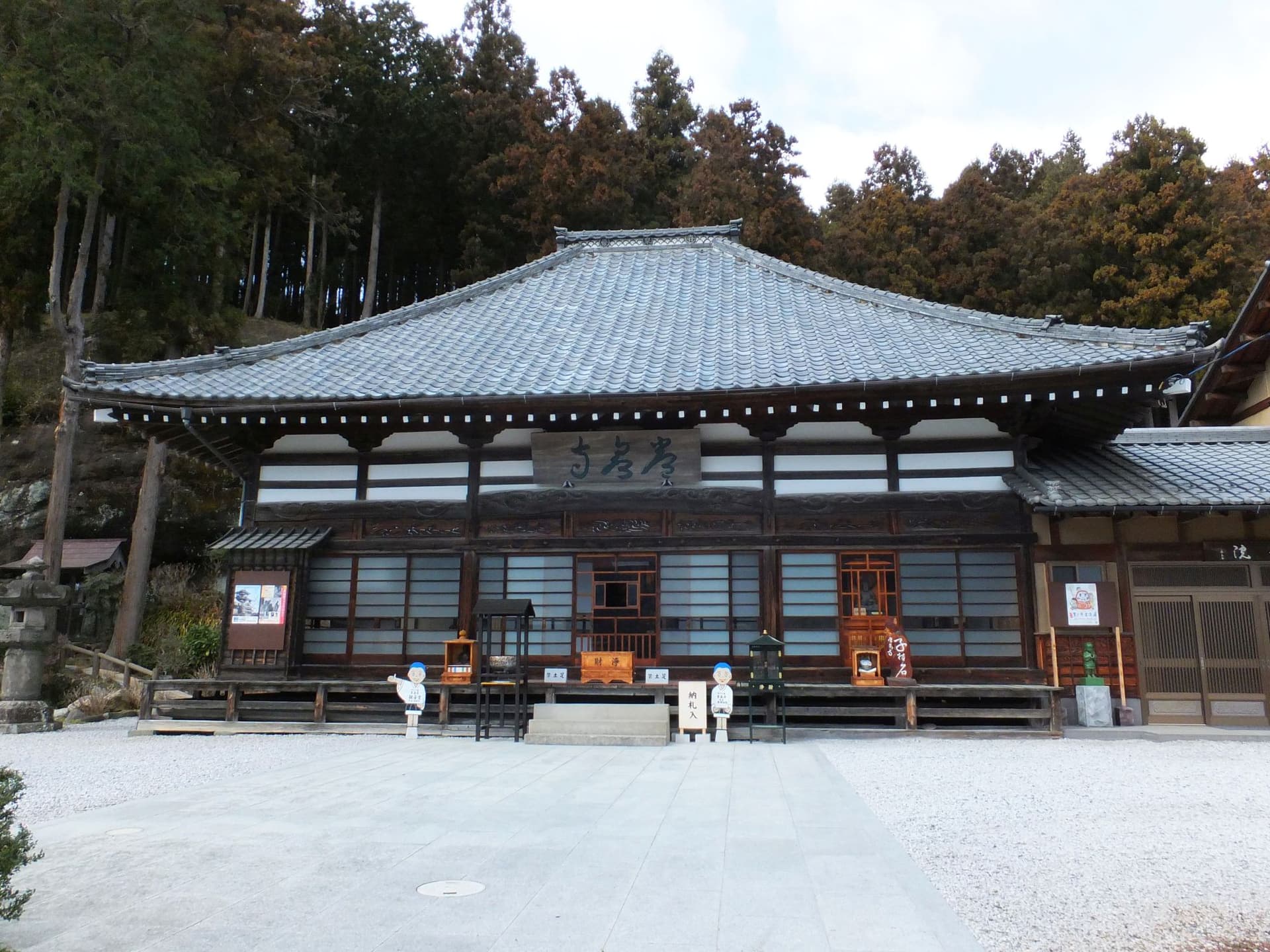
Shinpuku-ji's unmanned Kannon-dō stands on a forested ridge of Mt. Takashino in Chichibu's Yamada district; pilgrim services come from affiliated Sōtō Zen Kōmyō-ji below. Climbing to chant before the closed zushi, then descending for the goshuin, traces a deliberate ritual geometry. Tradition says the wandering monk Ōdana Zenshi founded the hall to commemorate an elderly woman whose memorial rites he had assumed. Its one-piece wooden Shō Kannon is approximately 64 cm tall and Muromachi in date.
The documentary record begins when Chōkyō-era floods (1487–1489) damaged the original site, temporarily removing Shinpuku-ji from the 33-hall circuit before its late-Muromachi restoration as the 34th. Tradition dates the addition to 1536: with Saigoku's 33 in western Japan and Bandō's 33 in eastern Japan, Chichibu needed 34 to complete exactly one hundred Kannon halls, making this hilltop the hinge of the Hyakkannon system.
Fire destroyed the complex in 1860; the 1908 Kannon-dō is an irimoya-zukuri hall with copper roof and three-by-four-bay construction. The 2026 once-in-twelve-years Year of the Horse sōkaichō, March 18–November 30, opens the inner zushi to public viewing for the first time since 2014.
Why this place is sacred
Shinpuku-ji is muju — without resident priest. The Kannon-dō stands alone on a forested ridge with views across the Chichibu basin, free of urban noise and free of staff. Pilgrims arriving at the top often describe the silence as elemental: wind in the trees, their own breath, and the wooden hall with its closed zushi doors.
The descent to Kōmyō-ji at the foot of the hill, where the goshuin is issued, is itself part of the felt ritual structure — solitude on the way up, community at the base.
Three elements amplify the threshold. First is the steep zigzag climb, which many walking pilgrims describe as the moment the pilgrimage 'starts in the body' rather than the head. Second is the unstaffed hall: there is no priest, no shop, no transactional interruption between visitor and Kannon image. Third is the historical role — to climb here is to climb to the temple that closed the 100-Kannon circuit by becoming Chichibu's 34th in the late Muromachi period.
A memorial Kannon hall built by Ōdana Zenshi to honor the spirit of an elderly woman whose memorial rites he had assumed. The Shō Kannon was enshrined as the focus of merit-transfer (ekō).
From early-medieval memorial hall to flood-damaged ruin in the Chōkyō era (1487–1489), to restored 34th station of the Chichibu pilgrimage by 1536, to fire-destroyed complex in 1860, to Meiji-era rebuilt Kannon-dō in 1908, to current muju (unattended) hall paired administratively with Kōmyō-ji at the base of Mt. Takashino.
Experience and orientation
Walking pilgrims arriving at Shinpuku-ji from Shimabu-ji typically take about forty minutes on a switchback hill road. The forest deepens; the road narrows; the basin opens out behind the climber. The Kannon-dō at the top is small, weathered, and silent. Pilgrims approach, bow, place a coin, and chant the Heart Sutra or Kannon-kyō with no priest in attendance and no shop nearby — the closed zushi doors holding the Muromachi Shō Kannon behind them.
Many pilgrims comment on the contrast between the solitary hilltop and the lived village at Kōmyō-ji where the goshuin is issued. The descent is gentler than the ascent, and the seated stamp ritual at Kōmyō-ji often functions as a small return to community after the threshold work of the climb.
Pilgrims with children, with mobility constraints, or in heavy rain frequently choose to drive partway up to the limited hilltop parking, but the on-foot ascent is widely reported as the most resonant approach.
From Kōmyō-ji at the base, ascend the switchback hill road on foot (about 40 minutes from Shimabu-ji) or drive partway. At the Kannon-dō, bow, place a coin in the saisen-bako, light incense if available, recite a sutra, and leave an osamefuda. Descend to Kōmyō-ji to receive the goshuin and any pilgrim consultation.
Context and lineage
The Kannon Reigenki recounts that the wandering Sōtō monk Ōdana Zenshi built the original hall to honor the spirit of an elderly woman whose memorial rites he had assumed, enshrining a Shō Kannon as the focus of merit-transfer. After flooding in the Chōkyō era (1487–1489) damaged the Chichibu pilgrimage infrastructure, Shinpuku-ji was reinstated in the late Muromachi period as the 34th hall, completing the Hyakkannon by 1536.
Sōtō Zen, with administration through Kōmyō-ji at the base of Mt. Takashino. Founding tradition is internal to the Chichibu Kannon Reigenki literature; institutional Sōtō affiliation reflects the same Edo-Meiji reorganization that shaped most of the Chichibu circuit.
Ōdana Zenshi (大棚禅師)
Traditional founder per the Kannon Reigenki — a wandering Sōtō monk who built the original hall as a memorial work. Not independently documented outside the local tradition.
Late-Muromachi Chichibu pilgrimage reorganizers
Anonymous administrators who, by 1536, added Shinpuku-ji as the 34th temple, completing the 100-Kannon supersystem with Saigoku and Bandō.
Meiji-period rebuilders
Builders of the present 1908 Kannon-dō after the 1860 fire destroyed the earlier complex.
Kōmyō-ji administrators
The Sōtō Zen temple at the base of Mt. Takashino that has long managed Shinpuku-ji's goshuin, ofuda, and parishioner services on behalf of the muju hilltop hall.
Traditions and practice
Recitation of the Kannon-kyō (Lotus Sutra chapter 25) or the Heart Sutra at the hilltop hall; offering of a small coin and optional incense; leaving an osamefuda inscribed with personal prayers; descent to Kōmyō-ji for the goshuin and any kuyō (memorial) requests.
Pilgrim reception year-round at Kōmyō-ji; intensified Horse-Year unveiling in 2026 from March 18 through November 30. Annual maintenance and seasonal cleaning of the unstaffed hilltop Kannon-dō are administered by Kōmyō-ji.
Allow 45–75 minutes from Shimabu-ji including the climb up and the descent to Kōmyō-ji. Walking pilgrims can use the ascent as a deliberate body-prayer; arrive at Kōmyō-ji for the goshuin during stamp office hours.
Sōtō Zen Buddhism
ActiveShinpuku-ji is institutionally a Sōtō Zen temple. Following the 1860 fire that destroyed the main hall complex, the site became muju and the affiliated temple Kōmyō-ji at the base of Mt. Takashino took on goshuin issuance, ofuda distribution, and parishioner services on Shinpuku-ji's behalf.
Kannon (Avalokiteśvara) devotion
ActiveThe principal image is a Shō Kannon (Holy Kannon) — a one-piece carved wooden standing figure approximately 64 cm tall, dated to the Muromachi period. Shinpuku-ji's pivotal historical role is its addition to the Chichibu circuit by the early 16th century, which raised the temple count to 34 and made the Saigoku-Bandō-Chichibu super-circuit total exactly one hundred Kannon halls.
Perspectives and open questions
Shinpuku-ji's significance is layered: a hilltop memorial hall in local tradition, the temple that completed the 100-Kannon supersystem in scholarly accounts, and a place of physical threshold for walking pilgrims.
Scholarly perspective
Scholars place Shinpuku-ji's addition within the late-Muromachi consolidation of the Chichibu pilgrimage as the explicit reason the circuit has 34 rather than 33 temples — completing the Hyakkannon supersystem with Saigoku and Bandō. The current Kannon-dō (1908) is a Meiji-era rebuild on a much older foundation; the principal Shō Kannon image is generally dated to the Muromachi period.
Living and traditional perspectives
Local devotional tradition treats Shinpuku-ji as the pivotal hall whose presence makes the 100-Kannon pilgrimage of all Japan possible. The pairing of the unmanned hilltop hall with the manned base temple at Kōmyō-ji is itself part of the felt ritual structure: descent and ascent, solitude and community, are built into the visit.
Alternative interpretations
Some popular pilgrim guides describe the climb to Shinpuku-ji as a 'second purification' after the threshold of Shimabu-ji — body work that prepares the pilgrim for the 32 temples ahead.
Open questions
The historical Ōdana Zenshi is not independently documented, and the original founding date is unknown. The Kannon Reigenki accounts must be read as devotional historiography rather than archival history.
Plan your visit
Access and arrival
Approximately 40 minutes on foot up a switchback hill road from Shimabu-ji. By car, limited parking near the hilltop; most drivers park at Kōmyō-ji and walk up. Kōmyō-ji is in the Yamada district of Chichibu. Mobile phone signal is generally reliable in the basin; the hilltop has weaker coverage but remains within emergency-call range.
A range of ryokan and minshuku in central Chichibu, about 15–20 minutes by car. The Chichibu basin also has Western-style hotels near Seibu-Chichibu Station for pilgrims arriving from Tokyo.
Respectful visit
Footwear suitable for a hill climb (no high heels). White oizuru optional; many pilgrims wear it. Remove hats inside any interior worship space.
Exterior photography of the hall and forest is fine. Do not photograph the principal image when zushi doors are open during the Horse-Year unveiling without explicit permission. No flash, no tripods inside the hall.
Small coin (5 yen traditional), incense if available, osamefuda. Goshuin fee at Kōmyō-ji is typically 300–500 yen.
Do not leave litter on the hillside. Do not climb on the structure. Drone use requires prior temple consent.
Do not attempt the climb in heavy rain — the path becomes muddy and slippery. The hall is unstaffed; do not enter unfastened structures or leave litter. Goshuin must be obtained at Kōmyō-ji rather than at the hilltop hall.
Current practical details
Address
3095 Yamada, Chichibu, Saitama 368-0004, Japan
Phone
Hours, fees, and access can change — verify on the official source before you travel. Practical details last checked Jun 2026.
Location
Map loads as you approach this section.
Pilgrim reflections
A portrait of encounter, not a score
Pilgrims describe what they felt, how present they could become, and whether the place would shape a journey. There are no stars and no ranking of traditions.
No reviewed reflections yet
The first pilgrims can help describe the character of being here.
Share a reflection
Available after an account-backed “Been there.” Every reflection is reviewed before publication.
Nearby sacred places
Explore other sacred places in the region. Proximity does not establish access or travel time; check each place’s guidance.



References
Sources consulted for this page. Source categories describe the publication, not a guarantee that every claim is verified. Traditional accounts and outside interpretations may differ.
- 012番 真福寺 — 秩父札所 — Chichibu Fudasho Renraku Kaigi (Chichibu Fudasho Liaison Council)officialOfficial Chichibu pilgrimage organization page; confirms Sōtō Zen sect, Shō Kannon principal, and that the goshuin is issued from Kōmyō-ji at the foot of the hill.
- 02Pilgrimages — Canton to Chichibu: An Introduction — USC Scalar (David W. Chappell project)academicAcademic digital scholarship; situates the early-16th-century addition of Shinpuku-ji within the formation of the 100-Kannon supersystem.
- 03Chichibu 34 Kannon Pilgrimage temple guide — Chichibu Omotenashi Tourism OrganizationofficialLocal government tourism authority; pilgrimage history including the 1488 (Chōkyō 2) consolidation date.
- 04Chichibu Fudasho (34 sacred places of the Kannon) — Saitama Prefecture Tourism Support DeskofficialVisitor etiquette, sectarian distribution; mentions the steep ascent to Shinpuku-ji.
- 05真福寺 (秩父市) — Wikipedia (Japanese) — Wikipedia contributorsofficialDocuments Sōtō Zen affiliation, Ōdana Zenshi founding tradition, the 1860 (Man'en 1) fire that destroyed the main complex, the 1908 (Meiji 41) reconstruction of the Kannon-dō, and the wooden Shō Kannon principal image (Muromachi, 64 cm).
- 06Chichibu 34 Kannon Sanctuary — Wikipedia (English) — Wikipedia contributorsofficialConfirms Shinpuku-ji's role as the 34th-added temple completing the Hyakkannon (100 Kannon) circuit by 1536.
- 07真福寺(秩父三十四所観音霊場・札所2番) — Tabi MagguideJapanese travel guide; provides access details and notes the Kōmyō-ji pairing for stamp issuance.
Pilgrim glossary
- Kannon
- The bodhisattva of compassion, central to many East Asian pilgrimage routes.
- Sutra
- A canonical Buddhist scripture, often chanted as part of practice.
- Zen
- A Japanese Buddhist school emphasizing seated meditation and direct insight.
Share a photo
Help visitors recognize Shimpuku-ji. Every submission is reviewed before publication.