Goka-dō
One of only two 100-Kannon temples enshrining Juntei Kannon, born from a night of poetry
Understand sacred places, explore living traditions, and learn how to engage respectfully with Pilgrim Map.
Access has not been verified. Check current local guidance before planning a visit.
Yokoze, Saitama Prefecture, Japan
Read the sources
Station 5 of 34
Chichibu 34 Kannon PilgrimageVisit essentials
A quick read before you go
- Duration
- 20–40 minutes including the walk to Chōkō-ji for the goshuin.
- Access
- About 2 km east of Kinshō-ji and 1 km west of Boku'un-ji, in Yokoze Town.
Overview
Goka-dō stands quietly in the Yokoze valley, about 2 km east of Kinshō-ji and a short walk west of the other Yokoze temples. Its name — 語歌堂, the 'Hall of Speaking Poetry' — records a founding legend that ties the temple unusually directly to a literary art. The mountain name, Ogawa-san, and the institutional affiliation, Rinzai Zen of the Nanzen-ji school (臨済宗南禅寺派), set Goka-dō apart from the Sōtō-dominant majority of Chichibu temples — a small but consequential sectarian distinction.
The Kannon-dō itself is unstaffed. Goshuin and pilgrim services are administered from Chōkō-ji, the paired tutelary temple about 250 m east of the hall. This 'Kannon-dō plus tutelary temple' configuration is rare on modern pilgrimages and preserves an older devotional geometry: the worship hall stands alone in its precinct, and the temple-of-residence sits a short walk away. Pilgrims approach the hall, chant or pray before the closed zushi, and then walk to Chōkō-ji for the goshuin.
The principal image is Juntei Kannon (准胝観音, Cundī Avalokiteśvara), an esoteric form of Kannon with multiple arms and associations with purification and child-blessing. Among all 100 temples of the Saigoku-Bandō-Chichibu pilgrimage system, only two enshrine Juntei Kannon as honzon: Goka-dō and Kamidaigo-ji at Saigoku #11. Standing in front of the closed zushi at Goka-dō is therefore standing before an esoteric form of Kannon that pilgrims will not encounter elsewhere on the Chichibu route.
The associated mantra is 'Om share shure jundei sowaka.'
The temple's name comes from a foundational legend in which the lay founder Honma Magohachi spent a night discussing the 'profundities' of waka poetry with a wandering monk; by morning, Magohachi had attained mastery of the poetic Way and the monk had vanished, having been an emanation of Kannon. The hall was named Goka-dō in commemoration.
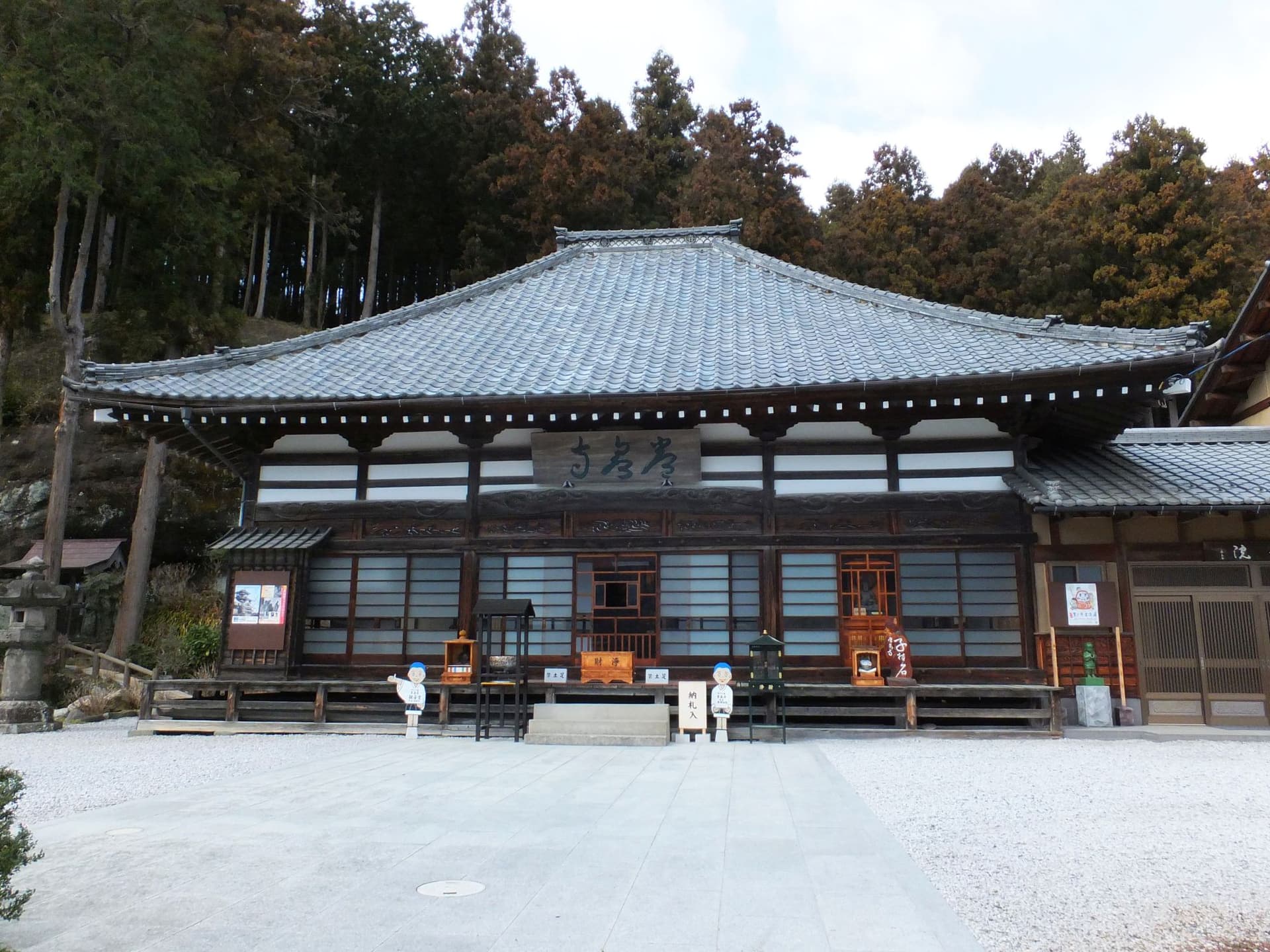
The present Kannon-dō dates to the Bunka era (1804–1818) and is reported to have been the first work of a 25-year-old local master carpenter; it has a square plan approximately 7.2 m on each side, with a Niō Gate. The hall is a designated historic site of Yokoze Town.
In 2026, the once-in-twelve-years Year of the Horse sōkaichō (March 18 – November 30) opens the inner zushi to public viewing, allowing pilgrims to meet the rare Juntei Kannon directly.
Why this place is sacred
The thinness of Goka-dō is felt as singularity. Pilgrims walking the Chichibu circuit encounter Shō Kannon and Jūichimen Kannon repeatedly across the 34 temples; arriving at Goka-dō, they stand before an esoteric form of Kannon they will not meet again on this pilgrimage. The closed zushi behind the modest Bunka-era hall holds Juntei Kannon, and the unfamiliarity is itself part of the felt experience.
Two further elements amplify the threshold. The first is the spatial geometry: the unstaffed Kannon-dō and the manned Chōkō-ji 250 m east preserve a configuration that has largely disappeared from modern Japanese pilgrimage, where most stations consolidate hall and administration. To walk from one to the other is to walk a small ritual distance. The second is the literary legend.
Goka-dō is one of the few sites in the Chichibu circuit explicitly tied to a literary art; pilgrims who arrive with poems of their own, or who pause to read or compose waka in the precinct, find that the temple's foundation story makes a place for that practice.
An enshrinement hall for a Juntei Kannon image attributed by tradition to Jikaku Daishi Ennin (794–864). The 9th-century image attribution is hagiographic and not independently corroborated.
From traditional foundation by the local lay patron Honma Magohachi to Bunka-era (1804–1818) reconstruction of the present Kannon-dō, reportedly the maiden work of a 25-year-old local master carpenter. Administrative pairing with Chōkō-ji preserves the older 'Kannon-dō plus tutelary temple' configuration. Designated a historic site of Yokoze Town.
Experience and orientation
Pilgrims arriving at Goka-dō from Kinshō-ji often note the change of scale: after the dense statue forest of the fourth temple, the fifth is a single small hall in a quiet precinct, with a Niō Gate at the entrance and trees framing the view. The hall is unstaffed. Pilgrims approach, bow, place a coin in the saisen-bako, and chant or recite the Juntei Kannon mantra before the closed zushi.
The walk to Chōkō-ji to receive the goshuin acts as a small, deliberate continuation of the visit — about 250 m east, often through residential lanes. Chōkō-ji administers the pilgrim services and inscribes the stamp. For poets and writers, Goka-dō can function as a particularly resonant stop: the legend is explicit that Kannon's compassion is realized here through the careful articulation of a poetic art, not only through silent prayer.
Some visitors leave waka inscribed on osamefuda; others read quietly in the precinct.
Bow at the Niō Gate and approach the Kannon-dō. Place a coin in the saisen-bako, light incense if available, and chant the Heart Sutra or the Juntei Kannon mantra ('Om share shure jundei sowaka'). Leave an osamefuda — including a poetic offering if you wish. Walk 250 m east to Chōkō-ji to receive the goshuin.
Context and lineage
Honma Magohachi, a leading lay Buddhist of the village, devoted himself to waka poetry and classical literature. One night, a traveling monk arrived at the Kannon-dō; the two stayed up discussing the 'profundities' of poetry until dawn. Magohachi awoke with a fully realized poetic mind. The monk had vanished and was understood to be Kannon. The hall was renamed Goka-dō ('Hall of Speaking Poetry') in commemoration.
Rinzai Zen Buddhism, Nanzen-ji school (臨済宗南禅寺派) — placing Goka-dō among the minority of Chichibu temples not under Sōtō Zen administration. Day-to-day management runs through Chōkō-ji; the Rinzai liturgy and koan-centered practice background underlie the temple's quiet emphasis on direct realization.
Honma Magohachi (本間孫八)
Lay founder of Goka-dō per local tradition; central figure in the temple's waka poetry legend. A leading lay Buddhist of the Yokoze village who treated poetry as a contemplative practice.
Jikaku Daishi Ennin (794–864)
Heian-period Tendai master traditionally credited with carving the principal Juntei Kannon image. The attribution is hagiographic and not independently corroborated.
The anonymous Bunka-era carpenter
Local master carpenter, age 25, reported to have built the present Kannon-dō (approximately 7.2 m square) as his first work. His specific identity is not consistently given across sources.
Chōkō-ji administrators
Priests of the paired tutelary temple about 250 m east of the Kannon-dō, who continue to administer Goka-dō's goshuin, parishioner services, and pilgrim reception.
Traditions and practice
Recitation of the Kannon-kyō or the Juntei Kannon mantra ('Om share shure jundei sowaka') at the Kannon-dō; quiet reading or composition of waka in the precinct, in keeping with the founding legend; leaving an osamefuda inscribed with personal prayers or poetry; receiving the goshuin at Chōkō-ji.
Sutra recitation and offerings on behalf of Goka-dō by Chōkō-ji priests; goshuin issuance and parishioner services at Chōkō-ji; Yokoze Town cultural-property stewardship of the Kannon-dō. The 2026 Horse-Year unveiling intensifies devotional traffic from March through November.
Allow 20–40 minutes including the walk to Chōkō-ji. Pilgrims with literary interests can plan for a longer stay; the precinct supports quiet reading and composition. Visitors who want to chant the Juntei Kannon mantra should familiarize themselves with the syllables in advance.
Rinzai Zen Buddhism (Nanzen-ji school)
ActiveGoka-dō is institutionally a Rinzai Zen temple of the Nanzen-ji school (臨済宗南禅寺派), making it one of the minority of Chichibu temples not under Sōtō administration. Day-to-day management runs through Chōkō-ji, the paired tutelary temple. The Rinzai liturgy and koan-centered background underlie the temple's quiet emphasis on direct realization.
Juntei Kannon (Cundī) devotion
ActiveGoka-dō's principal image is Juntei Kannon (准胝観音, Cundī Avalokiteśvara) — an esoteric form of Kannon with multiple arms and associations with purification and child-blessing. Juntei Kannon as principal image is exceptionally rare on the 100-Kannon pilgrimage system: among all 100 temples, only Goka-dō and Kamidaigo-ji (Saigoku #11) hold Juntei Kannon as honzon. The associated mantra is 'Om share shure jundei sowaka.'
Waka poetry heritage tradition
ActiveGoka-dō derives its name from a foundational legend in which the temple's lay founder Honma Magohachi spent a night discussing the 'profundities' of waka poetry with a wandering monk; by morning, Magohachi had attained mastery of the poetic Way and the monk had vanished, having been an emanation of Kannon. The hall was named Goka-dō ('Hall of Speaking Poetry') in commemoration. This is one of the few sites in the Chichibu circuit explicitly tied to a literary art.
Perspectives and open questions
Goka-dō holds a layered identity: a small Bunka-era Rinzai hall, the rare seat of Juntei Kannon on the 100-Kannon system, and a literary site explicitly tied to waka poetry through its founding legend.
Scholarly perspective
Goka-dō is understood as a Bunka-era Yokoze Kannon hall under the Rinzai Nanzen-ji school, paired with the tutelary Chōkō-ji. Its distinctive features for scholars are the rare Juntei Kannon as principal image — one of only two in the entire 100-Kannon system, alongside Kamidaigo-ji at Saigoku #11 — and the embedded waka poetry legend tying the temple to literary practice.
Living and traditional perspectives
Local devotees treat the Magohachi waka legend as part of the lived character of the temple, not merely a story; visiting poets and calligraphers sometimes inscribe poems on their osamefuda. The Juntei Kannon is approached for purification and for prayers concerning children.
Alternative interpretations
Esoteric (Mikkyō) reading of Juntei Kannon emphasizes purification and the breaking of obstacles. Some popular guides interpret the waka legend as itself an example of the bodhisattva's skillful means (upāya) — meeting the devotee through his own art.
Open questions
The Jikaku Daishi attribution of the principal image is hagiographic and historically unverifiable. The named identity of the 25-year-old Bunka-era carpenter who built the present hall is not consistently given across the sources reviewed.
Plan your visit
Access and arrival
About 2 km east of Kinshō-ji and 1 km west of Boku'un-ji, in Yokoze Town. By foot from Yokoze Station on the Seibu Chichibu Line, about 15–20 minutes. Limited parking near the hall; pilgrims by car often park at Chōkō-ji. Mobile phone signal is reliable in Yokoze.
Yokoze Town offers small minshuku and farm-stays close to the fifth through ninth temples. Central Chichibu, about 10–15 minutes by car, has a fuller range of ryokan and Western-style hotels.
Respectful visit
Comfortable, modest clothing. White oizuru optional. Remove hats inside any interior worship space.
Exterior photography of the Kannon-dō and Niō Gate is fine. Avoid flash inside; do not photograph the principal image during the Horse-Year unveiling without explicit permission.
Small coin (5 yen traditional), incense, osamefuda. Goshuin fee at Chōkō-ji is typically 300–500 yen.
Do not climb on the Niō Gate or the Kannon-dō. Drone use prohibited without prior temple consent.
The hall is unstaffed; please leave the precinct as you find it. Goshuin must be obtained at Chōkō-ji rather than at the Kannon-dō.
Current practical details
Address
6119 Yokoze, Chichibu District, Saitama 368-0072, Japan
Phone
Hours, fees, and access can change — verify on the official source before you travel. Practical details last checked Jun 2026.
Location
Map loads as you approach this section.
Pilgrim reflections
A portrait of encounter, not a score
Pilgrims describe what they felt, how present they could become, and whether the place would shape a journey. There are no stars and no ranking of traditions.
No reviewed reflections yet
The first pilgrims can help describe the character of being here.
Share a reflection
Available after an account-backed “Been there.” Every reflection is reviewed before publication.
Nearby sacred places
Explore other sacred places in the region. Proximity does not establish access or travel time; check each place’s guidance.



References
Sources consulted for this page. Source categories describe the publication, not a guarantee that every claim is verified. Traditional accounts and outside interpretations may differ.
- 01札所五番語歌堂 — 横瀬町ホームページ — Yokoze Town GovernmentofficialOfficial Yokoze Town designation page; Goka-dō is a designated historic site of Yokoze Town.
- 02秩父札所 第五番 小川山 語歌堂 — Chichibu Fudasho — Kaiun Pilgrimage GuideofficialPilgrimage guide; describes the paired structure with Chōkō-ji (長興寺) ~250m east where the goshuin is issued, preserving the original 'Kannon-dō plus tutelary temple' configuration.
- 035th Sacred Place, Goka-do of Mt. Ogawa | CHOCOTABI SAITAMA — Saitama Prefecture / Chocotabi SaitamaofficialPrefectural English-language source; the Magohachi Honma waka legend and identification of the wandering monk as an incarnation of Kannon.
- 04語歌堂 — Wikipedia (Japanese) — Wikipedia contributorsofficialConfirms Rinzai Zen Nanzen-ji school affiliation, mountain name Ogawa-san, principal image Juntei Kannon (准胝観音) traditionally attributed to Jikaku Daishi, the founding-by-Honma-Magohachi tradition, the Bunka-era (1804–1818) reconstruction of the present Kannon-dō, and the rarity of Juntei Kannon as principal image among the 100-Kannon pilgrimage sites.
- 05准胝観音 — Wikipedia — Wikipedia contributorsacademicBackground on Juntei Kannon (Cundī Avalokiteśvara), an esoteric form of Kannon associated with purification and child-blessing; rare as principal image in Japan.
- 06Chichibu 34 Kannon Sanctuary — Wikipedia — Wikipedia contributorsofficialPilgrimage-level overview.
Pilgrim glossary
- Honzon
- The principal Buddhist deity enshrined as a temple's central object of worship.
- Kannon
- The bodhisattva of compassion, central to many East Asian pilgrimage routes.
- Bodhisattva
- An enlightened being who postpones full nirvana to help others toward awakening.
- Sutra
- A canonical Buddhist scripture, often chanted as part of practice.
- Mantra
- A sound, word, or phrase repeated as part of meditation or ritual.
- Zen
- A Japanese Buddhist school emphasizing seated meditation and direct insight.
- Koan
- A paradoxical question used in Zen training to break conceptual thinking.
Share a photo
Help visitors recognize Goka-dō. Every submission is reviewed before publication.