Kinshō-ji
A forest of roughly 1,300 stone Buddhas wrapping a Kansei-era famine memorial
Understand sacred places, explore living traditions, and learn how to engage respectfully with Pilgrim Map.
Access has not been verified. Check current local guidance before planning a visit.
Chichibu, Saitama Prefecture, Japan
Read the sources
Station 4 of 34
Chichibu 34 Kannon PilgrimageVisit essentials
A quick read before you go
- Duration
- 60–90 minutes for a full visit including the main hall, the Niō-mon, the Jibo Kannon, and…
- Access
- About 2 km south of Jōsen-ji.
Overview
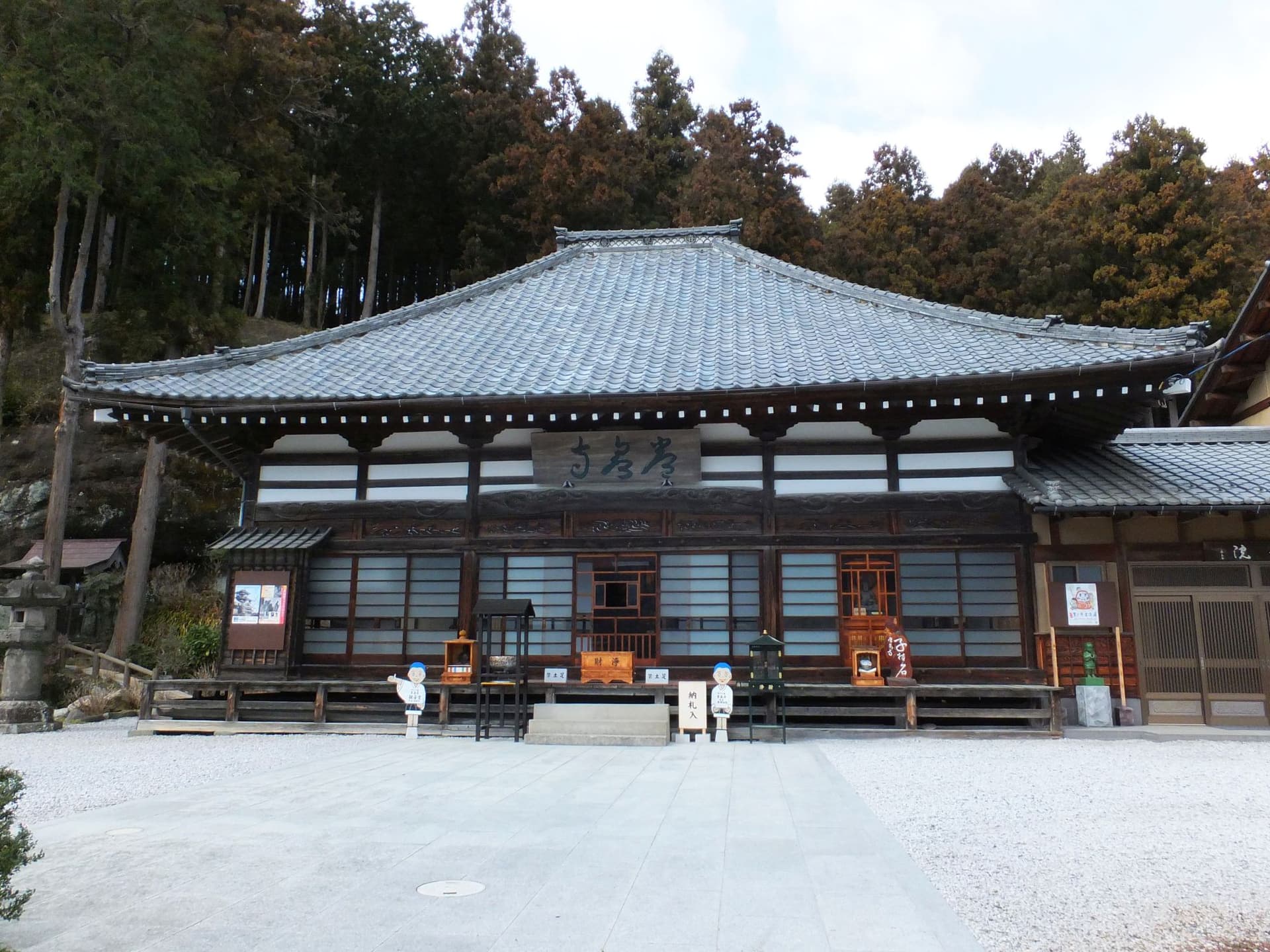
Kinshō-ji rises against a slope of conglomerate bedrock about 2 km south of Jōsen-ji. The mountain name, Kōkokuzan, means 'High-Valley Mountain'; the precinct unfolds in tiers, with the Niō-mon and its towering guardian statues at the entrance, the main hall above, and the path of stone Buddhas spread across the surrounding hillside.
The principal image of pilgrimage is a Jūichimen Kannon — Eleven-Headed Avalokiteśvara — kept behind closed zushi doors and unveiled to public viewing only during the once-in-twelve-years Year of the Horse sōkaichō.
What makes Kinshō-ji extraordinary is the stone Buddha forest. After the 1783 eruption of Mt. Asama and the resulting Tenmei famine, the Kansei-era abbot Kōsen Dōgaku launched a campaign for one thousand small stone Buddha statues as memorial offerings for the victims and as objects of donor merit. Donations from across Japan ultimately reached approximately 3,800 statues; about 1,300 survive today, lining the stone steps and arrayed across the conglomerate hillside in the geometry the abbot designed in the 1790s.
The grouping is a Saitama Prefecture designated Tangible Folk Cultural Property and is one of the most distinctive sacred landscapes on the Chichibu route.
In front of the main hall stands the Jibo Kannon — the 'Compassionate Mother Kannon' — donated in 1791 by the Edo merchant Yoshinoya Hansaemon. The figure is Kannon nursing an infant, and is reported by tradition to have been modeled on a design by a celebrated ukiyo-e artist of the period.
It is among the most photographed and most personally addressed objects on the Chichibu pilgrimage, drawing prayers for safe childbirth, healthy children, and family well-being far beyond the formal pilgrimage circuit.
Some popular guides propose a Maria Kannon reading of Jibo Kannon imagery, but evidence of hidden-Christian practice at Kinshō-ji is not established; it remains possibility, not fact.
Why this place is sacred
The thinness of Kinshō-ji is dense and visual. Most thin places ask the visitor to attend to one feature; Kinshō-ji asks attention from every direction at once — guardian statues at the gate, small stone Buddhas along every path, the maternal Jibo Kannon in front of the main hall, the conglomerate slope underfoot tying it all to deep geological time.
Three elements amplify the threshold. The first is the density of statuary. Each of the surviving 1,300 figures is different: some smiling, some weathered nearly featureless, some clearly the work of accomplished sculptors and others the work of village donors. Walking the path is an act of memorial-by-presence.
The second is the Niō-mon: the dramatic guardian gate frames the entry from everyday road into the stone-Buddha forest, and the contrast between guardian fierceness and the maternal Jibo Kannon is widely noted. The third is the conglomerate geology — the rough, banded bedrock visible along the slopes is a Chichibu Geopark identified site, anchoring the human memorial in a geological timescale far older than any Buddhist text.
A medieval Sōtō Zen temple in the Chichibu basin. Available sources do not give a precise founding date; the temple's distinctive identity emerged in the Kansei era (1789–1801) under abbot Kōsen Dōgaku, whose stone Buddha campaign began in response to the Tenmei famine.
From medieval Sōtō foundation to Kansei-era famine memorial site through Kōsen Dōgaku's stone Buddha campaign of the 1790s; to Saitama Prefecture designated Tangible Folk Cultural Property in modern administration; to current functioning pilgrimage temple with the Jibo Kannon as a magnet for prayers concerning children and family.
Experience and orientation
Pilgrims arriving at Kinshō-ji from Jōsen-ji often pause first at the Niō-mon and its guardian statues before climbing the stone steps. The Jibo Kannon stands in front of the main hall — a tender Kansei-era image of Kannon nursing a child — and is widely reported as the most personally addressed object on this stretch of the pilgrimage. Many visitors approach it directly with private prayers about pregnancy, the safety of a child, or the memory of one.
From the main hall, the path of stone Buddhas opens out across the conglomerate slope. Pilgrims walk slowly, sometimes silently, sometimes pointing out a particular figure to a companion. The smaller statues are too numerous to take in as a single image; visitors typically settle on one or two as the focus of their attention.
The contrast between guardian fierceness at the gate and maternal tenderness at the Jibo Kannon, and the further contrast between dense human memorial and deep geological time in the bedrock, gives Kinshō-ji an unusual range for a single visit.
Pass beneath the Niō-mon guardians, then climb to the main hall for coin, sutra, and osamefuda offerings. Visit Jibo Kannon, walk slowly among the stone Buddhas without contact, and finish with goshuin.
Context and lineage
After the 1783 eruption of Mt. Asama and the ensuing Tenmei famine, abbot Kōsen Dōgaku appealed for one thousand stone Buddha statues to memorialize the dead. Donors from across Japan sent approximately 3,800 statues, of which about 1,300 survive today. In 1791, the Edo merchant Yoshinoya Hansaemon donated the Jibo Kannon, a stone Kannon-and-child image based, by tradition, on a design by a well-known ukiyo-e artist.
Sōtō Zen, with the mountain name Kōkokuzan ('High-Valley Mountain'). The temple's present identity is shaped less by sectarian doctrine than by the late-18th-century stone Buddha donation campaign, which gave the precinct its distinctive social and material character.
Kōsen Dōgaku (古仙登嶽)
Kansei-era abbot of Kinshō-ji and organizer of the stone Buddha campaign in response to the Tenmei famine. The architect of the temple's current sacred landscape.
Yoshinoya Hansaemon (吉野屋半左衛門)
Edo merchant donor of the Jibo Kannon, dated 12 August 1791. The donation tied the temple to lay-merchant patronage networks of the late Edo period.
Anonymous Edo and Chichibu stonecutters
Sculptors of the surviving approximately 1,300 statues (originally about 3,800). Their styles vary widely, reflecting both professional studios and village donors.
Saitama Prefecture conservation administrators
Modern stewards of the stone Buddha group, designated a Tangible Folk Cultural Property. The conservation framework supports public access while limiting interventions on the statues themselves.
Traditions and practice
Recitation of the Kannon-kyō or the Heart Sutra at the main hall; prayers before the Jibo Kannon for safe childbirth, healthy children, and family well-being; walking among the stone Buddhas as a meditative act of remembrance for the famine dead; leaving an osamefuda inscribed with personal prayers.
Sōtō priests perform daily liturgy and issue goshuin. Conservation stewardship of the stone Buddha group and the Niō-mon proceeds under Saitama Prefecture cultural-property guidelines. The 2026 Horse-Year unveiling intensifies devotional traffic from March through November.
Allow 60–90 minutes for a full visit including the main hall, the Niō-mon, the Jibo Kannon, and walking through the stone Buddha groups. Early-morning visits at 08:00 opening offer the most contemplative experience of the statue paths.
Sōtō Zen Buddhism
ActiveKinshō-ji is institutionally a Sōtō Zen temple with the mountain name Kōkokuzan. Its present identity is shaped by the late-18th-century stone Buddha donation campaign organized by the Kansei-era abbot Kōsen Dōgaku.
Kannon (Avalokiteśvara) devotion
ActiveThe principal pilgrimage image is a Jūichimen Kannon (Eleven-Headed Avalokiteśvara). Equally famous is the Jibo Kannon stone statue in front of the main hall — Kannon nursing an infant, donated in 1791 by Yoshinoya Hansaemon, reported by tradition to be modeled on a design by a celebrated ukiyo-e artist.
Edo-period famine memorial / stone Buddha donation
ActiveAfter the 1783 eruption of Mt. Asama and the resulting Tenmei famine, abbot Kōsen Dōgaku launched a campaign for one thousand small stone Buddha statues as memorial offerings for victims and as objects of donor merit. Donations from across Japan ultimately reached approximately 3,800 statues; about 1,300 survive today. The grouping is a designated Saitama Prefecture Tangible Folk Cultural Property.
Maria Kannon hypothesis (Hidden Christian)
HistoricalSome popular and travel-media sources propose that Kinshō-ji's Jibo Kannon was the kind of image used by hidden Christians (kakure kirishitan) during the Tokugawa-era prohibition of Christianity to disguise Marian devotion. This is a known scholarly conjecture for Maria Kannon imagery in general; specific evidence for hidden Christian practice at Kinshō-ji itself is not established. Reported as possibility, not fact.
Perspectives and open questions
Kinshō-ji holds a layered identity: a Sōtō Zen temple, a famine memorial, a piece of late-Edo social history, and an ongoing destination for prayers about children and family. Each layer is read differently by different communities.
Scholarly perspective
Kinshō-ji is treated by both art historians and folklorists as a key Chichibu site for studying late-Edo lay Buddhist responses to catastrophe: the Tenmei famine, mediated through abbot Kōsen Dōgaku's stone Buddha campaign, produced a precinct that is simultaneously a religious art site, a famine memorial, and a piece of social history. The Saitama Prefecture designation of the stone Buddha group as a Tangible Folk Cultural Property formalizes that scholarly reading.
Living and traditional perspectives
Local devotees address the Jibo Kannon directly, particularly mothers and grandmothers praying for healthy children. The stone Buddha forest is treated as a place where one's own grief or wish can be quietly placed alongside many others'.
Alternative interpretations
The Maria Kannon hypothesis — that Edo-era hidden Christians used Jibo Kannon imagery to disguise Marian devotion — appears in some popular guides to Kinshō-ji. It is a generally plausible reading of Maria Kannon imagery in Japan; specific evidence at Kinshō-ji itself is not established and should be presented as possibility, not fact.
Open questions
The precise current count of stone Buddhas — sources give 'approximately 1,300' from an originally donated set of about 3,800 — and the named ukiyo-e artist whose drawing was the model for the Jibo Kannon are not consistently specified across the available sources.
Plan your visit
Access and arrival
About 2 km south of Jōsen-ji. By car: parking on site; about 10–15 minutes from central Chichibu via local roads. By bus: Seibu-Kankō bus from Seibu-Chichibu Station to the 'Kinshō-ji-mae' stop. By foot from Jōsen-ji: about 30 minutes through residential and forested lanes. Mobile phone signal is reliable in the basin.
A range of ryokan and minshuku in central Chichibu, about 10–15 minutes by car. Yokoze Town offers smaller minshuku and farm-stay options closer to the fifth through ninth temples.
Respectful visit
Comfortable, modest clothing and sturdy shoes. The stone-Buddha paths and the conglomerate slope can be uneven. White oizuru optional.
Generally welcome on the precinct including the Jibo Kannon and the stone Buddha groups. Avoid flash inside the main hall. Do not photograph the principal image during the Horse-Year unveiling without explicit permission.
Small coin (5 yen traditional), incense, osamefuda. Goshuin fee typically 300–500 yen.
Do not touch, climb on, or rearrange the stone Buddha statues. Drone use prohibited without prior temple consent. Maintain quiet during others' prayer.
Do not touch, climb on, or rearrange the stone Buddhas, a Saitama Prefecture Tangible Folk Cultural Property. Conglomerate slopes become slippery in heavy rain; sturdy shoes are essential.
Current practical details
Address
1803 Yamada, Chichibu, Saitama 368-0004, Japan
Phone
Hours, fees, and access can change — verify on the official source before you travel. Practical details last checked Jun 2026.
Location
Map loads as you approach this section.
Pilgrim reflections
A portrait of encounter, not a score
Pilgrims describe what they felt, how present they could become, and whether the place would shape a journey. There are no stars and no ranking of traditions.
No reviewed reflections yet
The first pilgrims can help describe the character of being here.
Share a reflection
Available after an account-backed “Been there.” Every reflection is reviewed before publication.
Nearby sacred places
Explore other sacred places in the region. Proximity does not establish access or travel time; check each place’s guidance.


References
Sources consulted for this page. Source categories describe the publication, not a guarantee that every claim is verified. Traditional accounts and outside interpretations may differ.
- 01札所4番 高谷山 金昌寺 / 秩父市 — Chichibu City GovernmentofficialMunicipal government page; confirms mountain name Kōkokuzan, the Saitama Prefecture designation of the stone Buddha group as a Tangible Folk Cultural Property, and the Kansei-era origin of the stone Buddha project.
- 02札所4番金昌寺の礫岩層と石仏群 — Chichibu GeoparkofficialOfficial geopark site; describes the conglomerate strata of the temple grounds and the relationship between the bedrock and the stone Buddhas.
- 034番 金昌寺 — 秩父三十四所観音霊場 — Chichibu Fudasho Renraku KaigiofficialOfficial pilgrimage council page; sect (Sōtō Zen), principal image (Jūichimen Kannon), and Jibo Kannon information.
- 04札所4番・高谷山 金昌寺 — Chichibu Omotenashi Tourism OrganizationofficialLocal government tourism authority; visitor protocols and architectural highlights.
- 05Chichibu Fudasho — A Journey Through History — Saitama Prefecture Tourism Support DeskofficialDescribes Kinshō-ji's stone Buddha collection and the Kosodate (child-rearing) Kannon as foci of fertility/family prayer.
- 06Japanese Busshi (Sculptors), Edo Period — Mark Schumacher (Onmark Productions)academicReference work on Edo-period Buddhist sculpture; useful for context on Kansei-era stone Buddha donation practice.
- 07Chichibu — Learn About Temples And Shrines On A Day Trip From Tokyo — MATCHA Japan Travel GuideguideTravel-media coverage; notes the Maria Kannon connection — that Christian-era pilgrims may have used Jibo Kannon imagery as cover for Marian devotion during the bakuhan-era Christian prohibition.
- 08Chichibu 34 Kannon Sanctuary — Wikipedia — Wikipedia contributorsofficialPilgrimage-level overview.
Pilgrim glossary
- Kannon
- The bodhisattva of compassion, central to many East Asian pilgrimage routes.
- Sutra
- A canonical Buddhist scripture, often chanted as part of practice.
- Zen
- A Japanese Buddhist school emphasizing seated meditation and direct insight.
Share a photo
Help visitors recognize Kinshō-ji. Every submission is reviewed before publication.