Kōjō-ji
A National-Treasure 1432 Zen pagoda above Setoda Bay on Ikuchijima
Understand sacred places, explore living traditions, and learn how to engage respectfully with Pilgrim Map.
Access has not been verified. Check current local guidance before planning a visit.
Onomichi, Hiroshima Prefecture, Japan
Read the sources
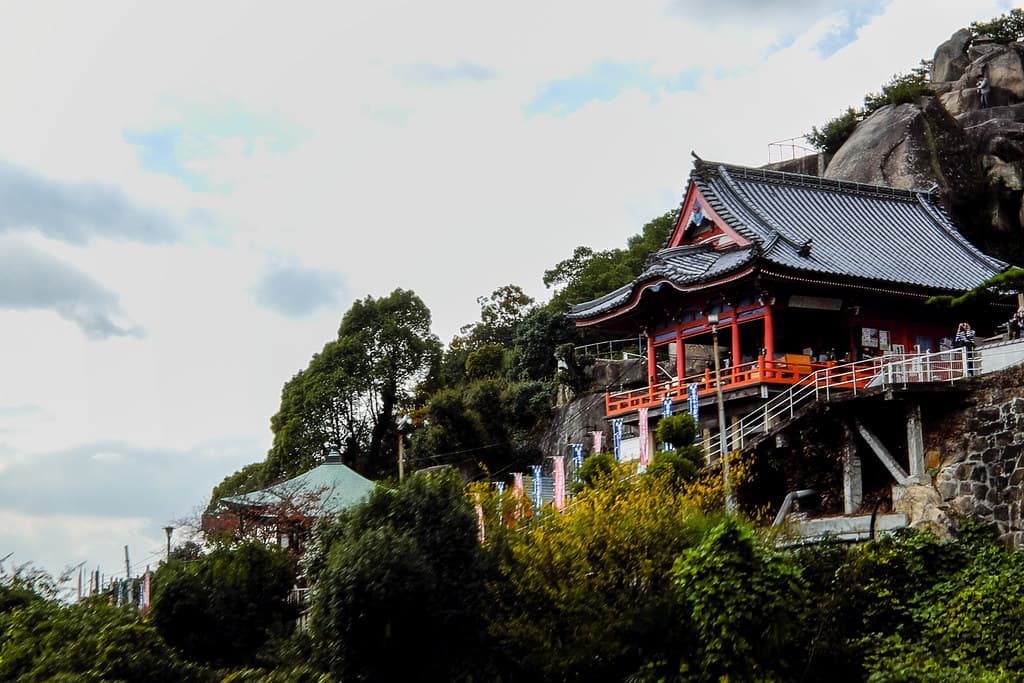
Image of Kōjō-ji. Image source · CC-BY-3.0
Station 11 of 33
Chūgoku 33 Kannon PilgrimageVisit essentials
A quick read before you go
- Duration
- 45–60 minutes including the climb up the stone staircase.
- Access
- Address: 553-2 Setoda-chō, Onomichi, Hiroshima Prefecture (Ikuchijima).
Overview
Kōjō-ji occupies a small hilltop precinct on Mt. Chōon, above Setoda Bay on Ikuchijima — one of the larger islands of the Geiyo archipelago, now linked to the mainland by the Shimanami Kaidō cycling road. The temple's full name, Chōon-zan Kōjō-ji, names two things: 'Tide-Sound Mountain' for the rhythmic surf audible from the precincts, and 'Toward-the-Heights Temple' for the upward orientation of Sōtō Zen practice.
Founding tradition is securely dated. In 1400 (Ōei 7), local lord Ikuchi Morihira invited the Zen master Tokuō Myōkū (徳翁妙空) — a Dharma-successor in the lineage of Buttsū-ji's Daidō Ichii — from nearby Mihara. Tokuō transferred from the Buttsū-ji line and consecrated Mt. Chōon as a Kannon ground; Kōjō-ji was thus founded as a Sōtō Zen prayer-temple endowed for protection from disasters and prosperity for the Setouchi shipping community.
(The transfer of allegiance from Buttsū-ji's Rinzai line to Sōtō Zen is part of the Ikuchi clan's complex devotional history.)
The 1432 (Eikyō 4) three-story pagoda, built under the Ikuchi (Kobayakawa-related) patrons Nobumoto and Nobumasa, is the temple's defining feature. It was designated a National Treasure in 1958 and is recognized within the 'Sailing through History — A Voyage along the Setouchi Five Ports' Japan Heritage story. The pagoda's hybrid Wayō-Karayō (Japanese-and-Chinese-Zen) architectural style is exceptional among Muromachi pagodas, valuable because most original timbers survive and the build date is documented.
For pilgrims on the Chūgoku 33 Kannon route, Kōjō-ji is #11 — the next numbered station after Senkō-ji and the first stop on the Ikuchijima leg.
Why this place is sacred
Kōjō-ji's quality of thinness is best understood through the conversation between pagoda and sea. The 19-metre 1432 three-story pagoda stands on the small hilltop above Setoda Bay; from its base, the surrounding view drops away to the strait, the islands of the Geiyo archipelago, and (to the north) the Tatara Bridge of the Shimanami Kaidō. The pagoda's Wayō-Karayō hybrid construction blends domestic Japanese (Wayō) carpentry with the Chinese-Zen (Karayō) vocabulary that the founding Sōtō line had inherited from Song-dynasty masters.
Most of the original timber survives. The build date is documented, which is rare among Muromachi pagodas; this combination is the basis of the National Treasure designation.
The temple's institutional course is similarly compressed. The 1400 founding under Ikuchi Morihira and Tokuō Myōkū made Kōjō-ji a Sōtō Zen prayer-temple from inception; it has remained Sōtō through the centuries since. The mountain name — Chōon-zan — encodes a meditative cue: the 'tide-sound' from the bay below is read by some practitioners as a natural sutra recitation, audible at all hours from the precinct.
The Sōtō Zen tradition here remains active. The contemporary temple hosts zazen and shakyō (sutra copying) experiences via SOIL Setoda, the local cultural-tourism collaboration; pilgrim goshuin and nōkyō are issued daily; the principal honzon (Shaka Nyorai) and the pilgrimage honzon (Shō-Kannon, hibutsu) are venerated in the main hall. The temple's quiet character — uncrowded compared to the gaudy Kōsan-ji at the foot of the hill — gives the pagoda viewing the contemplative pace its construction was meant to support.
Founded in 1400 (Ōei 7) by local lord Ikuchi Morihira and Zen master Tokuō Myōkū as a Sōtō Zen prayer-temple, endowed for protection from disasters and for prosperity of the Setouchi shipping community. Tokuō was a Dharma-successor in the lineage of Buttsū-ji's Daidō Ichii but transferred to Sōtō Zen at the founding; from inception, Kōjō-ji has been Sōtō.
The temple's institutional course shows a clear arc: 1400 founding under Ikuchi-clan patronage; 1432 (Eikyō 4) construction of the three-story pagoda under patrons Ikuchi (Kobayakawa-related) Nobumoto and Nobumasa; medieval and Edo-period continuation as a Sōtō Zen Setouchi shipping-prayer temple; 1958 National Treasure designation of the pagoda; modern integration into the Shimanami Kaidō cycling-tourism economy and the SOIL Setoda zazen experience. Sectarian affiliation has remained Sōtō throughout.
Experience and orientation
Setoda Port on Ikuchijima is reached by ferry from Onomichi (~40 minutes) or by car/bicycle along the Shimanami Kaidō cycling road. From the port, a ten-minute walk through the small Setoda village brings the visitor to the foot of Mt. Chōon. A steep stone staircase rises up the hillside, passing the lower precinct buildings before opening onto the upper terrace.
The 19-metre three-story pagoda dominates the terrace. Its vermilion paintwork is maintained, but the timber frame beneath is original 1432 work. Visitors familiar with later Edo-period pagodas register Kōjō-ji's as visibly older — the proportions are tighter, the brackets more compressed, the Karayō vocabulary more pronounced. From the pagoda's base, the view drops away to Setoda Bay and the surrounding islands.
The main hall houses the principal honzon, Shaka Nyorai, and the pilgrimage honzon Shō-Kannon (hibutsu). Worship follows standard Sōtō Zen form: bow at the hall entrance, light incense, drop a saisen coin in the offertory box, and recite or quietly listen to the Heart Sutra. Pilgrims bring their nōkyō-chō to the temple office for the Chūgoku 33 #11 stamp. Bookable zazen and shakyō sessions are arranged through SOIL Setoda.
A small admission fee (typically 300 yen) is collected for the grounds.
From Setoda Port, walk ten minutes through the village to the foot of Mt. Chōon. Climb the stone staircase to the upper terrace. Pause at the 1432 three-story pagoda. Walk to the main hall, light incense, and offer at the saisen box. Recite the Heart Sutra if equipped. Pilgrims request the Chūgoku 33 #11 nōkyō at the temple office during posted hours. Bookable Zen experiences (zazen, shakyō) are arranged in advance through SOIL Setoda.
Context and lineage
In 1400 (Ōei 7), local lord Ikuchi Morihira — head of the Ikuchi clan that had held Ikuchijima since 1343 — sought to consecrate Mt. Chōon above Setoda Bay as a Buddhist prayer-ground. He invited Tokuō Myōkū (徳翁妙空), a Zen master from nearby Mihara who was a Dharma-successor in the lineage of Buttsū-ji's Daidō Ichii, to found the temple.
Tokuō transferred from the Buttsū-ji line and consecrated the site as a Sōtō Zen establishment; Kōjō-ji was thus founded as a Sōtō prayer-temple endowed for protection from disasters and prosperity for the Setouchi shipping community.
The 1432 (Eikyō 4) three-story pagoda was built under the patronage of Ikuchi (Kobayakawa-related) Nobumoto and Nobumasa, the Ikuchi family having become connected by marriage and adoption to the powerful Kobayakawa clan of nearby Mihara. The pagoda's documented build date and surviving original timber make it a key node in Japanese architectural history. It was designated a National Treasure on June 9, 1958.
Through the medieval and Edo periods, Kōjō-ji continued as the principal Zen prayer-temple of Setoda, in dialogue with the Setouchi shipping economy on which Setoda's prosperity depended. In the 20th century, the temple's National Treasure status drew architectural pilgrims as well as devotional ones; in the 21st century, integration into the Shimanami Kaidō cycling-tourism economy and the SOIL Setoda cultural project has made the temple accessible to a wider visiting community.
Kōjō-ji is a parish temple of Sōtō Zen Buddhism (曹洞宗), the Japanese Zen school founded by Dōgen (1200–1253) at Eihei-ji. Its zazen-centered ritual program (silent seated meditation, sutra chanting, periodic Kannon-kō observances) frames the daily and annual liturgy. From its 1400 founding, the temple has been continuously Sōtō, despite its founder Tokuō Myōkū's earlier Rinzai (Buttsū-ji) connections.
Ikuchi Morihira (生口守平)
Founding patron
Late-14th-century local lord of the Ikuchi clan, holders of Ikuchijima since 1343. In 1400 he invited the Zen master Tokuō Myōkū from Mihara to consecrate Mt. Chōon as a Buddhist prayer-ground and founded Kōjō-ji as a Sōtō Zen prayer-temple.
Tokuō Myōkū (徳翁妙空)
Founding abbot
Zen master from Mihara, a Dharma-successor in the lineage of Buttsū-ji's Daidō Ichii. Transferred from the Buttsū-ji line to Sōtō Zen at the 1400 founding of Kōjō-ji and served as the temple's first abbot.
Ikuchi (Kobayakawa-related) Nobumoto and Nobumasa
Pagoda patrons
Early-15th-century Ikuchi-family patrons, connected by marriage to the Kobayakawa clan, who funded the construction of the 1432 (Eikyō 4) three-story pagoda — the temple's defining feature and a National Treasure.
Postwar conservators and the 1958 designation committee
Modern stewards
The Agency for Cultural Affairs designated the 1432 pagoda a National Treasure on June 9, 1958, in recognition of its hybrid Wayō-Karayō construction, surviving original timber, and documented build date. The temple's modern conservation has been undertaken in coordination with the Agency.
Postwar resident clergy and SOIL Setoda partners
Contemporary stewards
The community responsible for daily Sōtō Zen liturgy, pilgrim stamping, the maintenance of the National Treasure pagoda, and the bookable zazen and shakyō experiences offered in partnership with the SOIL Setoda cultural-tourism collaboration.
Traditions and practice
The temple's liturgy follows Sōtō Zen forms — silent zazen, recitation of the Hannya Shingyō, and the Sōtō morning service (chōka). Annual Kannon-kō observances mark the seasonal devotional calendar. Bookable zazen sessions for visitors and corporate groups are offered through SOIL Setoda; shakyō (sutra copying) experiences are similarly arrangeable.
Pilgrims arrive year-round for the Chūgoku 33 #11 stamp; many combine the visit with Senkō-ji (#10) and Buttsū-ji (#12) on the same day or weekend. Setoda Port's ferry connection from Onomichi and the Shimanami Kaidō cycling road bring a steady stream of architectural pilgrims for the pagoda. Late March to early April brings cherry blossoms framing the pagoda; clear-weather mornings give unobstructed sea views. The Setoda Sunset Festival in late June draws additional visitors.
Allow 45 to 60 minutes for the climb and the upper terrace. Pause at the 1432 pagoda before approaching the main hall — its proportions register most clearly when given uninterrupted attention. Light incense at the main hall, offer at the saisen box, and recite or listen to the Heart Sutra. Pilgrims should bring their nōkyō-chō to the temple office for the #11 stamp. Bookable zazen and shakyō sessions are arranged in advance through SOIL Setoda.
The 'Tide-Sound' name encourages a pause on the upper terrace to listen to the bay below as a natural sutra recitation.
Buddhism
ActiveKōjō-ji is a parish temple of Sōtō Zen Buddhism, the Japanese Zen school founded by Dōgen at Eihei-ji. From its 1400 founding under local lord Ikuchi Morihira and Zen master Tokuō Myōkū, the temple has been continuously Sōtō. As Chūgoku 33 #11, it is the first numbered station on the Ikuchijima leg of the Chūgoku Kannon route. The 1432 three-story pagoda — a National Treasure of hybrid Wayō-Karayō construction — is one of the rare Zen pagodas of pre-Edo date with most original timbers intact, and it grounds the temple's identity in the encounter between Japanese and Chinese-Zen architectural vocabularies.
Chūgoku 33 Kannon Pilgrimage
Active#11 of the Chūgoku 33 Kannon Pilgrimage and the first numbered station on the Ikuchijima leg. The pilgrimage honzon is Shō-Kannon (Ārya-Avalokiteśvara), enshrined as a hibutsu in the main hall.
Perspectives and open questions
Kōjō-ji is a temple where Muromachi architectural history and contemporary Sōtō Zen practice meet under the same hilltop pagoda. The site rewards visitors who hold the 1432 build date and the living zazen tradition open at once.
Scholarly perspective
The Eikyō-4 (1432) pagoda is a textbook hybrid of Wayō and Karayō Zen architecture, valuable because most original timbers survive and the build date is documented; this is rare among Muromachi pagodas. The National Treasure designation (1958) reflects this combination. The 1400 founding under Ikuchi-clan patronage is documented in the temple's own records and in regional gazetteers; the transfer of the founding abbot Tokuō Myōkū from the Buttsū-ji Rinzai line to Sōtō Zen is similarly attested.
Living and traditional perspectives
Local maritime communities historically prayed here for safe sailing and prevention of fires in Setoda's densely built shipping town. The Sōtō Zen tradition treats Mt. Chōon's 'tide-sound' as a meditation cue: the constant surf from below as a natural sutra recitation. Pilgrim devotion to the Shō-Kannon as the route honzon continues alongside the temple's principal Shaka Nyorai veneration.
Alternative interpretations
The 'Tide-Sound Mountain' name is sometimes read as a meditation cue — the constant surf from below as a natural sutra recitation, with the temple itself as a silent chanter. The combination of National Treasure pagoda and uncrowded precinct gives some visitors a sense of having found the architectural quality of Kyoto without the crowds.
Open questions
{"Pre-1400 use of Mt. Chōon as a sacred site is plausible (the Ikuchi clan had been on the island since 1343) but undocumented","The exact Karayō architectural lineage of the 1432 pagoda's master builder is not securely identified","Detailed liturgical content of internal Sōtō Kannon-kō observances at this site is not documented in retrieved English sources"}
Plan your visit
Access and arrival
Address: 553-2 Setoda-chō, Onomichi, Hiroshima Prefecture (Ikuchijima). From Setoda Port: 10-minute walk uphill. Setoda Port is reached by ferry from Onomichi (~40 minutes) or by car/bicycle along the Shimanami Kaidō cycling road (~15 minutes from the Tatara Bridge). Phone: 0845-27-0800. Mobile phone signal is reliable on all major Japanese carriers in Setoda.
Setoda offers a small range of guesthouses, ryokan, and the SOIL Setoda hotel within walking distance of the port. Many pilgrims base themselves in Onomichi and treat Setoda as a day trip; cyclists on the Shimanami Kaidō often stay one night in Setoda.
Respectful visit
Modest casual; comfortable walking shoes for the steep stone staircase. Pilgrim coat (hakui), sedge hat (sugegasa), and walking stick (kongō-zue) appropriate for those on the Chūgoku 33 circuit.
Outdoor photography of the pagoda exterior, main hall, and bay views is permitted. No photography of seated zazen sessions in progress. No flash inside any hall.
Coin offerings at the main hall saisen box; admission fee at the temple entrance. Pilgrim stamp fee paid at the temple office.
Pilgrimage Shō-Kannon honzon is a hibutsu, not on regular public display | Pagoda interior viewing is restricted; do not climb on pagoda railings or step onto its base platform | Do not touch any timber of the 1432 National Treasure pagoda | Quiet voices in the main hall, especially during zazen sessions | No photography of zazen sessions in progress
The pilgrimage Shō-Kannon is a hibutsu, not on regular public display. The pagoda interior is generally not enterable; do not climb on the pagoda railings or steps. The stone staircase up the hillside is steep — sturdy footwear is recommended. Photography of the pagoda exterior is welcomed; no photography of seated zazen sessions in progress. A small admission fee is collected at the entrance.
Current practical details
Address
57 Setodachō Setoda, Onomichi, Hiroshima 722-2411, Japan
Phone
Hours, fees, and access can change — verify on the official source before you travel. Practical details last checked Jun 2026.
Location
Map loads as you approach this section.
Pilgrim reflections
A portrait of encounter, not a score
Pilgrims describe what they felt, how present they could become, and whether the place would shape a journey. There are no stars and no ranking of traditions.
No reviewed reflections yet
The first pilgrims can help describe the character of being here.
Share a reflection
Available after an account-backed “Been there.” Every reflection is reviewed before publication.
Nearby sacred places
Explore other sacred places in the region. Proximity does not establish access or travel time; check each place’s guidance.


References
Sources consulted for this page. Source categories describe the publication, not a guarantee that every claim is verified. Traditional accounts and outside interpretations may differ.
- 01向上寺 — Chūgoku Kannon Reijō #11 — Chūgoku 33 Kannon Pilgrimage AssociationofficialConfirms #11 and pilgrimage honzon
- 02Three-story pagoda at Kojoji Temple — Cultural Heritage Online (Bunka-chō) — Agency for Cultural Affairs (Japan)officialAuthoritative for National Treasure designation and 1432 date
- 03Kojoji Temple — Dive! Hiroshima — Hiroshima Prefecture TourismofficialTourism overview and access
- 04向上寺三重塔 — 文化遺産オンライン — Agency for Cultural Affairs (Japan)officialPagoda height (19 m), Wayō-Karayō hybrid style, original timber
- 05向上寺 — Wikipedia (JA) — WikipediaofficialSect (Sōtō), founder, dates
- 06Kojoji Temple — Good Luck Trip — Good Luck TripguideVisiting hours / SOIL Setoda zazen experience
- 07Kojo-ji & three-story pagoda — Setouchi Finder — Setouchi FinderguideCycling-route context, Setoda views
Pilgrim glossary
- Honzon
- The principal Buddhist deity enshrined as a temple's central object of worship.
- Kannon
- The bodhisattva of compassion, central to many East Asian pilgrimage routes.
- Sutra
- A canonical Buddhist scripture, often chanted as part of practice.
- Dharma
- The teachings of the Buddha; also the universal law underlying them.
- Zen
- A Japanese Buddhist school emphasizing seated meditation and direct insight.
Share a photo
Help visitors recognize Kōjō-ji. Every submission is reviewed before publication.