Selge
A Pisidian mountaintop city that fielded 20,000 soldiers and has never been excavated
Understand sacred places, explore living traditions, and learn how to engage respectfully with Pilgrim Map.
Access has not been verified. Check current local guidance before planning a visit.
Antalya, Turkey
Read the sources
Station 4 of 7
St Paul TrailVisit essentials
A quick read before you go
- Duration
- Two to three hours for the ruins themselves; allow additional time for the mountain road…
- Access
- From Antalya, drive east to Manavgat or Side, then north to Beşkonak, cross the Oluk Bridge over…
Overview
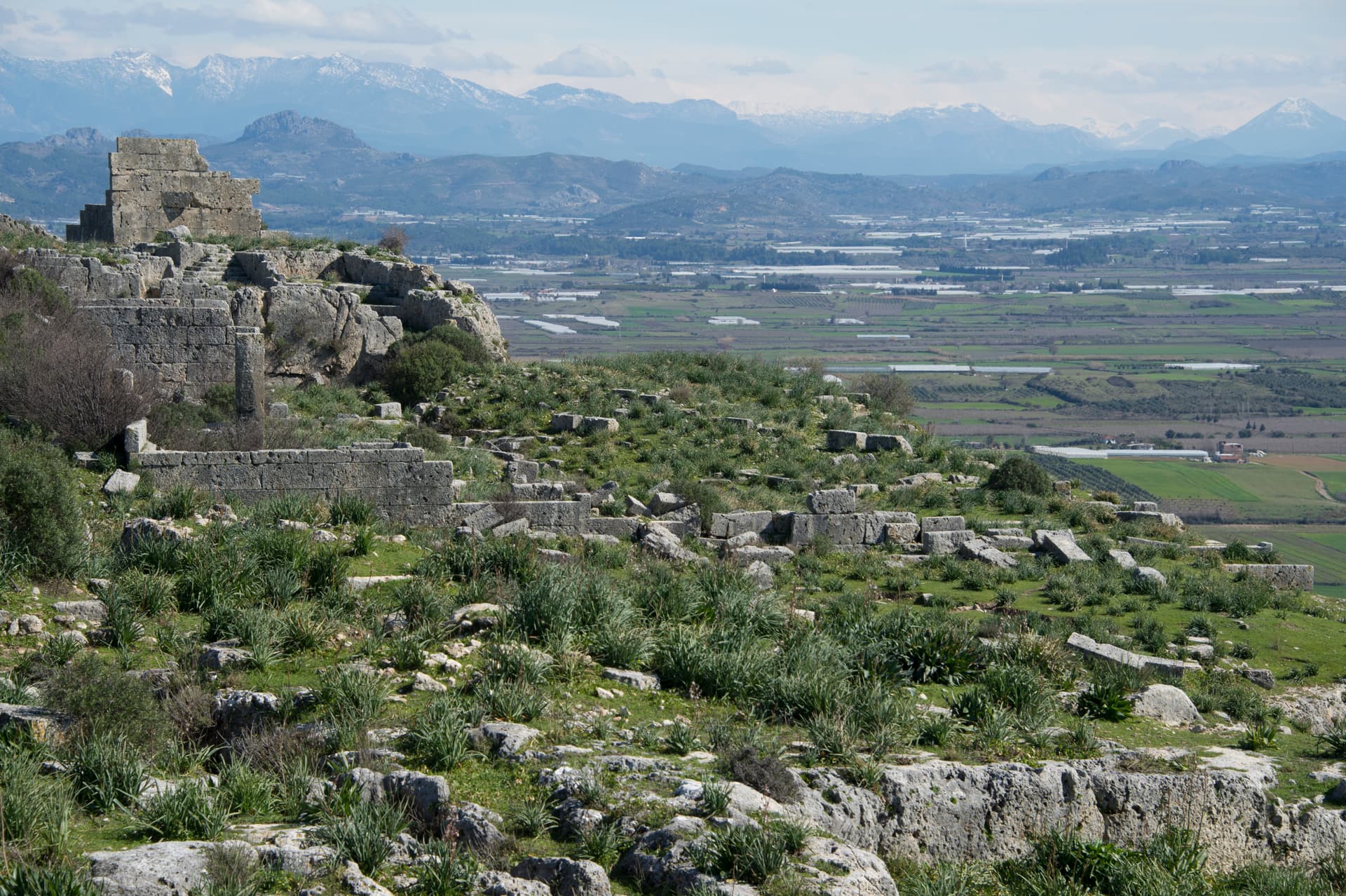
Selge occupies a mountain plateau reached only through narrow gorges and river canyons—the geology that now draws rafters to Köprülü Canyon. Several hundred metres below, the Köprüçay threads between peaks forming natural walls. For the Pisidians, geography was theology: unforceable approaches signaled divine protection.
Strabo records two founding traditions at the boundary of Pamphylian Greek and indigenous Anatolian worlds. One names Spartan colonists; the other Calchas, companion of legendary seer Mopsos, who co-founded Aspendos. Together they claimed both heroic Spartan-warrior and Trojan War prophetic-oracular prestige.
At its 3rd-century-BCE height Selge could field 20,000 soldiers, ranking among the Hellenistic Mediterranean's major military powers. Its coins circulated; a Zeus temple commanded the acropolis; stadium and theater sustained Greek civic competition. No formal excavation has opened the site. Its theater remains largely as left, with intact auditorium, mountain views, and unread stones.
Why this place is sacred
Selge's Zeus — identified in inscriptions as Zeus Keraünios (Zeus the Thunderer) or possibly a Pisidian sky deity who adopted the Greek name — was housed in an Ionic temple on the acropolis at the city's highest point. This positioning was not merely practical. In Pisidian and wider Anatolian mountain theology, the sky deity's temple belonged at the summit: the closer to the weather, the closer to the divine.
Selge's acropolis temple would have been visible from the gorge approaches miles below, its columns catching morning light before the rest of the plateau was illuminated.
The city's celebrated independence — its ability to resist Hellenistic, Roman, and later pressures — reinforced this sacred geography. A city that could not be taken was a city under divine protection. The very impossibility of its position made theological claims on behalf of its patron deity. Selge never needed to narrate its sacredness: the landscape made the argument for it.
The Byzantine church built within the ancient city marks the translation of this energy into Christian terms without fully dissolving it. Sacred sites often outlast their formal theologies, and Selge's mountain plateau continued to hold significance for Christian inhabitants long after the Zeus temple fell silent.
Mountain stronghold and sacred civic centre of the Pisidian people, with a Zeus temple on the acropolis representing the sky-deity whose presence was identical with the mountain's weather and altitude.
Pre-classical Pisidian settlement → classical Pisidian city (from 1st millennium BCE) → most powerful phase 3rd century BCE under Achaeus and against Pergamon → Roman period with retention of Pisidian cultural identity → Byzantine settlement with church construction → gradual decline and abandonment → ruins overlap with modern village of Altınkaya → currently unexcavated, accessible within Köprülü Canyon National Park
Experience and orientation
The road to Selge from the coast approaches through Köprülü Canyon, and this passage should not be hurried. The river gorge is several hundred metres deep in places, the road carved into canyon walls that close overhead, and the transition from coastal Pamphylian landscape to Pisidian highland is gradual and then sudden.
When the canyon opens onto the mountain plateau and the village of Altınkaya appears, you are inside the ancient city before you know it — houses and ancient walls share the same terraces.
The theater is the site's most legible monument. The cavea — the semicircular bank of seating — survives across many rows, the upper tiers open to the mountain backdrop. From the stage position, look outward: the view extends beyond the plateau edge into the canyon below. The scale of what the Selgians built here, in a mountain fortress accessible only by gorge road, communicates something about what Pisidia meant to itself.
The Zeus temple on the acropolis requires a short additional climb beyond the theater. The Ionic columns have fallen, but the platform dimensions survive and the position — highest point of the accessible ruins, with a view across the canyon system — provides the theological context the temple's plan implies. This is where the sky god lived in the city's theology.
The view from here on a clear morning, with cloud formations moving through the canyon below, makes that theology coherent.
The agora's stone pavement and cisterns are scattered through the plateau's eastern section. The stadium is large but its seating has collapsed into the hillside. The Byzantine church, built from reused ancient material, sits near the theater — a palimpsest of sacred reuse that is itself instructive.
Park at or near Altınkaya village and walk. The ruins are interspersed with the village's agricultural terraces and a few inhabited houses — the line between ancient and modern is intentionally unclear here. Treat the whole plateau as the site, because it is.
Context and lineage
Strabo preserves two founding traditions for Selge that reflect competing claims on cultural identity rather than historical fact. In the first, Lacedaemonian (Spartan) colonists established the city — grounding it in the heroic warrior tradition and the most celebrated polis of the Greek world.
In the second, Calchas, a companion of the seer Mopsos, was the founder — connecting Selge to the prophetic and oracular traditions associated with the Trojan War's aftermath and the seers who migrated through Anatolia following the war's end. Mopsos himself was credited with co-founding Aspendos on the coast below. Whether historical or mythological, these competing origins placed Selge in a web of prestige claims that spanned Greek heroic legend and Anatolian prophetic tradition.
Historically, Selge emerged as a significant power in the 1st millennium BCE and reached its apex in the 3rd century BCE. During the period of Hellenistic conflict, the Selgian leader Achaeus commanded Galatian mercenaries against Pergamon in alliance with the Seleucid king Antiochus III. The city maintained this independent political agency — fielding 20,000 soldiers according to ancient sources — while retaining cultural practices that marked it as Pisidian rather than Hellenistic Greek.
Pisidian foundation (1st millennium BCE, Strabo's two competing traditions) → most powerful Pisidian city 3rd century BCE → Roman period with cultural continuity → Byzantine settlement (church constructed from ancient material) → decline and abandonment, probable 7th century CE → modern village of Altınkaya overlapping ruins → currently within Köprülü Canyon National Park, unexcavated
Strabo
Geographer who recorded Selge's two founding traditions and estimated its military capacity at 20,000 soldiers; the primary ancient literary source for the city
Achaeus of Selge
Led Galatian mercenaries against Pergamon in alliance with Seleucid forces in the 3rd century BCE, demonstrating the city's independent political reach
Alexander the Great
Selge maintained its independence during Alexander's campaign through Anatolia; unlike Sagalassos (sacked) and unlike Termessos (siege attempted), Selge appears to have negotiated its continued autonomy
Traditions and practice
The Zeus temple on the acropolis was the religious focus of Selgian civic life. Public sacrifices, seasonal festivals, and the oracle consultations that were part of Greek religious practice took place here, with the mountain position lending the rites a natural drama of sky and weather. The stadium hosted athletic competitions — games that combined religious observance with civic display in the Hellenic pattern. The theater served public performance, both dramatic and political.
The site receives visitors primarily as part of Köprülü Canyon excursion packages combining white-water rafting with a stop at the ruins. No formal excavation program is currently active, though the site's significance is recognized. The village of Altınkaya continues to occupy the plateau, its residents farming terraces that ancient Selgians also cultivated.
Let the canyon approach slow you down. Stop before reaching Altınkaya, if the road permits, and look back down the gorge — you will be seeing the approach as the city's defenders saw potential attackers: a narrow, controllable throat. The city's confidence in its position is legible from that perspective.
At the theater, find the upper row and sit. The view from here encompasses the plateau, the canyon edge, and the mountain backdrop simultaneously. Notice how the auditorium opens toward the gorge rather than away from it: the natural landscape was not the backdrop but the stage.
Climb to the Zeus temple platform before descending. The acropolis position requires only a few extra minutes from the theater and contextualises the entire site — from here the city is readable as a composition of civic spaces arranged vertically from canyon floor to divine precinct summit.
Pisidian Religion / Zeus Worship
HistoricalAn Ionic Zeus temple on the acropolis formed the religious and symbolic apex of Selgian civic life. Zeus at Selge likely syncretized with an older Pisidian weather deity, continuing a mountain sky-god tradition whose roots precede the Greek overlay.
Temple rituals, sacrifices, and seasonal festivals at the acropolis Zeus temple; athletic games in the stadium; theatrical performances in the theater
Early Christianity / Byzantine
HistoricalA Byzantine church built from reused ancient material within the city marks the continued inhabitation of the plateau and the translation of its sacred significance into Christian terms.
Christian liturgy within a structure built from Selgian architectural spoils
Archaeological Heritage
ActiveSelge is one of the most significant unexcavated Pisidian cities. Its location within Köprülü Canyon National Park provides national-level protection. The theater's exceptional preservation makes it a priority for future systematic study.
Heritage tourism; sporadic surface survey work; national park conservation
Perspectives and open questions
Selge can be read as a Pisidian statement about the relationship between mountain landscape and divine power, as a case study in ancient Mediterranean independence, or as one of the most significant unexcavated archaeological sites in Turkey.
Scholarly perspective
Selge is regarded as the most powerful city in ancient Pisidia at its height, with ancient sources (Strabo, Polybius) giving it a military capacity of 20,000 soldiers. Its theater is among the best-preserved in Turkey, rivaling more famous examples despite receiving far less scholarly attention. The complete absence of formal excavation makes it both a significant gap in the archaeological record and, for the same reason, a site of exceptional future potential.
The two founding traditions recorded by Strabo (Spartan colony versus Mopsos-companion origin) reflect a well-documented pattern of Anatolian cities claiming Greek heroic ancestry to position themselves within Hellenistic cultural hierarchies.
Living and traditional perspectives
The Pisidians of Selge have no living descendants traceable today. Their language, material culture, and religious traditions are known through coins, inscriptions, architectural remains, and ancient literary references. What the sources preserve consistently is a people who understood mountain position as inseparable from sacred identity and who maintained cultural and political independence with unusual tenacity.
Alternative interpretations
The never-excavated Zeus temple on Selge's acropolis is one of the most literally intact pre-classical religious sites in Anatolia: not restored, not opened, not studied in detail, still in the position where it was built. For those engaged with the pre-Greek Anatolian sacred landscape, this represents something rare — a sky-god precinct whose theology has not been filtered through excavation interpretation.
Open questions
The interior of the Zeus temple and the full extent of the necropolis remain unknown. The city's exact founding date and whether the Spartan or Mopsos founding tradition contains historical memory are unresolved. The cause of 7th-century CE decline — earthquake, Arab raids, environmental disruption, or some combination — is uncertain.
Plan your visit
Access and arrival
From Antalya, drive east to Manavgat or Side, then north to Beşkonak, cross the Oluk Bridge over Köprüçay, and drive approximately 13 km up the mountain road to Altınkaya village. Private car or organised tour essential; no public transport. National park access; no separate ruins admission fee. No mobile signal at the site; the last reliable signal is typically in Beşkonak town. For emergencies, the nearest settlement with reliable access is Beşkonak.
No accommodation at the site. Manavgat (south, ~45 km) and Side (nearby) offer full tourist infrastructure. Organised day tours from Antalya, Side, or Alanya typically combine Selge with Köprülü Canyon rafting.
Respectful visit
No religious dress code. Practical clothing for mountain and archaeological terrain; sturdy shoes for the uneven stone surfaces.
Permitted freely within the archaeological areas. When photographing within or near the village, exercise normal courtesy toward residents.
Not applicable.
Do not disturb stones, remove artifacts, or enter private agricultural areas. The village and ruins overlap; be attentive to the boundary between ancient structure and current use.
The mountain road from the coast is narrow and requires a robust vehicle; some sections may require care in wet weather. No admission fee is charged, and no formal facilities exist at the ruins. The village is inhabited; treat residents with the ordinary courtesy you would extend to anyone living in their own home.
Location
Map loads as you approach this section.
Pilgrim reflections
A portrait of encounter, not a score
Pilgrims describe what they felt, how present they could become, and whether the place would shape a journey. There are no stars and no ranking of traditions.
No reviewed reflections yet
The first pilgrims can help describe the character of being here.
Share a reflection
Available after an account-backed “Been there.” Every reflection is reviewed before publication.
Nearby sacred places
Explore other sacred places in the region. Proximity does not establish access or travel time; check each place’s guidance.



References
Sources consulted for this page. Source categories describe the publication, not a guarantee that every claim is verified. Traditional accounts and outside interpretations may differ.
- 01Selge Theatre — The Ancient Theatre Archive — Ancient Theatre ArchiveacademicDetailed documentation of the theater structure
- 02Selge, Turkey — World Archaeology — World ArchaeologyacademicDetailed scholarly overview of history and archaeological remains
- 03Selge — Turkish Archaeological News — Turkish Archaeological NewsguideUp-to-date archaeological news and site description
- 04Selge Ancient City — ArticHaeology — ArticHaeologyguideGeneral historical overview
- 05Selge Ancient City — Antalya Guide — Antalya.tcguidePractical visitor information and historical context
- 06Köprülü Canyon National Park — Visitor Guide — ExcursionSideguideAccess and visitor practical information
- 07Selge — Archiqoo — ArchiqooguideSite description and structural overview
Share a photo
Help visitors recognize Selge. Every submission is reviewed before publication.