Basilica of Our Lady of Guadalupe
Where the Virgin appeared to Juan Diego, and twenty million pilgrims still seek her gaze
Understand sacred places, explore living traditions, and learn how to engage respectfully with Pilgrim Map.
Access has not been verified. Check current local guidance before planning a visit.
Mexico City, Mexico City, Mexico
Read the sources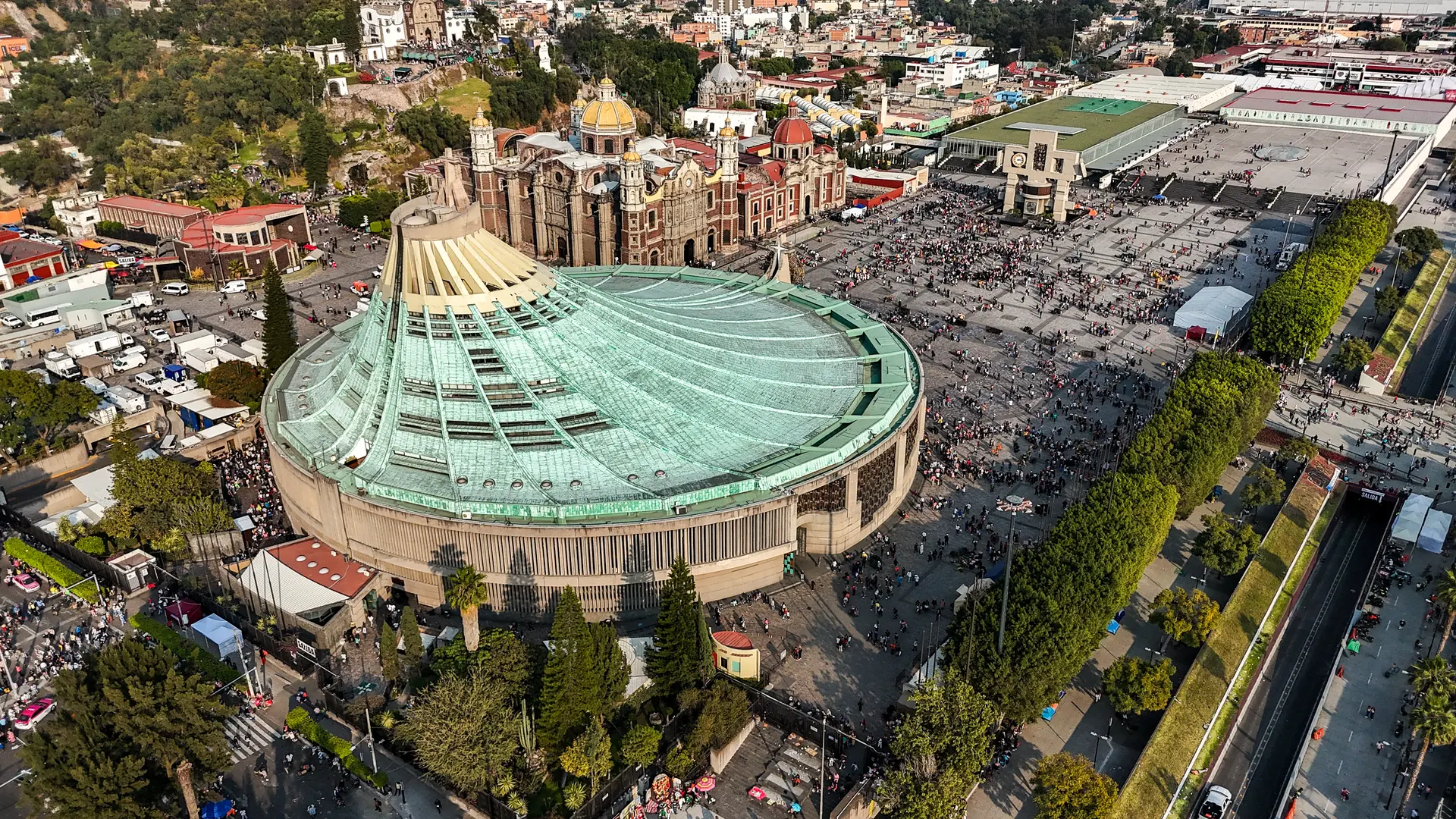
Featured in this guide
Sacred Sites for Life’s Hopes and Goals
The hopes, beliefs and practices behind 50 places of pilgrimage
Featured in this guide
100 Sacred Sites of Healing and Pilgrimage
100 places of healing devotion, sacred water, and ancient sanctuary traditions
Featured in this guide
Marian and Christic Apparitions
Catholic-recognised and disputed sites where Mary is said to have appeared
Visit essentials
A quick read before you go
- Duration
- A basic visit requires two to four hours to see the New Basilica, pass the tilma, climb Tepeyac…
- Access
- The Basilica is easily reached by Mexico City's metro system.
Overview
Before dawn on December 12, millions sing Las Mananitas, the Virgin's birthday serenade, after walking for days or travelling from distant countries. The world's largest annual pilgrimage culminates here, expressing a devotion active every day.
The Basilica of Our Lady of Guadalupe stands where the Virgin Mary appeared in December 1531 to Juan Diego Cuauhtlatoatzin, a recently converted Aztec peasant, speaking his Nahuatl language. She bore the dark skin of the mestiza, the mixed-race children who would become a new people.
When the bishop required proof, roses bloomed on the winter hillside; Juan Diego opened his cloak to reveal her image imprinted on rough cactus fibre, its colors enduring nearly five hundred years though expected to fade within decades.
Mexican and Latin American Catholics call her Morenita—the little dark one—an intimate mother who appeared to a poor Indigenous man rather than kings or priests, affirming a conquered people's dignity. Pilgrims arrive on their knees, fulfill vows made in illness or desperation, weep before the tilma, and leave transformed. Even skeptics describe five centuries of concentrated devotion as palpable.
Sites inside
Why this place is sacred
Tepeyac Hill was sacred before the Virgin arrived. The Aztecs made pilgrimage here to honor Tonantzin, 'Our Revered Mother,' an earth and fertility goddess whose shrine stood on this hillside overlooking the lake that surrounded Tenochtitlan. When Spanish friars destroyed the indigenous temples, they built a chapel on the ruins—a common colonial strategy of replacement. But what happened next was not replacement.
In December 1531, barely a decade after the conquest, the Virgin Mary appeared to Juan Diego not as the European Madonna but as a woman who looked like his own people, who spoke his language, who stood before the sun and moon like the goddess imagery his ancestors would have recognized. She requested a chapel on the very hill where Tonantzin had been venerated.
Whether one understands this as divine sanctification of indigenous sacred space or as syncretism that allowed old devotion to continue in new form, the effect was unprecedented: within seven years, an estimated nine million indigenous people accepted baptism.
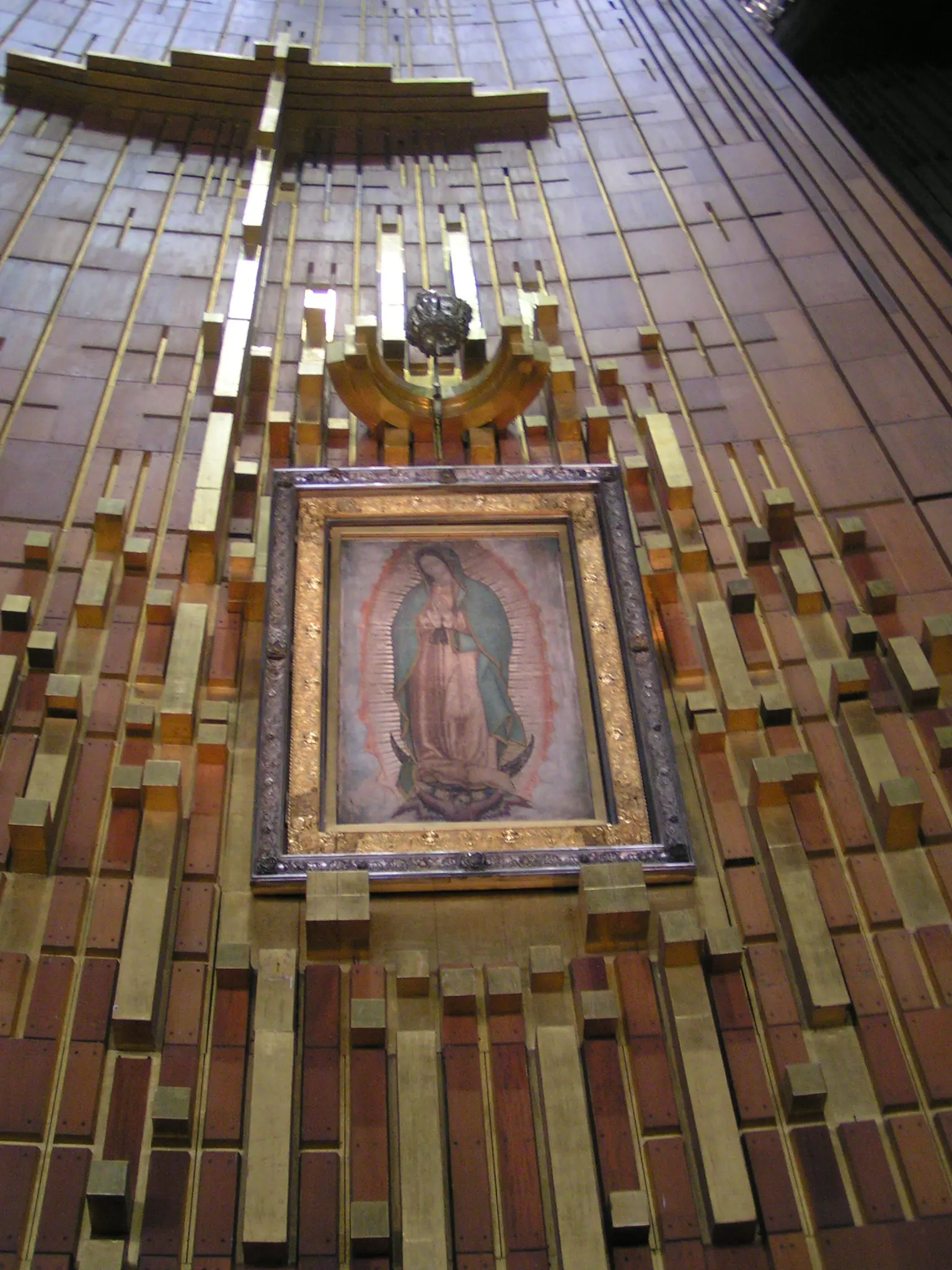
The tilma itself defies easy explanation. Cactus fiber of this type typically disintegrates within twenty to sixty years. This one has survived nearly five centuries, surviving a nitric acid spill in 1785 and a bomb explosion in 1921 that destroyed a nearby crucifix while leaving the image unharmed. Some scientific analyses report no brush strokes or underdrawing; others claim to have found reflected images in the Virgin's eyes visible only under extreme magnification. Skeptics dispute these findings.
What remains undisputed is that millions of people have stood before this image and experienced something that altered their lives.
Pilgrimage creates its own sacredness. Nearly five hundred years of continuous devotion—the prayers, the tears, the vows fulfilled, the miracles attributed—have accumulated here like sediment. Each pilgrim who arrives on their knees adds to this weight. Whatever one believes about the events of 1531, the reality of this accumulated intention is undeniable.
The Virgin's request, according to the traditional account, was simple: she wanted a chapel built on Tepeyac Hill where she could show her love and compassion, hear the prayers of her people, and offer them protection. The shrine that grew from this request was never meant as monument or museum but as a place of encounter—a location where the divine remained accessible to anyone who sought it.
The first chapel, built immediately after the apparitions, was soon replaced by larger structures as pilgrims multiplied. The Old Basilica, an elegant baroque church completed in 1709, served for over two centuries before subsidence from the drained lakebed began to make it structurally unsound. In 1976, the New Basilica opened—a striking circular structure designed by Pedro Ramirez Vazquez that can hold ten thousand worshippers with sight lines ensuring everyone can see the tilma.
The site has grown into an entire complex. The Old Basilica, now stabilized, hosts smaller services. Chapels mark the sites of each apparition on Tepeyac Hill, reached by stairs and escalators. The Capilla del Pocito, a jewel of baroque architecture, stands over a spring once believed miraculous. A carillon of forty-eight bells rings melodies across the plaza. What began as a peasant's vision has become the spiritual heart of an entire continent.
Why pilgrims come
Consolation and personal needs
Pilgrims approach Mary as a mother and intercessor within Catholic devotion. The basilica describes petition, gratitude, consolation and the strengthening of faith as reasons people come.
How devotees visit
Visitors bring intentions in prayer, join worship and give thanks. The basilica receives written petitions as another way to express concerns for oneself or others.
These are religious traditions and devotional practices, not promises of an outcome. Follow the community’s current guidance.
Healing traditions
Guadalupan healing narrative
The basilica's account tells how Juan Diego was seeking a priest for his gravely ill uncle, Juan Bernardino, during the apparitions of December 1531. Mary reassured Juan Diego, and his uncle later said that she had appeared to him too and restored his health. The healing is part of the wider Guadalupan narrative; it took place where Juan Bernardino was ill, not inside the later basilica.
Ways to participate
Offer a prayer for someone who is ill while viewing the image, then find a place where you can remain quietly without stopping the flow of visitors. The basilica provides prayers and public liturgies for pilgrims. Bringing the intention of a relative or caregiver connects naturally with the story of Juan Diego's concern for his uncle.
These accounts describe religious traditions and reported experiences. They do not promise a cure or replace medical care.
Experience and orientation
The first encounter with the tilma often produces unexpected responses. Visitors find themselves weeping without warning. They had planned to observe, to photograph, to check a famous site off their list—and instead they are undone. The experience is so consistent that regular visitors recognize the expression: the moment when a tourist becomes a pilgrim.
The moving walkway beneath the main altar carries visitors past the image at a steady pace, preventing the crowds from stopping but also preventing prolonged gazing. This limitation creates its own effect: the encounter is brief, intense, and often leaves people wanting to return. Many ride the walkway multiple times, each pass revealing something new in the Virgin's downcast eyes, her posture of prayer, the rays of light surrounding her.
What pilgrims describe is not merely aesthetic appreciation. They speak of feeling seen, of sensing a presence that knows their suffering, of leaving burdens at her feet that they had carried for years. The language varies—Catholics speak of the Blessed Mother; others simply describe a maternal comfort that seemed to emanate from the image itself. Skeptics who came to analyze often leave uncertain, unable to explain why they felt what they felt.
The collective experience amplifies during the December 12 celebrations. Millions of pilgrims fill the plaza and surrounding streets. Many have walked for days, some for weeks, arriving from distant states or countries. When the clock strikes midnight on December 11 and Las Mananitas begins—the traditional birthday serenade sung by famous musicians and millions of ordinary voices—something shifts. Individual seekers become part of a continental devotion that has continued unbroken for nearly half a millennium. The effect is not easily described.
Those who have experienced it often speak of it as one of the most significant moments of their lives.
Approach the Basilica with whatever you carry. Pilgrims come with prayers for healing, gratitude for answered petitions, or simply a longing for something they cannot name. You need not be Catholic, need not believe the apparition story, need not have any spiritual framework at all. The site does not require your belief; it only requires your presence.
Consider what you might ask of the Morenita if you allowed yourself to ask for anything. Consider what you might release if you had a place to leave it. Many who come here find that the question matters more than the answer—that simply standing before the image with genuine openness creates space for something to shift.
Watch the other pilgrims. The grandmother on her knees crossing the plaza. The teenager crying softly after passing the tilma. The indigenous dancers whose offerings take the form of movement. Their devotion is not performance; it is the living tradition that has sustained this place for centuries. Let their sincerity inform your visit, even if you cannot share their certainty.
Context and lineage
The traditional account, recorded in the Nican Mopohua written in Nahuatl around 1556, tells of four encounters over four days. On December 9, 1531, Juan Diego Cuauhtlatoatzin, a widowed peasant in his fifties, was walking to Mass when he heard birdsong of unusual beauty coming from Tepeyac Hill. At the summit he encountered a young woman surrounded by golden light who spoke to him in Nahuatl.
She identified herself as the Virgin Mary, mother of the very true deity, and asked him to tell the bishop to build a chapel on this hill where she could offer her love and protection to all who sought her.
Bishop Juan de Zumarraga was skeptical. Juan Diego was a poor convert of no standing; such claims required proof. Over subsequent days, the Virgin appeared again, instructing Juan Diego to persist. When he tried to avoid her to care for his dying uncle, she met him on the road and healed the uncle from a distance. Finally, she told him to climb the hill and gather flowers.
It was December. The hillside was barren. Yet Juan Diego found Castilian roses—not native to Mexico—blooming in abundance. He gathered them in his tilma, his rough cactus-fiber cloak, and carried them to the bishop. When he released the cloak's corners and the roses cascaded to the floor, both men saw what had appeared on the fabric: the Virgin's image, painted by no human hand, in colors that would not fade for five centuries.
The devotion that began with a peasant's vision became central to Mexican identity. The Virgin of Guadalupe's image accompanied Father Hidalgo's army in the 1810 independence movement. She appears on flags, in homes, tattooed on skin. Her feast day is a national holiday. When Pope John Paul II canonized Juan Diego in 2002, twelve million people gathered for the ceremony.
Four popes have visited this site. The Vatican has elevated the New Basilica to the status of Minor Basilica and designated it a place of special pilgrimage. But the lineage that matters most is simpler: generation after generation of families who have come here to pray, who have taught their children the story, who have fulfilled vows their grandparents made.
The scholarly debates and ecclesial recognitions matter less than this continuous transmission of devotion from parent to child across five centuries.
Our Lady of Guadalupe
apparition
The Virgin Mary as she appeared to Juan Diego: a mestiza woman with dark skin, hands joined in prayer, surrounded by golden rays, standing on a crescent moon, wearing a star-covered mantle. She is the Patroness of Mexico, the Americas, and the unborn.
Saint Juan Diego Cuauhtlatoatzin
saint
The indigenous peasant to whom the Virgin appeared. Canonized by Pope John Paul II in 2002, he is the first indigenous American saint. His tilma bearing the miraculous image has been preserved for nearly five centuries.
Bishop Juan de Zumarraga
historical
The first bishop of Mexico City, a Franciscan friar who initially doubted Juan Diego's account but accepted the miraculous sign of the image. He ordered the first chapel built at Tepeyac.
Tonantzin
deity
The Aztec mother goddess worshipped at Tepeyac Hill before the conquest. Some Nahuatl-speaking communities still refer to the Virgin as 'Tonantzin Guadalupe,' reflecting the continuity some perceive between the devotions.
Traditions and practice
The traditional practices at Guadalupe emerge from nearly five centuries of devotion. Holy Mass is celebrated hourly throughout the day, with the Eucharist at the center of Catholic worship. Pilgrims recite the rosary, the repetitive prayer that creates a meditative rhythm. Novenas—nine days of focused prayer—prepare for major feast days. The faithful light candles, leave flowers (especially roses, echoing the miracle), and bring photos or petitions to leave at the shrine.
The Matachines are the 'soldiers of the Virgin,' dance groups in vivid costumes with feathered headdresses who perform throughout the December celebrations and whenever pilgrim groups arrive throughout the year. Their dance is prayer in motion, an offering that requires days of training and physical sacrifice.
The Concheros, identifiable by their enormous plumed headdresses and the concha (armadillo-shell instruments) they play, represent an even more explicit fusion of pre-Hispanic and Catholic tradition, their dances preserving Aztec elements within the framework of Marian devotion.
The practice of mandas—vows made to the Virgin in moments of crisis, promising pilgrimage in exchange for her intercession—structures much of the devotion. Pilgrims who arrive on their knees, crossing the plaza in painful progress, are fulfilling such vows. The suffering is not masochism but offering, a physical inscription of gratitude for prayers answered.
Contemporary pilgrims engage with the Basilica in varied ways. Some arrive for a quick prayer during a lunch break; others undertake multi-day walking pilgrimages from distant states. The moving walkway beneath the tilma allows efficient passage for the constant flow of visitors, while side chapels offer spaces for quieter prayer. Confession is available throughout the day. Religious objects can be blessed.
The December 12 celebration remains the pinnacle of the liturgical year. The night of December 11 builds toward Las Mananitas at midnight. Famous musicians broadcast nationwide. Torch-lit processions wind through the streets. The Matachines and Concheros dance without ceasing. By morning, millions have gathered for the principal Mass. The celebration continues throughout December 12, with special services, traditional foods, and the continued arrival of pilgrims who make this journey annually.
If you visit outside major celebrations, attend Mass if you are Catholic, or sit quietly during a service if you are not. The liturgy provides a framework for encounter that has developed over two millennia. You need not understand Latin or follow every gesture; you can simply be present.
Ride the moving walkway past the tilma more than once. The first pass often produces only a rush of impressions. On the second or third, you may notice details: her eyes, her posture, the way she seems to be listening. Let yourself look at her as if she were looking at you.
Climb Tepeyac Hill to visit the chapels marking the apparition sites. The Capilla del Cerrito at the summit stands where Juan Diego gathered roses. The climb itself is a small pilgrimage, a physical engagement that creates space for reflection.
Watch the pilgrims. The devotion of others, when sincere, can open something in observers. Do not photograph their suffering or their tears without permission; but do let their example inform your understanding of what this place means to those who come seeking.
Roman Catholicism
ActiveThe Basilica of Our Lady of Guadalupe is the most important Marian shrine in the Americas and the world's most-visited Catholic pilgrimage site. It enshrines the miraculous image of the Virgin that appeared on Juan Diego's tilma in 1531. Our Lady of Guadalupe is the Patroness of Mexico, the Americas, and the unborn. For nearly five centuries, Catholics have come here to venerate her image, fulfill vows, and seek her intercession. The devotion represents a unique synthesis of Spanish Catholicism and indigenous Mexican spirituality, creating a form of Marian devotion that speaks with particular power to mestizo identity.
Daily Holy Mass is celebrated hourly throughout the day. The faithful venerate the tilma, pray the rosary, and participate in novenas and special devotions throughout the liturgical year. The Feast of Our Lady of Guadalupe on December 12 draws millions of pilgrims for Las Mananitas, torch-lit processions, and traditional dances. Pilgrims fulfill mandas, approaching the basilica on their knees in gratitude for answered prayers. Religious objects are blessed. Confession is available throughout the day.
Pre-Hispanic/Aztec (Historical)
HistoricalTepeyac Hill was sacred ground before the Spanish conquest. The Aztec people made pilgrimage here to venerate Tonantzin, 'Our Revered Mother,' an earth and fertility goddess. The site's pre-existing sacredness contributed to the powerful religious synthesis that emerged after the apparitions. Some scholars understand the Guadalupan devotion as incorporating elements of Tonantzin worship; others see the Virgin's appearance at this sacred site as divine sanctification of indigenous sacred space within a Christian framework.
Historical practices at Tepeyac included pilgrimage and offerings to Tonantzin as mother goddess. These practices ceased with Spanish colonization and the destruction of the temple. What remains is the memory of this older layer of sacredness and, in some Nahuatl-speaking communities, the continued use of 'Tonantzin' as a name for the Virgin.
Perspectives and open questions
The Basilica of Our Lady of Guadalupe invites multiple interpretations that need not resolve into a single narrative. Catholic devotion, historical analysis, indigenous perspectives on syncretism, and questions that remain genuinely open all contribute to understanding a site that has shaped millions of lives and the identity of an entire nation.
Scholarly perspective
Historians recognize the Guadalupan apparitions as one of the most consequential religious events in the history of the Americas. Whatever one's position on their supernatural nature, the social and cultural effects are documented: the mass conversion of indigenous peoples to Christianity, the development of a distinctly Mexican form of Catholicism, and the emergence of a symbol that would become central to Mexican national identity.
Scholars debate the degree of syncretism between Guadalupan devotion and pre-Hispanic veneration of Tonantzin. Some see deep continuity, arguing that indigenous converts understood the Virgin as a Christian form of the mother goddess they had always worshipped. Others emphasize the distinctly Christian nature of the devotion, noting that the Nican Mopohua presents the Virgin in thoroughly orthodox terms. The historical evidence supports elements of both views—suggesting that different communities and different individuals related to the Virgin in different ways.
The tilma itself has been subject to various scientific analyses. Some researchers report anomalies—the absence of brush strokes, the preservation of fibers that should have disintegrated, reflected images in the eyes visible under magnification. Other scientists dispute these findings or offer conventional explanations. No definitive scientific consensus exists on what the tilma is or how the image was produced.
Living and traditional perspectives
Within Catholic teaching, the apparition at Guadalupe is recognized as an authentic Marian apparition. The Church has elevated the site to special pilgrimage status, canonized Juan Diego, and designated Our Lady of Guadalupe as Patroness of the Americas. For the faithful, the tilma is a miraculous image—not made by human hands—that provides continuing access to the Virgin's presence and intercession.
For Mexican and Latin American Catholics especially, the Virgin of Guadalupe is not merely a doctrine to be affirmed but a relationship to be lived. She is the Morenita who chose to appear as one of them, who speaks their language, who understands their struggles. The millions who come each year do not come to examine an artifact; they come to encounter their mother.
Alternative interpretations
Some New Age and esoteric interpretations understand the Virgin of Guadalupe as a manifestation of the 'Divine Feminine' that transcends any single religious tradition. The imagery—sun, moon, stars, standing upon the serpent—is interpreted through various mystical and astrological frameworks. Some connect the site to earth energies or ley lines.
Indigenous perspectives vary. Some Nahuatl-speaking communities continue to call her 'Tonantzin Guadalupe,' maintaining a continuity they understand as authentic to their experience. Others see the Virgin as a colonial imposition that replaced their ancestors' traditions. Still others hold both perspectives simultaneously, honoring the complexity of five centuries of religious history.
Open questions
Genuine mysteries remain around the Guadalupan apparitions. The tilma's preservation defies easy explanation—cactus fiber of this type does not typically survive five centuries. The image's resistance to damage, including the 1921 bombing that destroyed a nearby crucifix while leaving the tilma unharmed, invites questions. The reported anomalies in the weave, the pigments, and the reflected images in the eyes remain subjects of dispute rather than resolution.
What accounts for the consistency of experience reported by visitors across centuries and across belief systems? Why do skeptics who came to debunk often leave uncertain? These questions may point to something beyond current explanation—or to psychological and social dynamics we do not yet fully understand. The honest position acknowledges the mystery without pretending to resolve it.
Plan your visit
Access and arrival
The Basilica is easily reached by Mexico City's metro system. La Villa-Basilica station on Line 6 (red line) exits directly into the area. Deportivo 18 de Marzo station on Line 3 (olive green line) is an alternative. Multiple bus routes serve the neighborhood. If driving, parking is available but limited, especially on weekends and during celebrations; ride-sharing services are recommended.
The Villa de Guadalupe neighborhood offers hotels at various price points within walking distance of the basilica. For December 12, these fill months in advance. The wider Mexico City area provides extensive accommodation options accessible by metro. Some pilgrimage groups organize transportation and lodging as package arrangements through Catholic travel organizations.
Respectful visit
Dress modestly, as appropriate for a Catholic church. Shoulders and knees should be covered. No shorts, sleeveless shirts, or revealing clothing. This is not strictly enforced, but respectful dress honors the sacred nature of the site and aligns you with the pilgrims for whom this visit carries profound significance.
Photography is permitted throughout most of the basilica complex. On the moving walkway, you have only seconds to photograph the tilma—accept this limitation rather than blocking other visitors. Flash should not be used during Mass or in proximity to the tilma. The Matachines and Concheros may be photographed from a respectful distance during public performances. Individual pilgrims in prayer or performing mandas should not be photographed without permission.
Candles and flowers, especially roses, are traditional offerings. Monetary offerings support the basilica's operations. Pilgrims often bring photographs of loved ones, written petitions, or objects to be blessed. These offerings are sincere expressions of devotion, not transactions; approach them in that spirit.
No food or drink inside the basilica. Hats should be removed by men inside the church. Pets are not permitted. During December 12 celebrations, crowd management measures may limit access to certain areas. Large bags must be stored at facilities near the entrance.
Be aware that during major celebrations, especially December 12, crowds become immense—millions of people in a confined space. This requires advance planning, patience, and acceptance that your experience will be shaped by the collective rather than individual contemplation. Medical services are available but easily overwhelmed.
Do not photograph pilgrims performing mandas (crossing the plaza on their knees) without their permission. Their suffering is sacred to them, not content for social media. Exercise similar discretion with the Matachines and Concheros unless photographing from a respectful distance.
If you are not Catholic, approach the site with genuine respect rather than anthropological detachment. You are welcome here, but you are entering one of the holiest sites of a living tradition. Your skepticism may be valid; expressing it within the basilica is not.
Current practical details
Address
Fray Juan de Zumárraga No. 2, Villa Gustavo A. Madero, Gustavo A. Madero, 07050 Ciudad de México, CDMX, Mexico
Phone
Hours, fees, and access can change — verify on the official source before you travel. Practical details last checked Jun 2026.
Location
Map loads as you approach this section.
Pilgrim reflections
A portrait of encounter, not a score
Pilgrims describe what they felt, how present they could become, and whether the place would shape a journey. There are no stars and no ranking of traditions.
No reviewed reflections yet
The first pilgrims can help describe the character of being here.
Share a reflection
Available after an account-backed “Been there.” Every reflection is reviewed before publication.
Dates and observances
Upcoming festivals, feast days, and pilgrimages connected to this place. Add any to your calendar, or browse the full observance calendar.
- Add to calendar
Feast of Our Lady of Guadalupe
Dec 12 – Sun, Dec 13, 2026Pilgrimage
One of the world's largest religious pilgrimages, drawing an estimated 10-12 million people around Dec 12. Festivities begin the night before with an all-night vigil, Las Mananitas at midnight, indigenous dances, and torch-running pilgrims.
- Add to calendar
Feast of Our Lady of Guadalupe
Dec 12 – Mon, Dec 13, 2027Pilgrimage
One of the world's largest religious pilgrimages, drawing an estimated 10-12 million people around Dec 12. Festivities begin the night before with an all-night vigil, Las Mananitas at midnight, indigenous dances, and torch-running pilgrims.
Nearby sacred places
Explore other sacred places in the region. Proximity does not establish access or travel time; check each place’s guidance.
Our Lady of Guadalupe, Mexico
Mexico City, Mexico City, Mexico
0.0 km away
Tlatelolco Archaeological Zone
Mexico City, Mexico City, Mexico
4.2 km away
Templo Mayor Archaeological Zone and Museum
Mexico City, Mexico City, Mexico
5.8 km away
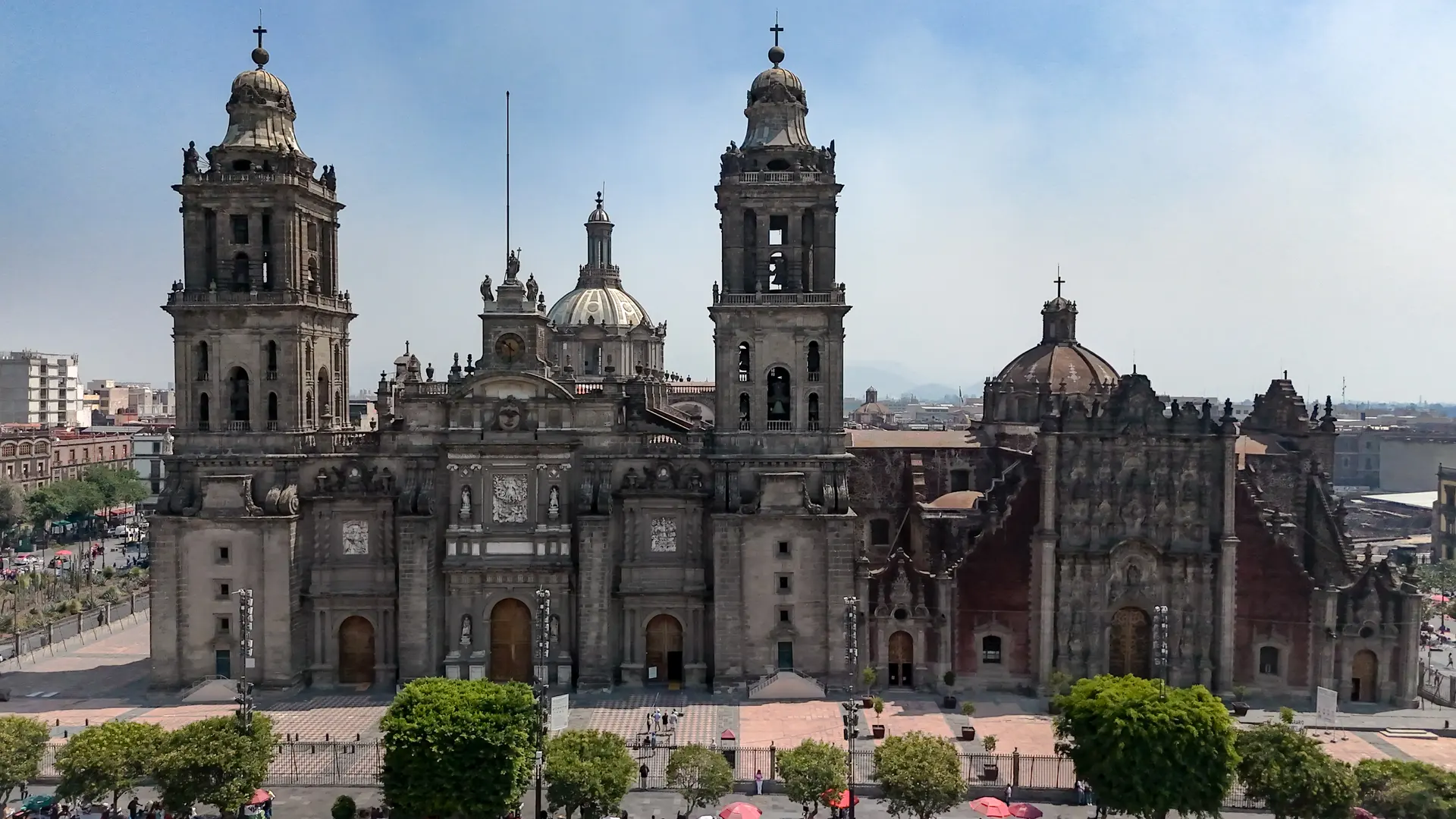
Mexico City Metropolitan Cathedral
Mexico City, Mexico City, Mexico
5.8 km away
References
Sources consulted for this page. Source categories describe the publication, not a guarantee that every claim is verified. Traditional accounts and outside interpretations may differ.
- 01Basilica of Guadalupe | Church, Virgin Mary, Pilgrimage — Encyclopaedia BritannicaacademicAuthoritative encyclopedia entry
- 02Inside the world's biggest pilgrimage for the Virgin Mary — National GeographicguidePhoto essay on the pilgrimage
- 03The story of Our Lady of Guadalupe — Vatican NewsofficialOfficial Vatican coverage of the feast day
- 04New Basilica of Guadalupe - Mexico City — Mexico City GovernmentofficialOfficial city government information
- 05Basilica of Our Lady of Guadalupe - Wikipedia — Wikipedia contributorsacademicComprehensive article on basilica history, architecture, and significance
- 06Our Lady of Guadalupe - Wikipedia — Wikipedia contributorsacademicDetailed information on the apparition, image, and devotion
- 07The place where image of Our Lady of Guadalupe appeared on Juan Diego's cloak — Catholic News AgencyspiritualDetailed account of the apparition site
- 08Historic 12.5 million pilgrims visit Our Lady of Guadalupe Shrine in Mexico — Catholic News AgencyspiritualRecent pilgrimage statistics
- 09St. Juan Diego and the Miracle of Our Lady of Guadalupe — National Shrine of the Immaculate ConceptionspiritualAccount of Juan Diego and the miracle
- 10Where is the tilma of Our Lady of Guadalupe? — EWTNspiritualInformation on the tilma's location and display
- 11Basílica de Nuestra Señora de Guadalupe and Tepeyac Hill — HistoricalMXacademicHistorical context and pre-Hispanic connections
- 12The Science (Or Lack Thereof) Behind Juan Diego's Tilma — Magis CenteracademicBalanced analysis of scientific claims about the tilma
- 13Our Lady of Guadalupe 'completely beyond' scientific explanation, says researcher — Catholic News AgencyspiritualDr. Adolfo Orozco's research on the tilma
- 14Tonantzin - Wikipedia — Wikipedia contributorsacademicPre-Hispanic goddess worshipped at Tepeyac
- 15The Virgin of Guadalupe and Tonantzin — MexicoloreacademicAnalysis of religious syncretism
- 16Matachines. The Dancers of the Virgin of Guadalupe — OmnesspiritualTraditional dance practices at the basilica
- 17Concheros dance in devotion to Our Lady of Guadalupe — Catholics & CulturesacademicAcademic analysis of Concheros dancers
- 18Guadalupe pilgrims flood Mexico City as U.S. parishes join hemisphere-wide celebration — National Catholic ReporterspiritualCoverage of 2025 celebration
- 19Saint Juan Diego — Basilica of GuadalupeofficialSupports the attributed account or visitor practice in the healing section; not evidence of clinical efficacy.
- 20Prayers — Basilica of GuadalupeofficialSupports the attributed account or visitor practice in the healing section; not evidence of clinical efficacy.
Share a photo
Help visitors recognize Basilica of Our Lady of Guadalupe. Every submission is reviewed before publication.