Sacro Monte di Oropa
The largest Marian shrine in the Alps, built around a Black Madonna
Understand sacred places, explore living traditions, and learn how to engage respectfully with Pilgrim Map.
Access has not been verified. Check current local guidance before planning a visit.
Biella, Biella, Italy
Read the sources
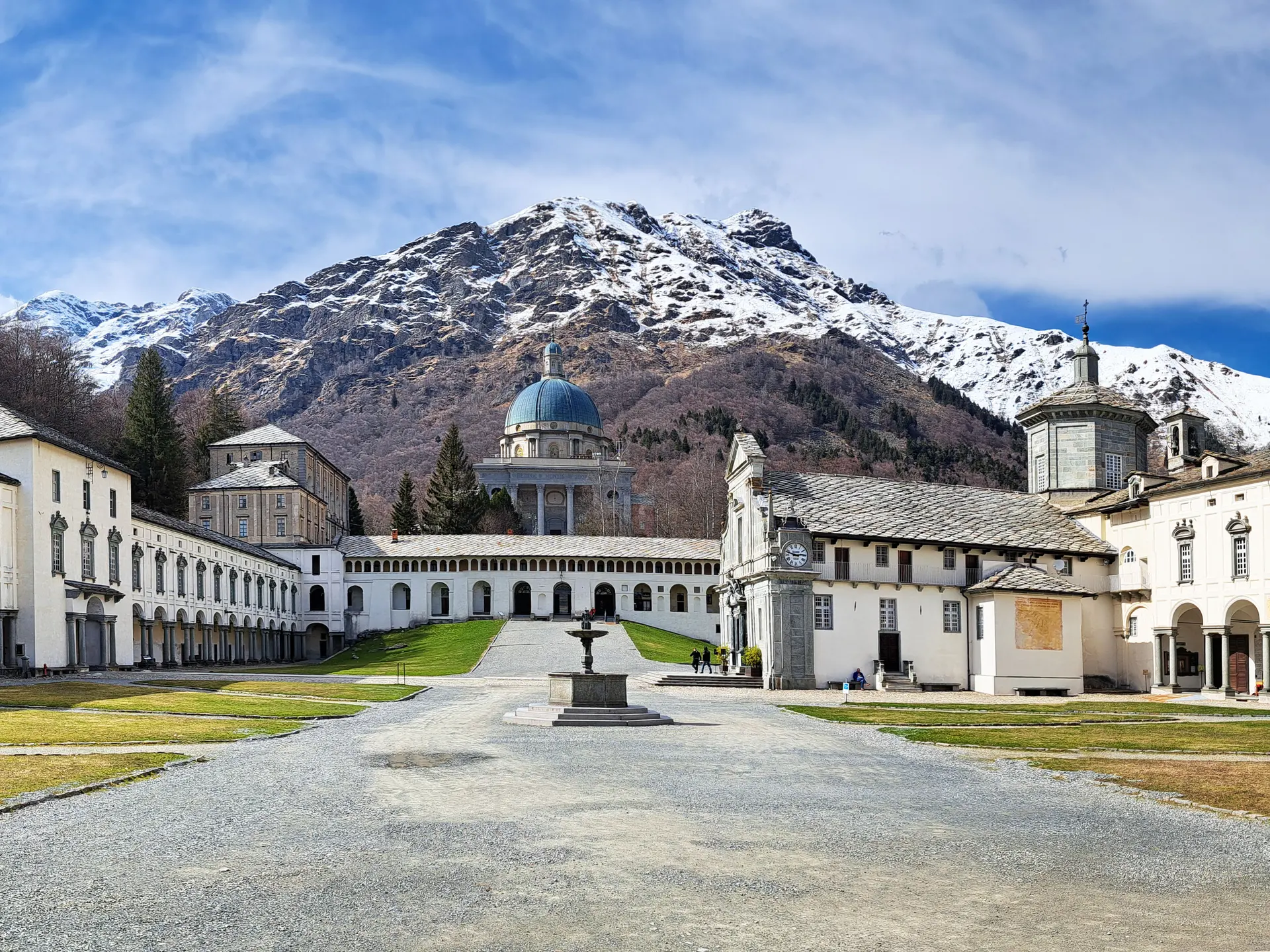
Image of Sacro Monte di Oropa. Image source
Visit essentials
A quick read before you go
- Duration
- A visit to the basilicas alone takes one to two hours; walking the full Sacro Monte chapel path…
- Access
- Oropa is reached by road from Biella, about 13-15 kilometers away, with parking near the…
Overview
Oropa makes a large claim in mountain stone. The Upper Basilica took seventy-five years to build and was finished only in 1960, above an older sanctuary that drew pilgrims long before its Baroque devotional path.
The Sacro Monte climbs through twelve chapels begun in 1617 under Capuchin friar Fedele da San Germano, with later work by Savoyard architects including Filippo Juvarra and Guarini. The Crowning of Mary chapel alone holds 156 modeled figures. Like the other Sacri Monti, the path offered pilgrims unable to reach the Holy Land a comparable journey near home.
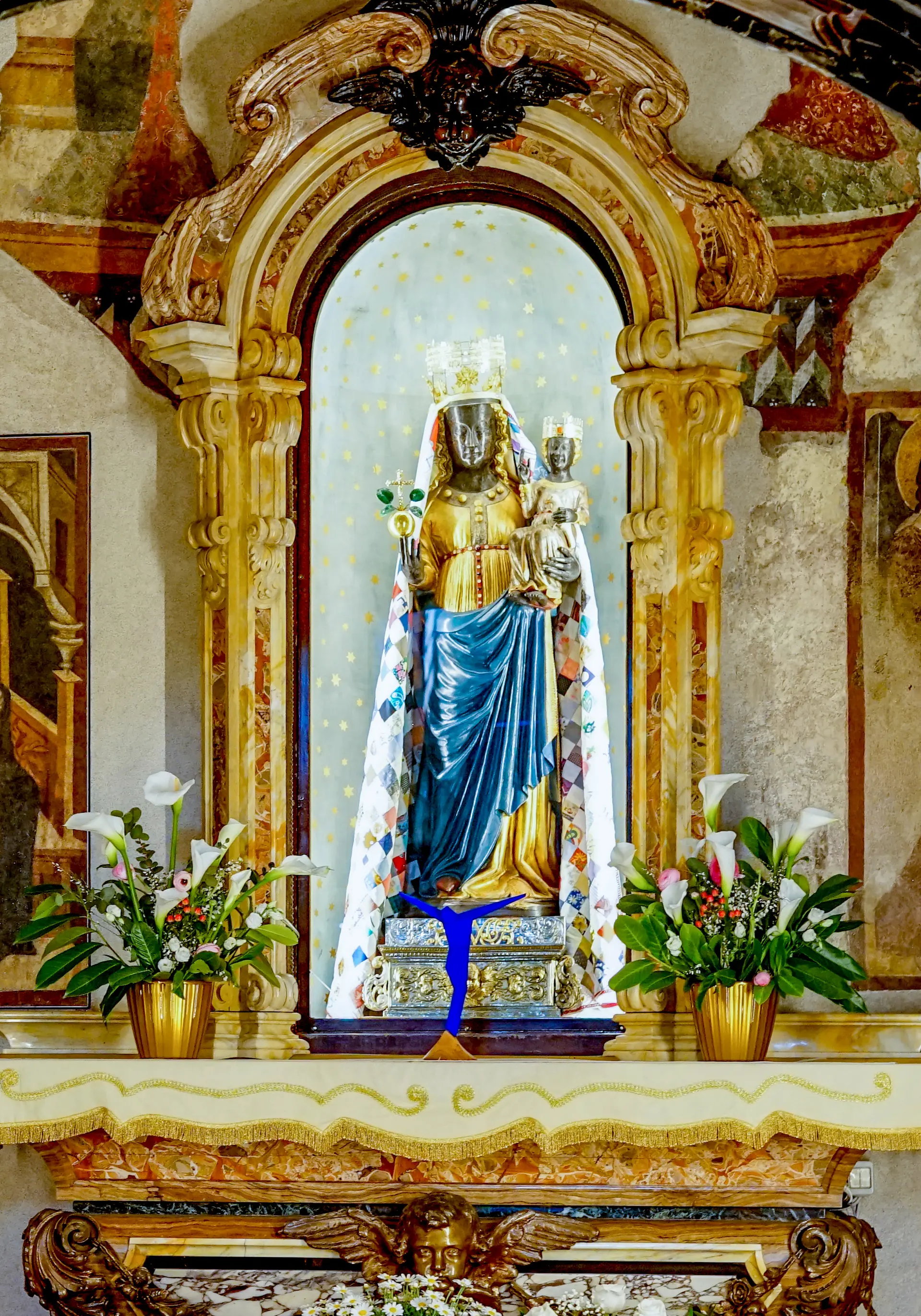
Yet the mountain's center is a smaller, age-darkened wooden statue in the older basilica. Pious tradition says Saint Luke carved it and Saint Eusebius of Vercelli carried it from Jerusalem in the fourth century, hiding it from persecution until it became supernaturally heavy and refused to move. Art historians date the surviving statue to the thirteenth century. The sanctuary does not hide this unresolved nine-hundred-year gap between legend and object.
Why this place is sacred
Two claims sit on top of each other at Oropa, and the gap between them is part of what makes the site interesting rather than a problem to be resolved.
The devotional claim is that the statue now venerated in the Ancient Basilica was carved by Saint Luke in the first century and carried from Jerusalem to Piedmont by Saint Eusebius of Vercelli in the fourth, after his exile ended in 363 AD.
Fleeing local persecution, he is said to have hidden it in a mountain cave; when custodians later tried to relocate it, the statue became too heavy to move — read, within the tradition, as a divine instruction that a sanctuary be built on that exact spot.
The documented claim is narrower. The wooden statue itself is dated by art historians to the late thirteenth century, likely the work of a sculptor from the Valle d'Aosta, and the earliest surviving written records of churches on the site — dedicated to St. Mary and St. Bartholomew — date only to the early thirteenth century. Whatever devotional life existed at Oropa before that documentary record is not independently verifiable from the sources available.
What both claims agree on is scale and duration: this has been treated as a place of unusual protective power for a very long time, credited historically with intercession against drought, plague, and pestilence, and the Sacro Monte devotional path built from 1617 was conceived explicitly as a means of intensifying that pilgrimage experience — a walkable 'New Jerusalem' through scenes from the Virgin's life, culminating in a chapel called Paradise.
To give pilgrims unable to travel to the Holy Land a physically walked, immersive substitute journey through episodes of the Virgin Mary's life, culminating at a sanctuary already venerated for a miraculous protective image.
Construction of the Sacro Monte's chapels began in 1617 and continued for decades under a succession of Savoyard architects. The Ancient Basilica received its Royal Gate from Filippo Juvarra; the Upper Basilica, a much larger later addition, was built between 1885 and 1960.
The statue itself has been formally crowned four times: in 1620, 1720, and 1820 as centennial commemorations, and again in a pontifical coronation on August 29, 2021, performed by Cardinal Giovanni Battista Re on behalf of Pope Francis — a rare enough event that no comparable ceremony is expected for decades. The whole complex was inscribed in 2003 within the UNESCO World Heritage listing for the Sacri Monti of Piedmont and Lombardy.
Experience and orientation
The altitude announces itself before anything devotional does — 1,159 meters, cold air even in summer, the mountains close enough to feel like walls rather than backdrop. The chapel path threads through this setting rather than competing with it, each stop a small enclosed scene of painted terracotta figures before the trail opens again to the Alps.
Most visitors report the two basilicas producing different registers of feeling entirely. The Upper Basilica, finished only in 1960, reads as monumental — deliberately large, built to receive the roughly 800,000 people who arrive here in an ordinary year. The Ancient Basilica, older and darker, is where the emotional weight concentrates, largely because of proximity to the statue itself: visitors describe an atmosphere thick with accumulated devotion rather than architectural grandeur.
A visit to the basilicas alone runs an hour or two; walking the full chapel path and the surrounding nature reserve adds another two to four hours depending on pace. Neither pace is wrong — the mountain has been visited both ways, by pilgrims on votive errands and by tourists on day trips, for centuries.
If time allows only one basilica, choose the older one — the statue itself, not the scale of the newer building, is what most pilgrims come for, and photographs of the Upper Basilica's size do not substitute for standing near the image people have been praying to since well before either building existed. Dress warmly regardless of season; the altitude and mountain weather can undercut a summer forecast quickly.
Context and lineage
Pious legend holds that Saint Luke the Evangelist carved the Oropa statue in the Holy Land in the first century, and that Saint Eusebius of Vercelli, first bishop of Vercelli, brought it to Piedmont after his exile ended in 363 AD, distributing similar statues to Crea and Cagliari.
Fleeing persecution by local pagans, he is said to have hidden the statue in a mountain cave; when custodians later attempted to move it, its weight became supernaturally immovable, taken as a sign that a sanctuary should be built there.
Historically, the surviving statue is dated by scholars to the late thirteenth century and attributed to a sculptor from the Valle d'Aosta — placing the physical object roughly nine centuries after the legendary narrative, though thirteenth-century documents already record churches dedicated to St. Mary and St. Bartholomew at the site, suggesting devotional use considerably older than the current statue. The Sacro Monte project proper was finalized between 1617 and 1620 by the Capuchin friar Fedele da San Germano.
Oversight of Oropa passed from its Capuchin founder through successive Savoyard-era architects and into the ordinary structures of the Diocese of Biella, which administers the sanctuary today. The pattern of centennial coronations — 1620, 1720, 1820, and the 2021 pontifical ceremony marking a modern continuation of that cycle — gives the site a rare, unusually visible thread of institutional continuity across four centuries.
Saint Eusebius of Vercelli
traditional founder
Credited by pious legend with bringing the statue from the Holy Land to Piedmont in the fourth century, though the object itself dates centuries later.
Fedele da San Germano
founder of the Sacro Monte
Capuchin friar who finalized the Sacro Monte devotional-chapel project between 1617 and 1620.
Filippo Juvarra
architect
Savoyard court architect who designed the Royal Gate of the Ancient Basilica during a later architectural phase.
Giovanni and Antonio d'Enrico
sculptors
Brothers who sculpted Chapel XV, the 'Crowning of Mary,' populated with 156 modeled figures — one of the most elaborate Baroque tableaux in the Sacri Monti series.
Cardinal Giovanni Battista Re
modern ecclesiastical figure
Performed the pontifical coronation of the statue on August 29, 2021, on behalf of Pope Francis, continuing a centennial coronation tradition begun in 1620.
Traditions and practice
Historic practice centered on votive and thanksgiving pilgrimage: Biella's annual civic procession originated as a vow made during a seventeenth-century plague outbreak, and continues to this day as an annual pilgrimage rather than a one-time historical event. Centennial episcopal and pontifical coronations of the statue — 1620, 1720, 1820, and 2021 — mark the tradition's longest-running recurring ceremony.
Regular Masses are held in both the Ancient and Upper Basilicas, along with Rosary and Vespers services with Eucharistic Blessing on a recurring schedule. Biella's votive civic pilgrimage occurs annually; the Fontainemore pilgrimage occurs only once every five years.
A major annual Marian festivity takes place each September, and the 'dust-free face' ritual — wiping the Madonna's face with a white cloth to check for dust, observed for roughly three hundred years as evidence of a continuing small miracle — happens each mid-November.
Visitors wanting more than a scenic mountain visit might time their trip to the September festivity or the November dust-inspection ritual, both of which draw a devotional crowd rather than a tourist one, or simply attend one of the regular Masses in the Ancient Basilica to experience the space as it functions day to day rather than as a monument. Guided tours in multiple languages are available through the sanctuary's own visitor services.
Roman Catholicism
ActiveOropa is one of the most important Marian shrines in the Alps and the largest Marian sanctuary in the Alpine region, centered on the Black Madonna, a statue venerated as miraculous and traditionally credited to a fourth-century arrival from the Holy Land. The Sacro Monte functions as a Counter-Reformation devotional path allowing pilgrims to walk a symbolic journey through the Virgin Mary's life without traveling to Palestine.
Veneration of the Black Madonna statue, walking the chapel-lined devotional path, attending Mass in either basilica, organized parish and diocesan pilgrimages, votive and thanksgiving pilgrimages such as Biella's annual plague-deliverance procession, and the annual November ritual inspection of the statue for dust.
Perspectives and open questions
Oropa holds its central tension openly rather than resolving it: mainstream scholarship dates the statue to the thirteenth century while institutional tradition teaches a first-century carving and fourth-century arrival, and the sanctuary's own history pages present both without forcing a single answer.
Scholarly perspective
Art historians date the surviving wooden statue to the late thirteenth century, likely the work of a Valle d'Aosta sculptor, rather than to the first-century Saint Luke or fourth-century Eusebian narrative preserved in pious legend. The Sacro Monte complex itself is treated by heritage scholars as a paradigmatic Counter-Reformation project, part of the broader Alpine phenomenon of the nine Sacri Monti designed to offer an accessible substitute pilgrimage to the Holy Land through immersive Baroque tableaux.
Living and traditional perspectives
Catholic devotional tradition maintains that the statue was carved by Saint Luke the Evangelist in the Holy Land and brought to Piedmont by Saint Eusebius of Vercelli in the fourth century, miraculously fixed to its mountain location by supernaturally increased weight — a narrative still taught and commemorated within the shrine's own institutional history and liturgical calendar, alongside the centennial coronation tradition it underpins.
Alternative interpretations
Some popular and speculative writing on Black Madonnas generally, including at Oropa, connects the dark-skinned iconography to pre-Christian goddess veneration or continuity with earlier pagan sacred sites reputedly present before Christianization. These claims are not substantiated by mainstream art-historical or archaeological scholarship and are presented here as an acknowledged alternative interpretive strand rather than established fact.
Open questions
The precise origin and meaning of the statue's dark coloring — whether original pigment, oxidized varnish, centuries of candle-smoke exposure, or a deliberate iconographic choice — remains debated, as is typical of Black Madonna scholarship generally. Whether any genuine pre-Christian cultic use of the Oropa site preceded the thirteenth-century documentary record is unverified beyond legendary tradition.
Plan your visit
Access and arrival
Oropa is reached by road from Biella, about 13-15 kilometers away, with parking near the sanctuary; the Sacro Monte chapel path itself can only be reached and walked on foot, within the roughly 1,518-hectare Sacred Mount of Oropa Special Nature Reserve. No mobile phone signal or emergency-access information specific to the site was available at time of writing; visitors should check with the sanctuary or the Biella tourist office for current conditions before undertaking longer nature-reserve trails.
The sanctuary complex itself includes historic hospice buildings that have long accommodated pilgrims; specific current booking details were not confirmed in sources reviewed. Biella, 13-15 kilometers away, offers the standard range of hotel accommodation for visitors preferring to stay in town.
Respectful visit
Modest dress is expected inside both basilicas — shoulders and knees should be covered, consistent with general Catholic shrine etiquette across Italy.
General photography is permitted in most areas, but flash photography near the Black Madonna statue is discouraged or prohibited, and photography during Mass or other liturgical services is not permitted.
Votive candles are available for lighting, and monetary donations toward the sanctuary's upkeep are welcomed but not obligatory.
Camping and open fires are strictly prohibited on the grounds; food and drink are banned within the monument area and under the chapel arcades. Visitors are asked to maintain quiet and reverence inside both basilicas, which remain active worship spaces rather than exhibition halls.
Do not expect informal access to the statue itself outside of scheduled viewing and Mass times; this is an actively venerated object in daily liturgical use, not a museum piece available for close inspection on demand. Flash photography near the statue is discouraged, and photography during Mass or other services is not permitted.
Location
Map loads as you approach this section.
Pilgrim reflections
A portrait of encounter, not a score
Pilgrims describe what they felt, how present they could become, and whether the place would shape a journey. There are no stars and no ranking of traditions.
No reviewed reflections yet
The first pilgrims can help describe the character of being here.
Share a reflection
Available after an account-backed “Been there.” Every reflection is reviewed before publication.
Nearby sacred places
Explore other sacred places in the region. Proximity does not establish access or travel time; check each place’s guidance.
References
Sources consulted for this page. Source categories describe the publication, not a guarantee that every claim is verified. Traditional accounts and outside interpretations may differ.
- 01Sanctuary of Oropa — Wikipedia contributorsacademicOverview of the sanctuary's founding legend, the Black Madonna statue, construction phases (Ancient Basilica, Royal Gate by Juvarra, Upper Basilica 1885-1960), coronation history, and pilgrimage statistics (~800,000 visitors/year, ~100 organized pilgrimages).
- 02Sacro Monte di Oropa — Wikipedia contributorsacademicDetails on the 12 devotional chapels plus 7 nearby structures, construction beginning 1617, the Baroque Chapel XV 'Crowning of Mary' by Giovanni and Antonio d'Enrico with 156 modelled figures, and UNESCO status as one of nine Sacri Monti of Piedmont and Lombardy.
- 03La storia del Santuario (History of the Sanctuary) — Santuario di OropaofficialOfficial sanctuary history: 4th-century founding tradition attributed to St. Eusebius, first written records from the 13th century (churches of St. Mary and St. Bartholomew), architects involved (Arduzzi, Gallo, Beltramo, Juvarra, Guarini, Galletti, Bonora), three-courtyard layout, Upper Basilica consecrated 1960.
- 04Sacro Monte di Oropa — Sacri Monti di Piemonte e Lombardia (official UNESCO series body)officialOfficial inter-regional body managing the UNESCO Sacri Monti series; site-specific visitor and heritage information.
- 05Sacro Monte of Oropa (official visitor leaflet) — Sacri Monti di Piemonte e LombardiaofficialOfficial English-language visitor leaflet for the UNESCO-listed Sacro Monte di Oropa.
- 06The Black Madonna of Oropa — Interfaith Mary PagespiritualDevotional/comparative-religion overview of Black Madonna traditions with specific coverage of Oropa's dust-free-face annual miracle observance (mid-November) and Marian veneration practices.
- 07Sanctuary of Oropa – Biella Italy — Catholic Shrine BasilicaspiritualCatholic devotional source; corroborates founding legend, statue material (cedar of Lebanon), and the tradition of the statue's supernaturally increased weight preventing relocation.
- 08The Catholic Pilgrim's Guide to Oropa, Italy — DestinationesSource contextPilgrimage-focused travel guide; corroborates altitude (1,159m), 16-centuries-long pilgrimage tradition, and annual visitor volume.
- 09Sacro Monte di Oropa, Italy - the important pilgrimage site at the Oropa Sanctuary — Italy This WaySource contextGeneral travel/heritage overview of the site and surrounding Biellese Alps.
- 10The Sanctuary of Oropa, nigra sum sed formosa — Indagini e MisteriSource contextPopular/mystery-angle article exploring speculative and esoteric interpretations of the Black Madonna phenomenon at Oropa; used only for noting alternative/esoteric framing, not as a factual source.
Share a photo
Help visitors recognize Sacro Monte di Oropa. Every submission is reviewed before publication.