Ryūseki-ji
Where a wooden Kannon hall stands directly on the back of a stone dragon
Understand sacred places, explore living traditions, and learn how to engage respectfully with Pilgrim Map.
Access has not been verified. Check current local guidance before planning a visit.
Chichibu, Saitama Prefecture, Japan
Read the sources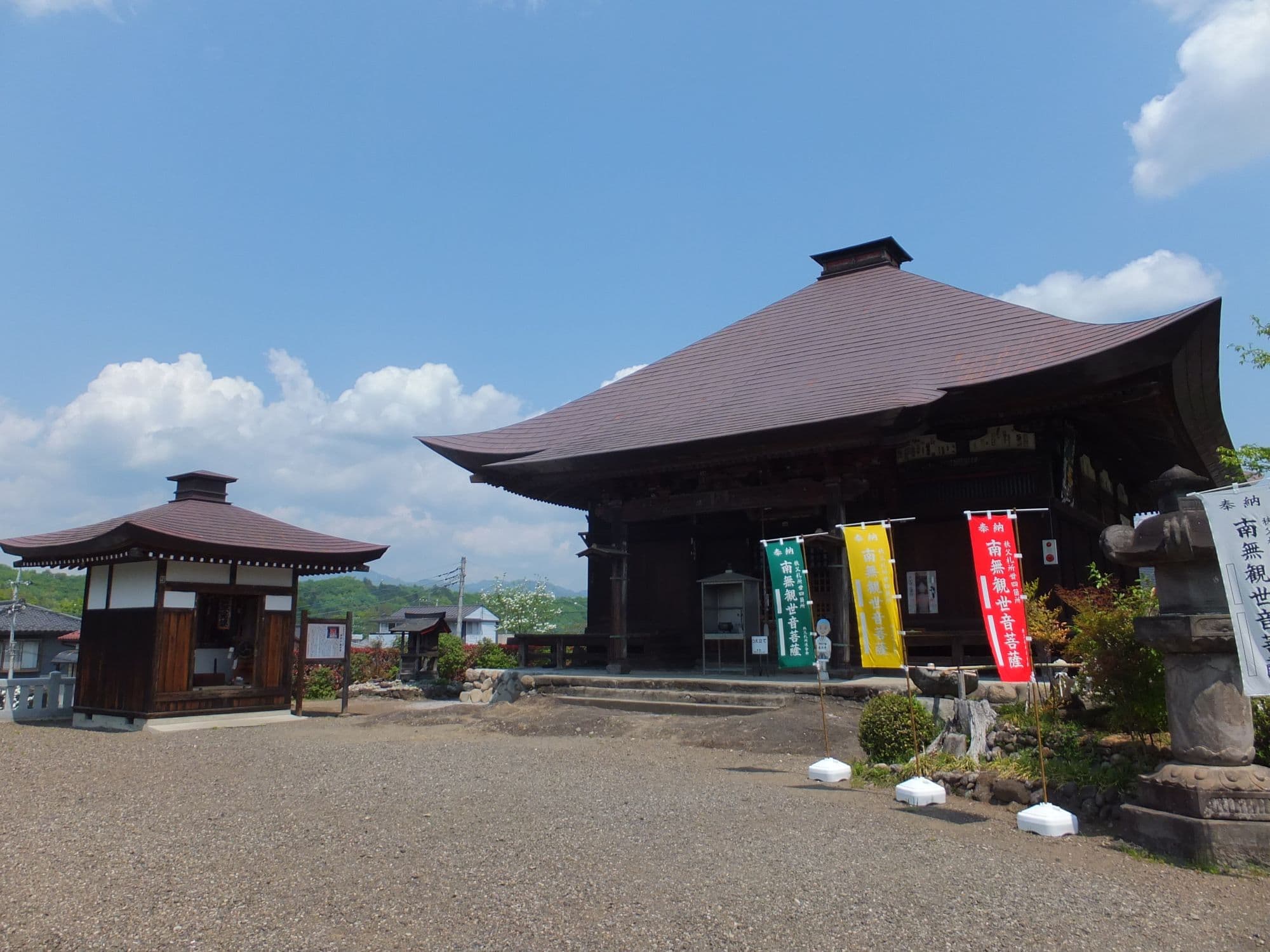
Station 19 of 34
Chichibu 34 Kannon PilgrimageVisit essentials
A quick read before you go
- Duration
- 20–40 minutes, including time at the Sai-no-Kawara mizuko-Jizō field.
- Access
- About 1.5 km northeast of Seibu-Chichibu Station; roughly a 25-minute walk or short taxi ride.
Overview
Chichibu 34 pilgrims reach Ryūseki-ji northeast of central Chichibu on a terrace above the Arakawa river. It first resembles other rural fudasho stops—a tile-roofed Kannon hall, small precinct, and stamp office—but the hall stands directly on a single conglomerate-sandstone boulder, with no concrete pad or carved base between wood and rock. Building and earth are physically continuous.
The name 龍石, Ryū-seki, or 'Dragon Rock,' comes from a Heian-period legend: during severe drought, the monk Kūkai prayed here; the earth split; and a dragon emerged from the bedrock, ascended into clouds, and brought torrential rain. The stone was enshrined as the dragon's body and the Kannon hall raised above it. Chichibu Geopark geologists read the same rock as marine sediment laid down when ancient flows entered prehistoric Chichibu Bay—the legendary water-releasing bedrock was once seabed.
Both readings coexist without contradiction.
The Sōtō Zen affiliation later reorganized an older esoteric cult site whose atmosphere endures. Beside the hall, a Sai-no-Kawara field of small Jizō statues for unborn or deceased children creates a threshold where river, rock, and the unfinished lives of mizuko share ground.
Why this place is sacred
Three layers concentrate the thin-place character of Ryūseki-ji. The first is geological: the Kannon-dō sits on a single conglomerate-sandstone monolith, its chert inclusions visible in the surrounding outcrop. There is no engineered foundation; the temple floor and the bedrock meet without intermediary, and pilgrims describe the felt sense of standing 'on the dragon's back.' The second is mythic: the rain-dragon legend renders the rock as a body that once opened, released water, and closed again.
The third is liminal: the adjacent Sai-no-Kawara, where parents leave small toys, sweets, or stones for children who died unborn or young, gives the precinct an unmistakable boundary tone. Together these layers make the site less a temple-with-a-rock than a rock that has gathered a temple, a legend, and a community of grief around itself.
Likely a pre-Buddhist water-and-stone cult site, then a Heian-period esoteric Buddhist rain-prayer station, then reorganized as a Sōtō Zen temple within the medieval Chichibu Kannon pilgrimage circuit.
The Kūkai rain-prayer legend belongs to Heian-era Shingon amagoi practice; later Zen consolidation in the Chichibu region brought the site under Sōtō administration. Inclusion in the 34 Kannon route is documented from the late medieval period, with the once-every-twelve-years Year of the Horse opening pattern stabilizing in the Edo era.
Experience and orientation
The walk in from Seibu-Chichibu Station takes about twenty-five minutes. The temple sits in Ohata-machi on the terrace above the river, surrounded by low houses and small fields. At the gate, the bedrock is already visible: dark, marbled with chert, slightly rough. Step inside and the Kannon hall reveals itself standing directly on the stone. There is no podium, no concrete pad. Pilgrims pause here longer than they expect.
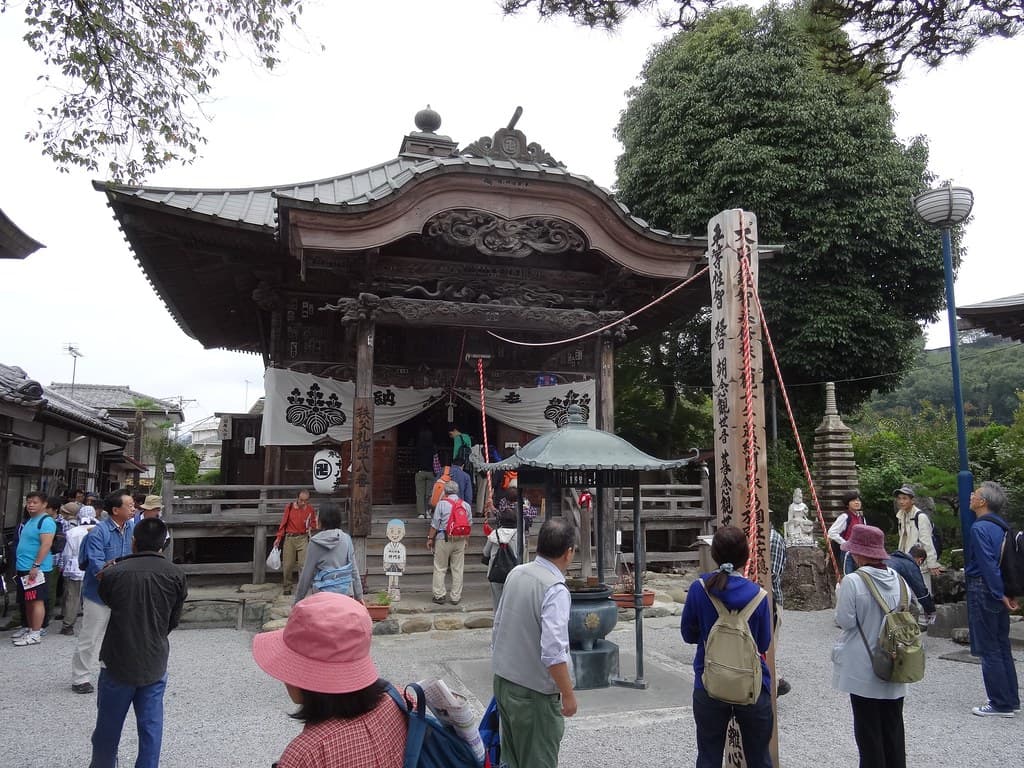
Inside the hall, sutra recitation before the Senju (Thousand-Armed) Kannon takes only a few minutes. Outside, walking the rock takes longer. The conglomerate's surface is uneven; sturdy shoes help. To one side of the hall, the Sai-no-Kawara field opens into a quieter zone. Small stone Jizō statues stand in irregular ranks, draped in red bibs, surrounded by toys, water cups, and stacked stones. Visitors are welcome to leave a small offering or simply stand.
Many do not stay long; the field is honest in a way that does not invite lingering for its own sake.
The hall faces broadly south. The Sai-no-Kawara field is on the precinct's eastern flank; the bedrock is most visible inside and just beneath the hall. Iwanoue-dō (#20) lies about two kilometers east across the Arakawa.
Context and lineage
Local tradition dates the founding to a Heian-period drought-relief ritual by Kūkai (Kōbō Daishi, 774–835). The monk prayed for rain at this spot; the earth split, a great dragon rose from the rock and ascended to heaven, calling down clouds; rain fell and saved the harvest. The stone was then enshrined as Ryū-seki, 'Dragon Rock,' and a Kannon hall was raised on top.
Modern Chichibu Geopark documentation describes the same outcrop as a Pliocene-Pleistocene conglomerate sandstone with chert clasts, formed when sediment flows from the rising Chichibu mountains entered the ancient Chichibu Bay.
Sōtō Zen Buddhism, with an underlying Heian-period esoteric (Shingon) substratum preserved in the rain-dragon foundation legend.
Kūkai (Kōbō Daishi, 774–835)
Founder by tradition; Shingon-school monk credited with the rain-prayer that summoned the dragon. Historicity uncertain — many Chichibu sites carry similar Kūkai foundation legends.
The Senju Kannon honzon
Principal image; a Thousand-Armed Kannon enshrined at the back of the hall on the bedrock. Iconographic origin undocumented.
Chichibu Geopark interpreters
Modern stewards of the site's geological reading; Ryūseki-ji is a designated Geopark site for its conglomerate-sandstone monolith and chert inclusions.
Mizuko-kuyō practitioners
Ongoing community of parents and pilgrims who maintain the adjacent Sai-no-Kawara field through small offerings of toys, sweets, water, and stacked stones.
Traditions and practice
Sutra recitation (typically the Heart Sutra) before the Senju Kannon. Goeika hymn-singing. Mizuko-kuyō at the adjacent Sai-no-Kawara, performed individually or as part of organized memorial visits. Goshuin issuance at the nōkyōjo. The once-every-twelve-years Year of the Horse grand opening — next in 2038 — exposes the inner sanctum.
Daily nōkyōjo operation (08:00–17:00, closing at 16:00 from November to February). Pilgrim flow is heaviest during the umadoshi unveiling years and during cherry-blossom and autumn-foliage seasons. Geopark visitors increasingly arrive interested in the bedrock as much as the temple.
Approach the hall slowly and notice where the wood floor meets the stone. If moved, leave a small offering at the Sai-no-Kawara — toys, water, or a stacked stone — without disturbing what other parents have left. Walk the perimeter of the bedrock outside the hall before leaving; the chert inclusions are most visible in raking light.
Sōtō Zen Buddhism
ActiveRyūseki-ji is presently a Sōtō Zen temple within the Chichibu 34 Kannon route. The current administration sits atop an older Shingon-esoteric devotional layer expressed in the rain-dragon legend; the temple thus holds both Zen and earlier esoteric currents in a single precinct.
Esoteric Buddhist rain-prayer (historical)
HistoricalThe temple's foundational legend belongs to the Heian-period amagoi tradition in which Shingon ritualists drew water-dragons from sacred sites in time of drought. The practice is no longer enacted at the temple but remains the substrate of its self-understanding.
Mizuko-kuyō (memorial for unborn or deceased children)
ActiveThe adjacent Sai-no-Kawara field gathers an ongoing community of parents and pilgrims who leave offerings to Jizō for mizuko. The field is among the most affecting features of the Chichibu route and a primary reason many visitors return.
Geological / heritage interpretation (Chichibu Geopark)
ActiveRyūseki-ji is a designated site within the Chichibu Geopark, recognized for the conglomerate-sandstone monolith and chert inclusions on which the Kannon hall is built. The Geopark interpretation runs parallel to Buddhist devotion rather than displacing it.
Perspectives and open questions
Ryūseki-ji invites at least three readings — Buddhist devotional, geological, and folk-mythic — and the temple's identity comes precisely from refusing to choose among them. The same bedrock is the dragon's body, ancient seabed, and Sōtō Zen foundation; pilgrims, geologists, and mizuko-kuyō practitioners each bring a different attention to it.
Scholarly perspective
Geologically, the Kannon-dō rests on a Pliocene-Pleistocene conglomerate sandstone with chert clasts representing radiolarian-bearing seafloor sediments — part of the wider Chichibu Bay sedimentary record interpreted by the Chichibu Geopark. Historically, the temple is a Sōtō Zen reorganization of an older popular cult site whose Heian-period founding by Kūkai is hagiographic rather than verifiable.
Living and traditional perspectives
For local pilgrims and Sōtō Zen practitioners, the rain-dragon legend functions as living tradition rather than folklore. The rock is venerated as the dragon's actual body; the legend is recited during rain-related observances and remains a frame for understanding the precinct's atmosphere.
Alternative interpretations
Some pilgrims read the bare bedrock as an exposed axis where compassion enters earth without intervening foundation — a Zen lesson of ground meeting ground. Others see the building's continuity with the rock as a deliberate teaching about impermanence resting on apparent permanence.
Open questions
Whether Kūkai ever visited the site (Ryūseki-ji is one of hundreds of Chichibu sites bearing his name in legend); the original date of the rock's enshrinement; the iconographic origin of the present Senju Kannon image.
Plan your visit
Access and arrival
About 1.5 km northeast of Seibu-Chichibu Station; roughly a 25-minute walk or short taxi ride. Free parking on-site. The temple sits on the Arakawa river terrace in Ohata-machi, Chichibu, Saitama.
Several minshuku and small hotels operate around Seibu-Chichibu Station; pilgrim-oriented inns can be booked through the Chichibu Fudasho Renraku Kyōgikai or city tourism office.
Respectful visit
Modest, weather-appropriate. Sturdy shoes for the uneven stone surfaces. Traditional pilgrim attire (white hakui, sedge hat, walking staff) is welcomed but not expected.
Permitted in precincts; the bedrock floor of the Kannon hall is a common subject. Be discreet around the Sai-no-Kawara mizuko field.
Saisen coins and incense at the Kannon hall. Small toys, sweets, water, or stacked stones at the Sai-no-Kawara.
Do not climb or chip the bedrock. Do not rearrange or remove items from the Sai-no-Kawara.
Do not climb on or chip the bedrock. Do not move or rearrange stones in the Sai-no-Kawara field — each is a gesture of grief left intentionally.
Current practical details
Address
15-31 Ōbatakemachi, 大畑町 Chichibu, Saitama 368-0011, Japan
Phone
Hours
Hours, fees, and access can change — verify on the official source before you travel. Practical details last checked Jun 2026.
Location
Map loads as you approach this section.
Pilgrim reflections
A portrait of encounter, not a score
Pilgrims describe what they felt, how present they could become, and whether the place would shape a journey. There are no stars and no ranking of traditions.
No reviewed reflections yet
The first pilgrims can help describe the character of being here.
Share a reflection
Available after an account-backed “Been there.” Every reflection is reviewed before publication.
Nearby sacred places
Explore other sacred places in the region. Proximity does not establish access or travel time; check each place’s guidance.



References
Sources consulted for this page. Source categories describe the publication, not a guarantee that every claim is verified. Traditional accounts and outside interpretations may differ.
- 01Chichibu 34 Kannon Sanctuary — Wikipedia contributorsofficialLists #19 Ryūseki-ji enshrining Senju (Thousand-Armed) Kannon.
- 02龍石寺 (秩父市) — Japanese Wikipedia contributorsofficialSōtō Zen affiliation, single-monolith hall siting, Heian-period Kūkai rain-prayer dragon legend.
- 03札所19番 飛渕山 龍石寺 — Chichibu City governmentofficialMunicipal record of mountain name and pilgrimage station.
- 04札所19番龍石寺の角礫質砂岩 — Chichibu GeoparkofficialGeological documentation of the conglomerate sandstone monolith on which the Kannon-dō stands.
- 0519番 龍石寺 — Chichibu Fudasho Renraku KyōgikaiofficialOfficial pilgrimage federation page.
- 06龍石寺。秩父市大畑町にある曹洞宗寺院 — Tesshow.jpguideConfirms Sōtō Zen affiliation and architectural details (7.5 by 4 bay Kannon hall on bedrock).
Pilgrim glossary
- Kannon
- The bodhisattva of compassion, central to many East Asian pilgrimage routes.
- Sutra
- A canonical Buddhist scripture, often chanted as part of practice.
- Shingon
- An esoteric Japanese Buddhist school emphasizing ritual, mantra, and mandala practice.
- Zen
- A Japanese Buddhist school emphasizing seated meditation and direct insight.
Share a photo
Help visitors recognize Ryūseki-ji. Every submission is reviewed before publication.