Iwanoue-dō
A Heian-era Kannon image that survived war on a bare rock above the Arakawa
Understand sacred places, explore living traditions, and learn how to engage respectfully with Pilgrim Map.
Access has not been verified. Check current local guidance before planning a visit.
Chichibu, Saitama Prefecture, Japan
Read the sources
Station 20 of 34
Chichibu 34 Kannon PilgrimageVisit essentials
A quick read before you go
- Duration
- 30–40 minutes; longer if walking the cliff path or continuing to #21 on the Nagaone-michi.
- Access
- About a 30-minute walk from Seibu-Chichibu Station, or short taxi/bus.
Overview
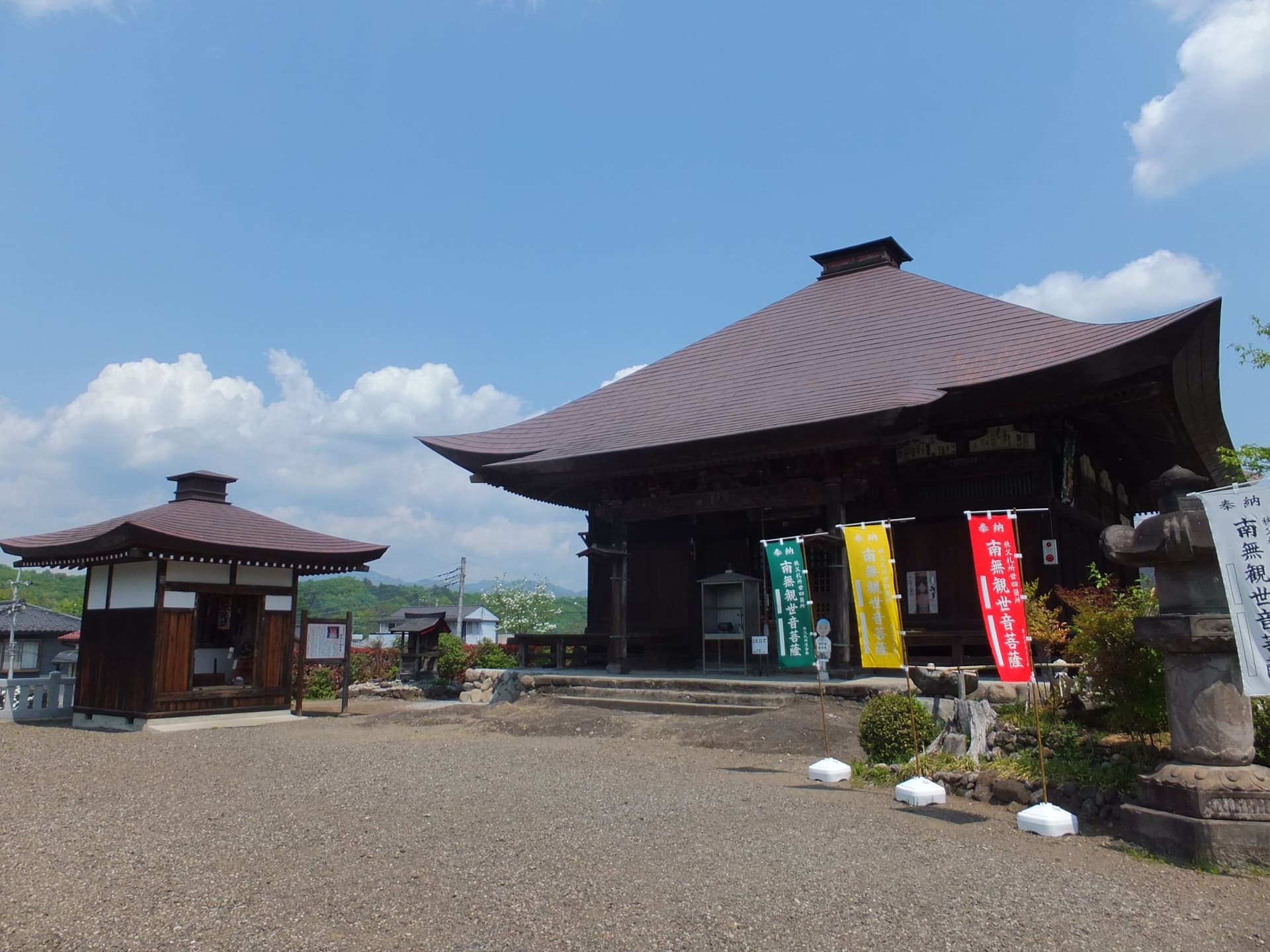
Iwanoue-dō occupies a high terrace above the Arakawa, backed by an 80-metre cliff and facing Mt. Bukō, the sacred anchor of Chichibu's spiritual geography. Behind the small worship hall, a limestone grotto preserves Jōmon-period rock-shelter remains, showing the cliff mattered millennia before a Buddhist hall stood here.
The name 岩之上堂, Iwa-no-Ue-dō or 'Hall above the Rock,' recalls the Ōnin era (1467–1469), when regional war burned the larger Ganshō-ji complex. Returning residents found only the Kannon image intact on bare rock. Pilgrims called it Iwa-no-Ue Kannon, the Kannon on the Rock, and the ruined complex slowly re-formed around what survived.
The image is a Fujiwara-period (late Heian, 10th–12th c.) Shō Kannon—Sacred or Holy Kannon—not Batō Kannon. Travel sources sometimes confuse it with Hashidate-dō's Batō Kannon temple (#28), but the Chichibu Fudasho federation and city of Chichibu identify this honzon as Shō Kannon and the sculpture as important regional Fujiwara-period Buddhist art. Uchida Takezaemon-no-jō Masashige restored the temple in the early Enpō era, around 1673.
The Uchida family has quietly maintained it for roughly three centuries, an unusual single-family stewardship on the route.
Why this place is sacred
Iwanoue-dō's threshold quality is built from vertical layering. At the base sits the river, then the bluff, then the cliff with its prehistoric rock-shelter, then the Kannon hall holding a Fujiwara-period image. Across the valley, Mt. Bukō rises — the local sacred mountain whose deity is woven, by legend, into the Chichibu route's protective geography. The narrative of the image-on-bare-rock concentrates the place's meaning: when everything human had burned, the bodhisattva remained.
For pilgrims facing personal loss, the temple offers a specific form of consolation — devotion as the remainder that persists when constructed life has fallen away.
Likely Jōmon-era ritual use of the cliff and rock-shelter, predating Buddhism by millennia. The Buddhist site emerges in the Heian period, traditionally dated to Emperor Shirakawa's 1077 Kumano pilgrimage; the original temple was named Ganshō-ji.
Ganshō-ji was destroyed in Sengoku-era warfare (Tenbun and Eiroku periods, mid-16th c.). By the late 15th century only the Kannon image remained on the rock, giving rise to the Iwa-no-Ue Kannon name. From around 1673 the Uchida family of local administrators restored the site over twenty-five years and have stewarded it for roughly three centuries since. The temple now functions as a Rinzai Zen hall of the Nanzen-ji branch within the Chichibu 34 pilgrimage.
Experience and orientation
The walk from central Chichibu climbs gradually to the bluff. Iwanoue-dō appears modestly, a small worship hall behind a wood gate, with the cliff and grotto rising directly behind. Inside, the Shō Kannon image sits in shadow; pilgrims who recite a sutra often pause longer than usual to look, partly because of the image's age, partly because of its survival history. Outside, the precinct is small enough to walk in five minutes but rewards slower attention.
The limestone grotto behind the hall opens into a cliffside path — uneven, occasionally steep — with rock-shelter remains visible along the way. Footing is uneven; sturdy shoes help. Pilgrims often turn back to face the valley before leaving: across the Arakawa, Mt. Bukō rises with its distinctive worked face. The Nagaone-michi (Long-Spine Road) walking route continues from here through #21 to #25, a stretch many pilgrims describe as the most atmospheric on the circuit.
The hall faces broadly west, opening onto the river valley with Mt. Bukō visible across the water. The cliff and grotto are immediately behind. Ryūseki-ji (#19) lies about two kilometres west across the Arakawa; Kannon-ji (#21) is the next station heading east into central Chichibu.
Context and lineage
By tradition, the temple was founded at the vow of Emperor Shirakawa during his 1077 Kumano pilgrimage. The original complex, Ganshō-ji, was destroyed in Sengoku-era warfare. When pilgrims returned, only the Kannon image was found, standing on the bare rock — and the surviving image gave the place its present name, 'Hall above the Rock.' From the early Enpō era (around 1673), Uchida Takezaemon-no-jō Masashige rebuilt the hall over twenty-five years, and his descendants have cared for the site since.
Rinzai Zen Buddhism, Nanzen-ji branch (Kyoto-affiliated rather than Kamakura's Kenchō-ji line).
Emperor Shirakawa (1053–1129)
Founder by tradition; the 1077 Kumano-pilgrimage vow that legendarily established the original Ganshō-ji. The story follows a stock pattern of imperial-pilgrimage hagiography and is not independently documented.
Uchida Takezaemon-no-jō Masashige
Edo-period restorer who began rebuilding the temple in the early Enpō era (around 1673), a project that took some twenty-five years.
The Uchida family (17th c. to present)
Three-century single-family stewards of Iwanoue-dō; an unusual arrangement on a pilgrimage route otherwise maintained by resident clergy.
The Fujiwara-period Shō Kannon honzon
Late-Heian sculpture (10th–12th c.) at the heart of the temple's identity; survived the Sengoku-era destruction of the surrounding complex and gave the temple its current name.
Jōmon-period inhabitants of the cliff rock-shelter
Earliest known users of the site; their cultural identity is undetermined, but the rock-shelter remains anchor the precinct to deep prehistoric time.
Traditions and practice
Heart Sutra recitation before the Shō Kannon. Goeika hymn-singing. Goshuin issuance at the nōkyōjo. The once-every-twelve-years umadoshi (Year of the Horse) grand opening — the next falls in 2026, with the inner sanctum exposed from spring through late autumn — brings rare access to the otherwise hidden honzon.
Daily nōkyōjo operation (08:00–17:00, closing at 16:00 from November to February). Pilgrim flow is heaviest during umadoshi years and during the cherry-blossom and autumn-foliage seasons. Many pilgrims arrive on foot via the Nagaone-michi walking section.
After incense and a brief sutra recitation, walk the cliff path behind the hall. Pause at the grotto. Then face Mt. Bukō across the valley before leaving. The temple rewards slower attention than its small footprint suggests; an hour is not too long.
Rinzai Zen Buddhism (Nanzen-ji branch)
ActiveIwanoue-dō is one of the Chichibu route's Rinzai temples and is affiliated with Kyoto's Nanzen-ji rather than Kamakura's Kenchō-ji branch. Its administration since the early Edo period has been unusual: rather than a resident priestly community, the Uchida family of local administrators has maintained the hall for roughly three centuries.
Pre-modern Ganshō-ji (historical)
HistoricalThe original temple complex on the site was named Ganshō-ji (願上寺) and was destroyed in the Sengoku-era warfare of the Tenbun and Eiroku periods. The current temple is its devotional successor, named for the Kannon image that survived the destruction.
Jōmon-era ritual use of the cliff (prehistoric)
HistoricalThe cliff and rock-shelter behind the hall preserve Jōmon-period habitation and likely ritual remains, anchoring the site to several millennia of human presence prior to any Buddhist institution.
Perspectives and open questions
Iwanoue-dō asks to be read on at least three timescales at once: a Jōmon prehistoric site, a Fujiwara-period sculpture, and a three-century family stewardship. The image-on-bare-rock origin story holds these layers together — devotion as what remains when everything constructed has burned.
Scholarly perspective
Sculpturally, the Iwanoue-dō honzon is regionally important: a Fujiwara-period (late Heian, 10th–12th c.) Shō Kannon, distinguished within Chichibu pilgrimage scholarship and noted by the Chichibu Fudasho federation. Archaeologically, the cliff behind the temple bears Jōmon-period rock-shelter evidence, suggesting the site has carried ritual significance for several millennia. Some travel sources erroneously identify the honzon as Batō (Horse-Headed) Kannon; primary Japanese sources and the Chichibu pilgrimage federation consistently confirm Shō Kannon.
The Batō Kannon temple on the route is Hashidate-dō at #28.
Living and traditional perspectives
Local memory venerates the Uchida family's three-century stewardship as itself a form of pilgrimage practice — a single family carrying the cult through tens of generations. The image's survival of the Sengoku-era fires is treated not as anecdote but as the temple's defining sacred fact.
Alternative interpretations
Some readings see Iwa-no-Ue Kannon as the bodhisattva's embodiment of indestructibility — the form that persists when constructed life has burned away. The vertical layering of the site, with prehistoric rock-shelter beneath a Heian image beneath an Edo-restored hall, is sometimes interpreted as compassion's continuity across cultural epochs.
Open questions
Whether Emperor Shirakawa actually established the temple (the legend follows a stock pattern in imperial-pilgrimage hagiography); the precise date and sculptor of the Fujiwara-period Kannon; the cultural identity of the Jōmon-era inhabitants of the cliff rock-shelter.
Plan your visit
Access and arrival
About a 30-minute walk from Seibu-Chichibu Station, or short taxi/bus. The temple sits on a bluff above the Arakawa in Terao district, Chichibu, Saitama. The Nagaone-michi walking section from #20 to #25 begins here.
Minshuku and small hotels around Seibu-Chichibu Station serve pilgrim travellers; bookings can be arranged via the Chichibu Fudasho Renraku Kyōgikai or the city tourism office.
Respectful visit
Modest, weather-appropriate. Sturdy shoes for the cliff and grotto path.
Permitted in the precinct and grotto. Avoid photographing the inner image; ask before photographing inside the hall.
Saisen coins and incense at the Kannon hall. Flowers are occasionally left at the rock-shelter.
Do not disturb the prehistoric rock-shelter or remove stones. Stay back from the cliff edge.
Do not disturb the prehistoric rock-shelter remains or remove stones from the grotto area.
Current practical details
Address
2169 Terao, Chichibu, Saitama 368-0056, Japan
Phone
Hours, fees, and access can change — verify on the official source before you travel. Practical details last checked Jun 2026.
Location
Map loads as you approach this section.
Pilgrim reflections
A portrait of encounter, not a score
Pilgrims describe what they felt, how present they could become, and whether the place would shape a journey. There are no stars and no ranking of traditions.
No reviewed reflections yet
The first pilgrims can help describe the character of being here.
Share a reflection
Available after an account-backed “Been there.” Every reflection is reviewed before publication.
Nearby sacred places
Explore other sacred places in the region. Proximity does not establish access or travel time; check each place’s guidance.


References
Sources consulted for this page. Source categories describe the publication, not a guarantee that every claim is verified. Traditional accounts and outside interpretations may differ.
- 01Chichibu 34 Kannon Sanctuary — Wikipedia contributorsofficialLists #20 Iwanoue-dō enshrining Shō Kannon (NOT Bato Kannon).
- 0220番 岩之上堂 — Chichibu Fudasho Renraku KyōgikaiofficialOfficial pilgrimage federation page.
- 03札所20番 法王山 岩之上堂 — Chichibu City governmentofficialMunicipal record.
- 04The Chichibu 34 Fudasho Kannon Pilgrimage — An Introduction — Pierce Salguero / USC ScalaracademicAcademic context for the pilgrimage.
- 05秩父札所 第二十番 法王山 岩之上堂 — Chichibu Ohenro pilgrimage portalguideConfirms honzon is Shō Kannon (representative Fujiwara-period sculpture); sect is Rinzai Nanzen-ji branch; Emperor Shirakawa 1077 founding legend; Uchida-family Edo-period restoration.
- 06Chichibu Fudasho — A Journey Through History — Saitama Tourism Support DeskguideSource of the contested Bato Kannon claim; we cite it but do not adopt the claim. Otherwise notes the 80-metre cliff backdrop and Jōmon rock-shelter remains.
Pilgrim glossary
- Honzon
- The principal Buddhist deity enshrined as a temple's central object of worship.
- Kannon
- The bodhisattva of compassion, central to many East Asian pilgrimage routes.
- Bodhisattva
- An enlightened being who postpones full nirvana to help others toward awakening.
- Sutra
- A canonical Buddhist scripture, often chanted as part of practice.
- Zen
- A Japanese Buddhist school emphasizing seated meditation and direct insight.
Share a photo
Help visitors recognize Iwanoue-dō. Every submission is reviewed before publication.