Kannon-ji
The Arrow Hall whose Kannon survived the 1923 Great Chichibu Fire
Understand sacred places, explore living traditions, and learn how to engage respectfully with Pilgrim Map.
Access has not been verified. Check current local guidance before planning a visit.
Chichibu, Saitama Prefecture, Japan
Read the sources
Station 21 of 34
Chichibu 34 Kannon PilgrimageVisit essentials
A quick read before you go
- Duration
- About 20 minutes for incense, sutra recitation, goshuin, and an amulet.
- Access
- About 8–10 minutes' walk west of Seibu-Chichibu Station, in the Saiwai-chō neighbourhood of…
Overview
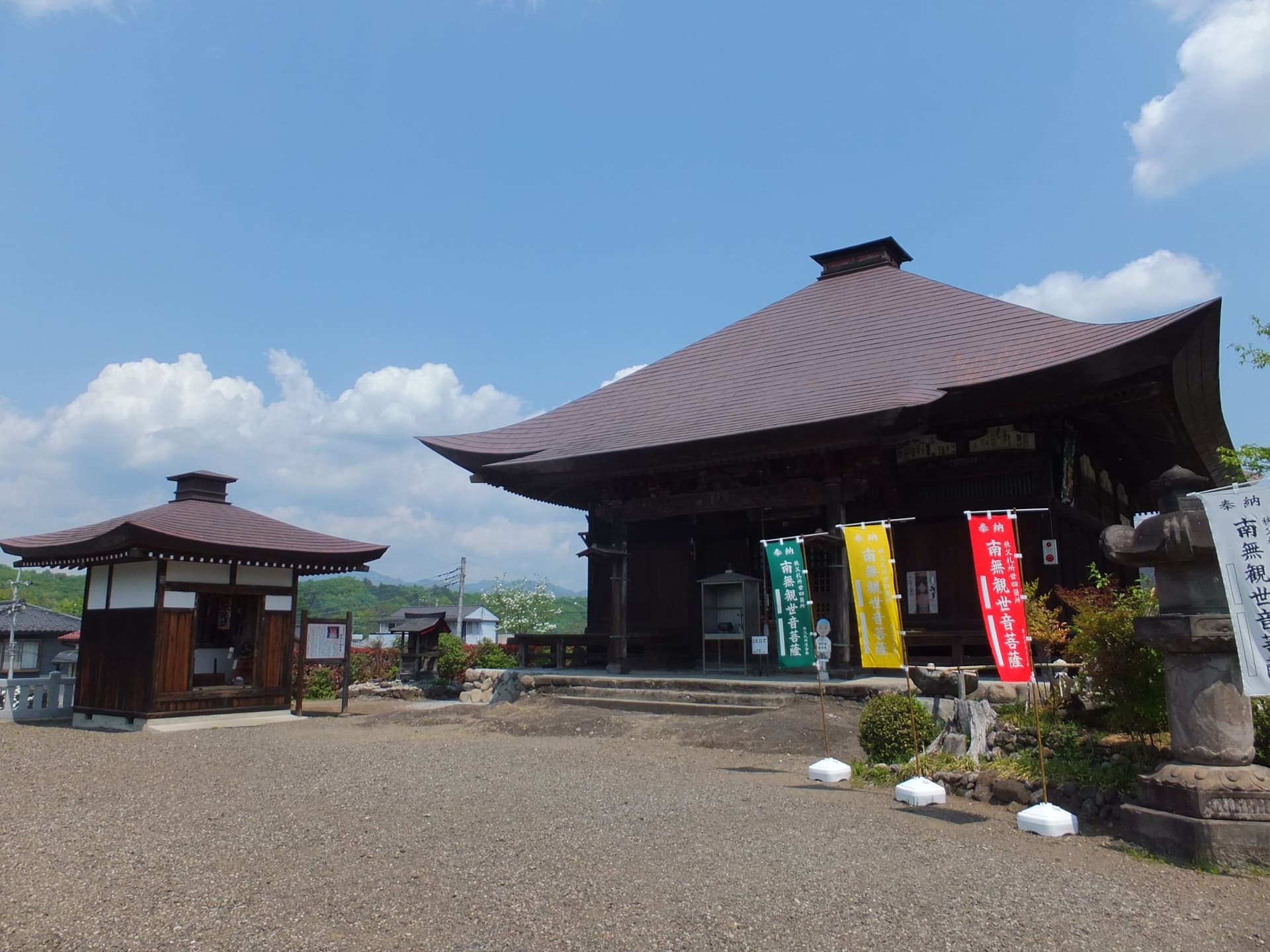
Kannon-ji stands in central Chichibu's Saiwai-chō, a short walk west of Seibu-Chichibu Station. Distinct from Imakumano Kannon-ji at Sennyū-ji in Kyoto, Shikoku 88 temple #16 in Kanonji, Kagawa, and Yashima Kannon-ji, it is locally called Yano-dō (矢之堂), 'Arrow Hall'; the historical plaque remains beneath the worship-hall eaves.
Yōkōzan Kannon-ji (要光山 観音寺) is a Shingon Buzan-ha temple, one of the Chichibu route's few non-Zen survivors in a Zen-dominated circuit, with Shō Kannon as its principal image. Three unresolved traditions explain Yano-dō: relocation from Yano Village in Kodama district, Heian warriors' arrow votives, or arrows loosed by Mt. Bukō's deity and Hachiman against malevolent spirits; the third appears on the precinct's 'Kannon Miracles Record.'
After the image survived the documented Great Chichibu Fire of 1923 (Taishō 12), pilgrims named it Hi-yoke Kannon, 'fire-prevention Kannon,' and commonly take fire-prevention amulets from the nōkyōjo.
Why this place is sacred
Yano-dō's threshold quality is built less on landscape than on narrative density. The precinct itself is modest — an in-town hall with a stamp office and a small forecourt — but it sits at the convergence of several Chichibu sacred-geography stories. The Mt. Bukō and Hachiman arrow-shooting legend places the temple at the symbolic centre of the valley's defensive cosmology.
The 1923 fire-survival adds a layer of documented modern miracle to that mythic ground: the Hi-yoke Kannon is at once a folk-theological figure and a specific image that came through a specific catastrophe. Pilgrims arrive with concerns about fire, household safety, and protection from sudden loss, and the small precinct concentrates that intent.
A Shingon Buzan-ha esoteric Buddhist temple within the medieval Chichibu Kannon pilgrimage. Origins are obscure; two competing legends place either an original hall in Yano Village in Kodama district or an arrow-votive cult tied to Hachiman and Mt. Bukō.
Despite the post-Meiji Zen consolidation that swept many Chichibu temples, Kannon-ji remained Shingon — one of a small number of esoteric survivors on the route alongside Saikō-ji (#16). The 1923 Great Chichibu Fire reframed the temple's identity around the Hi-yoke Kannon protective cult, and that reframing has held to the present.
Experience and orientation
From Seibu-Chichibu Station the walk takes under ten minutes through low-rise neighbourhoods. The temple gate is unassuming; visitors who do not know to look for the Yano-dō name plaque under the eaves can easily miss the historical layer. Inside, the precinct is small enough to take in at a glance: stamp office to one side, a Kannon hall in front, fire-prevention amulets and goshuin available at the desk.
Most visits last about twenty minutes. Pilgrims light incense, recite a sutra (often the Heart Sutra), and request goshuin. The Hi-yoke amulets are among the most frequently purchased items. Many visitors then continue on foot to Dōji-dō (#22) further along the historic pilgrim road, or back into central Chichibu toward the train.
The temple stands in the Saiwai-chō neighbourhood of central Chichibu. Iwanoue-dō (#20) lies east on the bluff above the Arakawa; Dōji-dō (#22) is the next station to the south.
Context and lineage
Founding date is undocumented. Three local legends are recorded: a relocation tradition (the Kannon hall was originally in Yano Village in Kodama district, now part of Honjō / Misato area in Saitama, and was later moved to Chichibu, retaining the village name); a warrior-votive tradition (Heian-era warriors offered arrows here for victory in the frontier wars); and a kami-Buddha co-protection tradition (the deity of Mt.
Bukō and Hachiman together loosed arrows from this site to vanquish demonic forces afflicting the region). The third version is preserved in the precinct's 'Kannon Miracles Record' tablet. The Hi-yoke Kannon identity dates to a documented 1923 event: when the Great Chichibu Fire of Taishō 12 devastated the area, the Kannon image survived intact.
Shingon Buddhism, Buzan-ha branch — esoteric tradition founded on Mt. Hase, distinct from the Kōyasan-ha lineage.
The Shō Kannon honzon
Principal image. Survived the 1923 Great Chichibu Fire intact and is venerated as Hi-yoke Kannon, fire-prevention Kannon.
Hachiman (kami)
Warrior-god of the kami-Buddha co-protection legend; said to have loosed arrows from this site, with the Mt. Bukō deity, against malevolent spirits.
The deity of Mt. Bukō
Local mountain god paired with Hachiman in the temple's defining combat-protection legend.
Heian-era frontier-war votaries (legendary)
Warriors who, in one version of the temple's origin, offered arrows here as votives for victory — origin of the 'Arrow Hall' name.
Survivors of the 1923 Great Chichibu Fire
The community for whom the image's survival became a documented miracle, re-energizing the Hi-yoke Kannon cult.
Traditions and practice
Heart Sutra recitation before the Shō Kannon. Hi-yoke (fire-prevention) prayers and amulet purchase. Arrow-themed votive offerings, a holdover from the Yano-dō warrior tradition, are still occasionally seen. Goeika hymn-singing. Goshuin issuance at the nōkyōjo. The once-every-twelve-years umadoshi (Year of the Horse) grand opening — 2026 is one such year — exposes the inner sanctum.
Daily nōkyōjo operation (08:00–17:00, closing at 16:00 from November to February). The temple is most often visited as part of an in-town pilgrim cluster including stations #15–#22.
Bow at the gate and look up: the historical Yano-dō name plaque is preserved beneath the eaves of the worship hall. After incense and sutra recitation, ask at the nōkyōjo about the Kannon Miracles Record tablet if interested in the Hachiman / Mt. Bukō legend. A Hi-yoke amulet is the temple's signature take-home object.
Shingon Buddhism (Buzan-ha)
ActiveKannon-ji is one of the few non-Zen survivors on the Chichibu route. Like Saikō-ji at #16, it preserves an esoteric devotional thread within an otherwise Zen-dominated circuit. The temple is closely associated with fire-prevention (hi-yoke) prayers since the Kannon image survived the 1923 Great Chichibu Fire.
Yano-dō kami-Buddha co-protection (legendary)
HistoricalThe temple's older name preserves a medieval combinatory cult in which Hachiman and the Mt. Bukō deity were said to have shot arrows from this site to vanquish malevolent spirits afflicting Chichibu. The legend is no longer ritually enacted but remains the temple's defining narrative.
Perspectives and open questions
Kannon-ji is sometimes confused with Kannon-ji #16 of the Shikoku Pilgrimage in Kanonji, Kagawa, with the Yashima Kannon-ji also on the Shikoku route, and with the Imakumano Kannon-ji within Sennyū-ji in Kyoto. These are entirely separate institutions in different prefectures and pilgrimage circuits. Local Chichibu usage avoids the confusion by calling this temple Yano-dō, after the historical name plaque preserved beneath its eaves.
Scholarly perspective
Kannon-ji's persistence as a Shingon Buzan-ha temple on the Chichibu route is a survival of pre-Meiji esoteric Buddhism, paralleling Saikō-ji at #16. Pilgrimage scholarship (the USC Scalar 'Pilgrimages: Canton to Chichibu' project; the Chichibu Fudasho federation's documentation) treats the Yano-dō legends as products of medieval combinatory worship in which kami like Hachiman and the Mt. Bukō deity operated alongside Buddhas as a unified protective field.
Living and traditional perspectives
Local Chichibu memory treats the Hachiman / Mt. Bukō / Kannon co-protection legend as a foundational charter for the valley's sacred geography. The 1923 fire-survival is read in folk theology as a saiyū ('marvelous response') confirming the Kannon's protective vow.
Alternative interpretations
Some pilgrims experience the temple as a small but dense node in Chichibu's protective cosmology, holding together kami, Buddha, warrior, and ordinary household concerns about fire and safety in a single precinct. Others read the survival of the Shingon affiliation through the Meiji Zen consolidation as itself a quiet form of protective continuity.
Open questions
Whether the 'Yano' name reflects an actual relocation from Yano Village in Kodama district or is a folk-etymology of a Heian arrow-votive cult; the original date of the founding under either tradition; the precise role of Hachiman shrines in the temple's medieval administrative arrangement.
Plan your visit
Access and arrival
About 8–10 minutes' walk west of Seibu-Chichibu Station, in the Saiwai-chō neighbourhood of central Chichibu. Free parking available.
Numerous minshuku and small hotels around Seibu-Chichibu Station serve pilgrim travellers; bookings can be arranged via the Chichibu Fudasho Renraku Kyōgikai or city tourism office.
Respectful visit
Modest, weather-appropriate. Traditional pilgrim attire is welcomed but not expected.
Permitted in the precinct. Avoid flash inside the hall during ceremonies.
Saisen coins, incense, occasional arrow-themed votives.
Do not touch the historical Yano-dō name plaque or other precinct tablets.
Do not touch the historical Yano-dō name plaque or precinct tablets.
Current practical details
Address
2352 Terao, Chichibu, Saitama 368-0056, Japan
Phone
Hours, fees, and access can change — verify on the official source before you travel. Practical details last checked Jun 2026.
Location
Map loads as you approach this section.
Pilgrim reflections
A portrait of encounter, not a score
Pilgrims describe what they felt, how present they could become, and whether the place would shape a journey. There are no stars and no ranking of traditions.
No reviewed reflections yet
The first pilgrims can help describe the character of being here.
Share a reflection
Available after an account-backed “Been there.” Every reflection is reviewed before publication.
Nearby sacred places
Explore other sacred places in the region. Proximity does not establish access or travel time; check each place’s guidance.



References
Sources consulted for this page. Source categories describe the publication, not a guarantee that every claim is verified. Traditional accounts and outside interpretations may differ.
- 01Chichibu 34 Kannon Sanctuary — Wikipedia contributorsofficialLists #21 Kannon-ji enshrining Shō Kannon.
- 02札所21番 要光山 観音寺 — Chichibu Fudasho Renraku KyōgikaiofficialOfficial pilgrimage federation page.
- 03Chichibu Pilgrimage Circuit (city pamphlet, includes #21) — Chichibu City governmentofficialMunicipal record.
- 04The Chichibu 34 Fudasho Kannon Pilgrimage — An Introduction — Pierce Salguero / USC ScalaracademicAcademic context.
- 05秩父札所 第二十一番 要光山 観音寺 — Chichibu Ohenro pilgrimage portalguideConfirms Shingon Buzan-ha sect; honzon is Shō Kannon; Yano-dō name origin; 1923 fire-survival 'fire-prevention Kannon' epithet.
- 06Yokozan-Kannoji Temple - No. 21 Pilgrimage, Chichibu — TripAdvisor reviewersguideVisitor accounts; useful only for atmosphere.
Pilgrim glossary
- Kannon
- The bodhisattva of compassion, central to many East Asian pilgrimage routes.
- Sutra
- A canonical Buddhist scripture, often chanted as part of practice.
- Shingon
- An esoteric Japanese Buddhist school emphasizing ritual, mantra, and mandala practice.
- Zen
- A Japanese Buddhist school emphasizing seated meditation and direct insight.
Share a photo
Help visitors recognize Kannon-ji. Every submission is reviewed before publication.