Pergamon
The city where Satan's throne once stood — UNESCO World Heritage acropolis of the Attalid kings, sacred to Zeus, Athena, and the first Christian martyrs
Understand sacred places, explore living traditions, and learn how to engage respectfully with Pilgrim Map.
Access has not been verified. Check current local guidance before planning a visit.
İzmir, Turkey
Read the sources
Visit essentials
A quick read before you go
- Duration
- Half day for the acropolis alone.
- Access
- Located at modern Bergama, İzmir Province.
Overview
Pergamon's theatre is the steepest in the ancient world. Eighty tiers rise almost vertically above the stage; from the top, the Bakırçay plain reaches forty kilometres south, making the audience feel at the world's edge. That ambition shaped the Attalid city of 281–133 BCE. Eumenes II, the city's greatest builder, commissioned the Great Altar of Zeus, placed by some ancient lists among the Seven Wonders, with a 120-metre gods-and-giants frieze.
His library held 200,000 scrolls, the largest outside Alexandria; Athena's temple crowned a terraced sequence from divine to intellectual to civic to physical life, encoding a complete cosmology in the rock face above a provincial Anatolian plain.
Later, Pergamon's early Christians resisted the imperial cult that made it Roman Asia's religious capital, and some died. The writer of Revelation, in a letter to this Christian community, called Pergamon the city where Satan's throne is, a phrase debated for two thousand years. The Great Altar now stands in a Berlin museum; its empty plinth gives absence its own quality.
Why this place is sacred
Pergamon's thinness comes not from remoteness or geological antiquity but from accumulated sacred claims at one high point above the plain. Kybele (Cybele), Anatolia's Great Mother, had a rock-cut sanctuary on the northwestern hill before the Attalid city and Greek arrival; the Attalids incorporated rather than displaced it, placing the Phrygian goddess beside Zeus, Athena, and Dionysus.
The Hellenistic layer, the site's most architecturally dense, joined the Great Altar of Zeus, Athena's temple and library, the Roman emperors' Temple of Trajan, Demeter's southern sanctuary, and the gymnasium below. The Altar's Gigantomachy made divine order against chaos a cosmological argument visible across the plain. Roman imperial-cult temples then gave Pergamon religious primacy in Asia Minor. First-century Christians lived between high human aspiration toward divinity and human pretension to it—the tension held in Revelation's phrase.
A Byzantine church, an Ottoman mosque, and living Bergama extend occupation without resolving a site continuously inhabited and contested.
Royal acropolis and sacred city of the Attalid dynasty; centre of Hellenistic intellectual and religious life; later Roman administrative and imperial cult capital of Asia Minor; early Christian community; UNESCO World Heritage Site.
Pre-Greek Kybele sanctuary → Archaic period settlement → Attalid dynasty capital (281–133 BCE) → Roman province of Asia capital, first imperial cult temple (29 BCE) → early Christian community, addressed in Revelation 2:12–17 → Byzantine period → Ottoman period, including mosque construction at the Red Basilica → German Archaeological Institute excavations from 1878 → UNESCO World Heritage inscription 2014 ('Pergamon and its Multi-Layered Cultural Landscape') → ongoing excavations and conservation
Experience and orientation
The acropolis of Pergamon rises so abruptly above the modern town of Bergama that the cable car (teleferik) from the base feels less like a convenience and more like a rite of passage — a five-minute transition from the flat street level of a provincial Turkish city to a place that commands the plain in every direction.
Arrive early. The midday acropolis in summer has almost no shade, and the most important things to see are best in the morning light. Begin at the Temple of Trajan on the upper level — the largest surviving structure on the acropolis, a Corinthian temple built partly by Trajan and partly by Hadrian, restored to partial standing by German archaeologists. From the temple podium, the view south takes in the full sweep of the Bakırçay valley.
The scale of the platform, artificially created by the Attalids on the hillside, becomes clear from this height.
From the Temple of Trajan, descend toward the theatre, which opens suddenly below. This is the site's most visceral moment: the theatre does not ease you in but drops you into its steepest tiers immediately. Sit near the top if possible.
The wood-and-stone stage building that would have stood at the bottom — reconstructed temporarily for performances — is gone; the stage platform gives directly onto the hillside, and the view from the upper seats is of plain and sky rather than of architectural enclosure. The theatre was positioned this way deliberately.
The platform where the Great Altar of Zeus stood is immediately south of the theatre. The Altar itself — its Gigantomachy frieze, one of the greatest works of Hellenistic sculpture — is in the Pergamon Museum in Berlin. What remains is the stone platform, some foundation courses, and the vertiginous prospect. The absence of the Altar is one of the most discussed lacunae in world heritage: the monument that made Pergamon's sacred reputation is not here.
Standing on the empty platform knowing this requires a particular kind of attention.
The sanctuary of Athena on the upper acropolis, adjacent to the library site, is quieter. The library — where 200,000 scrolls were once held, and which legend says Marc Antony stripped to give to Cleopatra — is a series of rooms whose scale is surprisingly modest for one of the ancient world's two great collections of knowledge.
For Christian pilgrims, the site carries additional weight. No church building survives on the acropolis, but the tradition locates the Pergamene Christian community here — among these temples, these imperial cult altars, in this city where emperor worship was the dominant public religion. Reading Revelation 2:12–17 at the site of the Great Altar platform gives the text a specific topographic charge.
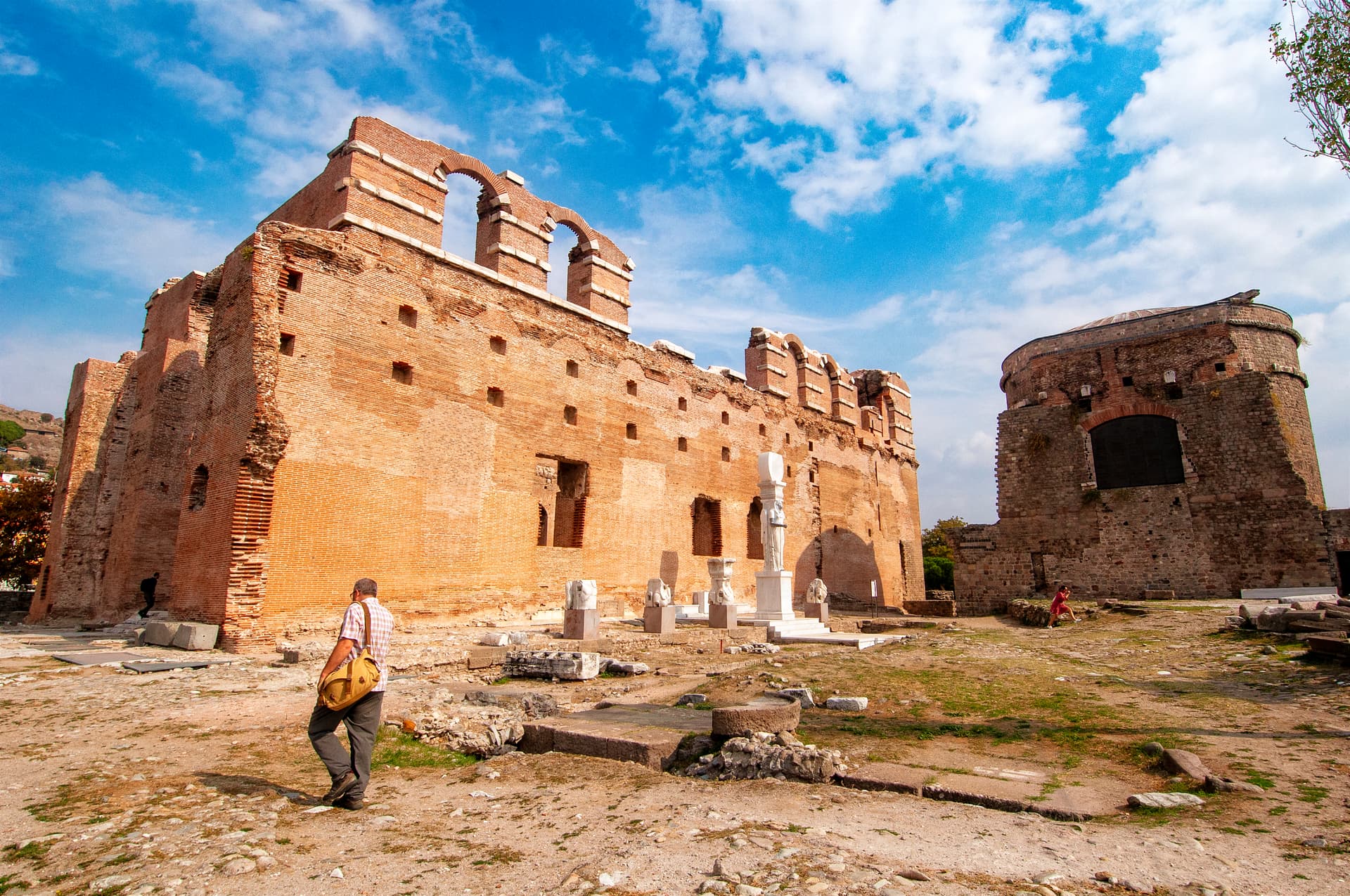
Allow half a day for the acropolis. The Asclepieion, the Red Basilica in the town centre, and the Bergama Archaeological Museum each deserve separate visits; a full Pergamon experience is a full day.
Cable car (teleferik) from the base of the acropolis hill provides the primary access. The acropolis entry is at the upper teleferik station. Main monuments from top to bottom: Temple of Trajan → Library/Athena sanctuary → Great Altar platform → Theatre → Lower acropolis structures. The Asclepieion is 2 km west of the acropolis, accessible by car or foot. The Red Basilica is in the Bergama town centre.
Context and lineage
The Attalid dynasty came to power at Pergamon through a combination of geopolitical fortune and calculated cultural investment. Philetaerus, the founder of Attalid independence, held a treasury at Pergamon and used it to establish control after Alexander's death; but it was his successors, particularly Eumenes II (197–159 BCE), who transformed the city into an assertion of intellectual and sacred authority designed to rival Alexandria and Athens.
Eumenes II commissioned the Great Altar of Zeus in the aftermath of the Attalid victory over the Galatians — a nomadic people from the Anatolian interior whose raids had destabilized the Hellenistic world for decades.
The Gigantomachy frieze was not merely mythological decoration: it was an argument that the Attalids had imposed cosmic order on chaos, that their victory over the Galatians repeated the divine victory over the Giants, that Pergamon was a place where the gods' work continued in human form.
The mythological foundation of the city was equally calculated: the Attalids promoted the tradition that Telephus, son of Heracles, founded Pergamon, connecting the dynasty to the greatest hero of the Greek world and positioning the city as inheritor of the deepest roots of Greek heroic tradition.
Kybele sanctuary (pre-Greek) → Archaic period settlement → Attalid dynasty (281–133 BCE) → Roman province of Asia (133 BCE), first imperial cult temple (29 BCE) → early Christian community (1st century CE) → Byzantine period, church construction → Ottoman period, Red Basilica converted to mosque → German Archaeological Institute excavations (1878–present) → UNESCO World Heritage inscription (2014)
Traditions and practice
Ancient religious life at Pergamon was organized around the major temples and their festival calendars: sacrifices to Zeus at the Great Altar; processions and games for Athena; Dionysiac festivals; Demeter rites at the southern slope sanctuary; the Asclepieion's healing incubation practices. The imperial cult added the requirement of formal reverence for the emperor — ceremonies that functioned as both religious obligation and political test, creating the conditions under which Christians in the city faced the choice between compliance and persecution.
Christian pilgrim groups visiting the Seven Churches of Revelation circuit conduct prayer services and Biblical study at the acropolis, often at the Great Altar platform or in view of the theatre. Guided heritage tours are the primary visitor mode. The German Archaeological Institute maintains one of the world's longest-running archaeological excavation programs at the site.
For any visitor, the morning approach is the most important practical decision: arrive at the cable car station at or before opening to reach the upper acropolis before the heat and crowds build. Move through the acropolis from top to bottom, following the descending sequence of terrace levels.
At the Great Altar platform, pause long enough to let the emptiness of the plinth register before moving on — this is one of the most significant absences in world heritage, and the photograph of an empty platform has a different quality from the hurried transit. At the theatre, sit at the upper tiers and let the steep drop of the seating registers in the body; the designed quality of the view is evident.
For Christian pilgrims, reading the Revelation passage at the site itself — 'to the angel of the church in Pergamon write' — in view of the imperial cult temple plinth gives the text a geographic specificity that no commentary can replicate.
Ancient Greek and Roman Polytheism
HistoricalOne of the densest concentrations of Hellenistic sacred architecture in the ancient world, culminating in the Great Altar of Zeus — one of the Seven Wonders according to some ancient lists — and including major temples to Athena, Dionysus, Demeter, and Kybele.
Temple sacrifices, festival processions, Dionysiac rites, Demeter mystery rites, oracle consultation, imperial cult ceremonies.
Roman Imperial Cult
HistoricalPergamon was the first city in Asia Minor to build a temple to the Roman emperor (to Augustus and Rome, in 29 BCE), making it the administrative and religious centre of Roman Asia Minor — the position the Book of Revelation identifies as 'Satan's throne.'
Emperor worship ceremonies, civic oaths, major games and festivals in honour of the imperial cult.
Early Christian — Seven Churches of Revelation
ActivePergamon is addressed as one of the Seven Churches in Revelation 2:12–17, praised for holding faith under extreme pressure while also rebuked for tolerating compromising teachings. A major stop on the active Seven Churches pilgrimage circuit.
Christian pilgrimage, prayer at the site, Biblical study tours, group worship services at the acropolis.
Pre-Greek Kybele worship
HistoricalA rock-cut sanctuary to Kybele (Cybele), the Anatolian Great Mother, on the northwestern hill of Pergamon predates the Greek city and represents the indigenous sacred layer beneath all subsequent traditions.
Kybele ecstatic rites, Phrygian mystery cult practices.
Archaeological and Scholarly Heritage
ActiveUNESCO World Heritage Site inscribed 2014. One of the most intensively excavated and documented ancient cities in the world, with German Archaeological Institute presence since 1878.
Ongoing excavation, conservation, heritage tourism, scholarly research.
Perspectives and open questions
Pergamon is one of the most multiply legible sacred sites in the world — a place that ancient Greeks, Romans, early Christians, Byzantine Christians, and modern secular visitors have all claimed for their own sacred geography in ways that do not simply cancel each other out.
Scholarly perspective
Pergamon is inscribed as a UNESCO World Heritage Site under the title 'Pergamon and its Multi-Layered Cultural Landscape' (2014), a formulation that acknowledges the site's extraordinary palimpsest of sacred and intellectual traditions. The German Archaeological Institute's excavations, continuous since 1878, make it one of the most intensively documented ancient sites in the world.
Scholarly attention has focused on three primary areas: the Attalid art program (particularly the Great Altar and the Gigantomachy frieze, now in Berlin); the Library and Pergamon's role in the history of ancient scholarship; and the city's central position in the development of Roman Asia as both administrative capital and imperial cult centre.
Living and traditional perspectives
For Christians on the Seven Churches of Revelation pilgrimage, Pergamon holds a specific quality of charged recognition. The Revelation text's phrase 'where Satan's throne is' has been interpreted as referring specifically to the Great Altar of Zeus — a massive elevated platform dedicated to the supreme deity of the pagan world, which Christian writers would have understood as the antithesis of their own Lord.
Standing at the empty altar platform while holding that text is an experience that many Seven Churches pilgrims describe as the most affecting stop on the circuit. The Pergamene church is praised for holding fast — for maintaining faith in a city where the stakes of that maintenance were existential.
Alternative interpretations
The pre-Greek Kybele sanctuary at Pergamon's northwestern hill represents a tradition that underlies all the subsequent Greek and Roman religious layers: the Anatolian Great Mother, the indigenous goddess of this terrain, whose worship preceded the Attalids by centuries and whose rock-cut sanctuary was deliberately preserved and incorporated into the Hellenistic city.
Some scholars of ancient religion argue that the Kybele layer at Pergamon is the most significant for understanding the deep history of sacred experience at this site — a claim for continuity across the Greek arrival that sits uneasily with the Hellenocentric narrative that the Attalids themselves promoted.
The esoteric tradition associates the acropolis with a significant telluric energy centre, and the site of the Great Altar specifically with a cosmic axis proposition comparable to that of the Omphalos at Delphi.
Open questions
The original appearance and precise installation context of the Great Altar in situ — now visible only as an empty platform — can only be imagined from the Berlin reconstruction. The fate of the Pergamon Library's 200,000 scrolls: the ancient story that Marc Antony removed them to give to Cleopatra (as compensation for the destruction of the Alexandrian Library) is disputed by scholars and may be a piece of hostile propaganda against Antony.
The full extent and nature of the Kybele sanctuary on the northwestern hill has not been fully excavated. The precise circumstances of the early Christian martyrdoms at Pergamon — who, when, and through exactly what mechanism of the imperial cult — are not documented in surviving sources beyond the Revelation text itself.
Plan your visit
Access and arrival
Located at modern Bergama, İzmir Province. 110 km north of İzmir via the D550 highway. Regular buses from İzmir (approximately 2 hours). Cable car (teleferik) from the base of the acropolis hill. Acropolis open daily approximately 08:30–17:30 (check current hours). Entrance: €15 or Aegean Museum Pass. Car park at the cable car base.
Bergama town offers hotels and guesthouses at various price points within walking distance of the acropolis cable car base. İzmir (110 km south) provides the full range of city hotel options for those visiting on a day trip.
Respectful visit
No dress requirements for the archaeological site. For Christian pilgrim groups conducting prayer services, modest dress is appropriate.
Permitted throughout the acropolis. No flash in museum areas. Drone use requires advance permission from the Ministry of Culture.
Not applicable to the archaeological site. Some Christian pilgrim groups hold brief prayer services at the Great Altar platform or at the theatre.
Do not climb on architectural remains. Stay on marked paths. Cordoned excavation zones must not be entered. Do not remove any material from the site.
The acropolis has very limited shade in summer; sun protection, hat, and water are essential. Some areas near active excavation zones are cordoned. The cable car has limited capacity in peak summer; early arrival prevents long queues. The slope from the cable car station to the upper acropolis involves significant uphill walking.
Location
Map loads as you approach this section.
Pilgrim reflections
A portrait of encounter, not a score
Pilgrims describe what they felt, how present they could become, and whether the place would shape a journey. There are no stars and no ranking of traditions.
No reviewed reflections yet
The first pilgrims can help describe the character of being here.
Share a reflection
Available after an account-backed “Been there.” Every reflection is reviewed before publication.
Nearby sacred places
Explore other sacred places in the region. Proximity does not establish access or travel time; check each place’s guidance.


References
Sources consulted for this page. Source categories describe the publication, not a guarantee that every claim is verified. Traditional accounts and outside interpretations may differ.
- 01Pergamon – Wikipedia — Wikipedia contributorsencyclopediaComprehensive overview of history, culture, monuments and religion
- 02Pergamon and its Multi-Layered Cultural Landscape – UNESCO World Heritage Centre — UNESCOofficialOfficial UNESCO inscription details (2014)
- 03Pergamum | Turkey, Location, Map, & History | Britannica — Encyclopaedia BritannicaencyclopediaAuthoritative reference entry
- 04How This Ancient City Thrived under the Successors of Alexander the Great | History Hit — History HitSource contextHistorical overview of the Attalid kingdom
- 05Pergamon Ancient City | UNESCO World Heritage Site in Turkey — Pergamon Ancient CityofficialDedicated site overview
- 06Pergamon in Türkiye – Spiritual Travels — Spiritual TravelsspiritualSpiritual and multi-faith significance of the site
- 07Bergama, Turkey – Sacred Destinations — Sacred DestinationsspiritualOverview of sacred dimensions of the site
- 08The Seven Churches of Revelation: Pergamum — Eyes to See the RevelationspiritualChristian pilgrimage significance of the Seven Churches connection
- 09BERGAMA (Acropolis) Entry Fee & Hours — Istanbul CluesguidePractical visitor information including hours and admission fees
Share a photo
Help visitors recognize Pergamon. Every submission is reviewed before publication.