Aigai
The Aeolian world's most powerful oracle, hidden on a mountain above western Turkey
Understand sacred places, explore living traditions, and learn how to engage respectfully with Pilgrim Map.
Access has not been verified. Check current local guidance before planning a visit.
Manisa, Turkey
Read the sources
Visit essentials
A quick read before you go
- Duration
- 3–5 hours for the main monumental areas; a full day for comprehensive exploration of the…
- Access
- Located near Yuntdağı Köseler village, Manisa Province, on Mount Yunt (Yunt Dağları).
Overview
Unlike continent-famous Delphi, Didyma, and Klaros, Aigai was the supreme regional oracle of Aeolis's twelve-city league. Its strategic Mount Yunt height also felt otherworldly, with underground water understood as a conduit of divine speech. A stone-paved sacred road led from the lower city to Apollo Chresterios—`the Prophetic`, a cult title found at no other major oracle—past altars and votives to a precinct where a priestess drank from the spring and voiced Apollo's answers.
Since 2004, Ege University excavations under Ersin Doğer have uncovered a 2,200-year-old agora with bull reliefs and Apollo inscriptions, a unique Hellenistic sundial in the council chamber, nearly 100 cisterns and sophisticated hydraulics. The sanctuary altar and precinct await full excavation. Aigai remains an underknown, accessible major ancient site in western Turkey.
Why this place is sacred
The geography of oracle sites in the ancient world follows a recognisable pattern: elevation, water, enclosure, often a subterranean element. Aigai on Mount Yunt has all of these. The altitude creates isolation from the ordinary world. The underground water sources — which the ancient mind understood as the earth's breath — were associated with the kind of pneumatic inspiration that enabled prophecy.
The sacred road imposed a process of approach, slowing the petitioner and marking the transition from the daily world to the zone of divine communication.
What made Aigai's oracle distinct from the great Ionian oracles of Didyma and Klaros was its specifically Aeolian character. The Aeolian cities maintained the Aigai sanctuary as a shared religious institution: it was their oracle, the place where the collective spiritual questions of a region were addressed. The pilgrims who came here were not only seeking personal guidance but participating in a larger conversation between a people and their god.
The combination of mountain setting, sacred water, a purpose-built processional road, and a tradition of over seven centuries of oracle function generates a quality at Aigai that is felt rather than explained. The site is not yet managed for visitors in the way that Ephesus or Pergamon are. Encountering it in this condition — partially excavated, half-revealed, still being understood — carries its own form of revelatory charge.
Principal oracle sanctuary of the Aeolian dodecapolis, dedicated to Apollo Chresterios (Apollo the Prophetic). The oracle mediated between the human and divine worlds through a priestess in contact with the sacred spring.
Functioning oracle from at least the founding period (c. 800 BC) through the Roman period. The city was a member of the Aeolian dodecapolis and later passed under Lydian, Achaemenid, and Attalid rule without loss of its oracle function. Declined in late antiquity as the oracle tradition ended. Site rediscovered and excavation begun 2004; ongoing annually since.
Experience and orientation
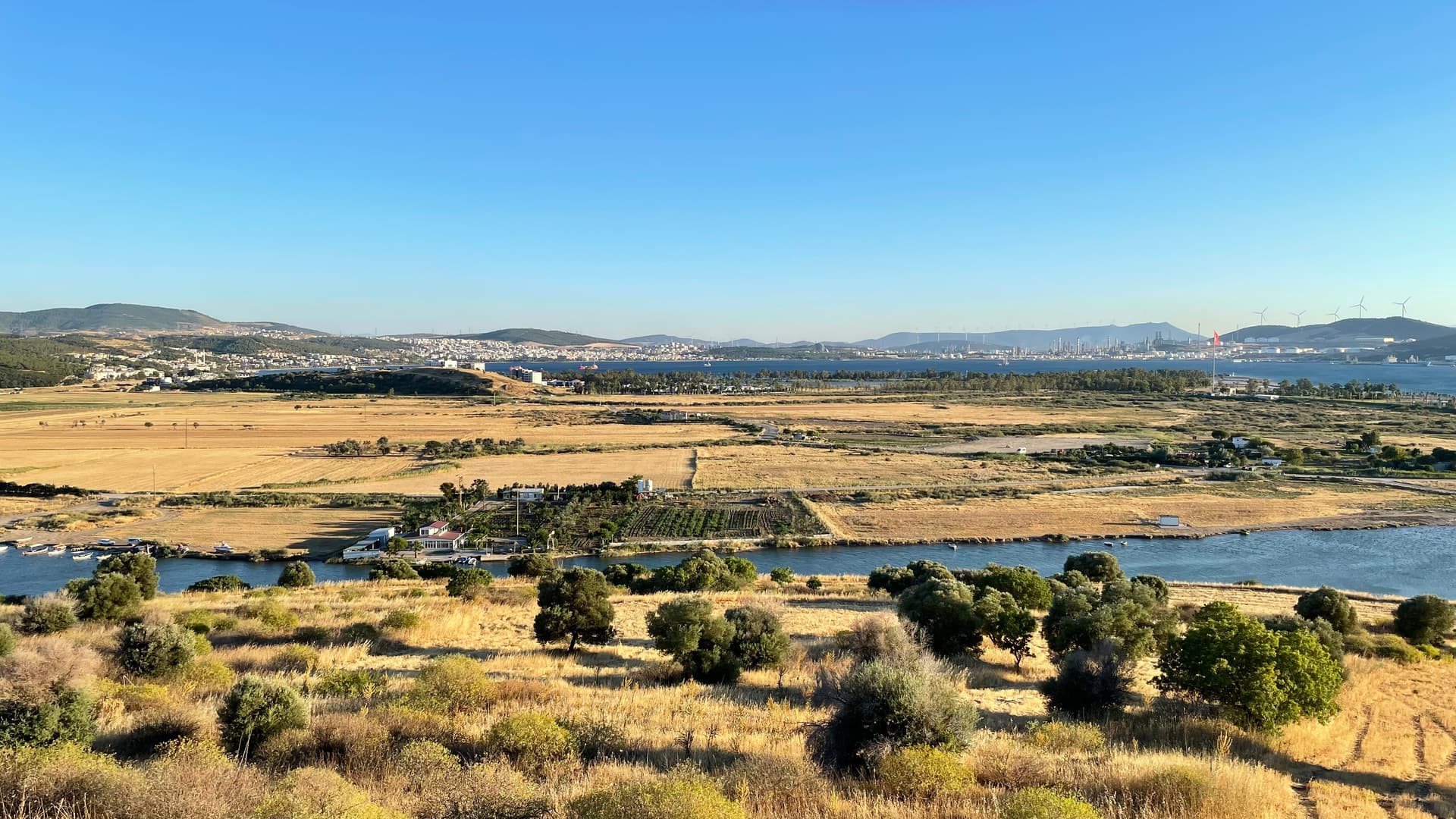
The road to Aigai via Yuntdağı Köseler climbs through the Yunt Mountains through terrain that becomes progressively less domesticated. The mountain has the quality of many ancient sacred places: not dramatic by the standards of a Cappadocian landscape, but persistent in its height, its silence, and its sense of separation from the valley world below.
The site itself is extensive — the city covered a substantial area, and the excavations have been working outward from the main monumental zone for two decades. What is most immediately visible includes the sacred road, paved in stone and still surprisingly intact in sections, climbing toward the Apollo precinct. Walk it slowly.
The road was built to pace a procession, not a tourist — to create a duration of approach that would have allowed the petitioner to shift their state of mind before reaching the oracle.
The agora area has yielded the most visually legible remains, including architectural elements with Apollo inscriptions and the bull-headed reliefs that indicate the presence of a major sanctuary. The council chamber (bouleuterion) where the unique sundial was found is nearby — a sundial unlike any other known from the Hellenistic world, suggesting Aigai's sophisticated engagement with astronomical timekeeping.
At the Apollo Chresterios sanctuary, the altar precinct and temple foundations are visible. Pause here. The underground water sources that made this the oracle site of the Aeolian world are not audible or visible, but their presence is structural: the entire sacred geography was organised around them. Where the priestess once sat to receive Apollo's voice through the earth's moisture, the ground is now dry limestone.
But the shape of the place — the enclosure, the orientation, the processional approach — preserves the intention.
Access requires a sturdy vehicle for the mountain road from Akhisar or Manisa. The site is not served by public transport. Active excavation seasons typically run in summer; access during excavation may require coordination with the Ege University team. No formal visitor infrastructure is in place; bring water, sun protection, and appropriate footwear.
Context and lineage
The city of Aigai was founded by Aeolian Greeks, the least-known of the three principal Greek dialect groups (alongside Dorians and Ionians), who settled along the northern Aegean coast of Anatolia beginning in the 10th–9th century BC. The Aeolian cities formed a religious and cultural league — the dodecapolis — that was documented by Herodotus and Strabo, though Aigai's membership was eventually replaced by Smyrna's.
The founding community selected Mount Yunt for its strategic qualities: elevation, defensibility, water sources. The association of underground water with Apollo's prophetic gift shaped the sanctuary from the beginning. The title given to the god here — Chresterios, the Prophetic — is not found as a cult epithet at any of the other great oracle centres; it is specific to Aigai, suggesting that prophecy was understood as the defining characteristic of this particular Apollo.
The city reached its most prosperous period under the Attalid dynasty of Pergamon in the 3rd and 2nd centuries BC. Attalid patronage funded the Hellenistic rebuilding of the Apollo temple and associated structures. When the kingdom passed to Rome in 133 BC, Aigai continued as a functioning city and oracle centre into the imperial period.
It appears to have been gradually depopulated rather than violently destroyed, the combination of its difficult terrain and the end of oracle culture in late antiquity rendering it economically marginal.
Aeolian Greek settlement (c. 800 BC) → Aeolian dodecapolis membership → Lydian and Persian rule → Attalid (Pergamon) patronage and rebuilding (3rd–2nd century BC) → Roman period continuation → late antique decline → rediscovery and ongoing excavation (2004–present)
Ersin Doğer
Lead archaeologist
Herodotus
Ancient historian
Strabo
Ancient geographer
Traditions and practice
Oracle consultation at Aigai followed the general pattern of Apolline oracle sites: a petitioner approached via the sacred road, likely after preliminary purification; animal sacrifice was performed at the great altar before the sanctuary; then the oracle process itself — the priestess in contact with the sacred spring, receiving Apollo's prophetic communication and transmitting it in verse or through an interpreter.
Sacred festivals of the Aeolian league may have included competitive events (musical, athletic) held at Aigai, as was common at major oracle sanctuaries.
The sacred road itself was a ritual instrument. Its stone paving, its defined route from city to sanctuary, and the votive monuments and altars that would have lined it created a staged transition from ordinary to sacred space. The walk was the first act of worship.
No active religious practices. Archaeological excavations are ongoing in annual seasons. The site receives few visitors relative to its significance.
Walk the sacred road from its lower end to the Apollo precinct without stopping. The appropriate pace for a processional road is slower than you think — the rhythm of procession is not the rhythm of tourism. At the oracle precinct, sit at the altar area for long enough for the space to stop being a ruin and start being a place.
Notice where the terrain drops or changes in a way that might indicate underground water — this is what the ancient builders were reading when they chose this specific location on this mountain.
In the agora, find the bull-headed reliefs if they are visible; bulls were the primary sacrificial animal of Apollo's major sanctuaries. The scale of the agora — 2,200 years old, still readable as an urban space — is evidence of a city that genuinely functioned, that had markets and politics and daily commerce alongside the oracle work.
Bring a copy of Strabo's Geography if you can; reading his description of the Aeolian dodecapolis while standing in one of its cities is a particular pleasure of Aigai that more famous sites cannot offer.
Ancient Greek religion — Apollo Chresterios oracle
HistoricalThe most important oracle of the Aiolis region, dedicated to Apollo Chresterios (the Prophetic). Pilgrims from the twelve Aeolian cities and beyond came seeking divine counsel via a priestess in contact with underground sacred water sources. The oracle occupied the same regional religious authority as Didyma held for Ionia.
Sacred road processions; animal sacrifice; oracle consultation through the priestess; votive offerings; periodic festivals of the Aeolian league
Ancient Greek religion — Athena worship
HistoricalAigai hosted a Temple of Athena on the city acropolis; ongoing excavations since 2017 continue to uncover this sanctuary, confirming the presence of Athena alongside Apollo in the city's religious life.
Civic religious rites, votive offerings, seasonal festivals
Archaeological and scholarly heritage
ActiveOngoing excavations by Ege University since 2004 under Ersin Doğer have revealed Aigai as one of the most significant and best-preserved ancient cities in western Turkey. Discoveries include the unique Hellenistic sundial, a 2,200-year-old agora, sophisticated waterworks, and the Apollo oracle precinct — making it a site of active scholarly interest.
Annual excavation seasons; international academic publication; conservation and restoration of exposed structures
Perspectives and open questions
Aigai has been interpreted through archaeological, religious-historical, sacred geography, and comparative oracle studies frameworks — the site's significance expanding as excavations reveal its true scale.
Scholarly perspective
Aigai is confirmed by Herodotus and Strabo as a member of the Aeolian dodecapolis, the league of twelve Aeolian cities that constituted one of the principal cultural groupings of early Greek Asia Minor. Its Apollo Chresterios oracle was the religious centre of this league — comparable in function to the oracles of Didyma (for Miletus and Ionia) and Klaros (for the broader Ionian league).
Excavations since 2004 have revealed a sophisticated urban centre including hydraulic engineering, a unique Hellenistic sundial, a well-preserved agora with Apolline inscriptions, and the oracle sanctuary precinct. The site's relative obscurity in classical scholarship reflects its difficult access rather than any lack of historical importance.
Living and traditional perspectives
In antiquity, Aigai was understood as a divinely favoured city whose prosperity was inseparable from Apollo's prophetic presence. The cult title Chresterios (the Prophetic) suggests that the Aigai oracle was defined by its prophetic function in a way that distinguished it from other Apolline sanctuaries. The communities that belonged to the Aeolian league came to Aigai not as strangers seeking exotic wisdom but as members of a tradition — a people returning to their god on their mountain.
Alternative interpretations
The combination of high altitude, underground water, mountain isolation, and oracle function places Aigai within a well-recognised pattern of ancient sacred geography in which subterranean elements were associated with prophetic and chthonic powers. Sacred sites sharing this combination — elevated, water-bearing, enclosing — appear across the ancient world in contexts associated with oracle, healing, and the communication with forces below the ordinary surface of experience.
Whether this pattern reflects geological reality (specific gases, spring chemistry), psychological response to particular environments, or something else remains genuinely open.
Open questions
The precise oracular ritual methodology at Aigai: whether the priestess inhaled, drank, or was otherwise in contact with the sacred spring; the relationship between Aigai's oracle and those of Didyma and Klaros in terms of organisational structure and pilgrimage traffic; the full extent of the Aeolian religious calendar at this site; the fate of the cult statues of Apollo and Athena.
Plan your visit
Access and arrival
Located near Yuntdağı Köseler village, Manisa Province, on Mount Yunt (Yunt Dağları). Accessible by road from Akhisar (approximately 35 km) or Manisa. The mountain road requires a high-clearance or 4WD vehicle for the final section. No public transport serves the site. No entrance fee has been documented; check current access arrangements with Ege University's archaeology department or local tourism offices in Manisa before visiting. Mobile phone signal is unreliable at altitude — check for network coverage before leaving the valley.
No emergency services are directly accessible at the site; the nearest town with services is Akhisar.
No accommodation at the site. The nearest town with hotels is Akhisar or Manisa. Visitors typically make Aigai a day trip from one of these towns or from İzmir (approximately 100 km southwest).
Respectful visit
Practical clothing for mountain terrain: sturdy footwear, sun protection, layers. No religious dress requirements.
Generally permitted. Respect any signage around active excavation areas. Do not photograph excavation trenches without permission from the site team if researchers are present.
Not applicable.
Do not enter roped or fenced excavation areas. Do not move or remove any material from the site. Do not disturb visible archaeological features. Stay on cleared paths where these exist.
The mountain road is not suitable for low-clearance vehicles. Excavation areas may be restricted during active digging seasons — look for roping or signage and respect it. The site has no formal visitor facilities; carry water and food. Mobile phone signal may be unreliable on the mountain. Inform someone of your plans before visiting this remote site.
Location
Map loads as you approach this section.
Pilgrim reflections
A portrait of encounter, not a score
Pilgrims describe what they felt, how present they could become, and whether the place would shape a journey. There are no stars and no ranking of traditions.
No reviewed reflections yet
The first pilgrims can help describe the character of being here.
Share a reflection
Available after an account-backed “Been there.” Every reflection is reviewed before publication.
Nearby sacred places
Explore other sacred places in the region. Proximity does not establish access or travel time; check each place’s guidance.

References
Sources consulted for this page. Source categories describe the publication, not a guarantee that every claim is verified. Traditional accounts and outside interpretations may differ.
- 01Aigai (Aeolis) - Wikipedia — Wikipedia contributorsencyclopediaOverview of history, location, and excavations
- 02Temple of Apollo Chresterios – AIGAI EXCAVATIONS AND RESEARCH — Aigai Excavations ProjectofficialOfficial excavation project website with detailed temple information
- 03The Most Important Oracle of the Aiolis Region: The 2,300-Year-Old Temple of Apollo Khresterios at Aigai — Anatolian ArchaeologyacademicAcademic account of the oracle sanctuary and its regional significance
- 042200-year-old agora of the ancient city of Aigai on Yunt Mountain was found — Anatolian ArchaeologyacademicDiscovery of the Hellenistic agora with Apollo-linked inscriptions
- 05Countless Artifacts, Structures And Roads Discovered In Ancient City Of Aigai, Turkey — Ancient PagesSource contextSummary of 2022 excavation season discoveries
- 06Ancient city of Aigai in western Turkey impresses with its complicated waterworks — Daily SabahSource contextCoverage of the hydraulic engineering finds
- 07Hidden oracle of Apollo awaits restoration — Hurriyet Daily NewsSource contextOverview of the oracle sanctuary's current state and restoration plans
- 08Rare Ancient Sundial Reveals Greek Maritime Mysteries in Turkey — Ancient OriginsSource contextDiscovery of unique Hellenistic sundial in the Bouleuterion
Share a photo
Help visitors recognize Aigai. Every submission is reviewed before publication.