Quirigua
A Maya city of stone trees, holding the tallest carved monoliths of the ancient Americas
Understand sacred places, explore living traditions, and learn how to engage respectfully with Pilgrim Map.
Access has not been verified. Check current local guidance before planning a visit.
Finca Quirigua D.M., Izabal, Guatemala
Read the sources
Visit essentials
A quick read before you go
- Duration
- 1.5 to 2.5 hours to walk the Great Plaza, ballcourt, and acropolis.
- Access
- In Los Amates municipality, Izabal, about 200 km northeast of Guatemala City off the Río Dulce…
Overview
In the hot, humid Motagua valley lowlands of Izabal, now ringed by banana plantations, Quiriguá preserves the Classic Maya's most monumental sculpture. Founded around AD 426 as Copán's subordinate, it claimed independence in 738 when King K'ak' Tiliw Chan Yopaat, or Cauac Sky, captured and sacrificed Copán's ruler. A century of monument-building unmatched in scale followed.
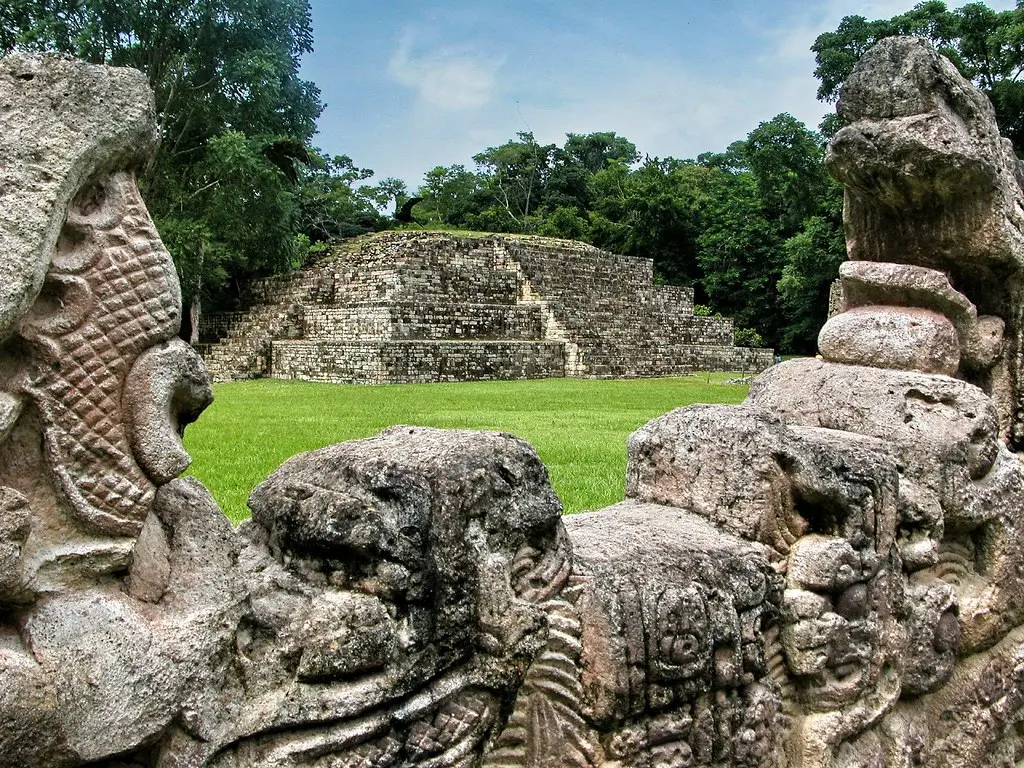
The Great Plaza makes royal time, creation myth, and heaven visible in stone. Its sandstone “stone trees,” crowned by Stela E, are Mesoamerica's tallest free-standing carved monoliths; boulder-carved zoomorphs depict the cosmic crocodile and creator deity Itzamna. Stelae A and C with Zoomorph B retell Maya creation and appear to reconstruct Orion and the three creation-stones on earth, while Zoomorph P depicts humanity's creation. Hieroglyphs also record ritual time, including a Katun-ending ceremony in 771.
UNESCO inscribed Quiriguá in 1981. No site-specific contemporary ceremony is documented, but its creation, three-hearthstone, and world-tree cosmology remains central to living Maya practice across Guatemala. The monoliths still frame kingship as cosmic order within a lush, bird-rich landscape.
Why this place is sacred
Quiriguá's power is concentrated in its stones. Nowhere else did the Maya raise carved monoliths so tall, and they were not mere portraits of kings but instruments of cosmology: stelae as 'stone trees' linking earth and sky, zoomorphs binding the three creation-stones into the king's throne, arrangements that seem to rebuild Orion and the moment of creation on the ground of the Great Plaza.
To walk among them is to enter an ancient argument that royal authority and the order of the cosmos were one and the same. The lowland forest-and-plantation setting along the Motagua, alive with birds, frames the monuments quietly. The thinness here is the thinness of a cosmos made tangible: standing beneath stones carved to map the creation of the world conveys the Maya vision of kingship as cosmic order more directly than any text.
Experience and orientation
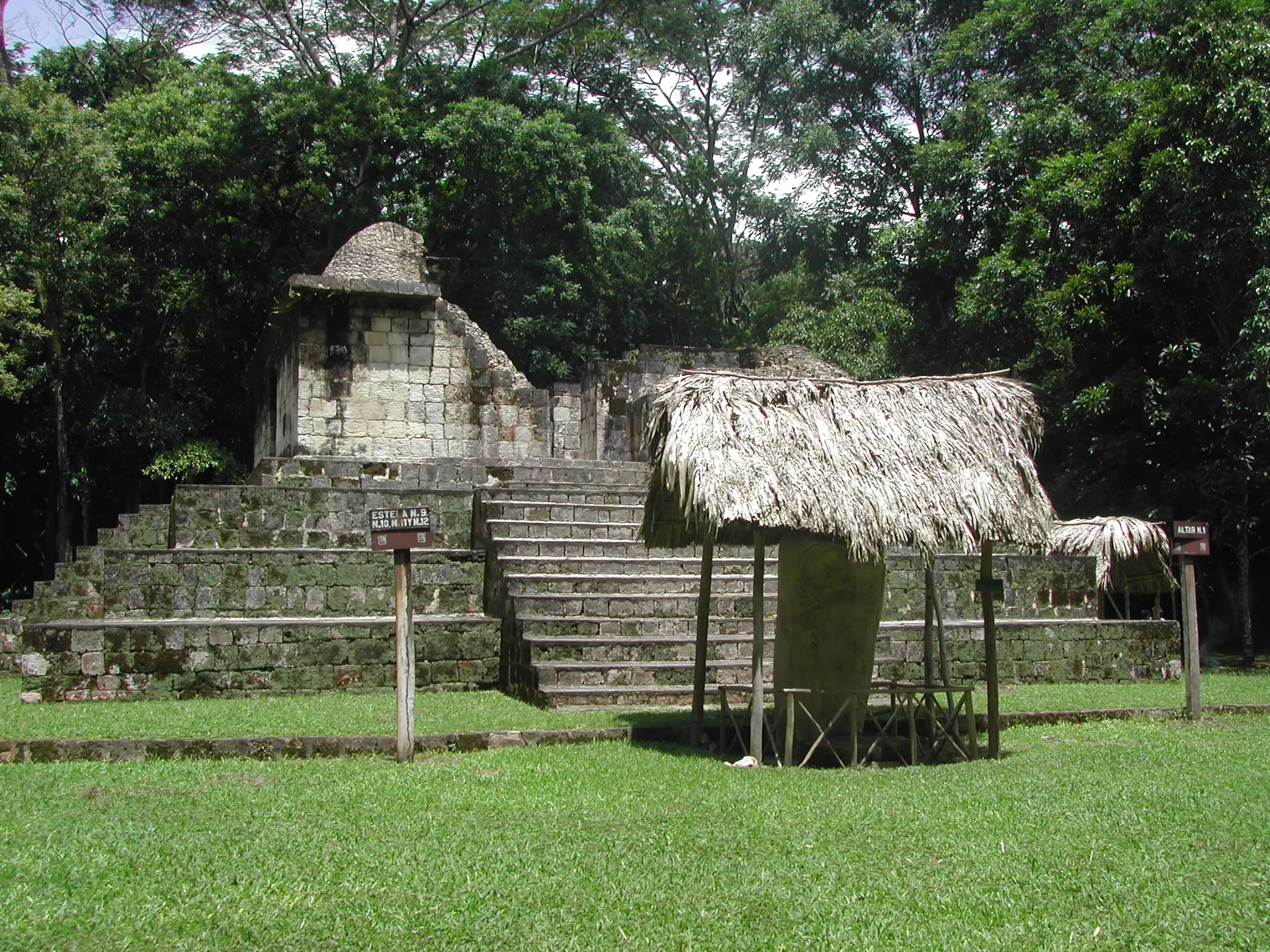
Visitors describe a compact, lush park ringed by banana farms, entered along a lane through the plantations. The towering sandstone stelae and massive boulder-carved zoomorphs are the focus, many now sheltered under thatch roofs to protect the carvings, and the surrounding forest is rich in birdlife. The monuments reward slow, close reading, ideally with a guide who can unfold the hieroglyphic texts and the creation imagery encoded in Stelae A and C, Zoomorph B, and Zoomorph P.
There is no formal participatory ritual at Quiriguá; the experience is one of standing beneath monoliths that map the creation of the world and conveying the ancient Maya vision of kingship as cosmic order. The Great Plaza, ballcourt, and acropolis form a walkable circuit.
Allow 1.5 to 2.5 hours to walk the Great Plaza, ballcourt, and acropolis. The lowlands are hot and humid; wear light clothing, a hat, sun protection, and bring water. Do not climb on or touch the stelae and zoomorphs.
Context and lineage
Quiriguá's monuments retell the Maya creation. Stelae A and C with Zoomorph B appear to rebuild the constellation of Orion on earth, the place of the three creation-stones, and Zoomorph P is read as the re-enactment of the creation of humankind, with the Cosmic Monster, Itzamna, binding the three stones into the king's sacred throne.
Historically, the city was founded around AD 426 under Copán's influence and rose to greatness when K'ak' Tiliw Chan Yopaat captured and sacrificed Copán's ruler in 738, an event its texts record and its monuments celebrate.
Classic Maya religion and royal ritual, whose creation cosmology continues in living Maya practice regionally.
K'ak' Tiliw Chan Yopaat (Cauac Sky)
King
Classic Maya of the lower Motagua valley
Builders
Maya sculptors and scribes
Monument carvers
Ajq'ijab' and contemporary Maya communities
Living tradition (regional)
Conservators and the UNESCO World Heritage authority
Custodians
Traditions and practice
Katun-ending stela dedications, public political ritual including the 738 sacrifice of Copán's king, ballgame ritual, and creation-myth re-enactments in stone.
No documented site-specific contemporary ceremony at Quiriguá; living Maya practice, rooted in the same cosmology, continues across the region.
Read the stelae and zoomorphs slowly with a guide to follow the creation narrative and the royal time-keeping carved into them. Let the monuments convey the Maya vision of kingship and cosmos rather than seeking a participatory rite.
Classic Maya religion and royal ritual
HistoricalUnder K'ak' Tiliw Chan Yopaat, Quiriguá broke from Copán in 738 and erected the greatest series of carved monoliths in the Maya world, encoding creation myth and royal time-keeping.
Stela 'planting' on Katun endings, public sacrifice (the 738 execution of Copán's ruler), ballgame ritual, and zoomorph dedication re-enacting the cosmos.
Contemporary Maya spirituality (regional)
ActiveThe living Maya of Guatemala continue calendrical and agricultural ceremonies rooted in the same cosmology expressed at Quiriguá, though no site-specific ritual at Quiriguá is documented.
New-year (Chol Q'ij / Tzolk'in) ceremonies, corn-cycle festivals, and fire and offering rites led by ajq'ijab'.
Perspectives and open questions
Quiriguá is celebrated for its monumental sculpture and victory over Copán, connected to living Maya cosmology, and noted in popular accounts for the astronomical reading of its monuments.
Scholarly perspective
Scholars describe a Classic Maya city famed for the tallest Maya stelae and elaborate zoomorphs, whose hieroglyphic texts record its 738 victory over Copán and its rulers' ritual time-keeping; it was inscribed as a UNESCO World Heritage Site in 1981.
Living and traditional perspectives
The cosmology carved at Quiriguá, creation, the three hearthstones, the world tree, remains central to living Maya religious practice across Guatemala.
Alternative interpretations
Popular accounts emphasize the astronomical reading of the monuments as an attempt to rebuild Orion and the cosmos on earth.
Open questions
Precise readings of some zoomorph texts and the full ritual choreography of the Great Plaza remain debated. Stela E's height is cited variously as around 35 feet carved or 36 feet overall, both referring to the same monument as the tallest free-standing Maya monolith.
Plan your visit
Access and arrival
In Los Amates municipality, Izabal, about 200 km northeast of Guatemala City off the Río Dulce highway; reached by car, bus, or tour, the entrance lane passing through banana plantations. Current exact hours and fees were not confirmed; check locally before visiting.
Respectful visit
Light, breathable clothing; a hat and sun protection for the hot, humid Motagua lowlands.
Permitted; avoid flash and touching the monuments to protect the carvings.
None are expected at the monuments.
Do not climb on or touch the stelae and zoomorphs; stay on designated paths; bring water for the hot, humid climate.
Do not touch the carvings or use flash, both of which damage the stone, and do not leave offerings at the monuments.
Current practical details
Address
7X95+HVV, Las Viñas, Guatemala
Phone
Hours
Hours, fees, and access can change — verify on the official source before you travel. Practical details last checked Jun 2026.
Location
Map loads as you approach this section.
Pilgrim reflections
A portrait of encounter, not a score
Pilgrims describe what they felt, how present they could become, and whether the place would shape a journey. There are no stars and no ranking of traditions.
No reviewed reflections yet
The first pilgrims can help describe the character of being here.
Share a reflection
Available after an account-backed “Been there.” Every reflection is reviewed before publication.
Nearby sacred places
Explore other sacred places in the region. Proximity does not establish access or travel time; check each place’s guidance.

References
Sources consulted for this page. Source categories describe the publication, not a guarantee that every claim is verified. Traditional accounts and outside interpretations may differ.
- 01Quiriguá — Wikipedia — Wikipedia contributorsacademicConfirms 738 AD capture of Copán's ruler by K'ak' Tiliw Chan Yopaat, stelae and zoomorphs, location at Los Amates (Izabal), UNESCO 1981.
- 02Quirigua — UNESCO World Heritage Site Travel Guide / World Heritage Centre — UNESCOofficialConfirms 1981 World Heritage inscription and outstanding stelae/monuments.
- 03Quiriguá — Living Maya Time (Smithsonian NMAI) — Smithsonian National Museum of the American IndianacademicAuthoritative overview of Quiriguá's monuments and history within Maya-time exhibition.
- 04Quirigua Archaeological Park — History and Facts — History Hit — History HitSource contextSummary of Quiriguá's history, independence from Copán, and monumental sculpture.
- 05The Stelae of Quirigua — Uncovered History — Uncovered HistorySource contextDetails Stela E as tallest monolith, Katun-ending ceremony of Jan 22, 771 CE, and creation-myth re-enactment in Stelae A, C and Zoomorph B.
- 06The Zoomorphs of Quirigua — Uncovered History — Uncovered HistorySource contextDescribes Zoomorph P (turtle, ~20 tons), cosmic crocodile, Itzamna/Cosmic Monster, creation-of-man imagery.
- 07Ruinas de Quirigua coordinates — latlong.net — latlong.netSource contextCoordinates ~15.2686 N, -89.0406 W; site within Los Amates municipality, Izabal.
Share a photo
Help visitors recognize Quirigua. Every submission is reviewed before publication.