Esquipulas
Where Central America walks to meet a dark crucified Christ carved in 1594
Understand sacred places, explore living traditions, and learn how to engage respectfully with Pilgrim Map.
Access has not been verified. Check current local guidance before planning a visit.
Esquipulas, Chiquimula, Guatemala
Read the sources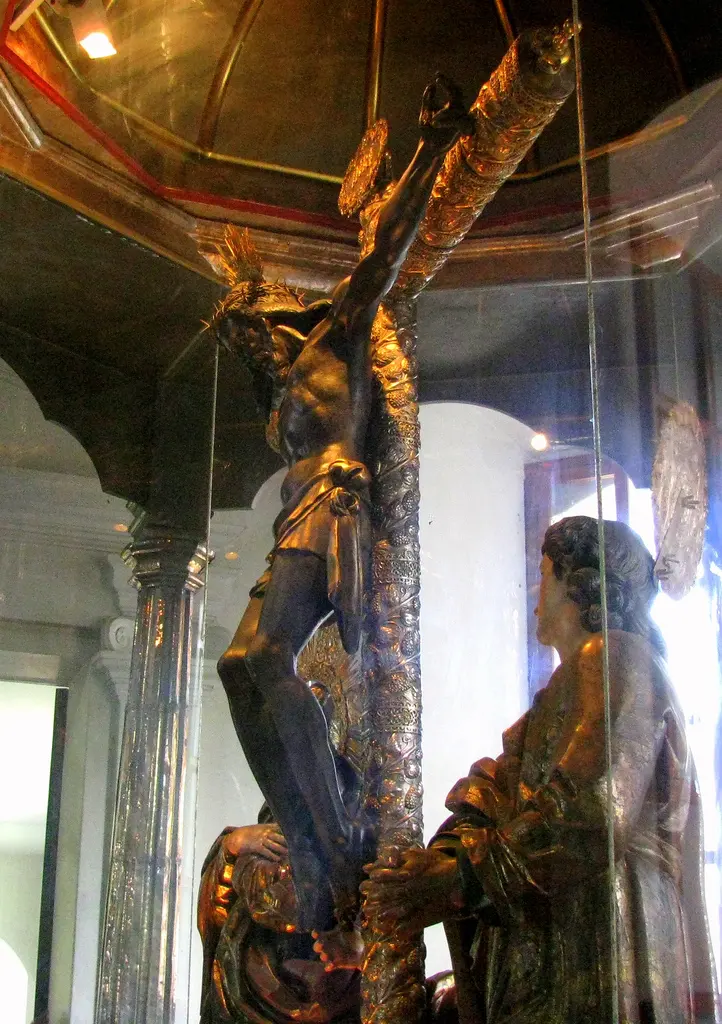
Image of Esquipulas. Image source · CC-BY-SA-2.0
Visit essentials
A quick read before you go
- Duration
- 1–3 hours for a focused visit and veneration.
- Access
- About 222 km east of Guatemala City via CA-9 (Atlantic Highway) and CA-10.
Overview
Esquipulas centers on a dark wooden Christ just under two metres tall, carved in Antigua Guatemala in 1594 by Portuguese-Guatemalan sculptor Quirio Cataño. The four-towered late-Baroque basilica, consecrated in 1759, dominates the valley and the town's pilgrimage life. Each January 15, walkers arrive from El Salvador, Honduras, Nicaragua, and southern Mexico; after approaching the altar's camarín, many leave backward rather than turn from Christ.
The image's darkness remains unexplained: some say Cataño was asked for an imagen oscura so local Ch'orti' Maya could recognize themselves; others cite candle smoke, oil, and pilgrims' touch, while restorers have cleaned and re-darkened it. Healings have been credited since the 1590s, notably Archbishop Pedro Pardo de Figueroa's reported 1737 cure.
Pope John XXIII raised the shrine to basilica status in 1961, John Paul II prayed here in February 1996, and the 1986 and 1987 Esquipulas accords helping end Central American civil wars were signed in the complex.
Why this place is sacred
The valley was already sacred when the Spanish arrived. Ch'orti' Maya tradition located a spring here, and the dark earth of the surrounding hills had its own ritual use.
The 1594 commission of a dark crucified Christ for the village priest was not a clean break from that landscape but a layering on top of it; modern scholarship treats Esquipulas as one of the clearest cases of Mesoamerican Catholic syncretism, where pre-Columbian veneration of earth, spring, and dark substance was recoded in Catholic form.
That continuity is still visible. Pilgrims buy small clay tablets called bendita tierra — 'blessed earth' — stamped with the image of Christ. Some are eaten, some dissolved in water, some carried home as protective amulets. Anthropologist John Hunter studied the practice in 1973 as a Mesoamerican geophagic tradition with documented mineral content. Outside the basilica, pilgrims still burn copal in open braziers, the smoke drifting against the white walls of an 18th-century Catholic church.
Inside, the camarín produces an unusual intensity. The chamber behind the altar is small, the image is at close range, and pilgrims often arrive after multi-day walks with a specific vow. Many press photographs, rosaries, or letters to the wood. The combined sensory load — incense, candle wax, exhausted pilgrim weeping, the bare presence of the image — is what longtime pilgrims mean when they describe Esquipulas as a place where one feels accompanied.
The 1986 and 1987 peace accords, signed in this complex by Central American presidents, give the place a further layer of political and historical depth.
The image was commissioned in 1594 by the parish priest of Esquipulas as a devotional crucifix for the small village church. Within decades the image had drawn regional reputation for healing; by 1737 the cult was prominent enough that an archbishop's reported cure became the basis for commissioning a new and far larger basilica.
The present basilica was designed by Felipe de Porres, built between 1735 and 1759, and consecrated on 4 January 1759. The pilgrimage grew steadily through the colonial and republican periods and survived the 19th-century anti-clerical movements that suppressed many regional shrines. In 1961 Pope John XXIII raised the church to the status of minor basilica.
The 1986 and 1987 Esquipulas peace accords, signed at the basilica complex, brought the site into international attention and contributed to the 1987 Nobel Peace Prize awarded to Costa Rica's Óscar Arias. Pope John Paul II prayed before the image on 6 February 1996. The basilica has been staffed by Benedictine monks since the mid-20th century.
Healing traditions
Historical devotional healing account
Guatemala's cultural registry links the great basilica at Esquipulas to Bishop Pedro Pardo de Figueroa's gratitude for a recovery in 1737. He attributed his healing to the Black Christ and supported the larger sanctuary that would receive the growing pilgrimage. The account explains how a personal petition became part of the building's history; the miraculous interpretation is the devotion's own.
Ways to participate
Bring your intention before the Black Christ, join public worship, or offer a prayer of thanks. Follow the basilica's current arrangements around the image and candles. A blessing or a quiet visit can express the same trust without needing to purchase a particular object.
These accounts describe religious traditions and reported experiences. They do not promise a cure or replace medical care.
Experience and orientation
Most pilgrims who arrive on foot enter the town from the south, where the road descends from the mountains and the four white towers of the basilica come into view. Many fall to their knees on the final stretch. Inside the town, the streets near the basilica are full of stalls selling candles, rosaries, photographs of the image, and the small stamped tablets of bendita tierra.
The basilica itself is bright and high inside, with a single broad nave leading to an elevated altar. The image of the Black Christ is set above and behind the main altar, and pilgrims do not see it directly from the nave; instead, they queue around to the back to enter the camarín, a narrow chamber where one can stand at very close range.
The queue is slow on ordinary days and exhausting on feast days; the line on January 15 can take many hours.
In the camarín, pilgrims have a few seconds at the image. Most touch the cross, some press rosaries or photographs of family members, many weep. There is no rush from staff; the rhythm is set by the pilgrims themselves. On leaving, one walks backward out of the chamber, keeping eyes on Christ — a long-standing local custom, not a formal rule.
Outside in the courtyards, copal braziers fill the air with resinous smoke. Pilgrims light candles at the open candle-burning area, often dozens at a time for specific intentions. Many sit afterward in the plaza, eating, resting, or sleeping; the long walks home will not start until the next morning.
If you have come for the January feast, accept that the queues are long and the town is full. Arrive a day or two before the principal feast on 15 January and plan to stay through the novena; the rhythm of the place is in the days, not the single hour at the image. Outside the feast, the basilica is open daily and the queue to the camarín may take only minutes.
Buy a small tablet of bendita tierra from the basilica shop rather than from street vendors; the shop's tablets are blessed and the proceeds support the Benedictine community.
Context and lineage
In 1594 the parish priest of Esquipulas commissioned the Portuguese-Guatemalan sculptor Quirio Cataño, then working in Antigua, to carve a crucifix for the village church. Tradition holds that the priest asked for an 'imagen oscura' so that the Ch'orti' Maya parishioners would recognise themselves in the figure; whether Cataño achieved this by dyeing the wood or by selecting a naturally dark species is not securely known.
The first miracle widely publicised was the reported 1737 healing of Archbishop Pedro Pardo de Figueroa of an unspecified serious illness; in gratitude he ordered the construction of the present basilica, which was consecrated in 1759. Pre-Columbian Ch'orti' tradition had already located a sacred spring in the valley; the basilica grounds preserve this spring as the Pozo del Señor, and pilgrims still draw water from it.
From the 1590s onward, Esquipulas drew a steadily expanding circle of pilgrims — first from the surrounding Ch'orti' towns, then from across colonial Guatemala, then across Central America after independence. Today the cult extends well beyond the region: Black Christ images modelled on Esquipulas are venerated in Chimayó, New Mexico (founded by a Guatemalan in the 1810s); Portobelo, Panama; and many Central American emigrant parishes in the United States.
The Benedictine community that staffs the basilica has held the shrine since the mid-20th century and is responsible for daily liturgy, pilgrim care, and the production of the bendita tierra tablets.
Christ (the Cristo Negro of Esquipulas)
deity
The crucified Christ as encountered through the 1594 image of Esquipulas. Catholic tradition holds that Christ acts through the image to heal, protect, and reconcile; pilgrims address him as Señor de Esquipulas.
Quirio Cataño
historical
Portuguese-Guatemalan sculptor of the late 16th century. Carved the image of the Black Christ in Antigua Guatemala in 1594 on commission from the parish priest of Esquipulas. He is one of the most influential colonial Central American sculptors.
Archbishop Pedro Pardo de Figueroa
historical
Archbishop of Guatemala whose reported cure before the image in 1737 brought the cult of Esquipulas to official attention and led him to commission the present basilica. He died in 1751, before the church was completed.
Felipe de Porres
historical
Guatemalan architect, son of the architect Diego de Porres. Designed the present four-towered basilica, built between 1735 and 1759 in a late-Baroque Guatemalan idiom.
Ek' Chuah and Maya earth-deities
deity
The Esquipulas valley is Ch'orti' Maya territory, and pre-Columbian devotion to springs, dark earth, and underworld forces — sometimes associated with the Maya deity Ek' Chuah — is widely cited by scholars as the substrate of the modern cult. Indigenous pilgrims still bring copal, maize, and earth to the image.
Traditions and practice
Veneration in the camarín is the heart of the visit. Pilgrims queue around behind the altar, enter the chamber, and have a brief close encounter with the image; touching the cross is permitted and almost universal. On leaving, pilgrims walk backward so as not to turn their backs on Christ. Outside, candles are lit in dedicated burning areas where the wax accumulates in waves, and copal incense is burned in open braziers.
Tablets of bendita tierra are bought, sometimes eaten, sometimes dissolved in water and drunk, sometimes carried home as protective amulets. Milagros — small metal ex-votos in the shape of healed body parts — are pinned in the basilica's anterooms.
Today's pilgrimage carries the same forms with the addition of modern travel. Many pilgrims still arrive on foot, especially from the surrounding Guatemalan and Honduran towns, but coaches now bring large groups from El Salvador, Nicaragua, southern Mexico, and the diaspora. The Benedictine community runs the basilica shop, where pilgrims can buy bendita tierra, candles, and printed prayers.
During the January feast, the novena from 6 to 14 January draws steady arrivals; the principal Mass on 15 January is concelebrated by bishops from across Central America. Holy Week processions involve the image; on Good Friday it is removed from the altar and carried in solemn procession through the town.
If you have come with a specific intention, the form is clear and welcoming. A candle from the basilica shop can express your intention; devotional earth is not for eating. Queue for the camarín. When you reach the image, take a few seconds — follow attendants’ instructions about approaching the image, name your intention silently, and let the next pilgrim through. Leave a written petition or a milagro in the anteroom. Leave the camarín carefully, following staff guidance.
After veneration, visit the Pozo del Señor, the sacred spring on the grounds, and follow the basilica’s current instructions for any use of its water.
For those undertaking the walking pilgrimage, the rhythm is the prayer. Travel in a small group, carry only what you need, and keep silence on the final approach to the town.
Roman Catholicism (Central American Black Christ cult)
ActiveEsquipulas is the principal Catholic pilgrimage site of Central America. The dark wooden crucifix carved in 1594 by Quirio Cataño has been credited with healings since the 1590s; the church was raised to basilica status by Pope John XXIII in 1961, and John Paul II prayed before the image in 1996. Pilgrims arrive from Guatemala, El Salvador, Honduras, Nicaragua, southern Mexico, and the diaspora, particularly during the January feast.
Veneration of the image in the camarín, with backward exit so as not to turn one's back on Christ. Lighting candles in the outer courtyards. Burning copal in open braziers. Buying and carrying or eating tablets of bendita tierra. Pilgrimage on foot, often hundreds of kilometres. Penitential processions during Lent and Holy Week.
Maya Ch'orti' Indigenous devotion
ActiveThe Esquipulas valley is Ch'orti' Maya territory, and Indigenous pilgrims have always been central to the cult. Scholars argue that the dark wood, the sacred spring, and the bendita tierra fit pre-existing Maya devotion to earth and underworld forces, making Esquipulas one of the clearest examples of Mesoamerican Catholic syncretism. Indigenous brotherhoods (cofradías) maintain their own ritual rhythm around the January feast.
Burning of copal and pom incense in the basilica's outdoor braziers. Bringing maize, candles, and earth-tablets to the image. Pilgrim dances and brotherhood processions during the January feast. Veneration at the Pozo del Señor spring.
Perspectives and open questions
Esquipulas is read in three overlapping ways: as a colonial Catholic shrine of regional importance, as a Maya Ch'orti' sacred landscape recoded in Catholic form, and as a 20th-century political site associated with the Central American peace accords. Each reading is partially right; the basilica's life rests on all three.
Scholarly perspective
Historians and anthropologists, including Carl Kendall in his study of the cult's regional reach, treat Esquipulas as a textbook case of Spanish colonial Catholicism layered onto a pre-existing Indigenous sacred landscape. The 1594 commission, the 1759 basilica, and the 18th-century miracle reports are securely documented in colonial archives. John Hunter's 1973 study of the bendita tierra tablets situates them within a documented Mesoamerican geophagic tradition. The 1986 and 1987 peace accords are recorded in Vatican and Central American state archives.
Living and traditional perspectives
For Catholic pilgrims, the image is Christ himself, acting through the dark crucifix to heal, protect, and reconcile. For Maya Ch'orti' and other Indigenous pilgrims, the same image is also an earth-being: the dark wood, the sacred spring, and the bendita tierra are read as a continuity with deep Maya devotion to the underworld and the substance of the earth itself. Both readings coexist in the same camarín queue.
Alternative interpretations
Some writers connect Esquipulas to a broader Atlantic 'Black Christ' phenomenon — Portobelo in Panama, Chimayó in New Mexico, San Augustine in Florida — and propose a shared Afro-Indigenous theology of dark divinity. This is contested but academically interesting; the historical evidence supports a Guatemalan origin for the type, with Chimayó in particular directly descended from Esquipulas through a Guatemalan emigrant in the early 19th century.
Open questions
Whether the wood of the image was deliberately stained dark by Cataño in 1594, or has darkened over centuries by candle smoke and lamp oil, has never been settled. Restorations have repeatedly cleaned the image and then re-darkened it. The exact mineral content of the bendita tierra varies between batches and is not standardised.
Plan your visit
Access and arrival
About 222 km east of Guatemala City via CA-9 (Atlantic Highway) and CA-10. Regular buses depart from the Zona 1 bus terminal in Guatemala City and from the Honduran border crossing at Agua Caliente. The town has extensive pilgrim accommodation, from cheap hospedajes to larger hotels. Mobile phone signal in Esquipulas is reliable on the main Guatemalan networks.
Esquipulas town has more pilgrim accommodation than most Central American towns of its size, ranging from inexpensive hospedajes to mid-range hotels. The Benedictine community offers limited retreat space at the basilica. Book well ahead for January 15.
Respectful visit
Modest dress. Walking clothes are welcomed and pilgrims often arrive in straw hats and dust. Shorts above the knee and beachwear are inappropriate inside the basilica. Sturdy walking shoes are essential for those completing the foot pilgrimage.
Permitted in the nave, courtyards, and exterior. Discouraged in the camarín out of respect for pilgrims at prayer. No flash anywhere inside the basilica.
Candles, flowers, milagros, written petitions, and small donations to the Benedictine community. The basilica shop sells bendita tierra tablets, rosaries, printed prayers, and replicas of the image; proceeds support the basilica and its pilgrim care.
Do not push ahead in the camarín line. Walk backward, not forward, out of the chamber. Avoid flash photography. Do not eat in the basilica or remove bendita tierra from any source other than the basilica shop.
Do not push ahead of pilgrims in the camarín line; many have walked for days and waited for hours. Avoid flash photography in the camarín and during the liturgies of the January feast. Bendita tierra is a culturally specific Mesoamerican practice — buy from the basilica shop, not from informal sellers, and do not treat it as a souvenir. Communion at Mass is reserved to practising Catholics, but veneration of the image is open to all.
Current practical details
Address
Esquipulas, Guatemala
Hours, fees, and access can change — verify on the official source before you travel. Practical details last checked Jun 2026.
Location
Map loads as you approach this section.
Pilgrim reflections
A portrait of encounter, not a score
Pilgrims describe what they felt, how present they could become, and whether the place would shape a journey. There are no stars and no ranking of traditions.
No reviewed reflections yet
The first pilgrims can help describe the character of being here.
Share a reflection
Available after an account-backed “Been there.” Every reflection is reviewed before publication.
Nearby sacred places
Explore other sacred places in the region. Proximity does not establish access or travel time; check each place’s guidance.


References
Sources consulted for this page. Source categories describe the publication, not a guarantee that every claim is verified. Traditional accounts and outside interpretations may differ.
- 01Basilica of Esquipulas — Guatemala Cultural Information SystemofficialSupports the attributed account or visitor practice in the healing section; not evidence of clinical efficacy.
Photo gallery
4 curated photos
Share a photo
Help visitors recognize Esquipulas. Every submission is reviewed before publication.