Pedasa
A Lelegian acropolis above Bodrum where an Athena sanctuary linked the Aegean to Phoenicia
Understand sacred places, explore living traditions, and learn how to engage respectfully with Pilgrim Map.
Access has not been verified. Check current local guidance before planning a visit.
Muğla, Turkey
Read the sources
Visit essentials
A quick read before you go
- Duration
- Two to three hours including the hiking approach from Bodrum or from the road junction.
- Access
- Approximately 4 km from Bodrum centre; the site is reachable by a 10-minute taxi from Myndos…
Overview
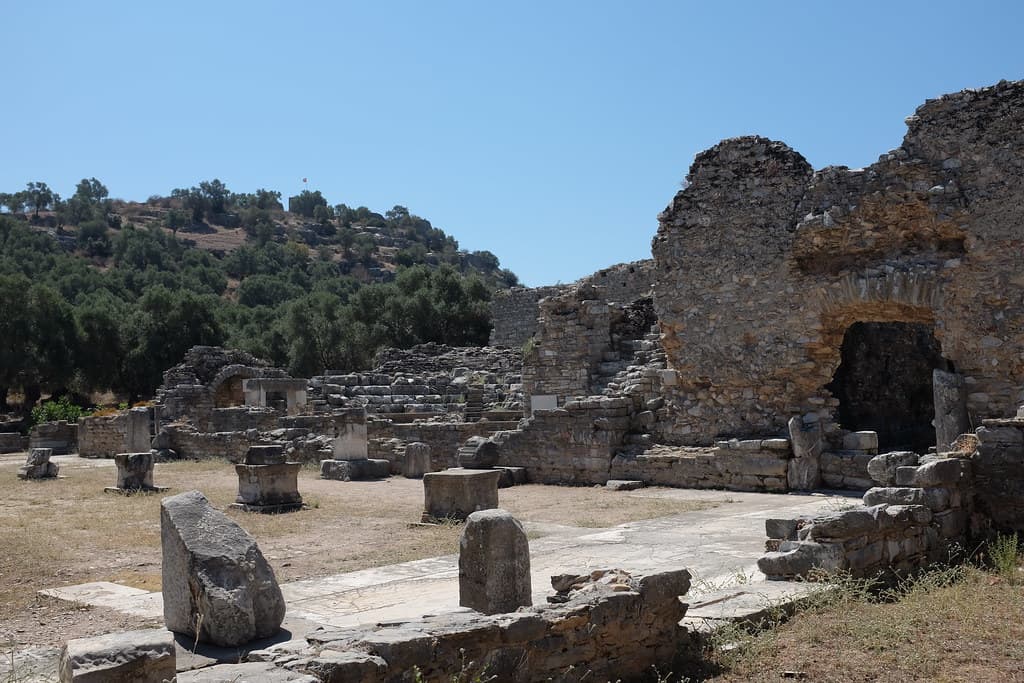
Pedasa asks attention not through restored spectacle but through walls that have stood in place for 2,500 years. Its thick, dry-stone Lelegian double walls follow the hilltop contour, still enclosing the sacred and defended space of one of Anatolia's most persistent civilisations.
Ancient writers including Herodotus and Strabo counted the Leleges among the Aegean and Anatolian worlds' oldest inhabitants. What distinguished them from their Carian neighbours and eventual overlords remains debated, but Pedasa was the centre of their presence on the Halicarnassus Peninsula—the headland where Bodrum now stands—from at least 2000 BCE through Carian, Persian, and eventually Hellenistic rule.
Its Temple of Athena was not a provincial copy of an Athenian cult but a deeply rooted sacred centre. Excavations since 2007 have revealed wider connections: bone carvings from the sanctuary votive deposit show Phoenician stylistic influence, suggesting that the Athena precinct was known to, or participated in, eastern Mediterranean trade and religious networks during the Archaic period. A holy road joined city and sanctuary, creating a sacred processional landscape of genuine regional importance.
Why this place is sacred
The sacred significance of Pedasa is concentrated in the Athena sanctuary and the holy road that connected city to precinct. This processional axis is the classic marker of a site understood by its users as a genuine sacred threshold — a place where the ordinary and the divine were formally separated and the movement between them ritually marked.
What the excavations since 2007 have added to this understanding is unexpected: the presence of bone carvings showing Phoenician stylistic influence among the votive offerings. In the Archaic period, Phoenician objects and stylistic influence followed trade routes and networks of religious prestige. Their presence at an Athena sanctuary on a Lelegian hilltop above the Aegean coast places Pedasa in a web of sacred significance that connected it, however indirectly, to the Levantine world. This was not an isolated provincial cult.
It was a sacred site whose reputation reached maritime traders and religious travellers crossing the eastern Mediterranean.
The Leleges themselves occupy a liminal position in the ancient world's self-understanding: pre-Greek but not fully Anatolian by the time of classical documentation, absorbed into the Carian cultural sphere but maintaining distinct practices (the platform tomb is a Lelegian signature). Pedasa's Athena sanctuary represents the point where this deep pre-Greek layer of the Aegean world made contact with wider Mediterranean sacred culture.
Sacred precinct of Athena serving as the primary religious focus of Lelegian civilization on the Halicarnassus Peninsula, with a holy road processional axis marking the city-to-sanctuary movement as ritually significant.
Lelegian sacred hilltop (2nd millennium BCE) → Archaic period Athena sanctuary with pan-regional connections evidenced by Phoenician-influence votive deposits → Carian period absorption with continued sacred function → Hellenistic and Roman period continuation → Byzantine-era occupation and gradual abandonment → ongoing excavations since 2007 revealing Archaic sanctuary evidence → accessible via hiking trail from Bodrum
Experience and orientation
The trail from Bodrum to Pedasa is part of the site experience, not merely its access route. The path climbs through typical Aegean maquis — rockrose, thyme, sage, and pine in combinations that produce strong scent in warm weather — and the hillside opens views of the peninsula progressively as you ascend. By the time the first Lelegian walls appear, you have already spent an hour in the landscape that formed the sacred geography these people inhabited.
The walls themselves are the first thing to notice when you arrive at the plateau. They are thick and laid without mortar in the Lelegian tradition: courses of fitted stone built to last through seismic disturbance and abandonment rather than through maintenance. Run a hand along the surface — the texture is not worn smooth in the way that more-visited ancient walls become worn, because not enough hands have touched these stones.
The site retains a quality of surface that more famous sites have lost.
The acropolis position rewards a slow circuit. Move around the hilltop perimeter before looking for the sanctuary area. The views change with each vantage: west to Bodrum and the open Aegean, north to the interior hills of the peninsula, south toward the coastal promontories. The Athena sanctuary area, identified through excavation, lies on the south slope of the acropolis; the holy road's trace leads downhill from the main precinct.
The theater, built in the 4th century BCE with a capacity of approximately 5,000, occupies the hillside below the acropolis — modest in scale but intact enough to convey the Lelegian civic ambition of a people history often treats as footnotes.
The platform tombs — distinctively Lelegian and Carian stone sarcophagi set on raised platforms — are scattered across the hillside. Their form is specific to this culture and this region; they identify the site unmistakably as Lelegian in a way that transcends linguistic or historical interpretation.
Approach via the hiking trail from Bodrum (approximately 5.4 km, medium difficulty). Organised hiking tours from Bodrum operators are available. No facilities at the site. The excavation areas may be partially fenced during active seasons.
Context and lineage
The Leleges were recorded by Herodotus, Strabo, and other ancient writers as among the most ancient inhabitants of the Aegean world — pre-Greek, pre-Carian in the region's consciousness, occupying a temporal and cultural position so early that later writers could only gesture at them. Pedasa was their centre on the Halicarnassus Peninsula.
The city's longevity — from at least 2000 BCE through the 13th century CE by some estimates — is itself a kind of origin story: a place that persisted across the rise and fall of every culture that surrounded it.
Herodotus mentions Pedasa (as Pidasa) in the context of Carian resistance against the Persian invasion of 497/6 BCE, placing it in the historical record at a moment of regional crisis. By the 4th century BCE, the Hecatomnid dynasty — the Carian satrapy whose most famous member was Mausolus — controlled the Halicarnassus region, and Pedasa operated within that political framework while maintaining its Lelegian cultural identity long enough to preserve distinctive burial practices and an active sanctuary tradition.
Lelegian foundation (2nd millennium BCE, possibly as early as 2000 BCE) → Archaic period Athena sanctuary with eastern Mediterranean connections → Carian period incorporation under Hecatomnid dynasty (4th century BCE) → Hellenistic and Roman period continuation → gradual decline → medieval-period final occupation → rediscovery and systematic excavation from 2007 onward
Herodotus
Mentioned Pedasa (as Pidasa) in his account of Carian resistance to Persia in 497/6 BCE; provides the site's earliest secure historical reference
Mausolus
Carian satrap whose Hecatomnid dynasty controlled the Halicarnassus region including Pedasa; his mausoleum in Bodrum was one of the Seven Wonders of the ancient world
Traditions and practice
The holy road linking the city to the Athena sanctuary was the primary ritual axis of Lelegian sacred life at Pedasa. Processional movement along this road — at festivals, at seasonal celebrations, at moments of communal petition to Athena — marked the boundary between the ordinary civic world and the sacred precinct.
Votive offerings recovered from the sanctuary include the Phoenician-influenced bone carvings that place the site in wider Archaic eastern Mediterranean religious networks, suggesting that offerings were brought here not only by local worshippers but by those with connections to the Levantine trade world.
Lelegian platform tomb burial — raising the dead on constructed stone platforms above ground level rather than interring them in rock-cut tombs — reflects a funerary theology specific to this culture. The platform tomb form survived into the Carian period, marking continuity of practice across political change.
Annual excavation campaigns since 2007 have been conducted by Turkish archaeologists, focusing on the Athena sanctuary, the holy road, and the platform tombs. The site is accessible via hiking trail and receives visitors primarily from Bodrum tourism. Local operators offer guided Pedasa hiking tours.
Walk the holy road trace before visiting the sanctuary precinct. The path is not fully reconstructed, but the direction — downhill from the sanctuary toward the city — is legible. Understanding this processional logic transforms the sanctuary from an isolated structure into a destination approached through ritual movement.
At the sanctuary area, look at the ground as much as the standing structures. Excavation work here has been conducted carefully and some areas remain open between seasons. The soil that produced Phoenician-influenced votive objects looks like any other soil; that is the point. This is a place whose significance was built up over centuries of individual acts of offering, most of them invisible to any single visit.
The platform tombs, scattered across the hillside, deserve individual attention. Find one that has its platform intact. The elevation of the burial above ground — not much, only a course or two of stone — communicates a theology of the dead: they are not underground, not returning to earth, but preserved between worlds on a threshold.
Athena Worship / Lelegian-Carian Religion
HistoricalThe primary sacred centre of Lelegian civilisation on the Halicarnassus Peninsula; the sanctuary's Phoenician-influenced votive deposits indicate connections to eastern Mediterranean religious networks in the Archaic period.
Processional rituals along the holy road to the Athena sanctuary; votive offerings at the temple precinct; sacrifices and seasonal festivals
Lelegian Indigenous Culture
HistoricalPedasa was the centre of Lelegian civilisation on the Halicarnassus Peninsula; the city's platform tombs, double walls, and acropolis-centred urban form reflect a distinctively Lelegian way of building and inhabiting sacred space.
Platform tomb burial; acropolis-centred civic and religious life; agricultural terrace farming reflecting long-term relationship with the landscape
Archaeological Heritage
ActiveSystematic excavations since 2007 have established Pedasa as a key reference site for understanding Lelegian civilisation and Archaic-period eastern Mediterranean religious connections. Ongoing fieldwork continues to reveal the sanctuary's extent.
Annual excavation campaigns focusing on the Athena sanctuary, holy road, and platform tombs; heritage hiking tourism from Bodrum
Perspectives and open questions
Pedasa can be engaged as a window into Lelegian civilisation — one of antiquity's most obscure persistent peoples — as evidence of Archaic Mediterranean religious networks that connected Aegean and Levantine traditions, or as an example of how hiking access creates a different quality of encounter with ancient sites.
Scholarly perspective
Pedasa is regarded by specialists as the most significant Lelegian settlement on the Halicarnassus Peninsula. Excavations since 2007 have confirmed the Athena sanctuary's importance and its unexpected eastern Mediterranean connections: Phoenician-influenced bone carvings in the sanctuary votive deposit place the site in scholarly conversation about Archaic-period networks of trade, religious influence, and cultural exchange across the eastern Mediterranean. The site is central to understanding Lelegian civilisation, which is otherwise reconstructed primarily from scattered ancient references and surface archaeology.
The relationship between Pedasa's Athena cult and the broader Archaic Athena tradition across the Aegean remains an open research question.
Living and traditional perspectives
The Leleges have no living community. Their culture is reconstructed from archaeological evidence, ancient literary references (Herodotus, Strabo, Thucydides, among others), and epigraphy. The Carians who absorbed Lelegian culture left more surviving material, including a partially deciphered language. What persists in the Pedasa record is a pattern of sacred attention directed toward a hilltop precinct over a very long period — from pre-Greek Anatolian origins through classical Greek religious forms.
Alternative interpretations
Pedasa's Lelegian identity has attracted interest from those investigating the pre-Greek sacred landscape of western Anatolia and the Aegean. The Leleges, as a people who appear in ancient sources as already old before the Greek world developed, represent a line of sacral tradition extending into a past that classical documents cannot illuminate.
The hilltop sanctuary's connections to Phoenician trade and religious networks add a further dimension: here, at the edge of the Aegean world, something was happening in the Archaic period that connected it to the Levant.
Open questions
The full extent of the Athena sanctuary and the nature of the Phoenician connections evidenced by the bone carvings remain under investigation. Whether Pedasa functioned as a pan-regional pilgrimage site or sanctuary with supralocal significance — as the votive evidence hints — is not yet established. The relationship between Pedasa and satellite Lelegian settlements on the peninsula, and the question of whether a holy road network connected multiple Lelegian sacred sites, awaits systematic research.
Plan your visit
Access and arrival
Approximately 4 km from Bodrum centre; the site is reachable by a 10-minute taxi from Myndos Gate (Bodrum's northwestern gate) to the trail start, or by minibus (dolmuş) to the general area with a short walk. Full hiking trail from Bodrum is approximately 5.4 km (medium difficulty, 1–2 hour ascent). No formal admission fee reported.
No mobile signal reliably available at the hilltop; verify current access arrangements with Bodrum Municipality or local tour operators, as excavation activity can affect site access. No facilities on site.
No accommodation near the site. Bodrum (4 km) has extensive tourist infrastructure for all budget levels. Organised Pedasa hiking tours from Bodrum operators include transport and return.
Respectful visit
No religious dress code. Comfortable hiking shoes are essential for the trail approach and the uneven terrain of the acropolis.
Permitted throughout the site; some excavation areas may be marked as restricted during active fieldwork seasons.
Not applicable.
Do not enter active excavation trenches. Do not disturb stones or remove any material — the ongoing excavation means that surface context has direct research value. Respect any temporary fencing around active work areas.
Active excavation areas are restricted during fieldwork seasons (typically spring and summer). Do not enter fenced excavation trenches. The hiking trail requires moderate fitness; return in good time before dark as the path is not lit.
Location
Map loads as you approach this section.
Pilgrim reflections
A portrait of encounter, not a score
Pilgrims describe what they felt, how present they could become, and whether the place would shape a journey. There are no stars and no ranking of traditions.
No reviewed reflections yet
The first pilgrims can help describe the character of being here.
Share a reflection
Available after an account-backed “Been there.” Every reflection is reviewed before publication.
Nearby sacred places
Explore other sacred places in the region. Proximity does not establish access or travel time; check each place’s guidance.



References
Sources consulted for this page. Source categories describe the publication, not a guarantee that every claim is verified. Traditional accounts and outside interpretations may differ.
- 01Bodrum Pedesa Ancient City — Bodrum Municipality — Bodrum MunicipalityofficialOfficial municipal description of the site
- 02Pedasa Athena Kutsal Alanı: Fenike Kökenli Kemik Oymalar ve Yakın Doğu Bağlantıları — PHASELIS JournalacademicAcademic journal article on Phoenician-origin bone carvings from the Athena sanctuary; Near Eastern connections
- 03Pedasa — Wikipedia — Wikipedia contributorsencyclopediaOverview of Lelegian-Carian city and its historical context
- 04Pedasa — The Temple of Athena and Excavations — CekisteguideDetailed description of the Athena sanctuary and holy road
- 05Pedasa Antique City — Taila Travel — Taila TravelguideVisitor overview and access information
- 06Ancient City of Pedasa Bodrum Turkey — Sue M. TravelsblogFirst-hand visitor account with good practical detail
- 07Pedasa Hiking Tour — Ibex Travel — Ibex TravelguideGuided hiking tour information
- 08Uncover one of the regions best kept secrets at Pedasa — Property TurkeyguideGeneral overview and access
Share a photo
Help visitors recognize Pedasa. Every submission is reviewed before publication.