Temple of Apollo, Didyma
Part ofDidyma
The ancient world's second-greatest oracle, where the sacred spring spoke Apollo's will
Understand sacred places, explore living traditions, and learn how to engage respectfully with Pilgrim Map.
Access has not been verified. Check current local guidance before planning a visit.
Aydın, Turkey
Read the sources
Visit essentials
A quick read before you go
- Duration
- 1.5–3 hours for the site alone.
- Access
- Located in central Didim town, Didim district, Aydın Province.
Overview
The ancient world rarely built an architecture devoted so completely to approach, threshold, and encounter with the divine. The Didymaion, Apollo's great Milesian sanctuary, was designed to create the conditions in which a human could receive divine communication.
Its outer colonnade comprised 122 Ionic columns, each nearly twenty metres tall, but never enclosed a roofed interior. Instead they surrounded the open-air adyton, where a sacred spring flowed, laurel trees grew, and the prophetess entered trance to receive Apollo's words. Pilgrims reached the court from below through two narrow vaulted tunnels, moving from monumental civic grandeur, through darkness, into an intimate bounded space open only upward.
The spring dried when Persians destroyed the first temple in 493 BC. Ancient tradition held that it reappeared as Alexander the Great approached in 334 BC, which the oracle took as confirmation of his divine mission. The oracle's words influenced emperors and allegedly endorsed Diocletian's persecution of Christians, placing this Apollo at the center of one of antiquity's most consequential theological conflicts. The spring is long dry, but the adyton still opens to the sky above the Aegean plain.
Why this place is sacred
The thinness at Didyma is architectural in the most literal sense: the Didymaion was designed to be a thin place. The open adyton — a sacred inner court without a roof — is unique among major Greek temples. Most temples enclosed the god within darkness, the cult image visible only to priests and on festival days. At Didyma, the sacred space was open to the sky because the sky was where Apollo moved.
The prophetess sat within sight of the stars.
The vaulted tunnels that connected the outer pronaos to the adyton were not merely practical passageways. They were a deliberate transition from the human scale of the massive colonnade — civic, imperial, designed to impress — to the intimate darkness before emergence into the oracle court.
The compression of the tunnel, the loss of sight, the re-emergence into open sky: this sequence was the spatial grammar of prophetic approach, encoding in stone the same threshold-crossing that the pilgrim's psychological journey required.
The sacred spring within the adyton added water to the architecture of encounter. The Delphic oracle's trance was associated with vapours from a fissure in the earth; Didyma's was associated with contact with sacred water — drinking from it, or sitting above it, or breathing its emanations.
The association of prophecy with underground water appears across the ancient world, in contexts as different as the oracle at Claros and the biblical springs at Shiloh: the earth's moisture as the medium through which the below communicates upward.
The modern scholar's question — what precisely produced the prophetess's trance state? — is unanswerable without direct evidence. The ancient worshipper's experience was not framed as a mechanism but as an encounter. Apollo was present in the spring, in the laurel, in the space open to the sky. The prophetess was his instrument.
Major prophetic oracle of the ancient Greek world, the most important in Asia Minor, administered by the priestly Branchid family and later by the city of Miletus. Pilgrims came seeking Apollo's guidance on personal, civic, and political matters.
Oracle function from at least the 7th century BC; earliest temple c. 560–550 BC; destroyed by Persians 493 BC; oracle dormant for over a century; Alexander the Great revived it 334 BC; Hellenistic temple begun 331 BC; construction continued for centuries but was never fully completed; oracle function continued through the Roman period; ended in late antiquity; site now a major archaeological destination.
Experience and orientation
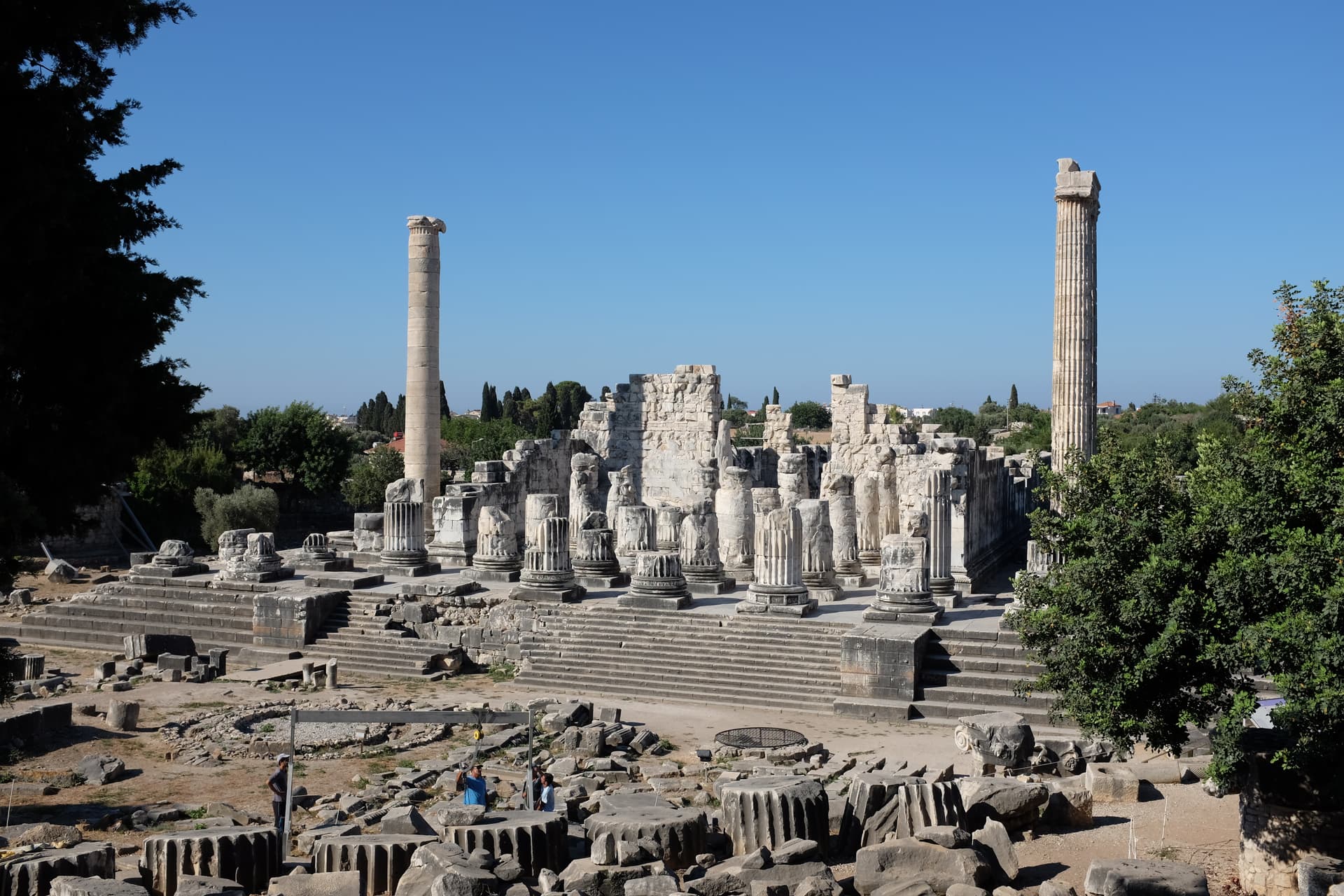
Photographs of the Didymaion are accurate in their details and entirely misleading in their effect. Seeing the surviving columns in person — particularly from a distance that allows three or four to stand together against the sky — recalibrates the body's sense of scale.
The outer colonnade of the Hellenistic temple was built with columns nineteen and a half metres tall, and a dipteral plan (double row of columns) that meant the approach from outside to the entrance was itself an experience of being enclosed within monumental space before entering the building at all.
The entrance leads through the pronaos — the outer hall, now open to the sky through the absence of its roof — to the point where the two vaulted tunnels descend. The tunnels are original: the same stone, the same narrowing, the same darkness that pilgrims and delegation members walked in antiquity. They are low enough to require attention, wide enough for one person comfortably. At the end of each tunnel, the adyton opens.
The adyton is the core experience. It is an open court — approximately 21 by 53 metres — enclosed by high walls but without a roof. The basin where the sacred spring once flowed is visible at the far end. The small inner naos that held the cult statue stands at the centre. The walls rise above you and above them is only sky.
The compression of the tunnels and the release into this bounded-but-open space is one of the more deliberately controlled spatial experiences surviving from antiquity.
Move through the adyton slowly. Find the spring basin. Stand at the point where the prophetess would have sat. Look up at the walls, then above them. This is where Alexander's victory was confirmed, where Diocletian's terror found divine sanction, where centuries of human urgency was compressed into the question that ancient petitioners asked: what will happen, and what should we do?
The site is centrally located in modern Didim town, well-signposted and easily accessible. An entry fee applies. Open year-round; check current hours locally. The site can be warm in summer by midday; early morning visits are recommended in July and August.
Context and lineage
The origin of Didyma's oracle belongs to the mythology of Apollo's gift of prophecy. The tradition held that Branchus — a beautiful youth beloved by Apollo — received the god's prophetic kiss and with it the gift of divination; his descendants, the Branchidae, became the hereditary priestly family who administered the oracle for generations.
Whether or not this myth preserves a historical memory of the oracle's founding, it encodes the oracle's self-understanding: the prophetic capacity came directly from Apollo, transmitted through human bodies chosen by the god.
The sanctuary's connection to the city of Miletus — one of the great intellectual and commercial centres of the ancient world — gave it an institutional framework of exceptional sophistication. The Sacred Way (Hiera Hodos), a 19 km processional road connecting the harbour sanctuary of Apollo at Panormos near Miletus to the Didymaion, was lined with statues, altars, and the tombs of notables.
Walking the Sacred Way to the oracle was itself a pilgrimage act, a structured approach through a sacred landscape that prepared the petitioner for what awaited at its end.
The Persians destroyed the first temple in 493 BC and carried the cult statue and the Branchid family into exile in Persia. The oracle fell silent for nearly 150 years. When Alexander the Great arrived at Miletus in 334 BC during his eastern campaign, the sacred spring at Didyma reportedly began to flow again — the first spontaneous re-emergence since the Persian destruction. The oracle's first pronouncement in a century and a half confirmed Alexander's divine descent from Zeus.
Whether this was diplomatic theatre or genuine religious experience, its effect was the same: the greatest oracle in Asia endorsed the greatest conqueror of the age, and the rebuilding of the Didymaion began.
Branchid family oracle (7th century BC) → first Archaic temple (c. 560–550 BC) → Persian destruction (493 BC) → dormancy → Alexander's revival (334 BC) → Hellenistic rebuilding (331 BC onward) → Roman imperial engagement → late antique closure → modern archaeological site
Branchidae
Hereditary priestly family
Alexander the Great
Patron and revivalist
Seleucus I and Antiochus I
Patrons
Diocletian
Consultor
Traditions and practice
The oracle process at Didyma was not an impromptu encounter but a structured ritual sequence. Petitioners arrived via the Sacred Way from Miletus, a 19 km journey that served as extended pilgrimage approach. At the sanctuary, they underwent purification — likely ritual bathing — before the consultation itself. Animal sacrifice was performed at the great altar in the outer precinct; the form of the animal's death (how it fell, what signs appeared) may have contributed to the prophetic reading.
The prophetess then descended to the adyton. Ancient sources differ on the precise mechanism of her trance: some say she drank from the sacred spring; others that she sat above it or inhaled vapours arising from it; others that she held a staff sacred to the god while standing in contact with the water.
Once in a trance state, she received Apollo's communication and transmitted it — typically in verse — to priests who could interpret or refine the message for the petitioner.
Every four years the Didymeia festival drew participants from across the Greek world: athletic games, musical competitions, sacred processions, and communal feasting. This was the oracle as civic institution — the anchor of a religious calendar that organised time for the entire region.
The Sacred Way processions were their own form of practice: the 19 km walk from Miletus, past the seated statues of the Branchid family lining the road, past altars and tombs, was a pilgrimage in the technical sense — a journey with a sacred purpose that the walk itself enacted.
No active religious practices. The site is a major archaeological tourist destination. Academic research and architectural conservation continue.
Enter through the original ground-level entrance if possible, not from a side access. The intended arrival sequence — across the open court of the pronaos, then into the darkness of the tunnels, then out into the adyton — encodes the oracle's spatial logic. Disrupting the sequence by entering from the side loses the experience the architects designed.
Once in the adyton, find the spring basin at the far end of the court. Spend time there, looking at the walls, then above them. The question the ancient prophetess answered in this space was always, ultimately, the same one: what should I do? The oracle did not describe facts; it gave guidance. Whatever the mechanism of the trance, the kind of question brought here was not a question you could answer with information alone.
Consider the astronomical orientation as you stand in the adyton: the temple faces approximately northeast (azimuth 55°), aligned — according to archaeoastronomical research published in the Journal of Skyscape Archaeology — toward the heliacal rising of the star Castor (α Geminorum) in the constellation Gemini. When the star first rose above the horizon before dawn on the relevant date, its light would have entered the adyton and fallen on the cult statue of Apollo.
This was not coincidence; it was the architecture of divine attention.
Ancient Greek religion — Apollo oracle and pilgrimage
HistoricalThe second most important oracle in the ancient Greek world after Delphi, and the most important in Asia Minor. The Branchid family and later Milesian administration oversaw centuries of prophetic consultation. Rulers from Alexander to Diocletian sought its counsel; it was a node in the political and religious life of the eastern Mediterranean for over a millennium.
Sacred Way procession from Miletus (19 km); purification; sacrifice at the great altar; oracle consultation via the prophetess; votive offerings; quadrennial Didymeia festival
Archaeological and scholarly heritage
ActiveThe fourth largest Greek temple ever built and the most important archaeological oracle site in Anatolia. Studied and excavated since the 18th century; current archaeoastronomical and architectural research continues to generate new findings about its design and function.
Ongoing architectural conservation; academic research; guided educational tours; publication of archaeoastronomical findings
Perspectives and open questions
Didyma has attracted scholarly, theological, archaeoastronomical, and sacred geography interpretations — each illuminating a different dimension of what the ancient world's most sophisticated oracle machine was designed to do.
Scholarly perspective
The Didymaion is the fourth largest Greek temple ever built and architecturally unique: its open adyton, purpose-built for oracle function, has no parallel among major Greek sanctuaries. Peer-reviewed archaeoastronomical research published in the Journal of Skyscape Archaeology has confirmed a non-cardinal orientation (azimuth 55.117°), likely aligned to the heliacal rising of Castor (α Geminorum) — a celestial bearing shared with other oracular sanctuaries (Hierapolis, Delphi) but absent from non-oracular Apollo temples (Delos, Rhodes).
This distinction suggests that astronomical alignment was specifically associated with the oracle function, not with Apollo worship in general. The Sacred Way (Hiera Hodos) from Miletus to Didyma has been archaeologically identified across most of its 19 km length and represents one of the most significant sacred processional landscapes in the ancient Mediterranean.
Living and traditional perspectives
The Didyma oracle's traditional self-understanding was simple and absolute: Apollo was present in the spring, in the laurel, in the space open to his sky, and the prophetess was his instrument. The oracle's authority rested not on the content of any individual pronouncement but on the structural claim that Apollo's will could be accessed here. The reappearance of the sacred spring at Alexander's approach was understood as a sign of divine endorsement — the earth itself confirming its allegiance.
This was the oracle's ultimate argument: that the ground had chosen to speak.
Alternative interpretations
The combination of sacred water, astronomical alignment, subterranean approach, and open sky at Didyma has attracted interpretation within frameworks of sacred geography, earth-energy networks, and geomantic tradition. The site appears in alternative accounts of Aegean oracle networks linking Delphi, Dodona, Didyma, and Klaros as nodes in a system of earth-based prophetic power.
The specific association of underground water with prophetic capacity — found independently at Didyma, Claros, and Delphi — has also attracted scientific speculation about natural gases or spring chemistry as a mechanism for altered states, though no definitive geological evidence has been confirmed at Didyma.
Open questions
The precise trance mechanism of the Didyma prophetess: whether spring water, vapour, physical contact, or another mechanism was primary; the exact nature of the Didymeia festival's ritual programme; the fate of the colossal cult statue of Apollo that stood in the inner naos; the full content of the oracle's most politically significant pronouncements (most are known only in summary); the precise relationship between the Didyma and Claros oracles in terms of shared priestly personnel and pilgrimage traffic.
Plan your visit
Access and arrival
Located in central Didim town, Didim district, Aydın Province. Approximately 100 km south of İzmir, 20 km south of Miletus (Milet). Accessible by dolmuş from Söke (the main regional hub) or Milas. The site is within walking distance of central Didim and well-signposted. Entry fee applies; verify current prices locally. Open year-round with seasonal hours (approximately 08:00–19:00 summer, 08:30–17:30 winter). Mobile phone signal is available throughout Didim town.
Didim town has extensive tourist accommodation, ranging from small pansiyon to resort hotels, concentrated around the coast. The site itself is in the town centre. Söke and Milas offer alternatives for those using the site as a base for the wider Maeander valley region.
Respectful visit
No specific dress requirements. Practical footwear recommended; the site involves uneven stone surfaces.
Photography permitted throughout, including in the tunnels and adyton. Tripod use may require permission; check with site staff.
Not applicable.
Do not touch or climb on columns, walls, or carved stonework. Do not cross conservation barriers. Stay on designated pathways in areas where these are marked.
The columns and architectural elements are not climbable; conservation barriers protect the most fragile sections. The site is adjacent to modern Didim town and can be busy in summer; early morning or late afternoon visits reduce crowds and improve the quality of the experience. Do not attempt to descend into or behind conservation barriers.
Location
Map loads as you approach this section.
Pilgrim reflections
A portrait of encounter, not a score
Pilgrims describe what they felt, how present they could become, and whether the place would shape a journey. There are no stars and no ranking of traditions.
No reviewed reflections yet
The first pilgrims can help describe the character of being here.
Share a reflection
Available after an account-backed “Been there.” Every reflection is reviewed before publication.
Nearby sacred places
Explore other sacred places in the region. Proximity does not establish access or travel time; check each place’s guidance.


References
Sources consulted for this page. Source categories describe the publication, not a guarantee that every claim is verified. Traditional accounts and outside interpretations may differ.
- 01Didyma - Wikipedia — Wikipedia contributorsencyclopediaComprehensive historical and archaeological overview
- 02The Temple of Apollo at Didyma - World History Encyclopedia — World History EncyclopediaacademicDetailed scholarly article covering history, architecture, and oracle function
- 03The Temple of Apollo in Didyma: An Oracle with a Celestial Bearing – Journal of Skyscape Archaeology — Journal of Skyscape Archaeology / Equinox PublishingacademicPeer-reviewed archaeoastronomy study of the temple's celestial alignment
- 04The Temple of Apollo in Didyma: An Oracle with a Celestial Bearing — ResearchGateacademicFull paper on celestial orientation and oracular function
- 05Temple of Apollo at Didyma – Turkish Archaeological News — Turkish Archaeological NewsacademicArchaeological news and updates for the site
- 06Didyma: Oracle of Apollo – World Pilgrimage Guide — Sacred Sites / Martin GrayspiritualPilgrimage and sacred site perspective; good overview of spiritual significance
- 07Didyma: Unveiling the Secrets of the Ancient Greek Oracle — History ToolsSource contextAccessible overview of oracle practices and history
- 08The Temple of Apollo at Didyma — World History EduSource contextOverview of temple history, architecture, and oracle function
Share a photo
Help visitors recognize Temple of Apollo, Didyma. Every submission is reviewed before publication.