Mausoleum at Halicarnassus
Where a widow's grief became one of the ancient world's supreme acts of devotion
Understand sacred places, explore living traditions, and learn how to engage respectfully with Pilgrim Map.
Access has not been verified. Check current local guidance before planning a visit.
Muğla, Turkey
Read the sources
Visit essentials
A quick read before you go
- Duration
- 30–45 minutes is sufficient for thorough exploration of the foundations and museum.
- Access
- Turgut Reis Caddesi No.
Overview
When Mausolus, satrap of Caria, died in 353 BCE, his wife and sister Artemisia II set out to build not merely a tomb but a cosmological statement. Raised over the following years, it joined Greek artistic genius to Persian imperial power on a scale that left ancient visitors speechless. Scopas, Bryaxis, Leochares, and Timotheus—four of the age's most celebrated sculptors—each took one side of its sculptural program.
The monument stood approximately 45 meters high: a tall podium, 36 Ionic columns, a stepped pyramid, and a white-marble quadriga. It endured for nearly eighteen centuries before Crusader knights dismantled it to build Bodrum Castle.
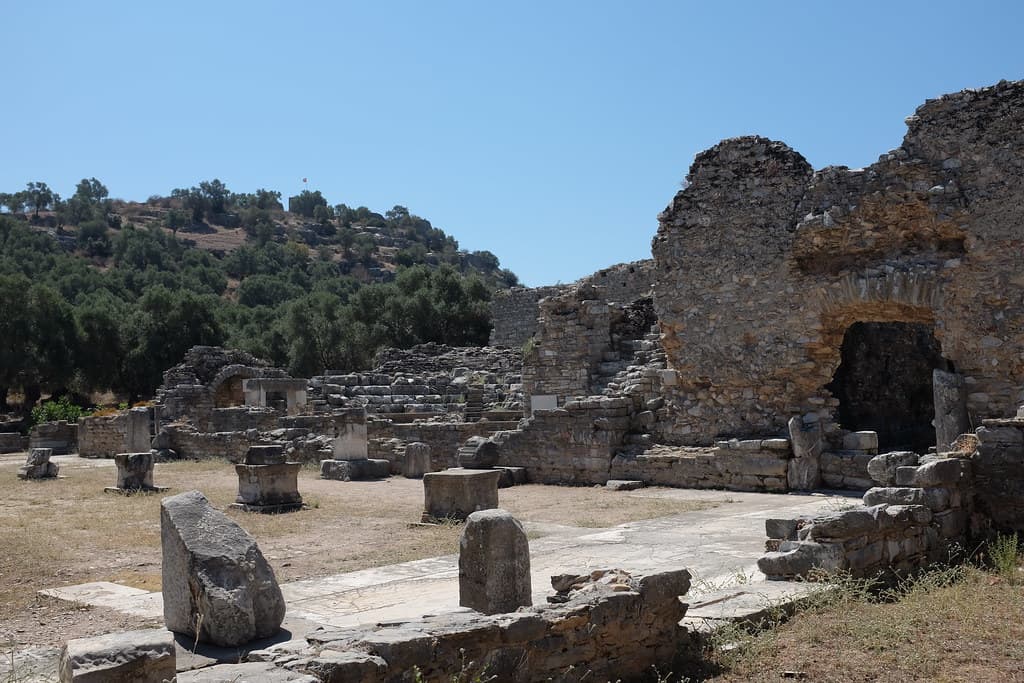
What the Knights of St. John left is a ground depression, scattered architectural blocks, and a small museum holding sculptural fragments excavated by Charles Thomas Newton in 1857. Visitors confront magnificent absence: the space where beauty and grief fused into a structure that redefined what a person could leave behind.
Why this place is sacred
The Mausoleum was sacred as the tomb of a man his city understood as its re-founder. Mausolus had transformed Halicarnassus into a prosperous cultural center, effectively a capital of a quasi-independent Carian state, and the hero cult that formed around his tomb treated him not merely as a deceased ruler but as a divine or semi-divine patron.
Archaeological evidence of animal sacrifices — oxen, sheep, lambs, birds — deposited on the monument's steps and sealed inside indicates that his tomb functioned simultaneously as a religious shrine. Ancient hero cults held that heroes whose tombs were located within or near a city exerted protective power over it. Mausolus was one of these heroes.
The remarkable depth of Artemisia's grief — ancient sources report she mixed his ashes with water and drank them — was itself held to be legendary, a model of devotion that elevated the entire act of mourning into something holy. The Mausoleum embodied this: the grief of one person, transmuted through artistic ambition and religious intention, into a permanent axis between the human and the divine.
Royal tomb and hero-cult sanctuary for Mausolus of Caria, combining commemorative, religious, and political functions.
From active hero-cult shrine (4th–1st century BCE) to inert ancient ruin (Roman period) to eventual medieval dismantlement by the Knights of St. John (15th century CE), who used its stones for Bodrum Castle. Since 1857, the site has operated as an archaeological excavation area and, more recently, a small museum.
Experience and orientation
Arriving at the site off the busy streets of central Bodrum, you descend into an excavated pit — the original footprint of the monument's massive podium. The sense of scale becomes immediately apparent from the depth of the cut into the bedrock and the scale of the surviving architectural blocks. The foundations suggest a platform larger than you imagined. Walk the perimeter slowly. The stone is warm from the sun and worn in ways that register centuries of handling.
Inside the small museum building, a scale model allows your mind to reconstruct what stood here: three tiers of stone climbing forty-five meters against the sky, crowned by four enormous marble horses pulling a chariot carrying statues of Mausolus and Artemisia. Sculptural fragments from Newton's 1857 excavation — a colossal portrait believed to be Mausolus himself, sections of the Amazonomachy frieze — give the scale of the lost decorative program.
The fragments are in the British Museum now; what is displayed here are casts and originals that did not make the journey to London. The experience this site offers is not the overwhelm of a complete monument but something rarer: the discipline of imaginative reconstruction in the presence of genuine loss. The absence is the subject. Artemisia built this to outlast time, and time outlasted it anyway.
Enter from Turgut Reis Caddesi in central Bodrum. Descend into the excavation pit, explore the foundations, then move through the museum building for sculptural fragments and the reconstruction model. Allow 30–45 minutes. The museum and foundations are both covered and outdoors — bring sunscreen for the outdoor section.
Context and lineage
Mausolus, satrap of Caria under Persian suzerainty, transformed Halicarnassus into a brilliant cultural hybrid — a city that looked Greek but was governed by a Persian-aligned dynast who understood himself as both. When he died in 353 BCE, his wife and sister Artemisia II took up the monument's construction, reportedly mixing his ashes into water and drinking them as an act of absolute devotion before dedicating what remained of her life to his commemoration.
She is said to have died two years later before the building was complete, her own grief an act of martyrdom. The architects Satyros and Pythius of Priene designed the structure; the sculptors Scopas, Bryaxis, Leochares, and Timotheus — each among the finest of their generation — carved its four faces. Ancient accounts held that even after Artemisia's death the sculptors continued working, judging the commission too great to abandon.
The structure that resulted was designated one of the Seven Wonders of the Ancient World by ancient writers including Antipater of Sidon. For roughly 1,600 years it stood. In the 15th century CE, the Knights of St. John quarrying stone for Bodrum Castle dismantled it almost entirely — and in doing so, inadvertently preserved the polished marble blocks in the castle walls where they can still be seen.
The Mausoleum belongs to the tradition of Carian dynastic art that fused Persian imperial form with Greek aesthetic achievement. It influenced Hellenistic and Roman funerary architecture profoundly — the Mausoleum's three-tiered podium-colonnade-pyramid form was imitated across the Greco-Roman world — and its name became the universal term for any grand tomb. Sculptural fragments from the site, divided between the British Museum (Newton's excavations) and the Bodrum site museum, represent the best surviving examples of 4th-century BCE Greek relief sculpture.
Mausolus of Caria
Satrap of Caria (d. 353 BCE), the tomb's dedicatee and subject of the hero cult
Artemisia II
Widow, sister, and successor of Mausolus; commissioner of the monument and presiding force behind its construction
Satyros and Pythius of Priene
Greek architects who designed the Mausoleum's tripartite form
Scopas, Bryaxis, Leochares, Timotheus
The four leading Greek sculptors who each took one face of the sculptural program
Charles Thomas Newton
British Museum archaeologist who excavated the site in 1857–58, recovering major sculptural fragments now in London
Kristian Jeppesen
Danish archaeologist (University of Aarhus) whose 1966–1977 excavations provided the most complete modern reconstruction of the monument's form
Traditions and practice
The hero cult of Mausolus was practiced at the monument's base. Archaeological evidence — deposits of sacrificed animals including oxen, sheep, lambs, and birds found sealed in the stairways — indicates formal ritual activity. These deposits were made and then sealed, suggesting a founding or dedicatory sacrifice rather than regular ongoing practice. The cult held that Mausolus, as a heroic re-founder of his city, remained a protective presence for Halicarnassus.
Civic rituals may have included festivals and commemorative ceremonies at the tomb, though documentation of these is incomplete.
The site operates as an open-air archaeological museum with no active religious dimension. The Bodrum Museum of Underwater Archaeology (in the castle built from the Mausoleum's own stones) contextualizes the broader heritage of ancient Halicarnassus.
Move slowly through the excavation pit, noting the scale of the surviving podium blocks. Run your hand along the cut stone — the precision of the original masonry survives in the surviving course courses. Stand at the deepest point of the excavation and consider the monument's intended height: the tip of the crowning quadriga would have been visible from the harbor and from ships at sea.
In the museum, study the colossal portrait of Mausolus carefully — consider what Artemisia asked Scopas to make of grief. The contrast between what this face once crowned and what remains is the meditation the site offers.
Carian Dynastic Hero Cult
HistoricalThe dominant religious tradition of the site in antiquity. Mausolus was venerated as the city's re-founder and as a hero-deity whose tomb functioned as a protective shrine for Halicarnassus. The archaeological deposits of sacrificed animals sealed in the stairways indicate formal cult activity.
Animal sacrifice (oxen, sheep, lambs, birds); dedicatory deposits; likely civic festival ceremonies
Archaeological and Scholarly Heritage
ActiveOne of the Seven Wonders of the Ancient World; foundational for understanding Hellenistic-Persian dynastic architecture and the Greek sculptural tradition of the 4th century BCE. The word 'mausoleum' entered every modern European language from this structure. Ongoing scholarly study of the fragments distributed between Bodrum and the British Museum continues.
Academic research, museum conservation, site management
Perspectives and open questions
The Mausoleum has been interpreted through four distinct lenses: as a triumph of dynastic ambition and grief, as a masterwork of Greco-Persian cultural synthesis, as the founding text of all funerary architecture, and as a meditation on time's indifference to human greatness.
Scholarly perspective
Scholars understand the Mausoleum as a deliberate political and aesthetic manifesto. Mausolus had spent his reign projecting an image of a Greek-cultured ruler within a Persian imperial framework — collecting Greek art, patronizing Greek intellectuals, rebuilding Halicarnassus on a Hippodamian grid. The Mausoleum was the culmination of this project: architecturally Greek but monarchically Persian in its scale and dynastic ambition.
Kristian Jeppesen's systematic excavations (1966–1977) provided the most detailed reconstruction of its form, establishing that the monument was approximately 45 meters high with a three-tiered structure. The sculptural program — four separately commissioned faces, each by a different master — is unprecedented in scale for a single monument.
Living and traditional perspectives
Within the Carian dynastic tradition, Mausolus was understood as a city re-founder whose tomb served as a perpetual protecting presence. The hero cult was not incidental but structural — the monument was designed as both tomb and shrine, a permanent point of contact between the living city and its divine patron. Artemisia's devotion, especially the account of drinking his ashes, was itself a religious act: she was incorporating him into herself, becoming the vessel of his continued presence.
Alternative interpretations
Some writers have noted the mythological resonances of the Mausoleum's sculptural program. The Amazonomachy frieze — battle between Greeks and Amazons — was a standard motif for the contest between civilization and its limits, while the Centauromachy depicted the same boundary in terms of animal nature.
Read together with the cosmic proportions of the building, these reliefs suggest a monument designed not merely to commemorate but to locate Mausolus within a cosmological order: the hero who had imposed culture on chaos.
Open questions
The crowning quadriga — the four marble horses and chariot bearing the statues of Mausolus and Artemisia — is known only from fragmentary evidence. We do not know what posture the statues assumed, what expressions they carried, or precisely what effect they would have produced at forty-five meters against the Halicarnassian sky. The exact nature and duration of the hero cult is incompletely documented.
Whether the burial chamber contained any goods when the Knights tunneled into it in the medieval period — and what they may have found or taken — remains unknown.
Plan your visit
Access and arrival
Turgut Reis Caddesi No. 93, Bodrum 48440. Walkable from Bodrum town center and the ferry terminal (5–10 minutes). Open daily except Monday: 8:30–17:30 (winter) / 8:30–18:30 (summer). Entrance fee approximately €3. Mobile phone signal is good throughout Bodrum. No specific emergency access concerns — the site is in the heart of a large tourist town.
Bodrum is a major tourist resort city with accommodation across all price ranges. Staying in the old town (Kumbahçe or Tepecik neighborhoods) places you within walking distance of the Mausoleum.
Respectful visit
No dress code. Comfortable, close-toed shoes recommended for the uneven excavation floor.
Photography is permitted throughout the site and inside the museum building.
Not applicable — there is no active religious practice at this site.
Do not climb, sit on, or touch ancient stonework. Follow all museum signage regarding the sculptural fragments. The site is closed on Mondays.
The excavation pit has uneven footing; wear shoes with grip. The outdoor foundations offer little shade — sun protection is important in summer.
Location
Map loads as you approach this section.
Pilgrim reflections
A portrait of encounter, not a score
Pilgrims describe what they felt, how present they could become, and whether the place would shape a journey. There are no stars and no ranking of traditions.
No reviewed reflections yet
The first pilgrims can help describe the character of being here.
Share a reflection
Available after an account-backed “Been there.” Every reflection is reviewed before publication.
Nearby sacred places
Explore other sacred places in the region. Proximity does not establish access or travel time; check each place’s guidance.



References
Sources consulted for this page. Source categories describe the publication, not a guarantee that every claim is verified. Traditional accounts and outside interpretations may differ.
- 01Mausoleum at Halicarnassus - Wikipedia — Wikipedia contributorsencyclopediaComprehensive overview of history, architecture, and excavation
- 02Mausoleum at Halicarnassus - World History Encyclopedia — World History EncyclopediaencyclopediaScholarly article on construction and cultural significance
- 03Mausoleum of Halikarnassos - British Museum — British MuseumofficialHolds major sculptural fragments from Newton's 1857 excavation
- 04Secrets of the Seven Wonders - Mausoleum at Halicarnassus — Archaeology MagazineacademicFeature article with recent archaeological context
- 05Mausoleum of Halicarnassus - Turkish Archaeological News — Turkish Archaeological NewsacademicTurkish archaeological context and site details
- 06The Incredible Story of How the Mausoleum of Halicarnassus Became an Ancient Wonder — The CollectorguideNarrative history aimed at general audience
- 07Mausoleum at Halicarnassus - The Lost Wonder of the Ancient World — Nomads Travel GuideguidePractical visitor information for 2026
- 08GPS coordinates of Mausoleum at Halicarnassus — latitude.toSource contextCoordinate verification source
Share a photo
Help visitors recognize Mausoleum at Halicarnassus. Every submission is reviewed before publication.