Iasos
A harbor city that was almost an island, shaped by five millennia of sea, stone, and the story of a boy and a dolphin
Understand sacred places, explore living traditions, and learn how to engage respectfully with Pilgrim Map.
Access has not been verified. Check current local guidance before planning a visit.
Muğla, Turkey
Read the sources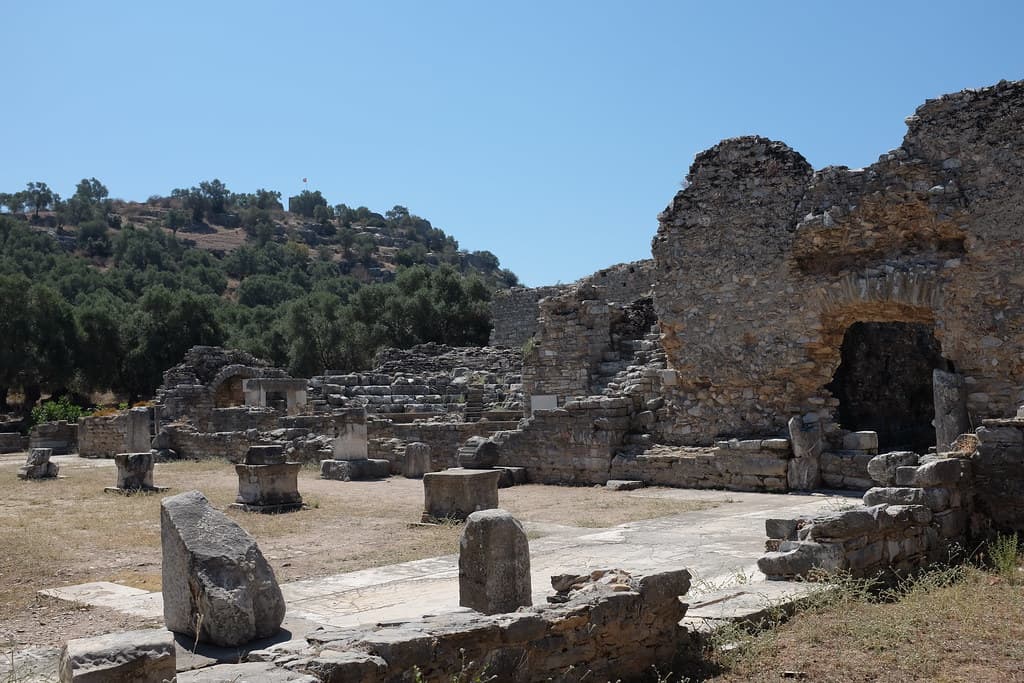
Image of Iasos. Image source
Visit essentials
A quick read before you go
- Duration
- 1–2 hours for the archaeological site; additional time for the village, harbor, and any nearby…
- Access
- Located near the village of Kıyıkışlacık, approximately 26 km west of Milas in Muğla Province.
Overview
Iasos occupies an in-between place: accessible by road now, though ancient records suggest it was once surrounded by water. Since the Neolithic period, inhabitants remained on this rocky promontory at the Gulf of Güllük's head—perhaps for its defensible ground, sheltered harbor, or Artemis Astias, a goddess whose domain joined wild coast and settlement. Five thousand years of habitation accumulated here.
Rather than a grand excavated showpiece, visitors find ruins interwoven with Kıyıkışlacık: fishermen near Hellenistic walls, Roman mosaics on the stony hillside, and the Italian archaeological mission continuing excavations begun in 1960. The famous story of Hermias and his dolphin companion, whose friendship ended with the dolphin's death when Hermias died, embodies Iasos's liminality between human and animal, land and sea, history and mythology.
Why this place is sacred
What makes a place feel like a threshold? At Iasos, several forces converge. The topography was always liminally positioned — nearly an island, connected to the mainland by a thread of land, with water present on three sides. This is a geography that ancient peoples read as sacred, a natural boundary between the world of the land and the world of the sea.
The patron goddess of the city, Artemis Astias, was a local variant of Artemis whose domain encompassed both harbor and wilderness — she protected the fishermen and the coastline simultaneously. The density of continuous habitation since the Neolithic speaks to something in this place that kept drawing people back: Minoan and Mycenaean connections in the Bronze Age, Carian indigenous culture, Greek colonial overlay, Roman prosperity, Byzantine continuation. Each layer is still present in the soil.
The famous dolphin legend of Hermias operates in this threshold space. Dolphins in ancient Greek culture were sacred to Poseidon and to Apollo — intermediaries between human consciousness and the deep. A boy who befriended a wild dolphin, who rode on its back across the harbor until his death, and whose companion then died of grief is a story about the permeability of the boundary between species, between the tame and the wild, between the living and the lost.
Alexander the Great, moved by the story, made the dolphin sacred to the city.
The promontory served as a naturally defensible settlement point from the Neolithic period onward, later developing into a Carian-Greek city-state with its own patron goddess, civic institutions, and harbor infrastructure.
From Neolithic settlement through Early Bronze Age (with evidence of a cist-grave cemetery from 3200–2600 BCE), through Bronze Age Minoan and Mycenaean connections, into the Carian and then Greek colonial period, Roman prosperity (notable fine mosaic floors in villas), and Byzantine continuation. Modern excavation began with the Italian School of Archaeology at Athens in 1960, producing one of the longest-running archaeological programs in Turkey.
Experience and orientation
What distinguishes Iasos from more formally presented archaeological sites is the quality of coexistence: ancient walls and Byzantine stonework are threaded through the active streets and harbors of Kıyıkışlacık. There is no clean separation between the archaeological past and the present life of the village. This can be disorienting at first — ruins appear in the middle of a lane, a Roman mosaic threshold sits at the edge of someone's garden.
But it offers something that more isolated sites cannot: the sense of a place that was never fully abandoned, that people kept finding worth returning to across five millennia. Walk toward the promontory's rocky tip and notice how the sea surrounds the site on multiple sides. At the right tide and light, it is not difficult to imagine the original island topography.
The Artemis sanctuary area, still being excavated, sits within this landscape as an absence that defines where the sacred zone was concentrated. The Roman villa mosaics visible at various points across the site speak to the prosperity of the city's later phase — this was a place where wealth and the arts arrived, not just trade. The Italian mission has worked methodically through the strata since 1960; at any given visit, active or recently completed trench work may be visible.
Approach from the small town of Kıyıkışlacık. The ruins are interspersed with the village; there is no single entrance gate. Walk toward the promontory's higher ground for the best overview of the site's topography and sea setting. The harbor area and the Roman-period villa mosaics are worth finding. Allow time to sit near the water.
Context and lineage
Ancient tradition held that Iasos was founded by colonists from Argos in the Greek mainland. But archaeology has revealed a far older human presence: Neolithic settlements, an Early Bronze Age (3200–2600 BCE) cist-grave cemetery, and Bronze Age connections to Minoan Crete and Mycenaean Greece that predate the Greek colonial narratives by millennia. The city was a Carian settlement long before Greek colonists arrived to add their cultural and religious overlay.
The patron deity Artemis Astias — a local Carian variant of Artemis not found elsewhere — speaks to the persistence of indigenous religious identity within the hellenized city. In the classical period, Iasos changed hands repeatedly: Persia, Athens, Sparta, the Hecatomnid satraps under Mausolus, then the Macedonians and eventually Rome.
Alexander the Great's recorded response to the dolphin legend of Hermias — making the dolphin sacred to the city and appointing a keeper — suggests that even in the Macedonian period, Iasos was understood through the lens of its most distinctive local myth.
Iasos sat within the broader Carian cultural and political sphere, sharing the region with Halicarnassus (Bodrum), Labraunda, and Mylasa. Its connections to Minoan and Mycenaean Bronze Age networks give it a lineage that precedes and exceeds the Greek colonial period. In the Roman era it prospered as a minor but comfortable city, producing the fine mosaic floors still visible on the site. The Italian excavation mission represents a continuous scholarly tradition of engagement with the site since 1960.
Hermias
The boy of Iasos celebrated in the city's most famous legend, whose friendship with a wild dolphin became a symbol of the city and attracted the attention of Alexander the Great
Amorges
Persian-backed ruler of Iasos defeated by Sparta in 411 BCE, whose capture changed the balance of the Peloponnesian War in Sparta's favor
Mausolus
Hecatomnid satrap who controlled Iasos in the 4th century BCE as part of his consolidation of Carian power
Doro Levi
Italian archaeologist who initiated systematic modern excavations at Iasos for the Italian School of Archaeology at Athens (1960–1972)
Fede Berti
Led the Italian excavation mission at Iasos from 1984 to 2011, producing major publications on the site's Bronze Age through Byzantine stratigraphy
Traditions and practice
The annual festivals for Artemis Astias centered on the goddess's sanctuary and included civic sacrifices and votive offerings. The harbor's sacred dimensions were maintained through observances to Poseidon, the god of the sea and of dolphins — the latter carrying particular local resonance given the Hermias legend. The bouleuterion hosted civic religious ceremonies, and multiple sanctuaries within the city served a population accustomed to layering indigenous Carian, Greek, and later Roman religious forms.
The Italian archaeological mission (continuing since 1960) conducts systematic excavation and publication. The small village of Kıyıkışlacık sustains itself through fishing and modest tourism. No active religious observances take place at the site.
Iasos rewards a particular kind of attention: the patient, open-eyed walk through a site that does not announce itself through dramatic standing structures but accumulates meaning through texture and layering. Walk the promontory's perimeter where land meets sea on multiple sides. Notice how the ancient and the contemporary coexist without drama — a wall running through someone's garden, a mosaic visible at the edge of a path.
Sit near the harbor and hold the dolphin legend of Hermias alongside the actual sea before you. The relationship between a human child and a wild cetacean — so close that the animal died of grief — is one of the ancient world's most vivid encoded encounters with non-human consciousness.
Artemis Astias Cult
HistoricalArtemis Astias was the patron goddess of Iasos — a local Carian variant of Artemis not attested elsewhere, whose domain encompassed the harbor, the wild coastline, and the city's protection. Her sanctuary has been identified by the Italian excavation mission.
Civic festivals, sacrifices, votive offerings at the Artemis sanctuary; the goddess served as the focal point of the city's religious identity across the Carian and Greek periods
Carian and Bronze Age Religion
HistoricalThe site's continuous habitation since the Neolithic period, with evidence of Bronze Age Minoan and Mycenaean connections, preserves a prehistory of sacred practice at this coastal promontory that substantially predates the Carian and Greek historical periods.
Bronze Age funerary practices (Early Bronze Age cist-grave cemetery, 3200–2600 BCE); Minoan and Mycenaean period ritual not yet fully documented
Byzantine Christianity
HistoricalIasos continued as a settlement into the Byzantine period, with Christian-era remains recorded in the multilayered stratigraphy of the site.
Christian liturgy; the site shows evidence of continuity through late antiquity and into the Byzantine period
Archaeological Scholarship
ActiveThe Italian School of Archaeology at Athens has maintained one of the longest-running excavation programs in Turkey at Iasos, active since 1960. The mission has produced foundational scholarship on Carian civilization, Bronze Age connections, and the city's multi-period stratigraphy.
Systematic excavation, artifact conservation and publication, site stewardship
Perspectives and open questions
Iasos can be read as a stratigraphic record of human choices about where to settle over 5,000 years, as a Carian-Greek city whose patron goddess held the wild coast under her protection, as the setting of an ancient story about interspecies friendship and grief, and as a living archaeological site where past and present have never been cleanly separated.
Scholarly perspective
Scholarly consensus identifies Iasos as one of the most continuously occupied sites in Caria, with evidence from the Neolithic through Byzantine periods. The Italian School of Archaeology at Athens has produced foundational publications on the Bronze Age Minoan and Mycenaean connections, the Carian-Greek transition, and the Roman-period prosperity visible in fine mosaic floors. The site's bilingual inscriptions in Carian and Greek have contributed to the decipherment of the Carian script.
The patron goddess Artemis Astias, local to Iasos, is a significant example of Carian religious identity persisting within a hellenized framework.
Living and traditional perspectives
No surviving indigenous tradition. The Carian language and culture were absorbed into Greek-Roman civilization. The legend of Hermias and the dolphin — preserved in ancient literary sources and commemorated by Alexander the Great — represents the most durable memory of Iasos's distinctive local identity.
Alternative interpretations
The dolphin legend of Hermias carries resonance for those interested in the spiritual dimensions of human-animal relationship. Dolphins in ancient Greek religion were sacred to both Poseidon and Apollo — liminal creatures that moved between the human world and the deep. The story of Hermias encodes something older than Greek religion: a recognition of cetacean consciousness and the possibility of genuine interspecies bonds whose severing constitutes a real grief.
The site's isthmus position — almost an island, almost part of the mainland — speaks to a liminal sacred geography that recurs in ancient cultures worldwide.
Open questions
The full extent of Bronze Age Minoan and Mycenaean-period occupation at Iasos has not been completely mapped. The nature of worship at the Artemis Astias sanctuary remains incompletely understood; the precise location of the sanctuary within the site is not confirmed in available sources. Portions of the ancient city are likely underwater due to sea-level changes over three millennia.
Plan your visit
Access and arrival
Located near the village of Kıyıkışlacık, approximately 26 km west of Milas in Muğla Province. From the D330 Bodrum–Milas highway, turn northwest at the junction about 10 km from Milas and continue 18 km to the village. Bodrum-Milas Airport is approximately 25 km away. No regular public bus service; taxi from Milas or car rental recommended. Mobile signal: generally available near the village. No dedicated visitor center; no confirmed regular opening hours — the site is largely open-access.
The village of Kıyıkışlacık has minimal accommodation options; small pansiyons may be available. Milas (26 km) has more standard hotel options. Bodrum (approximately 40 km) has full tourist infrastructure and is a common base for visits to the broader Carian archaeological landscape.
Respectful visit
No specific requirements. Sturdy footwear is practical for rocky promontory terrain.
Generally permitted throughout the site and village. The harbor setting, mosaic details, and sea-surrounded topography are visually distinctive.
Not applicable at this archaeological site.
Do not enter active excavation zones. Do not remove artifacts or disturb the archaeological layers. Respect the privacy and daily life of village residents.
Some excavation areas are active and restricted; observe any barriers. The promontory terrain is rocky and uneven. No public toilets or visitor facilities are reliably documented; the village has small cafes.
Location
Map loads as you approach this section.
Pilgrim reflections
A portrait of encounter, not a score
Pilgrims describe what they felt, how present they could become, and whether the place would shape a journey. There are no stars and no ranking of traditions.
No reviewed reflections yet
The first pilgrims can help describe the character of being here.
Share a reflection
Available after an account-backed “Been there.” Every reflection is reviewed before publication.
Nearby sacred places
Explore other sacred places in the region. Proximity does not establish access or travel time; check each place’s guidance.


References
Sources consulted for this page. Source categories describe the publication, not a guarantee that every claim is verified. Traditional accounts and outside interpretations may differ.
- 01Top 10 Archaeological Sites in Caria, Turkey — World History EncyclopediaacademicScholarly overview placing Iasos in regional context
- 02Iasos of Caria - All'Insegna del Giglio — Italian Archaeological Mission at IasosacademicItalian excavation mission publication
- 03Iasos (Site) - Perseus Digital Library — Perseus Project, Tufts UniversityacademicAcademic site record
- 04Iasos (Caria) - ToposText — ToposTextacademicCoordinates and ancient text references
- 05Iasos - Wikipedia — Wikipedia contributorsencyclopediaComprehensive overview of history, archaeology, and geography
- 06Iasos - Turkish Archaeological News — Turkish Archaeological NewsSource contextSite overview with archaeological context
- 07The Archaeological Site of Iasos and the Legend of Hermias and the Dolphin — Turkish MuseumsofficialCovers the famous dolphin legend and site history
- 08Iassos Ancient Carian City — ArticHaeologySource contextAccessible overview with site description
Share a photo
Help visitors recognize Iasos. Every submission is reviewed before publication.