Didyma
The oracle sanctuary at the end of the Sacred Way
Understand sacred places, explore living traditions, and learn how to engage respectfully with Pilgrim Map.
Access has not been verified. Check current local guidance before planning a visit.
Didim, Aydın, Turkey
Read the sources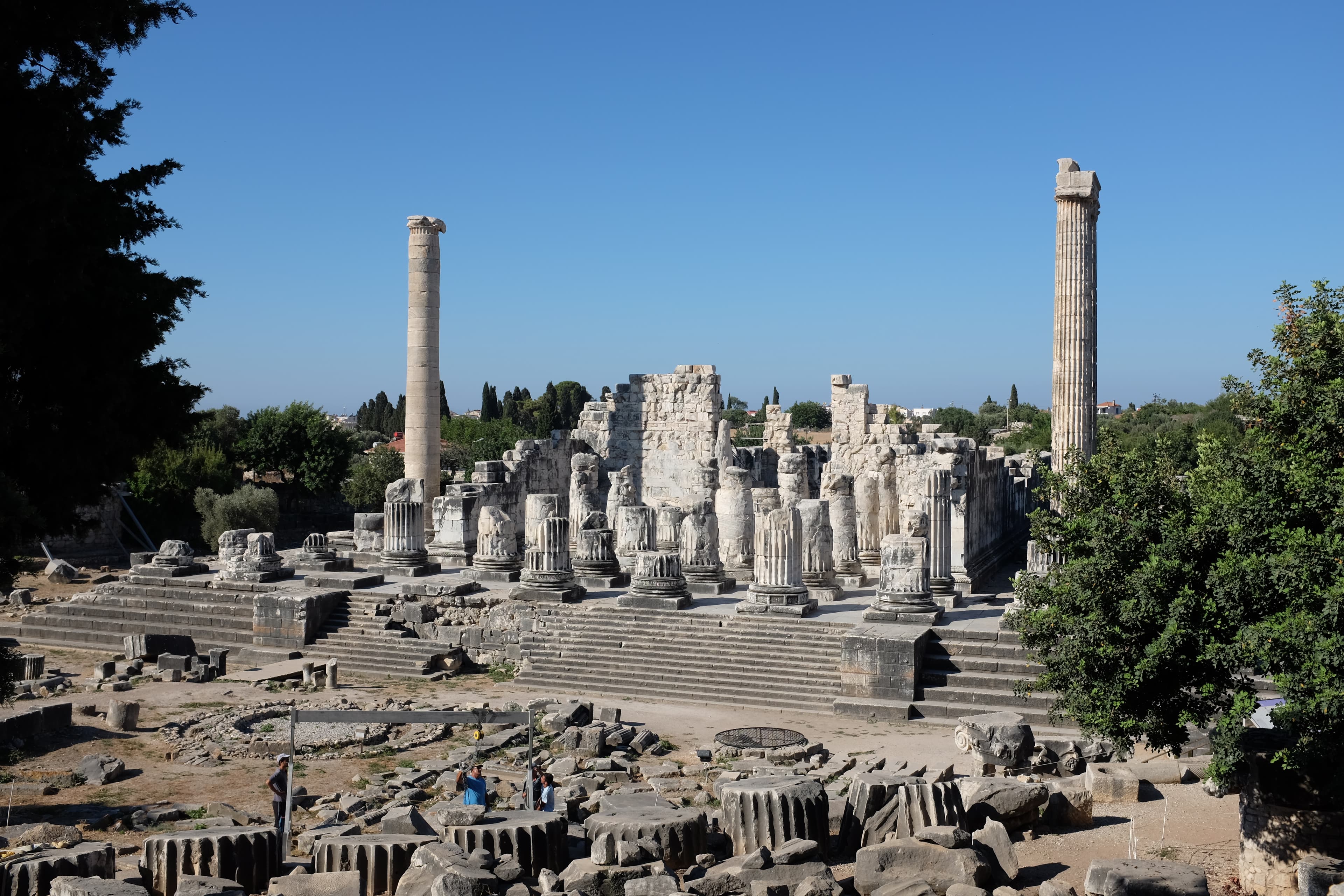
Frontal view of the Didymaion.. Image source · CC BY-SA 4.0
Station end of 2
Sacred Way of DidymaVisit essentials
A quick read before you go
- Duration
- 1.5 to 3 hours for the temple site itself; a full day if combined with Priene and Miletus as…
- Access
- Located within the modern town of Didim, Aydın Province, roughly 17 kilometers south of the…
Overview
The Temple of Apollo at Didyma—the Didymaion—was among the largest sanctuaries ever attempted in the Greek world and one of its most authoritative oracles. For roughly a thousand years, through Archaic cult origins, Persian destruction, Hellenistic rebuilding, and Roman-era consultation, priests interpreted Apollo's will for petitioners from Milesian citizens to Alexander the Great.
Didyma was the terminus of the Sacred Way, a processional road from the harbor city of Miletus: a visit completed a journey rather than reaching a standalone destination. On Turkey's Aegean coast, its dipteral colonnade and underground oracle chamber remain legible in a monument whose six centuries of construction never reached completion.
Places within this site
Why this place is sacred
What makes Didyma feel different from most ruined temples is that this was not a shrine of static devotion but an operating instrument of decision. Petitioners came here because they needed an answer they could not get anywhere else — about founding a colony, going to war, or resolving a private crisis — and for centuries, the sanctuary's priesthood provided one.
The underground adyton, still descendable today, is where that transaction took place: a sacred spring, an enclosed chamber, and a priest whose interpretation carried the weight of Apollo's own voice. The temple's unfinished state deepens rather than diminishes this: the Didymaion was under construction, on and off, for roughly six hundred years, and was still incomplete when the oracle itself was silenced. It is a monument to an institution that outlasted the building meant to house it.
A sanctuary and oracle of Apollo, functioning as one of the principal sources of divine consultation in the ancient Mediterranean, comparable in authority to Delphi.
Cult activity is attested from the 8th century BCE, predating full Greek colonization of the region. The Archaic temple, completed around 550 BCE, was destroyed by Darius I of Persia in 494 BCE following the sack of Miletus. Alexander the Great's visit initiated a monumental Hellenistic rebuilding that continued, with interruptions, through the Roman period without ever reaching completion. The oracle was formally silenced by Theodosius I's anti-pagan edicts, traditionally dated to 385 CE.
Rather than being destroyed outright, the site was Christianized: a basilica was built within the temple's adyton in the 5th or 6th century, and Didyma briefly held bishopric status under Justinian I as 'Justinianopolis' before declining through the early Middle Ages and suffering further damage in earthquakes in the 7th and 15th centuries CE.
Experience and orientation
Arrival is announced from a distance by the standing columns, some over nineteen meters, arranged in a footprint that was originally meant to carry 108 of them in a double ring. Walking the perimeter gives a sense of the temple's dipteral plan — colonnades nested within colonnades — before the path leads toward the east front, where two slender Corinthian columns mark the transition from open portico to enclosed interior.
From there, steps descend into the partially excavated adyton, the temple's innermost chamber, where the sacred spring and the mechanics of the oracle itself were located. The descent is unmistakably deliberate: whatever the actual ritual involved, the architecture itself stages a movement from public exterior to private threshold. On the exterior architrave, visitors consistently pause at the carved Gorgon (Medusa) heads, apotropaic guardians whose weathered faces are among the most reproduced images of the site.
The absence of a roof, of finished upper courses on many columns, and of any trace of the original cult statue leaves the site legible as a work permanently in progress rather than a ruin of something once complete.
Enter from the site's ticketed perimeter path; the temple platform and standing colonnade are immediately visible on approach, with the underground adyton accessible via stairs near the temple's eastern end.
Context and lineage
According to the sanctuary's own foundational legend, Apollo was struck by the beauty of a young shepherd named Branchus and, during a ritual encounter at a sacred spring, granted him the gift of prophecy. Branchus founded the oracle, and his descendants — the Branchidae — served as its hereditary priesthood for generations, giving the sanctuary its alternate ancient name.
Some ancient and modern accounts suggest the site's sacred use predates Ionian Greek colonization of the region, meaning the Apollo cult may have absorbed an earlier layer of local sacred practice rather than originating it outright.
Ritual authority at Didyma passed through the hereditary Branchidae priesthood in antiquity; no living lineage or successor tradition continues today. Modern stewardship of the site rests with Turkish heritage authorities and the archaeological teams, chiefly under the German Archaeological Institute, that have excavated it since the early twentieth century.
Traditions and practice
Petitioners submitted questions to a priest (the prophētēs), whose interpretation — tied to the sacred spring within the adyton — was understood to convey Apollo's answer. The quadrennial Great Didymeia festival brought athletic, musical, and dramatic competitions to the sanctuary, and processions along the Sacred Way from Miletus culminated in ritual sacrifice at Didyma's altars.
No religious community practices at Didyma today. Site engagement is archaeological and interpretive: ongoing excavation and conservation work continues under Turkish heritage authorities, and recent initiatives have focused on restoring public access to surviving stretches of the ancient Sacred Way between Didyma and Miletus.
Approach slowly from the temple's exterior rather than heading straight for the adyton. Walk the standing colonnade first, noting the unfinished upper courses on many columns, before descending into the underground chamber. Sit for a few minutes at the base of the east front, near the Corinthian columns, where the transition from open portico to enclosed sanctuary is most legible.
If time allows, seek out any accessible remnant of the Sacred Way to register the site as a destination reached rather than encountered in isolation.
Ancient Greek Religion (Apollo cult and oracle)
HistoricalDidyma housed one of the ancient Greek world's most important oracular sanctuaries, ranked second in prestige only to Delphi, issuing prophecies on matters of state, war, and colonization for Miletus and for rulers across the Mediterranean.
Oracle consultation via a priest interpreting signs tied to the sacred spring within the adyton; the quadrennial Great Didymeia festival with athletic and dramatic competitions; sacrifice at altars within the sanctuary.
Branchidae Priesthood and Oracle Mythology
HistoricalThe sanctuary's ritual authority was held by the hereditary Branchidae priesthood, descended from Branchus, whose myth gave the oracle a personal, lineage-based foundation distinct from Delphi's Pythia tradition.
Hereditary transmission of priestly office; ritual purification associated with the sacred spring linked to Branchus's original encounter with Apollo.
Sacred Way Pilgrimage (Miletus–Didyma processional)
HistoricalThe roughly 17-kilometer Sacred Way linked the Sanctuary of Apollo Delphinios in Miletus to the Didymaion, forming one of the best-documented processional routes of the ancient world and structuring a shared ritual geography between city and oracle.
Multi-day ritual processions with sacrifices at successive stops along the route, including sites associated with Milesian magistrates and the Nymphs; the route was lined with statue bases and inscriptions, portions of which survive.
Byzantine Christian Use
HistoricalFollowing the oracle's closure, the site was Christianized rather than abandoned: a basilica was built within the temple's adyton in the 5th or 6th century, and Didyma briefly held bishopric status under Justinian I as 'Justinianopolis.'
Christian liturgical use within the repurposed temple structure; episcopal administration until the site's decline in the early Middle Ages.
Archaeological and Conservation Stewardship
ActiveDidyma remains an active site of archaeological research and heritage conservation, with excavation history stretching from the German Archaeological Institute's early-twentieth-century campaigns to ongoing Turkish-led conservation and public-access initiatives along the Sacred Way.
Continued excavation and structural conservation; interpretive signage and guided tourism; recent projects to make surviving portions of the ancient Sacred Way walkable for visitors.
Perspectives and open questions
Didyma is read differently depending on the lens: as a monument to archaeological ambition, as a still-functioning symbol in spiritual-travel literature, and as a site whose oracular mechanics remain only partly understood even by specialists.
Scholarly perspective
Archaeologists and classical historians regard Didyma as one of the three or four most important oracular sanctuaries of the ancient Greek world, notable both for the sheer scale of its Hellenistic temple — among the largest ever attempted in Greek architecture — and for the unusually well-documented Sacred Way linking it to Miletus.
Excavation led by the German Archaeological Institute since the early twentieth century, particularly under Theodor Wiegand from 1905 to 1913, has clarified the temple's successive building phases, though the structure was never fully completed despite roughly six centuries of intermittent construction.
Living and traditional perspectives
No continuous devotional tradition is known to survive from antiquity; virtually all knowledge of the oracle's practices reportedly comes from classical Greek and Roman authors, including Herodotus and Strabo, supplemented by inscriptions recovered during excavation. Tradition holds that the Branchidae priesthood and its Apollo-Branchus founding myth are known only through this secondary, textual record.
Alternative interpretations
Contemporary spiritual-travel writing frequently pairs Didyma with Delphi as one of antiquity's paradigmatic 'places of the oracle,' framing the sanctuary's association with sacred springs and prophetic consciousness as a template for visionary or altered-state spiritual experience — an interpretive lens distinct from, though not contradicted by, the archaeological record.
Open questions
The precise mechanism by which the oracle produced its prophecies — whether through the sacred spring's water, vapor, ritual incubation, or ecstatic utterance interpreted by the priest — remains debated, since ancient sources themselves describe it inconsistently. The full original extent of structures along the Sacred Way is still being archaeologically reconstructed, and the site's earliest, pre-Greek layer of cult activity (attested from the 8th century BCE) is only partially understood.
Plan your visit
Access and arrival
Located within the modern town of Didim, Aydın Province, roughly 17 kilometers south of the Miletus archaeological site. Reachable by taxi (approximately 10–15 minutes from central Didim) or local dolmuş minibus; most visitors arrive by car or organized day tour from Kuşadası, Bodrum, or İzmir. Site hours are typically around 08:30–17:30, extending into early evening in summer; ticket prices and hours should be reconfirmed before visiting, as both fluctuate seasonally.
Mobile phone signal is generally reliable within Didim town and at the site itself, unlike more remote heritage sites in the region. No keyholder or advance booking is required for general site entry.
Didim town, immediately surrounding the site, offers a full range of tourist accommodation as an established coastal resort destination; no on-site or pilgrimage-specific lodging exists.
Respectful visit
No religious dress requirements. Sturdy, closed-toe footwear is strongly recommended given the uneven ancient stonework, and in spring, waterproof shoes are advisable since drainage-related ground moisture can affect parts of the site.
Permitted throughout the site, including within the excavated adyton. The Medusa/Gorgon head reliefs and the standing colonnade are the most frequently photographed features; early morning or late afternoon light is generally preferred.
None are appropriate or expected; the site has no active religious community and offerings are not part of contemporary visitor practice.
Stay on designated paths and walkways. Do not climb on columns, architraves, or excavated structural remains. Some areas may be cordoned off for ongoing conservation.
The site has no active ritual use; visitors should not treat the adyton or altars as functioning sacred space requiring devotional conduct, though respectful, quiet behavior remains appropriate given the site's historical gravity.
Location
Map loads as you approach this section.
Pilgrim reflections
A portrait of encounter, not a score
Pilgrims describe what they felt, how present they could become, and whether the place would shape a journey. There are no stars and no ranking of traditions.
No reviewed reflections yet
The first pilgrims can help describe the character of being here.
Share a reflection
Available after an account-backed “Been there.” Every reflection is reviewed before publication.
Nearby sacred places
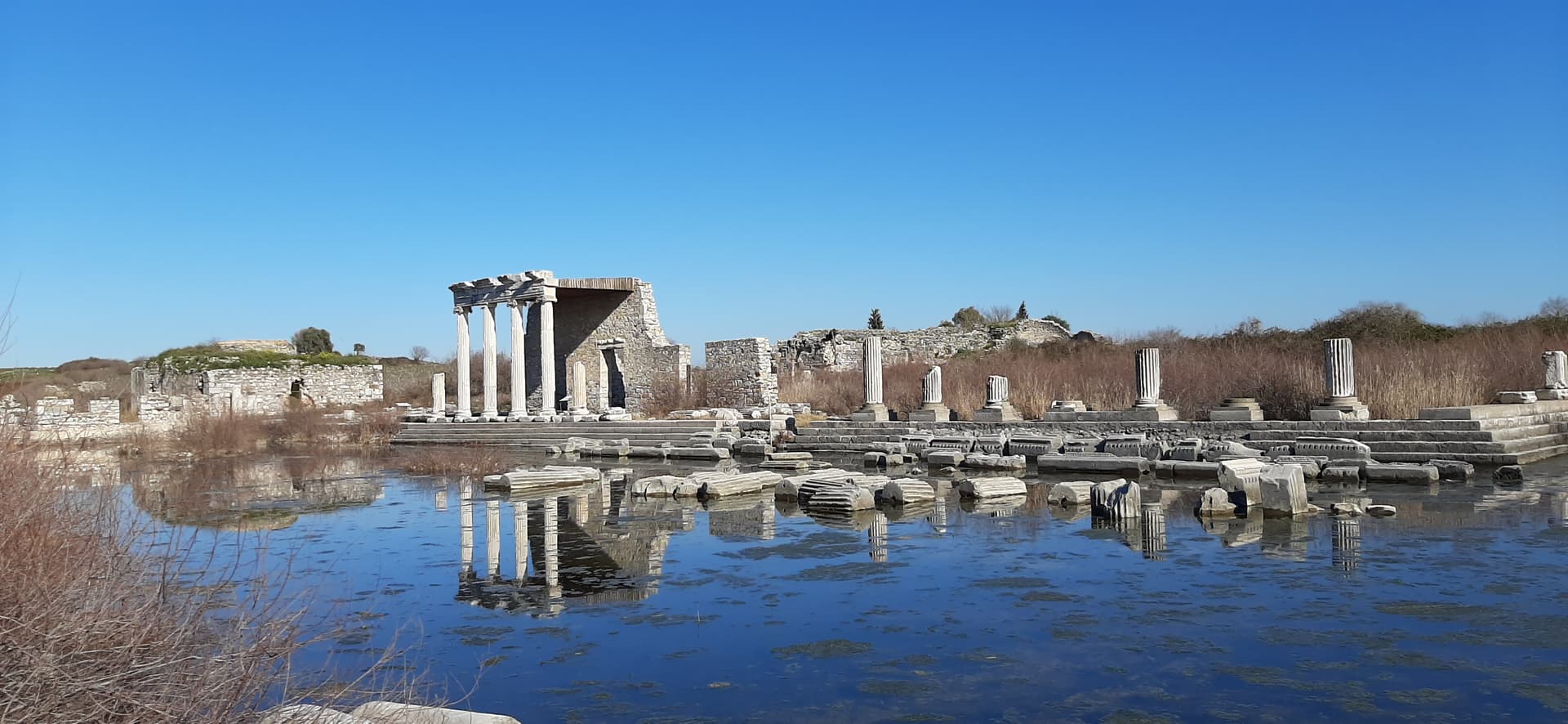
Explore other sacred places in the region. Proximity does not establish access or travel time; check each place’s guidance.



References
Sources consulted for this page. Source categories describe the publication, not a guarantee that every claim is verified. Traditional accounts and outside interpretations may differ.
- 01Didyma — Wikipedia — Wikipedia contributorsacademicComprehensive overview of history, the Branchidae priesthood, oracle mechanics, and site chronology
- 02Didyma | Oracle, Temple, Apollo | Britannica — Encyclopaedia BritannicaacademicAuthoritative encyclopedia entry confirming oracle status second only to Delphi
- 03The Temple of Apollo at Didyma — World History EncyclopediaacademicDetailed treatment of construction phases, Persian destruction, and Hellenistic rebuilding under Alexander
- 04Didyma - Livius — Jona Lendering, Livius.orgacademicClassical-history reference site with detailed source-critical notes on the Branchidae and oracle mechanics
- 05DIDYMA - Encyclopaedia Iranica — Encyclopaedia IranicaacademicCovers the Persian-period destruction of the sanctuary under Darius I and its place in Achaemenid history
- 06Processions, Propaganda, and Pixels: Reconstructing the Sacred Way Between Miletos and Didyma — American Journal of ArchaeologyacademicPeer-reviewed archaeological reconstruction of the 17km processional Sacred Way and its ritual stops
- 07Temple of Apollo at Didyma — Turkish Archaeological NewsacademicArchaeological summary with construction and excavation history
- 08Reimagining Didyma's Sacred Way — Turkish Archaeological NewsacademicCovers recent conservation and public-access efforts along the ancient processional route
- 09Theodor Wiegand — Wikipedia — Wikipedia contributorsacademicBiography of the German Archaeological Institute director who led excavations at Didyma 1905–1913
- 10Didyma - Madain Project — Madain ProjectacademicArchitectural detail on the dipteral temple plan, columns, and the Medusa/Gorgon frieze
- 11Didyma - World Pilgrimage Guide — Sacred Sites (Martin Gray)spiritualSpiritual-travel perspective on the oracle's contemplative and pilgrimage significance
- 12Sacred Way | Go Didim — Go Didim (municipal tourism portal)officialLocal municipal tourism authority description of the Sacred Way route and stops
- 13Visit Didim - Didim Holiday — Didim HolidaySource contextPractical visitor guide covering access, transport, and site logistics
- 14Didyma Turkey Guide 2026: Temple of Apollo & Sacred Way — Ancient TravelSource contextCurrent visitor information including ticketing, hours, and seasonal conditions
Photo gallery
3 curated photos
Share a photo
Help visitors recognize Didyma. Every submission is reviewed before publication.