Our Lady of Walsingham
England's Nazareth, restored in the 20th century after four centuries of ruined silence
Understand sacred places, explore living traditions, and learn how to engage respectfully with Pilgrim Map.
Access has not been verified. Check current local guidance before planning a visit.
North Norfolk, England, United Kingdom
Read the sources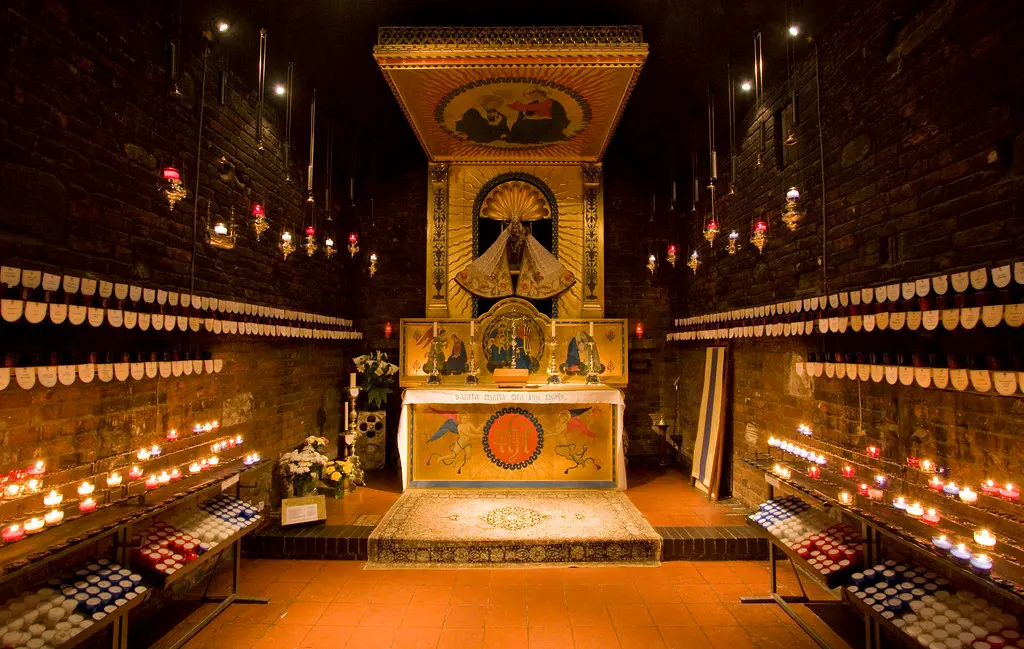
Visit essentials
A quick read before you go
- Duration
- Half a day for a focused visit to both shrines.
- Access
- Walsingham (Little Walsingham), Norfolk, about 30 miles north-west of Norwich.
Overview
Walsingham holds two shrines, both of Our Lady, both restored in the 20th century after four centuries of ruin. They sit a mile apart along a country lane in north Norfolk, and many pilgrims visit both in a single day.
The foundation story is medieval. Around 1061, a widowed noblewoman of Little Walsingham named Richeldis de Faverches reported three visions in which the Virgin Mary led her to a meadow and showed her the dimensions of the Holy House at Nazareth, asking her to build an exact replica in England. The Holy House she built drew pilgrims for nearly five centuries. Every English monarch from Henry III to Henry VIII came here.
Henry VIII himself walked barefoot from the Slipper Chapel as a young king before later ordering the shrine's destruction in 1538.
For nearly four centuries after the Reformation, the priory ruins stood at the centre of the village. Then in 1922, the Anglican parish priest Fr Alfred Hope Patten installed a new statue of Our Lady of Walsingham in the parish church, then built a replica Holy House for it — and during the 1931 construction, workmen rediscovered a medieval holy well. A mile away, in the small 14th-century Slipper Chapel, the Roman Catholic Church established its National Shrine in 1934.
In 2020 the bishops of England rededicated the country as the 'Dowry of Mary' at Walsingham. The two shrines now host Anglican, Catholic, Orthodox, and Methodist pilgrimages in turn, and the village's twin presence is widely understood as a distinctive ecumenical witness.
Why this place is sacred
The strange power of Walsingham is its layering. The Pynson Ballad, printed around 1496, records a foundation legend that places Mary's instruction here in 1061; the priory established by Augustinian canons by 1153 became the wealthiest in East Anglia, and royal pilgrimage continued unbroken from Henry III to Henry VIII. In 1538 Henry VIII's commissioners broke the medieval image, burned it in London, and dissolved the priory; the village's pilgrim economy collapsed within months.
For nearly four centuries the priory ruins stood as a monument to that destruction.
What happened in the 20th century gave Walsingham a different kind of thinness. In 1922 Fr Alfred Hope Patten, the Anglican vicar of the village, installed a new statue of Our Lady of Walsingham in his parish church, modelled on the seated 'Sedes Sapientiae' image known from medieval seals. Pilgrim numbers grew, and in 1931 he built a replica Holy House; during construction, a holy well was rediscovered under the floor.
A mile away at Houghton St Giles, the small 14th-century pilgrim chapel known as the Slipper Chapel — where medieval pilgrims had removed their footwear to walk the last Holy Mile barefoot — was restored in 1934 by Charlotte Boyd and the Diocese of Northampton as the Roman Catholic National Shrine.
The combined effect is unusual in Protestant lands: two Holy House replicas, two living shrines, twin national pilgrimages on adjoining May weekends, and a clearly bounded village that holds both. Pilgrims who walk the Holy Mile barefoot, as the medieval custom dictated, often report that the slowing of the body is the form the place asks for.
The priory ruins in the centre of the village hold the Reformation visibly present, and the contemporary devotional renewal does not erase that history but stands in dialogue with it.
The medieval Holy House and the priory that grew around it were built to make Nazareth available in England — a 'place of Mary's home' for pilgrims who could not reach the Holy Land. The Pynson Ballad explicitly frames the foundation as a Marian instruction; pilgrimage to Walsingham was understood as a substitute for pilgrimage to Nazareth.
From the 12th to the early 16th century, Walsingham was England's premier Marian shrine, with extensive royal patronage and a substantial Augustinian priory. Henry VIII suppressed it in 1538 as part of the broader Dissolution. From 1538 to 1922 the village retained the priory ruins but had no active shrine.
The 1922 Anglican restoration under Fr Hope Patten was followed by the 1934 Catholic restoration of the Slipper Chapel; the Anglican Holy House was rebuilt in a larger pilgrim church in 1931 and expanded through the 20th century. The Catholic National Shrine added a Chapel of Reconciliation in 1981 to accommodate large pilgrim groups. In 2020 the bishops of England rededicated the country as the 'Dowry of Mary' at Walsingham.
Healing traditions
Healing-water tradition
The Anglican shrine links its well ministry to a well rediscovered during construction in 1931. Its own history leaves open whether this was the medieval holy well, while recording subsequent reports of help and healing. Sprinkling developed as a prayerful encounter with water, accompanied by intercession for those who are sick. The sources reviewed here describe that continuing tradition without establishing a named individual healing case.
Ways to participate
Join an organized sprinkling service if offered during your visit, and let the shrine minister explain the gestures. You may also request prayer, a blessing, or information about laying on of hands and anointing. Bring the names of people you wish to remember. There is no need to perform a ritual privately or obtain oil yourself.
These accounts describe religious traditions and reported experiences. They do not promise a cure or replace medical care.
Experience and orientation
Most visitors arrive by car or pilgrim coach at one of the village car parks, or walk in along the Pilgrim Way from the Slipper Chapel a mile to the south. The traditional approach, still followed by many pilgrims, is to begin at the Slipper Chapel — removing one's footwear and walking the last mile barefoot into Walsingham.
The lane is narrow, lined with hedgerows and wildflower meadows that bloom heavily from April through June, and the pace of barefoot walking on a country road tends to draw silence from a group within the first hundred yards.
The Slipper Chapel itself is small, 14th-century, and contains the Catholic statue of Our Lady of Walsingham, papally crowned in 1954. The larger Chapel of Reconciliation next to it accommodates the National Pilgrimage on the last Sunday of May.
Inside the village, the Anglican Shrine occupies a substantial church complex with a replica Holy House at its heart; the venerated wooden image of Our Lady of Walsingham sits inside the Holy House on a raised altar, and pilgrims kneel close beneath her. The holy well lies a few steps away, and the Anglican shrine offers anointing with the oil of Walsingham as part of its regular pilgrim ministry.
The priory ruins stand a short walk from the Anglican shrine, in the grounds of Walsingham Abbey. The tall arch of the priory church, with its surviving east wall, is the most visible reminder of what was lost in 1538 and the most explicit historical layer of the pilgrimage. Pilgrims often spend time here in silence — not as a separate stop, but as part of the shape of the day.
A first visit is best made on a quieter weekday, ideally with time to walk the Holy Mile both ways and to spend time at both shrines and the priory ruins. The National Pilgrimage weekends in late May — Anglican on the Spring Bank Holiday Monday, Catholic on the last Sunday — are the most concentrated moments of the year, but they reward those who arrive willing to share the day with several thousand other pilgrims.
If you are coming with a specific intention, the Anglican shrine's anointing with the oil of Walsingham is offered freely and is the customary form for those who wish it. Bring a small empty bottle for water from the holy well.
Context and lineage
According to the Pynson Ballad, printed by Richard Pynson around 1496, the widowed noblewoman Richeldis de Faverches of Little Walsingham was led in three visions in 1061 by the Virgin Mary to a meadow on her estate, where she was shown the dimensions of the Holy House of Nazareth and instructed to build an exact replica.
Local tradition holds that twin holy wells appeared on the site of the original Holy House; one of these was rediscovered during the 1931 building works at the Anglican Shrine. The medieval Holy House and the Augustinian priory that grew around it became England's premier Marian pilgrimage site, with extensive royal patronage from the 12th to the early 16th century.
The shrine was suppressed in 1538 under Henry VIII; the priory was dissolved, the medieval image was burned in London, and the site fell silent. In 1922 Fr Alfred Hope Patten, the Anglican vicar, installed a new statue and began the restoration of the shrine. In 1934 Charlotte Boyd and the Diocese of Northampton restored the Slipper Chapel as the Roman Catholic National Shrine.
The medieval shrine was held for nearly four centuries by the Augustinian canons of Walsingham Priory, who managed both the Holy House and the surrounding pilgrim economy. After 1538 the site stood silent until the early 20th century. The Anglican Shrine of Our Lady of Walsingham is now an ecclesiastical guild within the Church of England, with its own rule of life and pilgrim ministries. The Roman Catholic National Shrine is administered by the Bishop of East Anglia.
Eastern Orthodox communities maintain a small parish in the village; Methodist pilgrimage groups participate regularly in ecumenical events. The two principal National Pilgrimages — Anglican (Spring Bank Holiday Monday) and Catholic (last Sunday in May) — fall on adjoining weekends each May.
Mary (Our Lady of Walsingham)
deity
The Mother of God as venerated under the title 'Our Lady of Walsingham', shown as the seated 'Sedes Sapientiae' (Seat of Wisdom) with the Christ child on her lap. Both the Anglican and Catholic statues are 20th-century reconstructions of the lost medieval image, each with its own iconographic choices.
Richeldis de Faverches
historical
Lay noblewoman of Little Walsingham, traditionally identified as the foundress of the shrine after her 1061 visions of the Virgin. Sources differ on whether she was a widow at the time of the vision and whether her son Geoffrey built the original Holy House. Some medievalists place the foundation in the early 12th century.
Fr Alfred Hope Patten
historical
Anglo-Catholic priest, vicar of Walsingham 1921–1958, and the principal figure in the Anglican restoration of the shrine. Installed the new statue in 1922 and built the replica Holy House in 1931, during which the holy well was rediscovered.
Charlotte Boyd
historical
Victorian Catholic convert and ecclesiastical patron who purchased the ruined Slipper Chapel in 1896. Her work made possible the 1934 Catholic restoration of the chapel as the National Shrine.
Henry VIII
historical
King of England (1509–1547). As a young king he walked barefoot from the Slipper Chapel to the shrine; in 1538 he ordered its dissolution and the destruction of the medieval image. His double relationship to Walsingham — pilgrim and suppressor — is part of the site's historical weight.
Traditions and practice
At the Anglican Shrine, pilgrims enter the Holy House, kneel before the image, and may approach for sprinkling with water from the holy well and anointing with the oil of Walsingham — a practice introduced by Fr Hope Patten and still central to the Anglican ministry. Candles are lit in front of the Holy House. Written petitions are placed at the image.
At the Catholic National Shrine, the focus is the small 14th-century Slipper Chapel and the larger Chapel of Reconciliation; daily Mass and confessions are offered, and the Catholic National Pilgrimage on the last Sunday of May includes a Eucharistic procession from the Chapel of Reconciliation along the Holy Mile.
The contemporary pilgrimage has retained the medieval forms and added an explicitly ecumenical layer. Anglicans, Catholics, Orthodox, and Methodists hold their own pilgrim weekends through the season, and it is common to meet pilgrims from all four traditions in the village over a single weekend. The Anglican Shrine's National Pilgrimage on the Spring Bank Holiday Monday in late May and the Catholic National Pilgrimage on the last Sunday of May are the two largest events of the year.
Youth 2000 retreats, healing pilgrimages, and quiet weekend retreats run year-round. The Anglican Shrine's anointing with the oil of Walsingham remains one of the most consistently sought practices and is offered freely after the laying-on of hands by the shrine clergy.
If you have come for the first time, give yourself a full day. Begin at the Slipper Chapel — choose footwear suited to the walk — and walk the Holy Mile into the village. Spend time at the Anglican Holy House, kneeling before the image, drawing water at the holy well, and approaching for sprinkling and anointing if you wish. Walk to the priory ruins and let the destruction of 1538 sit alongside the renewal of 1922.
End at the Slipper Chapel again with the late afternoon walk back. If travelling with someone unwell, ask the Anglican Shrine about its current healing ministry and accessible participation. Let its ministers guide any use of water or oil.
Anglicanism (Church of England)
ActiveThe Anglican Shrine of Our Lady of Walsingham, restored by Fr Alfred Hope Patten in 1922, is the principal Marian pilgrimage centre of the Church of England. The shrine includes a replica Holy House, the venerated wooden image of Our Lady of Walsingham, and the holy well rediscovered in 1931. The Anglican National Pilgrimage on the Spring Bank Holiday Monday draws thousands each year.
Veneration of the statue of Our Lady of Walsingham in the Holy House. Sprinkling and drinking from the holy well. Anointing with the oil of Walsingham. Walking the Holy Mile barefoot from the Slipper Chapel. Daily Eucharist at the Pilgrim Church. Annual National Pilgrimage on the Spring Bank Holiday Monday in late May.
Roman Catholicism
ActiveThe Slipper Chapel, the small 14th-century pilgrimage chapel about a mile from the village, was restored in 1934 as the National Shrine of Our Lady of Walsingham. The Catholic statue of Our Lady was papally crowned in 1954. In 2020 the bishops of England rededicated the country as the 'Dowry of Mary' at Walsingham. The Catholic National Pilgrimage on the last Sunday of May draws thousands.
Daily Mass and confessions at the Slipper Chapel and the Chapel of Reconciliation. Catholic National Pilgrimage on the last Sunday of May, including a Eucharistic procession from the Chapel of Reconciliation along the Holy Mile. Walking the Holy Mile from the Slipper Chapel into the village. Devotional prayer before the papally crowned image.
Eastern Orthodoxy
ActiveA small Eastern Orthodox parish in Walsingham hosts Orthodox pilgrimages tied to feasts of the Theotokos. Russian, Greek, and Antiochian Orthodox pilgrim groups visit through the year, particularly around the Dormition (15 August).
Veneration of icons of the Theotokos in Orthodox liturgical form. Pilgrimage tied to the Marian feasts. Participation in ecumenical events alongside the Anglican and Catholic shrines.
Methodism (ecumenical pilgrimages)
ActiveMethodist pilgrim groups visit Walsingham regularly, particularly around ecumenical events. The 2020 rededication of England as the Dowry of Mary was accompanied by Methodist participation.
Participation in ecumenical pilgrim events, services, and quiet retreat days at both shrines.
Perspectives and open questions
Walsingham is held in tension between three readings: as England's medieval Nazareth, suppressed in 1538 and now restored; as a 20th-century devotional renewal in twin Anglican and Catholic form; and as a contemporary site of ecumenical Marian pilgrimage. Each reading shapes what pilgrims of different traditions look for when they arrive.
Scholarly perspective
Medievalists treat Walsingham as definitively England's premier Marian shrine from the 12th to early 16th century, with extensive medieval and royal patronage; the Pynson Ballad is the principal narrative source. Modern scholarship, including the Janes and Waller collection Walsingham in Literature and Culture from the Middle Ages to Modernity (Ashgate, 2010) and Michael Rear's The Walsingham Way (Gracewing, 2011), treats the 1061 foundation date as devotional tradition rather than securely datable; the priory is documented from the early 12th century.
The 1538 suppression is well documented in Henrician state papers.
Living and traditional perspectives
For both Anglican and Catholic devotees, Walsingham is England's own Nazareth — Mary's chosen 'Dowry' on English soil. The 2020 rededication of England as the Dowry of Mary, performed at Walsingham, was understood by the bishops of England as a public renewal of a medieval consecration first attested in the 14th century. For Orthodox pilgrims, the venerated images of Our Lady of Walsingham connect English Marian devotion to the broader Christian tradition of holy images.
Alternative interpretations
Some writers have read Walsingham within a wider 'Marian landscape' of East Anglia and connected it to older female-divinity sites or holy wells; this is interpretive rather than documented. The 1931 rediscovery of the holy well during the building of the Anglican shrine is taken by some as a confirming providence and by others as a coincidence of careful excavation.
Open questions
The exact location of the medieval Holy House within the priory grounds is debated; archaeological work has narrowed but not settled the question. The 1061 date itself rests on the Pynson Ballad rather than contemporary documentation.
Plan your visit
Access and arrival
Walsingham (Little Walsingham), Norfolk, about 30 miles north-west of Norwich. For main-line trains, the nearest stations are King's Lynn (~25 miles) and Norwich (~30 miles); from either, take a bus or taxi to the village. The Wells & Walsingham Light Railway runs a heritage line from Wells-next-the-Sea in season. Regular pilgrim coaches arrive in pilgrim weekends from across England. Both shrines have car parks for individual visitors. Mobile signal in the village is reliable on the major UK networks.
The Anglican Shrine operates a pilgrim hospice (the Shrine Hospice) with single, twin, and family rooms. The Catholic National Shrine has guest accommodation at Elmham House. Village inns and bed-and-breakfasts also welcome pilgrims. Book well ahead for the National Pilgrimage weekends in late May.
Respectful visit
Modest, comfortable clothing; warm layers in cooler months; sturdy shoes that can be removed for the Holy Mile if walking barefoot. Norfolk weather is changeable; bring rain gear in any season.
Permitted on the grounds, at the priory ruins, and in the village. Discretion required inside the shrines; no flash and no photography during liturgies. Do not photograph the venerated images during pilgrim devotion.
Candles, written petitions placed at the Holy House or the Slipper Chapel, and donations to the upkeep of each shrine. The oil of Walsingham is given freely after anointing at the Anglican Shrine; pilgrims often bring small phials to refill.
Silence is requested in the Holy House and in the Slipper Chapel during prayer and liturgy. Pilgrims are asked not to take photographs of the image at devotion. Some chapels and the apparition-era buildings have restricted opening hours; check shrine websites for current schedules.
Communion at each shrine follows the host tradition's discipline: Anglican Eucharist at the Anglican Shrine, Catholic Mass at the National Shrine, and so on. Visitors are welcomed to attend liturgy in any tradition but should respect the disciplines around Communion. Photography during liturgies is inappropriate. The Holy House at the Anglican Shrine is small; on busy days pilgrims are asked to keep their time inside brief so others may approach the image.
Current practical details
Address
Our Lady of Walsingham, 32A Knight St, Little Walsingham, Walsingham NR22 6DA, UK
Hours, fees, and access can change — verify on the official source before you travel. Practical details last checked Jun 2026.
Location
Map loads as you approach this section.
Pilgrim reflections
A portrait of encounter, not a score
Pilgrims describe what they felt, how present they could become, and whether the place would shape a journey. There are no stars and no ranking of traditions.
No reviewed reflections yet
The first pilgrims can help describe the character of being here.
Share a reflection
Available after an account-backed “Been there.” Every reflection is reviewed before publication.
Nearby sacred places
Explore other sacred places in the region. Proximity does not establish access or travel time; check each place’s guidance.

References
Sources consulted for this page. Source categories describe the publication, not a guarantee that every claim is verified. Traditional accounts and outside interpretations may differ.
- 01History of pilgrimage to Walsingham — Anglican shrineofficialSupports the attributed account or visitor practice in the healing section; not evidence of clinical efficacy.
- 02What pilgrims do at Walsingham — Anglican shrineofficialSupports the attributed account or visitor practice in the healing section; not evidence of clinical efficacy.
Photo gallery
4 curated photos
Share a photo
Help visitors recognize Our Lady of Walsingham. Every submission is reviewed before publication.