Ely Cathedral
Where Norman stone meets fenland sky, and prayer has risen unbroken for nearly fourteen centuries
Understand sacred places, explore living traditions, and learn how to engage respectfully with Pilgrim Map.
Access has not been verified. Check current local guidance before planning a visit.
Ely, England, United Kingdom
Read the sources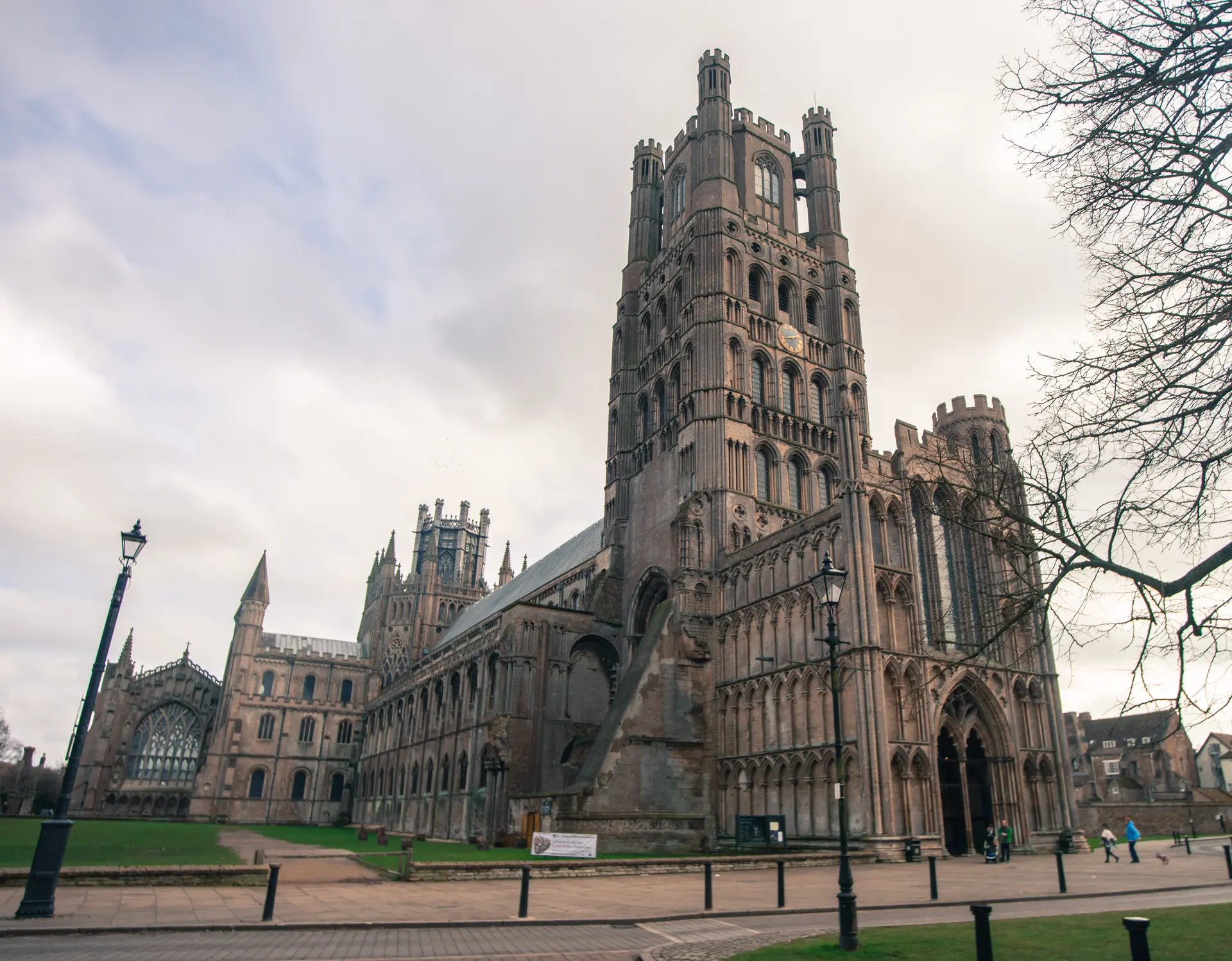
Image of Ely Cathedral. Image source · CC-BY-SA-4.0
Visit essentials
A quick read before you go
- Duration
- A cursory visit takes one to two hours.
- Access
- Ely is 15 miles north of Cambridge, reached by direct train in about 15 minutes.
Overview
Across the flat fens, Ely Cathedral appears like a stone vessel sailing dry land—the centuries-old “Ship of the Fens.” Before drainage, this island church served as landmark and refuge above marshes that could swallow unwary travellers.
St Etheldreda founded her monastery here in 673 CE on land she understood as set apart. Prayer has continued for nearly fourteen centuries: Vikings destroyed the first community, Normans rebuilt in stone, the Reformation stripped shrines, and Cromwell closed the cathedral. Its choir, rooted in the 10th century, still sings evensong most days where monks once chanted the Divine Office.
Above the crossing, the Octagon turned a collapsed medieval tower into one of England's most distinctive sacred spaces. Light descends from its lantern, drawing visitors to stop and look upward.
Why this place is sacred
The Isle of Ely was an island in truth when Etheldreda came here. The fens surrounded it with marshland that would not be drained for another millennium, creating natural isolation. She chose this place for its apartness, its quality of being in the world but withdrawn from it. That quality persists, even now that roads and railways connect Ely to everywhere.
The Norman builders who raised the present cathedral understood monumentality as devotion. The nave stretches over 75 meters, one of the longest in Britain, its massive cylindrical piers marching toward the altar like a procession of stone witnesses. This is architecture designed to humble, to create a space where human scale encounters something vast.
Then came the Octagon. In 1322, the Norman central tower collapsed. What might have been simply rebuilt was instead reimagined by Alan of Walsingham into something without precedent. The octagonal stone crossing, supporting a timber lantern that seems to float above it, creates an effect unlike any other medieval building. Light pours down from above. The eye is drawn upward. Visitors consistently describe a quality of opening, of boundary dissolving between inside and outside, earth and sky.
The accumulated weight of centuries matters too. Prayer has risen from this site almost without interruption since Etheldreda's time. The Benedictine monks who inhabited the monastery for over five hundred years structured their days around the Opus Dei, the Work of God, their chanted prayers marking the hours from before dawn until after dark. That pattern continues in modified form. Something of all those intentions seems to have soaked into the stone.
Etheldreda established her double monastery as a place of withdrawal and devotion, following the pattern of earlier Celtic Christian foundations. After the Norman Conquest, the rebuilt abbey served simultaneously as Benedictine monastery, pilgrimage destination centered on Etheldreda's shrine, and cathedral church for a new diocese. The medieval structure embodied all these functions: monks' choir for the monastic community, presbytery extended to accommodate pilgrims, and a building grand enough to represent episcopal authority.
The Reformation transformed Ely from monastery to Protestant cathedral, destroying the shrine that had drawn pilgrims for centuries. The monastic community was dissolved, its buildings repurposed or demolished. Yet the cathedral itself survived, adapting to new forms of worship while retaining its accumulated sanctity. The Victorian era brought restoration and revival, including the painted nave ceiling and renewed attention to Etheldreda's legacy.
Today, Ely holds both its medieval heritage and its living Anglican tradition, offering visitors an experience that spans fourteen centuries of continuous presence.
Experience and orientation
The first encounter is often the nave. Entering through the west door, you face a procession of massive Norman arches receding toward the distant altar. The effect is both overwhelming and somehow restful. The weight of stone above and around you creates a container, a held space. Even visitors who arrive with no spiritual intention often find themselves slowing, quieting, their voices dropping to whispers.
Then you reach the crossing, and the Octagon opens above. The shift is visceral. Where the nave presses down with its solid Romanesque bulk, the Octagon lifts. Light falls from the lantern in a quality different from windows along walls. You are standing beneath an opening to the sky. Many visitors report an involuntary pause here, a catching of breath, a sense of something expanding.
The Lady Chapel, reached through a passage north of the choir, offers a different quality entirely. This was once the most ornate space in England, its walls covered with over a hundred carved figures of the Virgin Mary. The Reformation stripped them away; what remains is a haunted elegance, tracery and light where sculpture once told stories. Some find this absence more moving than presence would be.
But the fullest experience of Ely comes at evensong. The cathedral choir, boys and men (and now girls as well), continues a tradition stretching back to the monastery's refoundation in 970 CE. When their voices rise in the antiphonal psalms and canticles, filling the space that was built for precisely this sound, something happens that transcends aesthetics. This is not a performance.
This is prayer that happens to be audible, continuing a practice that has marked time here for over a thousand years. Visitors often describe unexpected emotion during evensong, tears rising without clear cause, a sense of being caught up in something larger than themselves.
Ely rewards time. Rushing through to photograph the Octagon and depart misses what the building offers. Arrive early if you can, when light slants through eastern windows and crowds are thin. Walk the full length of the nave slowly, letting the rhythm of the arches work on you. When you reach the Octagon, stop. Look up. Stay longer than feels necessary.
If you have only one extended moment at Ely, let it be evensong. Arrive fifteen minutes early and take a seat in the quire, the choir stalls that once held Benedictine monks. You need not be Christian to be moved by what happens here. You need only be willing to be still, to let the voices wash over you, to become briefly part of a tradition that has outlasted empires.
Seek out the site of Etheldreda's shrine, marked now by a simple ledger stone in the Presbytery. The elaborate medieval shrine was destroyed in 1541, but pilgrims still come. Consider what draws people to a spot where something once was, where now only the memory of holiness remains.
Context and lineage
Etheldreda was born a princess of East Anglia around 636 CE, daughter of King Anna. Twice married for political alliance, she remained dedicated to virginity and religious life, eventually persuading her second husband to let her take the veil. In 673 she came to Ely, an island in the fens that had been part of her dowry, and established a double monastery for monks and nuns.
She served as abbess until her death in 679, reportedly from a throat tumor she interpreted as divine punishment for youthful vanity in wearing necklaces. When her body was exhumed sixteen years later for translation to a finer tomb, it was found incorrupt, the tumor scar healed. This incorruption became central to her cult. Pilgrims would later travel from across Europe seeking healing, particularly for throat and neck ailments.
Viking raiders destroyed Etheldreda's monastery around 870 CE, killing the community. For a century the site lay desolate. Then in 970, Bishop Ethelwold of Winchester refounded it as a Benedictine abbey, and continuous worship resumed. The Norman conquest brought Abbot Simeon, kinsman of William the Conqueror, who in 1083 began the great stone church that still stands. In 1109 Ely became a cathedral, seat of a new diocese, and the monastery simultaneously served as cathedral chapter.
The monastic community that Ethelwold refounded in 970 persisted until Henry VIII's Dissolution in 1539. For five and a half centuries, Benedictine monks maintained the daily round of prayer and worship, their lives structured by the Rule of St Benedict. The Dissolution ended the monastic presence, but the cathedral continued with a new chapter of secular canons.
Through the Reformation's destruction of shrines and images, through the Civil War years when Cromwell himself (who lived in Ely) ordered the cathedral closed, through restoration and revival, worship has continued.
The choral tradition is particularly remarkable. A boys' choir has sung at Ely since the monastery's refoundation, making it one of the oldest continuous musical traditions in England. Girls were added in 2006, broadening without breaking the chain that connects today's choristers to medieval predecessors singing the same psalms in the same space.
St Etheldreda
founder
Anglo-Saxon princess and virgin saint who founded the original monastery in 673 CE. Her incorrupt body and healing miracles made Ely one of medieval England's most important pilgrimage centers. Her feast day is celebrated on June 23.
Alan of Walsingham
architect
The sacrist who, after the Norman tower's collapse in 1322, designed the unprecedented Octagon that remains Ely's most distinctive feature. His engineering imagination transformed disaster into transcendence.
St Sexburga
abbess
Sister of Etheldreda and second abbess of Ely, she continued her sister's foundation and arranged the translation of her body. Feast day July 6.
William Hurley
master carpenter
Royal master carpenter who engineered the timber lantern of the Octagon, solving the seemingly impossible problem of suspending 400 tons of wood and lead above the stone crossing.
Traditions and practice
The Benedictine monks who inhabited Ely for five centuries structured their days around the Divine Office: the eight services from Matins before dawn through Compline at bedtime. This Opus Dei, the Work of God, was understood as the primary purpose of monastic life. The great building existed to house this prayer, the community existed to offer it, century after century, whether or not anyone witnessed.
Medieval pilgrims came seeking Etheldreda's intercession, particularly for throat ailments reflecting the nature of her death. They would venerate her shrine, make offerings, and hope for healing. The shrine's destruction in 1541 ended this practice within the cathedral, though Etheldreda's veneration continues among Catholics at the nearby church that holds her hand relic.
The cathedral maintains daily worship following the Anglican pattern. Morning Prayer and said Eucharist anchor the early hours. Evensong in the late afternoon continues the monastic tradition of sung evening prayer, with the cathedral choir in attendance most days during term time. The Sunday pattern includes early communion, the principal Sung Eucharist with full choir, and afternoon evensong.
These services are open to all. Visitors need not be Anglican or even Christian to attend. Those who come simply to observe are welcome; those who wish to participate will find prayer books provided. The cathedral understands itself as holding space for prayer on behalf of the wider community, continuing what the monks began.
If you seek more than architectural tourism, consider these possibilities. Attend evensong. Arrive fifteen minutes early, take a seat in the quire stalls if available, and let yourself be held by the service. You need not follow the words; simply let the voices and silences wash over you. This is what the building was made for.
Visit the site of Etheldreda's shrine, marked by a ledger stone in the Presbytery floor. The medieval shrine was destroyed, but people still come. Light a candle at one of the votive stands if this feels meaningful. Offer a silent prayer or simply stand in the accumulated weight of fourteen centuries of pilgrimage.
Find the Octagon and stand beneath it in silence. Look up. Let your attention rest on the light falling from the lantern. This is a space designed to lift the gaze toward something beyond the visible horizon. Allow it to work on you.
If time permits, climb the West Tower for the perspective it offers on the landscape Etheldreda chose, still visible for miles in every direction. The fenlands may be drained now, but the quality of openness remains.
Christianity - Anglican
ActiveEly Cathedral is the seat of the Bishop of Ely and the mother church for over 300 parishes in the Diocese of Ely. It represents the Anglican tradition's self-understanding as reformed Catholic Christianity, maintaining continuity with medieval practice while accepting Protestant theological developments. The building embodies this dual inheritance: medieval stone holding reformed worship.
Daily services follow the Anglican pattern: Morning Prayer, said Eucharist, and sung Evensong. Sunday brings the full liturgical program with Sung Eucharist as the principal service. The choral tradition, maintained by the cathedral choir of boys, girls, and adult singers, continues the monastery's medieval musical practice adapted to Anglican forms. Major festivals follow the church calendar, with particular emphasis on Advent, Christmas, Holy Week, Easter, and St Etheldreda's Day.
Christianity - Benedictine
HistoricalFor over five centuries (970-1539), Ely was a Benedictine monastery, one of England's wealthiest and most influential. The present building was constructed by and for this monastic community. Their daily round of prayer, their care for pilgrims, their scholarship and land management shaped everything about Ely that survives.
The monks structured their days around the Divine Office: the eight services from Matins through Compline that sanctified each day. This Opus Dei was supplemented by personal prayer, manual labor, and intellectual work. The monastery maintained the shrine of St Etheldreda and hosted pilgrims seeking her intercession. The choral tradition that continues today originated in their liturgical practice.
Christianity - Catholic
HistoricalBefore the Reformation, Ely was a Catholic cathedral and monastery, and Etheldreda was one of medieval England's most popular saints. Her shrine drew pilgrims from across Europe. This Catholic heritage was violently disrupted: the shrine destroyed, the images stripped, the monastic community dissolved. Yet Etheldreda's cult continues among Catholics, and the nearby RC church maintains the pilgrimage tradition.
Medieval pilgrims came to venerate Etheldreda's incorrupt body, to pray for healing (especially of throat ailments), and to leave offerings at her shrine. They processed through spaces designed to channel their devotion, moving from nave through choir to the shrine's resting place. Modern Catholic pilgrims may visit the cathedral as heritage site while maintaining devotion to Etheldreda at the Roman Catholic church that holds her hand relic.
Perspectives and open questions
Ely Cathedral invites interpretation from multiple angles: architectural achievement, living Christian tradition, medieval pilgrimage site, and monument to one woman's vision of withdrawal into God. These perspectives need not compete. The building is large enough to hold them all.
Scholarly perspective
Architectural historians value Ely as a textbook of English medieval building, demonstrating the transition from Norman Romanesque through Early English Gothic, Decorated Gothic, and beyond. The nave's massive cylindrical piers represent Norman confidence in scale. The Presbytery's lancet windows show the elegance of Early English work. The Lady Chapel and Octagon demonstrate the Decorated style's inventiveness.
The Octagon itself attracts particular scholarly attention. Pevsner called it 'one of the most original and daring designs of the whole Middle Ages.' The engineering challenge was substantial: replacing a collapsed square tower with an octagonal structure, then topping it with a timber lantern weighing 400 tons. How Alan of Walsingham conceived this solution, and how William Hurley executed it in wood, continues to engage structural engineers and architectural historians.
Archaeologists have traced the site's evolution from Etheldreda's 7th-century foundation through Viking destruction and Benedictine refoundation. Recent excavations have identified elements of the Anglo-Saxon monastery, including Etheldreda's Gate and the church of Holy Cross, expanding understanding of the early community.
Living and traditional perspectives
For Anglicans, Ely represents the living tradition of the English church, reformed but rooted in medieval soil. The choral services continue patterns established by the Benedictine monks, adapted but recognizable. The building embodies the Anglican conviction that Christianity in England did not begin at the Reformation but stretches back through the medieval church to the earliest missions.
For Catholics, Ely represents both heritage and loss. Etheldreda remains a venerated saint; her feast appears in the Catholic calendar. Yet her shrine was destroyed, her monastery dissolved, her tradition continued elsewhere. The nearby Roman Catholic church holds her hand relic, maintaining the pilgrimage tradition in modified form. Some Catholics visit Ely with complex feelings: gratitude for the building's preservation, grief for what was taken.
Alternative interpretations
Some visitors approach Ely through the lens of sacred geography, seeing in its fenland island setting a quality of liminality, threshold space between water and land. The long visibility across flat terrain creates an effect some describe as energetic: the building drawing attention from miles away, marking a spot where something gathers.
Others connect Etheldreda's story to broader feminine sacred traditions, seeing in her determination to maintain virginity against political pressure a form of resistance that transcends its Christian framing. Her choice of this isolated place, her establishment of a community for women alongside men, and her posthumous role as healer speak to experiences not contained by conventional religious categories.
Open questions
Genuine mysteries remain. Why did Etheldreda choose specifically this location? What was already here before she came? The presence of earlier settlement on the isle is documented, but whether any sacred significance predated Christianity remains unclear.
The exact nature of worship at the original 7th-century monastery, before Benedictine regularization, is largely inference. How much of Celtic Christian practice persisted here? What was lost when the Vikings came, and what survived in memory?
Etheldreda's incorruption was central to her cult, but what actually happened when her body was exhumed in 695? Medieval hagiography follows conventional patterns; disentangling historical event from pious tradition is often impossible. The phenomenon that drew pilgrims for centuries resists modern verification even as its effects remain historically documented.
Plan your visit
Access and arrival
Ely is 15 miles north of Cambridge, reached by direct train in about 15 minutes. From London King's Cross, the journey takes approximately 70 minutes. The cathedral is a 15-minute walk from the railway station through the historic town center. Car parking is available nearby. The cathedral is partially wheelchair accessible, with ramps to the main floor; the West Tower and some areas are inaccessible to those with mobility limitations.
Ely offers hotels, bed and breakfasts, and self-catering options within walking distance of the cathedral. The Lamb Hotel and Poets House Hotel provide characterful lodging in the historic center. Those seeking more contemplative accommodation might consider retreat houses in the wider Cambridgeshire area. Cambridge, 15 minutes by train, offers extensive accommodation options for those who prefer a larger city base.
Respectful visit
No formal dress code applies, but respectful attire is appreciated. This is not a beach or gymnasium. Smart casual clothing demonstrates awareness that you are entering sacred space. Hats may be removed as a traditional sign of respect, though this is not enforced.
Personal photography is generally permitted and no longer requires a permit. However, the cathedral asks visitors to consider their purpose. Are you here to see, or to capture having been here? Consider putting the camera away for your first pass through the building. Let your eyes adjust to the light and space before framing shots. Never photograph during services without explicit permission, and avoid using flash.
Monetary donations support the cathedral's ongoing maintenance and ministry. Donation boxes and card payment points are available throughout. The cathedral receives no regular government funding and relies on visitor generosity. Candles may be lit at votive stands as a form of prayerful offering.
Certain areas may be closed during services or special events. The West Tower climb requires booking and basic fitness. The Stained Glass Museum in the triforium has separate admission. Large bags are discouraged and may require checking. Food and drink are not permitted within the cathedral.
The cathedral is an active place of worship. Services take precedence over tourism. If you find yourself in the building during a service, either join or wait quietly in an area away from the worship space. Do not walk through the quire during evensong or treat services as background atmosphere for your visit.
The spiritual commercialism that attaches to some pilgrimage sites has not taken root at Ely. Be wary of any guides or services claiming special spiritual access or powers associated with the site. The cathedral offers what it offers to everyone equally.
Current practical details
Address
Chapter House, The College, ELY CB7 4DL, UK
Phone
Hours
Hours, fees, and access can change — verify on the official source before you travel. Practical details last checked Jun 2026.
Location
Map loads as you approach this section.
Pilgrim reflections
A portrait of encounter, not a score
Pilgrims describe what they felt, how present they could become, and whether the place would shape a journey. There are no stars and no ranking of traditions.
No reviewed reflections yet
The first pilgrims can help describe the character of being here.
Share a reflection
Available after an account-backed “Been there.” Every reflection is reviewed before publication.
Nearby sacred places
Explore other sacred places in the region. Proximity does not establish access or travel time; check each place’s guidance.

References
Sources consulted for this page. Source categories describe the publication, not a guarantee that every claim is verified. Traditional accounts and outside interpretations may differ.
- 01Ely Cathedral - Wikipediaencyclopedia
- 02Ely Cathedral - Official WebsiteSource context
- 03The Story of Ely - Ely CathedralSource context
- 04St. Etheldreda - Ely CathedralSource context
- 05The Octagon - Ely CathedralSource context
- 06Four styles of English medieval architecture at Ely Cathedral - Smarthistoryacademic
- 07Ely Cathedral's Lady Chapel - Smarthistoryacademic
- 08Ely Cathedral | History, Description, & Facts | Britannicaencyclopedia
- 09Ely Cathedral - Diocese of Elyofficial
- 10Ely Cathedral - The Association of English Cathedralsofficial
- 11The Stained Glass Museum, Elyofficial
- 12Recent discoveries at Ely Cathedral, Cambridgeshire: Aetheldreda's Gate, the church of Holy Cross and the possible boundary of the Anglo-Saxon monasteryacademic
- 13Ely Cathedral, St Etheldreda's RC Church - British Pilgrimage TrustSource context
Photo gallery
3 curated photos
Share a photo
Help visitors recognize Ely Cathedral. Every submission is reviewed before publication.