St. Edmundsbury Cathedral
Where a martyred king's shrine became the cradle of English liberty
Understand sacred places, explore living traditions, and learn how to engage respectfully with Pilgrim Map.
Access has not been verified. Check current local guidance before planning a visit.
West Suffolk, England, United Kingdom
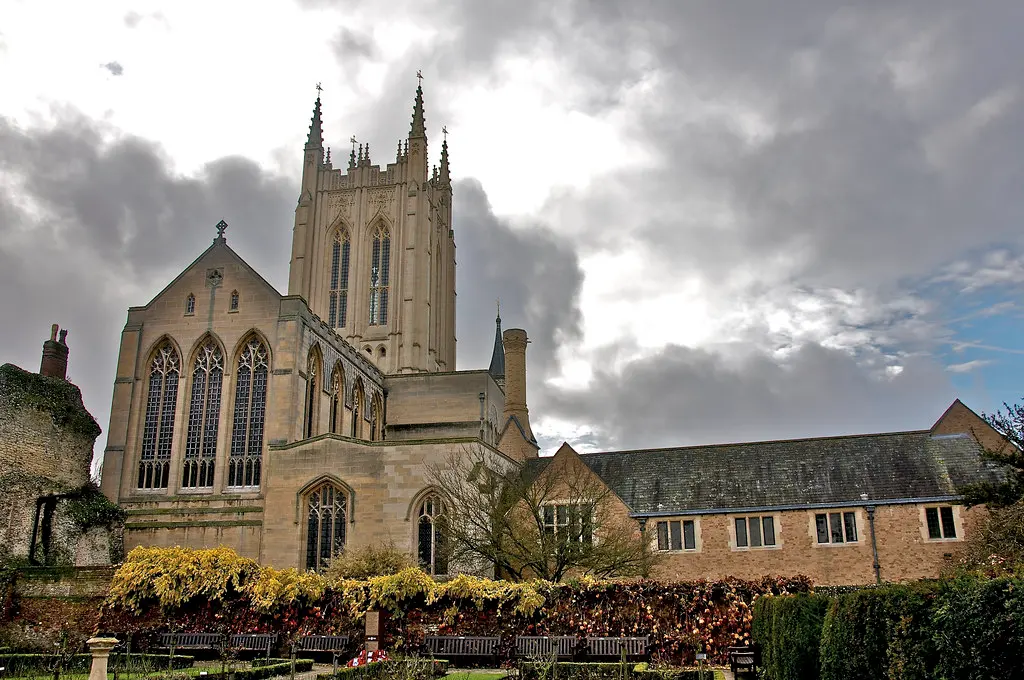
Image of St. Edmundsbury Cathedral. Image source
Visit essentials
A quick read before you go
- Etiquette
- As an active place of worship, St Edmundsbury Cathedral asks visitors for quiet respect.
Overview
Some places carry more history than their stones should hold. St Edmundsbury Cathedral is one such place, standing at the edge of what was once the Abbey of St Edmund, among the wealthiest and most powerful monasteries in medieval England.
Before Canterbury claimed the devotion of English pilgrims, before St George became the nation's patron, this was the sacred center of the realm. Here lay the relics of Edmund, the Anglo-Saxon king who chose death over compromise of his faith, killed by Danish arrows in 869. Kings walked through the Norman Tower on pilgrimage to his shrine. Barons gathered at that shrine in 1214 to swear the oath that would lead to Magna Carta.
The abbey fell at the Reformation, its shrine destroyed, Edmund's relics scattered to mystery. But the parish church of St James, which had served the town beside the abbey, survived and eventually transformed. In 1914, it became a cathedral. In the century since, architects have expanded it with extraordinary ambition, completing in 2005 a Gothic tower that medieval builders might have raised, had time and fortune allowed.
Today, worship continues as it has for nearly a millennium. Choral evensong fills the nave. Pilgrims arrive seeking the spirit of a king who died rather than yield. And something persists in this ground, layered with the intentions of centuries.
Why this place is sacred
The holiness of this ground predates the cathedral, predates even the abbey. It begins with a body and a story of faithfulness unto death.
In 869, Danish invaders killed Edmund, King of East Anglia. According to the accounts that shaped medieval devotion, he refused to renounce his Christianity or share his kingdom with pagans. He was tied to a tree, shot full of arrows, and beheaded. His followers found his head guarded by a wolf; when they reunited head and body, they miraculously fused. Whether history or hagiography, this narrative generated one of England's most powerful cults.
The relics arrived at Bury around 903. By the eleventh century, an abbey had grown around the shrine that would become one of the most lavish in Christendom. Pilgrims came seeking Edmund's intercession. Kings came to demonstrate devotion and secure blessing. The abbey grew wealthy beyond measure, its influence extending into the political heart of the kingdom.
Then, in 1214, on St Edmund's Day, something happened that would echo through eight centuries of constitutional history. The rebel barons, plotting to constrain King John, gathered at the shrine and swore a sacred oath to compel acceptance of the Charter of Liberties. Seven months later, Magna Carta was sealed at Runnymede.
The Dissolution of the Monasteries in 1539 destroyed the abbey and scattered Edmund's relics. But the parish church remained. Worship continued. And in the twentieth and twenty-first centuries, architects Stephen Dykes Bower and Hugh Mathew expanded what had been a modest church into a cathedral befitting its history, constructing in Gothic Revival style that honors the medieval vision while expressing contemporary devotion.
Visitors today encounter not one sacred layer but many: the ruins of the great abbey visible in the adjacent gardens, the twelfth-century Norman Tower serving as the cathedral's bell tower, the sixteenth-century Perpendicular nave, the twentieth-century quire and cloisters, and the twenty-first-century Millennium Tower. Each layer carries its own accumulated prayer.
The original church of St James, built in 1065 and rebuilt in 1135, served the townspeople of Bury St Edmunds as a parish church distinct from the great abbey. While pilgrims and nobles processed to St Edmund's shrine in the abbey church, ordinary residents worshipped here. The church stood in the abbey's shadow, both literally and spiritually, for four centuries.
When the Diocese of St Edmundsbury and Ipswich was created in 1914, this parish church became its cathedral, inheriting the spiritual weight of the destroyed abbey. The transformation was not merely administrative. Over the following century, the building was systematically enlarged to match its new role, eventually achieving the presence and scale that its history demanded.
The cathedral's expansion represents one of the twentieth century's most remarkable acts of Gothic Revival architecture. Stephen Dykes Bower, appointed architect in 1943, spent forty-five years extending the building in harmony with its medieval elements. He added a quire, Lady Chapel, St Edmund's Chapel, and cloisters, working in a Gothic idiom that contemporary critics sometimes dismissed but history has vindicated.
His successor Hugh Mathew completed the vision with the Millennium Tower, consecrated in 2005. Rising 150 feet, faced in Barnack limestone to match the Norman Tower, the new tower contains a ring of twelve bells and declares that the Gothic tradition remains capable of generating beauty, not merely preserving it.
This ongoing construction constitutes a form of prayer in stone. Each generation has added to the building not to aggrandize itself but to honor what the site holds. The result is a cathedral that grows organically, a living thing rather than a frozen monument.
Experience and orientation
The first thing many visitors notice is the light. The hammerbeam roof, designed by George Gilbert Scott in the nineteenth century, features painted angel figures that seem to float overhead. Colored and gilded, they transform what might be an ordinary parish church ceiling into something that lifts the eye and, with it, the attention.
Then comes the realization of scale. The cathedral extends beyond what one expects from the exterior, the twentieth-century additions revealing themselves as you move deeper: the quire with its carved stalls, the Lady Chapel with its vaulted ceiling, St Edmund's Chapel holding quiet space for prayer. Each transition moves the visitor further into sanctuary.
Those who attend Evensong describe the experience differently from simple visiting. The cathedral choir, following a tradition centuries old, fills the medieval space with sound that seems to have been designed precisely for it. The liturgy itself, with its ancient rhythms, creates a container for something to arise. First-time attendees often report surprise at being moved, having arrived out of cultural curiosity and left touched by something less easily named.
The Abbey Gardens adjacent to the cathedral add a dimension that purely interior visits miss. Walking among the ruins of the great abbey, seeing the scale of what the Dissolution destroyed, visitors often feel grief for what was lost mingled with gratitude for what survived. The Norman Tower, rising from the gardens as the cathedral's bell tower, physically connects the medieval and contemporary, its twelfth-century stonework still serving, still beautiful.
Those who come during life transitions report that the site offers a particular quality of holding. The layered history seems to relativize present troubles without dismissing them. Many visitors have stood before ruins of enterprises far grander than their own concerns and found, paradoxically, not discouragement but comfort: the faith continues, the prayers accumulate, the living worship persists.
St Edmundsbury rewards those who arrive with time rather than agenda. Begin with the Abbey Gardens if weather permits, letting the ruins establish the scope of what was once here. The Norman Tower, through which medieval pilgrims processed to St Edmund's shrine, stands as a threshold between eras.
Entering the cathedral, allow your eyes to adjust and rise to the hammerbeam roof before taking in details. Move slowly toward the quire and Lady Chapel, observing how the twentieth-century work extends the medieval spirit rather than contradicting it. St Edmund's Chapel offers a quiet space for sitting with whatever you have brought.
If your visit can include Evensong, attend without expectation. The service asks nothing of you but presence. Whether or not you share the faith it expresses, the accumulated intention of centuries of such worship has saturated these stones. Something of that saturation may touch you.
Before leaving, consider climbing the Millennium Tower if tours are available. The view across Bury St Edmunds and the Suffolk countryside offers perspective, both geographical and temporal.
Context and lineage
The story begins in 869, when Danish invaders captured Edmund, King of East Anglia. The earliest accounts describe a king who refused to renounce his Christian faith or submit to pagan rule. He was executed, becoming one of England's earliest and most beloved martyrs.
By 903, Edmund's remains had been moved to Bury, where a community of priests cared for the growing shrine. In 1020, King Canute, himself of Danish descent, established a Benedictine abbey at the site, perhaps as atonement for his ancestors' deed. The abbey grew rapidly in wealth and influence, becoming one of the four great abbeys of medieval England.
The cult of St Edmund rivaled Canterbury for pilgrimage importance until the twelfth century, when Thomas Becket's martyrdom shifted devotional attention. But Edmund remained powerful. Kings from William the Conqueror to Henry VII made pilgrimage to his shrine. The abbey accumulated vast landholdings and profound political influence.
On St Edmund's Day in 1214, this influence took constitutional form. The rebel barons, planning to constrain the increasingly tyrannical King John, chose Edmund's shrine for their secret oath. They swore upon the altar to compel John to accept limitations on royal power. Seven months later, at Runnymede, Magna Carta was sealed. Bury St Edmunds earned its motto: 'Shrine of a King, Cradle of the Law.'
The abbey did not survive the Reformation. In 1539, it was dissolved, its shrine destroyed, its monks pensioned off. What happened to St Edmund's relics remains mysterious. Some sources suggest they were hidden by loyal monks, others that they were taken to France. The great church fell into ruin.
But the parish church of St James, which had stood beside the abbey serving townspeople, continued. Four centuries later, it became the cathedral for a new diocese, inheriting the spiritual legacy of what the Dissolution had destroyed.
For five centuries before the Dissolution, Benedictine monks maintained worship and pilgrimage at the abbey. After 1539, the parish church continued Anglican worship through the upheavals of English religious history: the Civil War, the Restoration, the evangelical and Oxford movements, the challenges of modernity.
Since 1914, the cathedral has served as the mother church of the Diocese of St Edmundsbury and Ipswich, its bishops seated where abbots once held power. The choir maintains the English cathedral tradition of daily choral worship, singing evensong as their predecessors have for centuries, the words of the psalms worn smooth by repetition.
This continuity of prayer, unbroken for nearly a thousand years despite reformation, dissolution, and transformation, represents a form of transmission that transcends doctrine: the simple practice of gathering to worship, renewed each day.
St Edmund
saint
King of East Anglia, martyred in 869 for refusing to renounce Christianity to Danish invaders. Venerated as England's first patron saint before St George. His shrine at Bury drew pilgrims for five centuries.
Abbot Anselm
historical
Abbey of St Edmund abbot who built the Norman Tower (1120-1148), the ceremonial entrance for pilgrims approaching St Edmund's shrine. The tower still stands as the cathedral's bell tower.
Stephen Dykes Bower
historical
Cathedral architect from 1943 to 1988 who designed the quire, Lady Chapel, St Edmund's Chapel, and cloisters in Gothic Revival style. His work transformed a parish church into a building worthy of its history.
Hugh Mathew
historical
Architect who designed the Millennium Tower, completed in 2005. The tower fulfilled the cathedral's vision of a building with the presence its legacy deserved.
Traditions and practice
The cathedral follows the Anglican tradition of daily prayer that traces back through centuries of English Christianity. The Daily Office, with its structured round of psalms, readings, and prayers, creates a rhythm that sanctifies time. Eucharistic worship, centered on bread and wine, bread broken and shared, enacts week after week the mystery at the heart of Christian faith.
Choral Evensong, sung by the cathedral choir Tuesday through Saturday, represents one of the Anglican tradition's distinctive contributions to world spirituality. The service combines ancient texts with choral settings that range from the Renaissance to the present day, creating an experience that touches something deeper than intellectual assent.
St Edmund's Day, November 20, is observed as a Lesser Festival in the Church of England calendar. The cathedral marks this day with special services commemorating the martyr whose shrine made this ground holy. For those who come on pilgrimage, this day offers particular significance.
Beyond formal services, the cathedral offers contemplative practices for those seeking more than attendance. Thursday lunchtime brings a period of silent meditation, open to practitioners of any tradition or none, using the sacred space as container for interior stillness.
A monthly Service of Healing and Wholeness, held on the third Tuesday, offers prayer and laying on of hands for those carrying physical, emotional, or spiritual burdens. This practice connects to the ancient tradition of seeking healing at sacred sites while remaining grounded in contemporary pastoral care.
The cathedral regularly hosts concerts, exhibitions, and community events that, while not explicitly religious, extend the invitation to encounter something beyond the ordinary. Many visitors who would not attend a service find themselves moved by sacred music in this setting.
For seekers approaching St Edmundsbury without prior experience of Anglican worship, consider attending Evensong before or instead of the Sunday Eucharist. The service asks less of visitors in terms of participation while offering full immersion in the cathedral's atmosphere and musical tradition. You need not cross yourself, kneel, or take communion. Simply being present is sufficient.
If you come during the day between services, take time to sit in St Edmund's Chapel. Light a candle if that practice holds meaning for you. The cathedral welcomes prayer in whatever form is natural to you, whether silent meditation, verbal supplication, or simple attention.
Consider visiting multiple times if you are staying in the area. A first visit for exploration, a second for a service, and a third for quiet reflection will reveal more than any single encounter. The site has layers; let it unfold.
Anglican Christianity
ActiveSt Edmundsbury Cathedral serves as the seat of the Bishop of St Edmundsbury and Ipswich, the mother church of the diocese since 1914. It maintains the Anglican tradition of daily prayer, Eucharistic worship, and cathedral music. The building itself embodies Anglican identity in its layered history: pre-Reformation origins, survival through the turbulent centuries of English religious conflict, and ongoing transformation through Gothic Revival construction that honors the past while building for the future.
The cathedral celebrates daily Eucharist, maintaining the Anglican practice of regular communion. Choral Evensong, sung by the cathedral choir, offers one of the tradition's distinctive contributions to Christian worship. The Sunday pattern of services provides multiple entry points from quiet early Eucharist to the full sung morning service. Seasonal observances follow the church year, with particular attention to St Edmund's Day in November and the great festivals of Christmas and Easter.
Medieval Catholic Pilgrimage
HistoricalBefore the Reformation, the Abbey of St Edmund was one of England's premier pilgrimage destinations, housing the shrine of St Edmund the Martyr. Kings from William the Conqueror to Henry VII came to venerate the Anglo-Saxon saint who had become, for a time, England's patron. The abbey was among the wealthiest and most powerful Benedictine monasteries in Christendom. Its connection to the Magna Carta story added constitutional significance to spiritual importance.
Medieval pilgrims approached through the Norman Tower, processing to the shrine where St Edmund's relics lay in an elaborately decorated feretory. Offerings were made seeking the saint's intercession. The monastic community maintained continuous prayer in the great abbey church. Major feast days, particularly St Edmund's Day on November 20, drew crowds from across England and beyond.
Perspectives and open questions
St Edmundsbury Cathedral invites multiple ways of seeing. Historians recognize the site's extraordinary significance in both religious and constitutional history. Art historians appreciate the rare twentieth-century Gothic Revival work. Anglican visitors encounter a living tradition of worship. And those who come simply seeking stillness find a space that holds their presence without demanding explanation.
Scholarly perspective
Historians recognize the Abbey of St Edmund as one of medieval England's most significant religious institutions, rivaling Canterbury and Glastonbury in wealth, influence, and pilgrimage importance. The cult of St Edmund established patterns of royal devotion that persisted for five centuries. The abbey's role in the Magna Carta story, while sometimes romanticized, rests on documented history: the barons did gather at the shrine in 1214, did swear their oath, and did proceed to constrain King John.
Architecturally, the cathedral presents a scholarly interest of a different kind. Stephen Dykes Bower's Gothic Revival work, once dismissed by modernist critics as nostalgic pastiche, has gained respect as a serious engagement with medieval architectural language rather than mere imitation. The Twentieth Century Society has advocated for recognition of his contribution. The Millennium Tower, designed by Hugh Mathew, extends this reassessment into the twenty-first century, demonstrating that the Gothic tradition remains generative.
Living and traditional perspectives
Within the Anglican tradition, St Edmundsbury represents both continuity and renewal. The daily round of prayer connects contemporary worshippers to a practice that has continued, with interruptions but never abandonment, for a millennium on this ground. The cathedral's expansion in the twentieth century was not antiquarian nostalgia but living faith building its house.
For those who maintain devotion to St Edmund, the cathedral holds his memory even though his relics are lost. The annual observance of his feast day, the chapel bearing his name, and the persistent pilgrimage tradition keep alive a saint who was once the patron of England itself.
Open questions
Genuine mysteries attend this site. What happened to St Edmund's relics after the Dissolution remains uncertain. Some sources suggest monks hid them, perhaps in secret chambers beneath the ruined abbey. A French tradition claims they were taken to Toulouse, though this is disputed. Modern searches have found no trace.
The precise location of St Edmund's shrine within the original abbey church has been lost. Archaeological work continues in the Abbey Gardens, but the scale of destruction at the Dissolution makes reconstruction difficult.
What motivated the barons to choose St Edmund's shrine for their 1214 oath? The symbolism of an English king who died rather than submit to tyrants seems obvious, but whether this was strategic calculation or genuine devotion remains open to interpretation.
Plan your visit
Access and arrival
Bury St Edmunds offers lodging at all price points, from boutique hotels facing Angel Hill to chain hotels and bed-and-breakfasts. The Angel Hotel, adjacent to the cathedral, combines historic character with comfort. For those seeking retreat context, the surrounding Suffolk countryside offers quiet accommodations suited to contemplative visits.
Respectful visit
No formal dress code exists, but modest attire appropriate to a place of worship is advisable. Hats may be removed by men as a traditional mark of respect, though this is not required. Comfortable shoes for walking on stone floors and potentially climbing tower stairs are practical.
Personal photography is permitted during non-service hours. Flash photography is discouraged throughout the building. Tripods may be restricted. Professional photography and filming require advance permission. During any service, photography and recording are strictly prohibited for both safeguarding and spiritual reasons.
Admission to the cathedral is free, though donations are welcomed to support maintenance of the building and its ministry. Collection plates circulate during services; visitors are not obligated to contribute. Lighting candles in the prayer chapel typically involves a small suggested donation.
Photography prohibited during services. Some areas may have limited accessibility due to historic construction. Large bags may need to be left in available storage. The tower tour requires physical capability for climbing stairs.
If attending a service, arrive a few minutes early and allow ushers to guide you. Do not feel obligated to participate in elements you are uncertain about. Standing or sitting quietly when others kneel or move forward for communion is entirely appropriate for visitors.
Current practical details
Address
Angel Hill, Bury St Edmunds, Bury Saint Edmunds IP33 1LS, UK
Phone
Hours
Hours, fees, and access can change — verify on the official source before you travel. Practical details last checked Jun 2026.
Location
Map loads as you approach this section.
Pilgrim reflections
A portrait of encounter, not a score
Pilgrims describe what they felt, how present they could become, and whether the place would shape a journey. There are no stars and no ranking of traditions.
No reviewed reflections yet
The first pilgrims can help describe the character of being here.
Share a reflection
Available after an account-backed “Been there.” Every reflection is reviewed before publication.
Nearby sacred places
Explore other sacred places in the region. Proximity does not establish access or travel time; check each place’s guidance.

Share a photo
Help visitors recognize St. Edmundsbury Cathedral. Every submission is reviewed before publication.