Myra
Cliff tombs above the theatre, a buried city below, and the episcopal seat of the real Saint Nicholas
Understand sacred places, explore living traditions, and learn how to engage respectfully with Pilgrim Map.
Access has not been verified. Check current local guidance before planning a visit.
Antalya, Turkey
Read the sources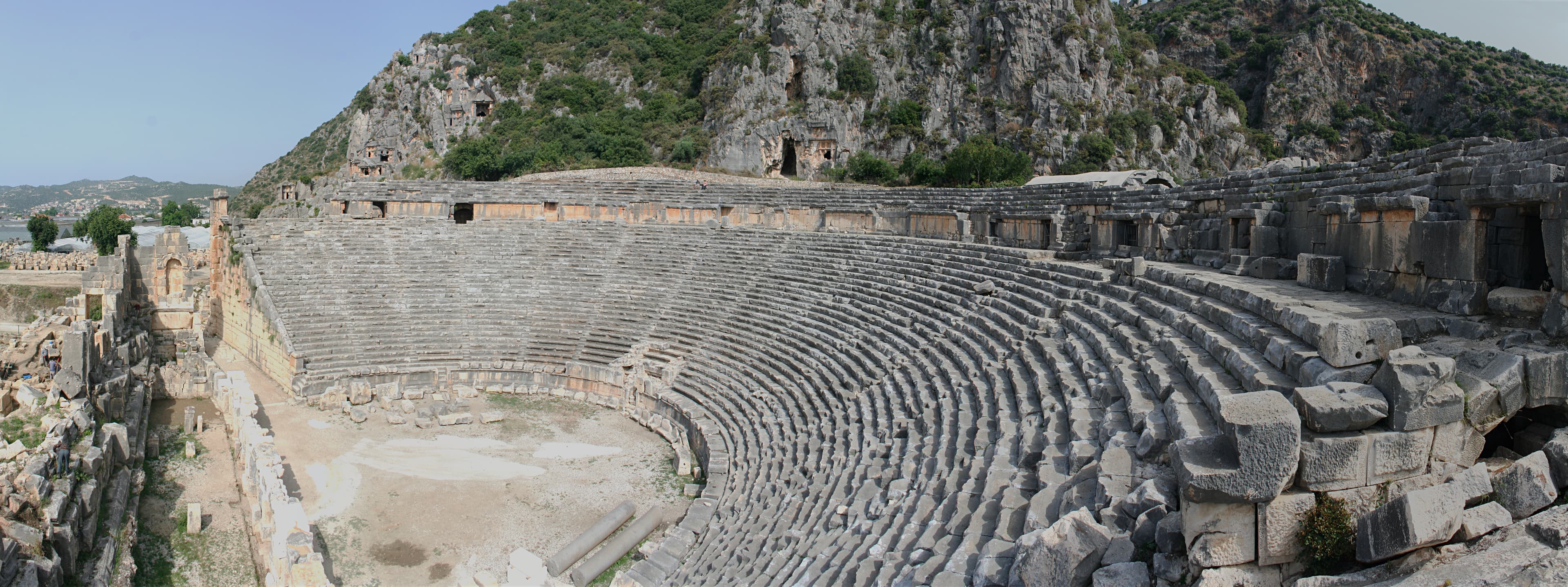
Image of Myra. Image source
Visit essentials
A quick read before you go
- Duration
- Half a day for the tombs and theatre plus the Church of Saint Nicholas.
- Access
- Demre is on the main coastal highway D400, 140 km west of Antalya and 100 km east of Fethiye.
Overview
The theatre at Myra was built to seat twelve thousand. It is the largest in Lycia. On the cliff face above it, the Lycians cut hundreds of tombs — pillar tombs, house-type tombs, façade tombs with carved pediments — covering the vertical rock in a dense overlay of funerary architecture.
The 'Painted Tomb' or Lion's Tomb in the river necropolis still retains traces of its original polychrome paint, a survival so rare that it changes the experiential register of everything around it: the past here has colour.
Beneath modern Demre, eighteen feet of alluvial sediment covers a virtually complete ancient city. Ground-penetrating radar surveys in 2009–2011 confirmed what excavators had suspected: the streets, insulae, and public buildings of ancient Myra are down there, largely intact, waiting. The Church of Saint Nicholas — built over the original basilica where the 4th-century bishop served and was buried — was itself buried and re-excavated multiple times.
In 2024, excavators discovered a sarcophagus beneath the church floor that may contain relics of the saint.
Nicholas of Myra was born in Patara around 270 AD. He became bishop of Myra in the early 4th century and served through the Diocletianic persecutions and the first Council of Nicaea in 325. His documented acts of charity — dowries given secretly to poor girls, sailors rescued at sea, the wrongly condemned defended — were specific enough to establish a historical person behind the legend.
The transformation of this particular bishop into a global figure is itself one of the stranger trajectories in religious history.
Why this place is sacred
The cliff-face tombs at Myra are not merely monuments. In Lycian belief, the dead were carried upward by winged beings; the tombs placed as high as possible on rock faces facilitated this journey. The density at Myra — hundreds of tombs, several necropoleis, covering the available cliff surfaces — suggests a community that invested enormous collective energy in maintaining the right relationship between the living city and its dead.
The theatre built at the cliff's base, with the tombs rising directly above the audience, created an unusual architectural relationship: the living assembled for civic and cultural life directly beneath the dwellings of their dead.
The Lion's Tomb (Painted Tomb) retains traces of original polychrome paint on its relief carvings. A painted figure, painted architectural details, the painted expression of a face — these details make the Lycian past sensory rather than merely visual. The degradation is ongoing; the colours are slowly leaving.
The Church of Saint Nicholas introduces a different order of sacred meaning. Nicholas was a historical person — his acts are documented in contemporary accounts and ecclesiastical records. The church was built over his burial site and was a pilgrimage destination within decades of his death. It was destroyed by Arab raids, rebuilt, buried by flood sediment, rediscovered, rebuilt again.
The present structure preserves walls, mosaic floors, and frescoes from multiple building phases, each repair a layer of continued communal investment in the saint's memory.
For pilgrims who come here, the power of the site is the reality of the connection: a specific person, in this specific place, performed specific acts of charity that were remembered and imitated. The global tradition of generous midwinter gift-giving — Santa Claus, Father Christmas, Saint Nicholas — traces back to a bishop in this small Lycian harbour town.
Major Lycian city with elaborate funerary culture; later the episcopal see of Saint Nicholas and a major centre of early Christianity in the region.
Lycian city-state (5th century BC attestation) → Lycian League member → Hellenistic and Roman development → early Christian episcopal see under Saint Nicholas (4th century) → Byzantine period with multiple church rebuildings → Arab raid destruction and rebuilding cycles → alluvial burial of much of the ancient city → partial excavation and ongoing recovery
Experience and orientation
The road from Demre town centre leads north to the archaeological zone, where the Roman theatre comes into view first — its seating banks rising against the hill, its cavea intact enough to give a clear sense of scale. Twelve thousand people once assembled here. Above and to the right of the theatre, the cliff face begins. Tombs occupy every available surface in clusters and rows.
The house-type tombs — carved to represent the fronts of Lycian wooden houses, with beamed ceilings and door frames — preserve in stone the architectural forms of an organic building tradition that has otherwise entirely vanished.
The river necropolis occupies the cliff face to the left of the theatre. Here the Lion's Tomb (Painted Tomb) is located. Finding it requires attention — it is one of many façade tombs in the cliff, and there is no prominent signage. But the residual paint is visible to a careful eye: traces of colour in the relief carvings, the suggestion of a face still holding its original hue. Stand before it for longer than seems necessary.
Walking the base of the cliff puts you directly beneath the tombs. Looking up: the scale of the funerary programme is fully visible only from this position. The distance between the ground and the highest tombs is considerable; some of the upper tombs would have required scaffolding or rope systems to cut. The effort invested is part of the message.
The Church of Saint Nicholas in Demre town centre is a separate visit — five minutes by car or a 20-minute walk through the modern town. The church is a museum, but it retains its sacred quality. The mosaic floors, the frescoed niches, the sarcophagi in the crypt (the saint's relics were stolen to Bari in 1087, but a 2024 discovery suggests some may remain) — all of these create a layered space where the historical and the devotional coexist.
The contrast between the two sites — the silent cliff with its ancient dead and the church still receiving pilgrims — is itself the Myra experience.
Allow half a day minimum for the full experience: one to two hours at the archaeological zone (theatre and cliff tombs), then the Church of Saint Nicholas in central Demre. Andriake harbour (5 km) extends the day into a full Myra complex visit.
Context and lineage
Myra's Lycian origins are embedded in its cliff necropoleis, which predate any written record of the city. The earliest written attestations are coins and inscriptions from the 5th century BC. As a member of the Lycian League, Myra held three votes in the federal assembly, placing it among the most powerful Lycian cities.
The Acts of the Apostles records Saint Paul changing ships at Myra's harbour Andriake during his journey to Rome as a prisoner (Acts 27:5–6) — a detail that drew Myra into the Christian apostolic itinerary.
Saint Nicholas served as bishop of Myra from approximately 300–343 AD. He was present at the Council of Nicaea in 325. Contemporary accounts record his gifts of dowries to three poor girls (leaving bags of gold coins at their windows by night), his rescue of sailors during a storm, and his defence of men wrongly condemned to death.
These acts were specific and local; the transformation into a universal figure of gift-giving generosity came gradually, accelerating in the medieval period and reaching its present global form through the Dutch Sinterklaas tradition.
Emperor Hadrian visited and supported the city. The Empress Theodora funded a significant restoration of the church in the 6th century. The Arab raids of the 7th and 9th centuries devastated Myra's harbour infrastructure. Subsequent flood events buried the ancient city under metres of sediment, creating the unusual situation in which one of Lycia's most important cities is largely intact but invisible beneath a modern town.
Lycian (5th century BC attestation) → Lycian League federation → Roman provincial development → early Christian episcopal see (Saint Nicholas, early 4th century) → Byzantine period with multiple church phases → Arab raid destruction and rebuilding → alluvial burial of ancient city → Ottoman period → modern excavations and tourism
Traditions and practice
Lycian funerary practice at Myra involved the two necropoleis — the river necropolis and the ocean necropolis — which together contain one of the largest concentrations of Lycian rock-cut tombs anywhere. Tomb inscriptions specified in legal terms who was permitted to be interred in each tomb and the financial penalties for violation. The tombs were maintained over time and were sites of ongoing ancestor veneration.
The early Christian community at Myra centered on the episcopal authority of the bishop. Saint Nicholas's documented ministry included direct charitable intervention for the poor and unjustly condemned — acts that were public and attested. The church built over his burial site was a pilgrimage destination within decades of his death, and the annual commemoration of his feast day (December 6) continued without interruption through Byzantine, Arab, and Ottoman disruptions.
The Church of Saint Nicholas in Demre is an active pilgrimage destination for Christians of all denominations worldwide. An annual outdoor Mass is celebrated on December 6 by the Patriarch of Constantinople or a delegated bishop, open to the public and attended by pilgrims from across the world. Turkish authorities have periodically permitted Orthodox Christian liturgies inside the church. The archaeological site receives visitors for cultural tourism.
If visiting the Church of Saint Nicholas, arrive when it opens to avoid the tour group peak hours. The church becomes quieter in late afternoon. Take time in the crypt area, where the saint's original sarcophagus was located before the theft to Bari in 1087. The mosaics on the floor of the main nave are among the best preserved in Anatolia; walk slowly rather than stepping without attention.
At the cliff tombs, walk the full base of the cliff rather than stopping at the theatre entrance. The river necropolis, to the left as you face the cliff, contains the Lion's Tomb with its residual paint — and is less visited than the section directly behind the theatre. Look up: the density of the funerary programme is only fully apparent from below.
The tombs in the highest registers of the cliff were placed there deliberately; their height was cosmologically significant.
If visiting in December, consider orienting the trip around December 6. The outdoor Mass is a rare experience of a living religious tradition at its historical origin point.
Christian Pilgrimage — Saint Nicholas
ActiveMyra was the episcopal see of Saint Nicholas (c. 270–343 AD), whose documented ministry of charity became the historical foundation for the global figure of Santa Claus/Father Christmas. The Church of Saint Nicholas in Demre is his original burial site and remains an active pilgrimage destination for Christians worldwide.
Christian pilgrimage; votive candle lighting and prayers; annual outdoor Mass on December 6 (Feast of Saint Nicholas) open to the public; periodic Orthodox liturgies inside the church.
Lycian Funerary Culture
HistoricalMyra's two necropoleis — the river necropolis and the ocean necropolis — contain one of the densest concentrations of Lycian rock-cut tomb architecture in the ancient world, covering the cliff faces above the Roman theatre. The Lion's Tomb (Painted Tomb) retains rare traces of original polychrome paint.
Rock-cut tomb construction; funerary inscriptions with legal specifications on tomb access; ancestor veneration; periodic maintenance and offering at tomb sites.
Archaeological / Scholarly
ActiveMyra is an exceptional case of a major ancient city that is largely intact but invisible, buried beneath 18 feet of alluvial sediment below modern Demre. Ground-penetrating radar has confirmed a complete city grid. Ongoing excavations are recovering the city room by room.
Annual excavation seasons directed by Prof. Nevzat Çevik of Akdeniz University; ground-penetrating radar surveys; systematic sediment removal and documentation.
Perspectives and open questions
Myra is approached through Lycian archaeology, Christian pilgrimage tradition, and the ongoing excavation of a largely buried ancient city — three frameworks that are each valid and that together capture the site's unusual depth.
Scholarly perspective
Myra was one of the six principal cities of the Lycian League and became a major centre of early Christianity. The Church of Saint Nicholas has been repeatedly excavated, rebuilt, and studied — the present building preserves fabric from multiple phases including the original 4th-century basilica, a 6th-century restoration funded by Empress Theodora, and later Byzantine and modern repair work.
Ground-penetrating radar surveys in 2009–2011 confirmed a virtually complete ancient city grid beneath modern Demre, making Myra one of the largest intact unexcavated ancient urban sites in Turkey. A 2024 discovery of a sarcophagus beneath the church floor that may contain relics of Saint Nicholas (believed stolen to Bari in 1087) has not yet been fully investigated.
Living and traditional perspectives
For Christian tradition, Myra is the episcopal see of one of the most widely venerated saints in the world — venerated equally by Catholics, Orthodox Christians, and many Protestants. Saint Nicholas's documented acts of charity created a model of specific, practical, anonymously given generosity that shaped centuries of Christian moral thinking.
The church, repeatedly destroyed and rebuilt, persists as a place of pilgrimage because the story of Nicholas is understood as historically grounded: a real person, in this real place, whose acts of charity were real enough to be remembered for seventeen centuries.
Alternative interpretations
Saint Nicholas's attributes — nocturnal generosity, protection of the vulnerable, association with winter — have been compared by some scholars to earlier pre-Christian traditions of midwinter beneficent spirits and Norse gift-riders (Odin was said to ride through the sky distributing gifts). Direct religious continuity between these traditions and the Nicholas cult has not been demonstrated, and the scholarly consensus favours independent development of the gift-giving motif within Christian tradition.
The comparison is worth noting for what it suggests about the deep human need that the Nicholas figure fulfils, across multiple traditions.
Open questions
The vast buried city beneath modern Demre is largely unexplored — its theatre, agora, temples, and street grid are confirmed by radar but not excavated. The 2024 sarcophagus discovery is unresolved: if it contains relics of Saint Nicholas, it would significantly alter the received narrative that his relics were entirely removed to Bari in 1087. The painted colours on the Lion's Tomb are slowly degrading; their full original palette is unknown and cannot be recovered.
Plan your visit
Access and arrival
Demre is on the main coastal highway D400, 140 km west of Antalya and 100 km east of Fethiye. Regular bus services from both cities. The rock tombs and theatre are approximately 1 km north of Demre town centre; the Church of Saint Nicholas is in the town centre. Andriake harbour is 5 km southwest. Entrance fees apply to both the archaeological zone and the church. Turkey Museum Pass accepted.
Demre has a range of simple to mid-range hotels and pansiyons. Kaş (30 km) and Kalkan (50 km) offer more varied boutique accommodation. Antalya (140 km) has the widest range. The Kekova area (15 km) has small boutique options for those wanting a quieter base.
Respectful visit
Modest dress is required inside the Church of Saint Nicholas — shoulders and knees covered. No specific requirement at the outdoor archaeological zone.
Permitted at the archaeological site. Inside the church, photography rules vary by season and visiting group type — check with staff on arrival. No flash near fresco surfaces.
Candle lighting and votive prayers are practiced by Christian pilgrims at the church. A candle stand is available near the entrance.
Do not touch fresco or mosaic surfaces inside the church. No climbing on tomb facades at the archaeological site. No removal of any materials from either site.
Modest dress is required at the Church of Saint Nicholas — shoulders and knees covered. Photography restrictions inside the church vary by season; check with staff on arrival. Do not touch fresco surfaces inside the church. No materials to be removed from the archaeological site.
Location
Map loads as you approach this section.
Pilgrim reflections
A portrait of encounter, not a score
Pilgrims describe what they felt, how present they could become, and whether the place would shape a journey. There are no stars and no ranking of traditions.
No reviewed reflections yet
The first pilgrims can help describe the character of being here.
Share a reflection
Available after an account-backed “Been there.” Every reflection is reviewed before publication.
Nearby sacred places
Explore other sacred places in the region. Proximity does not establish access or travel time; check each place’s guidance.

References
Sources consulted for this page. Source categories describe the publication, not a guarantee that every claim is verified. Traditional accounts and outside interpretations may differ.
- 01Myra, Turkey: St. Nicholas's Christian Capital — Biblical Archaeology SocietyacademicScholarly overview of Christian significance and recent excavations
- 02Myra - World Archaeology — World ArchaeologyacademicPeer-reviewed archaeology magazine feature
- 03St. Nicholas Church Myra/Demre — St. Nicholas CenterofficialDedicated Saint Nicholas research organization
- 04Myra - Wikipedia — Wikipedia contributorsencyclopediaComprehensive entry with archaeological citations
- 05St. Nicholas Church, Demre - Wikipedia — Wikipedia contributorsencyclopediaDetailed history of the Church of Saint Nicholas
- 06Myra and its Lycian tombs: an archaeological wonder in Turkey — Peter Sommer TravelsguideExpert archaeological tour operator; good tomb descriptions
- 07Sarcophagus of 'real Santa Claus' found at St. Nicholas Church in Turkey — Archaeology News Online MagazineacademicRecent 2024 discovery of possible Saint Nicholas sarcophagus
- 08St. Nick's Real Hometown Is an Ancient City in Turkey Entombed in Mud — Mental FlossguideAccessible overview of the buried city situation
Share a photo
Help visitors recognize Myra. Every submission is reviewed before publication.