Miletus
Where Western philosophy was born and Apollo's road to the oracle began
Understand sacred places, explore living traditions, and learn how to engage respectfully with Pilgrim Map.
Access has not been verified. Check current local guidance before planning a visit.
Aydın, Turkey
Read the sources
Station start of 2
Sacred Way of DidymaVisit essentials
A quick read before you go
- Duration
- 2–3 hours for Miletus alone.
- Access
- Located near the village of Balat in Aydın Province.
Overview
For roughly three centuries—from the 8th to the 5th century BCE—Miletus was among the most consequential cities in the known world. It stood on a peninsula in the Latmian Gulf, commanding four natural harbors and trade routes from the Black Sea to Egypt.
From the 8th to 5th century BCE it founded more than ninety Mediterranean and Black Sea colonies, developed the grid plan later codified and exported by Hippodamus, and produced Thales, Anaximander, and Anaximenes—the first philosophers to propose that human inquiry could reach the universe's governing principles rather than defer to gods' arbitrary desires.
This was not irreligiosity. Miletus maintained a profound bond with Apollo's oracle at Didyma, 17 kilometres south. A four-day procession went from the harbor through the Sacred Gate, past sculpted figures, to the oracular spring, drawing Mediterranean pilgrims seeking guidance on state, health, and destiny. The city held rational intelligibility and divine consultation together.
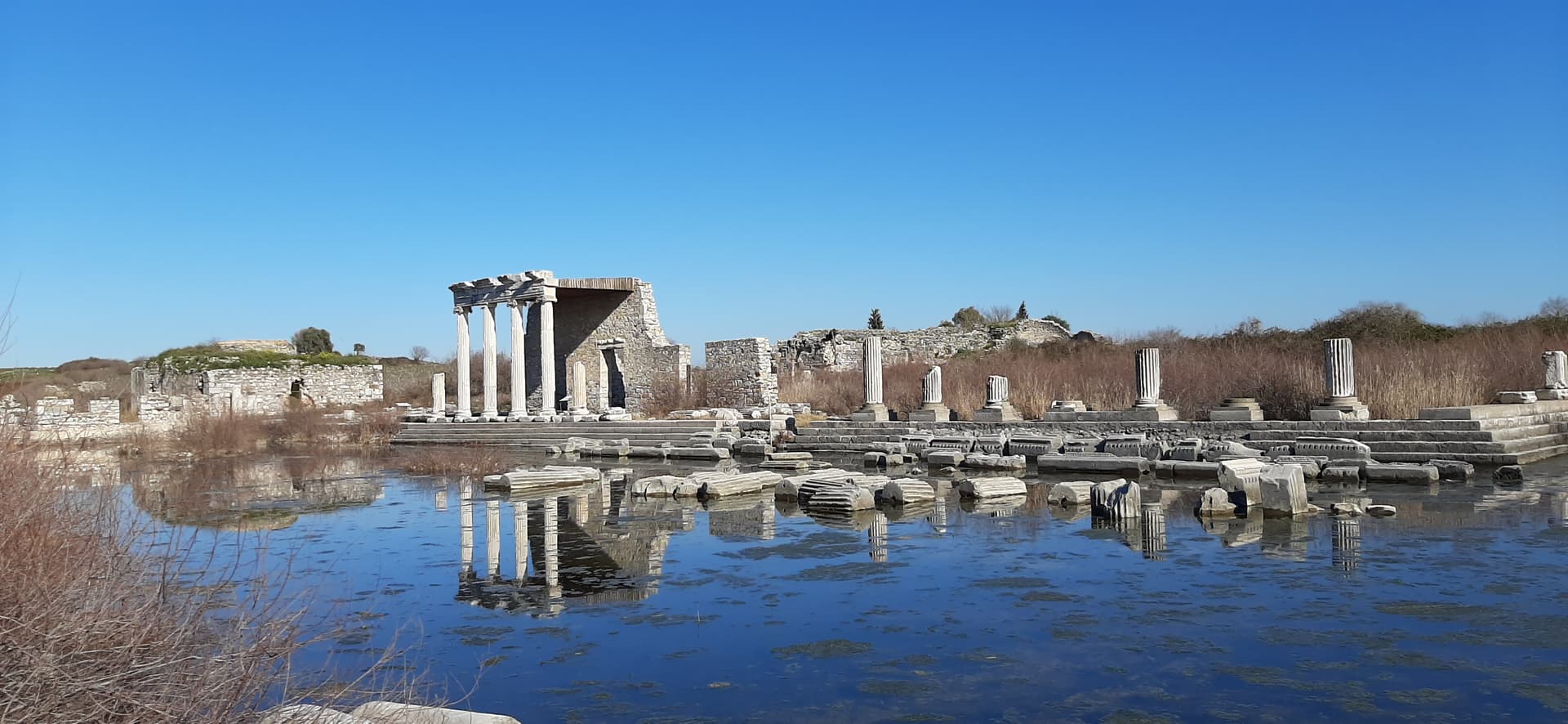
Over late antiquity the Maeander River gradually silted the harbors, stranding Miletus miles inland until it was abandoned. The Great Theatre, Faustina Baths, temple and harbor remains now rise from a flat plain that was once open water.
Places within this site
Why this place is sacred
The quality that makes Miletus spiritually significant is precisely its refusal to resolve the tension between reason and revelation. Thales stood in this city and proposed that all things were made of water—not as a creation myth but as an empirical hypothesis about fundamental substance. Anaximander, his successor, went further, proposing a formless infinite (the apeiron) as the source of all things, a concept that has echoes in Buddhist and Taoist thought about undifferentiated source-being.
Yet these same men, and the citizens who formed their intellectual context, sent annual processions south to the Didyma oracle to ask Apollo whether to go to war, where to plant crops, or how to placate a divine anger whose source they couldn't identify. The Sacred Way was not an embarrassment to Milesian philosophy but its contemporary.
To walk from the Bouleuterion where citizens debated rational governance to the harbor where the oracle pilgrimage set out was a short walk—a few hundred meters. The tension between these practices, held in a single city without apparent cognitive dissonance, is the site's deepest teaching. The physical dissolution of Miletus compounds this quality. The city that generated so much intellectual and spiritual vitality was ended not by conquest but by sediment.
The Maeander River—whose wandering course gave us the English word 'meander'—slowly filled in the harbors over centuries. The city that connected the world lost its connection. What remains stands in a plain that bears no visible relationship to the sea that once lapped at its gates.
Major Ionian Greek city-state serving as a commercial, colonial, intellectual, and religious center; primary embarkation point for the Sacred Way pilgrimage to the Didyma oracle.
From Mycenaean settlement to Ionian Greek city-state to Persian-controlled city (546–479 BCE) to a rebuilt Hellenistic city following Alexander's conquest, then Roman provincial center, Byzantine Christian community, Ottoman-era village, and finally abandoned settlement as the harbors silted. The philosophical tradition born here traveled west with the diaspora of Greek thought.
Experience and orientation
The Great Theatre is the site's organizing landmark—a structure that once seated 15,000 spectators and still commands the plain with the authority of serious architecture. Climb to the upper tiers and look out across the Maeander plain toward where you know the sea once was. The flatness is not ordinary agricultural flatness; it is the flatness of a silted harbor, a landscape that remembers being water.
The distance between the theatre and the sea grew incrementally over centuries, each generation living slightly further from the coast than the last, until at some point no harbor remained to justify the city's existence. The Faustina Baths, the Bouleuterion, the remnants of the Temple of Apollo Delphinios—each monument is legible as a fragment of civic life organized around the assumption that ships would keep arriving. They did not. The small on-site museum provides context that the open-air ruins cannot.
If you plan to walk any portion of the ancient Sacred Way, start at the site and orient yourself toward Didyma to the south—the road is 16.3 km long and portions remain traceable in the landscape. Even standing at the site's southern edge and looking in the direction of Didyma creates a different quality of attention than simply touring the ruins. You are standing where pilgrims assembled before walking four days to ask a god about their futures.
The site is located near the village of Balat in Aydın Province. The standard tourist circuit is the PMD (Priene–Miletus–Didyma) day tour; Miletus sits at the center of this triangle. Allow 2–3 hours for Miletus alone; combine with Didyma (17 km south) for the complete Sacred Way context.
Context and lineage
The city's founding myth attributed its origins to the Cretan hero Miletos, son of Apollo, who fled from Crete following a conflict with King Minos. This Apolline founding myth—the city born from Apollo's own bloodline—strengthened Miletus's claim to a special relationship with the god whose greatest sanctuary, Didyma, lay just to the south. Archaeological evidence shows Mycenaean and pre-Mycenaean occupation, with the area serving as a significant Bronze Age port.
The Ionian Greeks established themselves at Miletus from the 11th century BCE onward, and the city grew rapidly through colonial expansion and maritime trade to become the dominant city of the Ionian League by the 7th–6th centuries BCE. The Milesian School of philosophy—Thales, Anaximander, Anaximenes—flourished in this period.
Persian conquest in 546 BCE did not end the city but changed its character; the Ionian Revolt of 499–493 BCE, in which Miletus played a leading role, ended in the city's sack and partial depopulation. The city was rebuilt on a more regular grid plan—later attributed to the Milesian urban planner Hippodamus—and continued as a significant center through the Hellenistic and Roman periods before gradual decline as the Maeander silted its harbors.
Bronze Age Aegean (Mycenaean) → Ionian Greek city-state → Persian domination → Hellenistic city → Roman provincial center → Byzantine Christian community (Church of St. Michael) → Ottoman period → abandoned settlement
Thales of Miletus
Philosopher and mathematician (c. 624–546 BCE); proposed water as the fundamental substance of all things; predicted a solar eclipse in 585 BCE; considered the first philosopher of the Western tradition
Anaximander
Philosopher (c. 610–546 BCE); student of Thales; proposed the apeiron (boundless, indefinite) as the source of all things; produced one of the first maps of the known world
Anaximenes
Philosopher (c. 585–528 BCE); proposed air as the fundamental substance; connected the structure of the cosmos to the breath of life
Hippodamus of Miletus
Urban planner who theorized and systematized the grid street plan, influencing urban design across the ancient and modern world
Traditions and practice
The Sacred Way pilgrimage from Miletus to Didyma was among the most significant religious events in the ancient Aegean world. Pilgrims arrived by sea at Panormos port south of Miletus, then proceeded north through a sacred avenue lined with marble statues—seated figures and reclining lions—to the oracle sanctuary. The return journey from Miletus's Sacred Gate to the Temple of Apollo at Didyma covered 16.3 km and typically took four days, with overnight stops at way stations.
The quadrennial Great Didymeia festival combined oracle consultation with athletic competitions, dramatic performances, and animal sacrifices. The Temple of Apollo Delphinios within the city served as the urban counterpart to the great sanctuary at Didyma. Miletus also maintained temples to Athena, Dionysus, and other Olympian deities, with the city's religious calendar integrating these multiple cults.
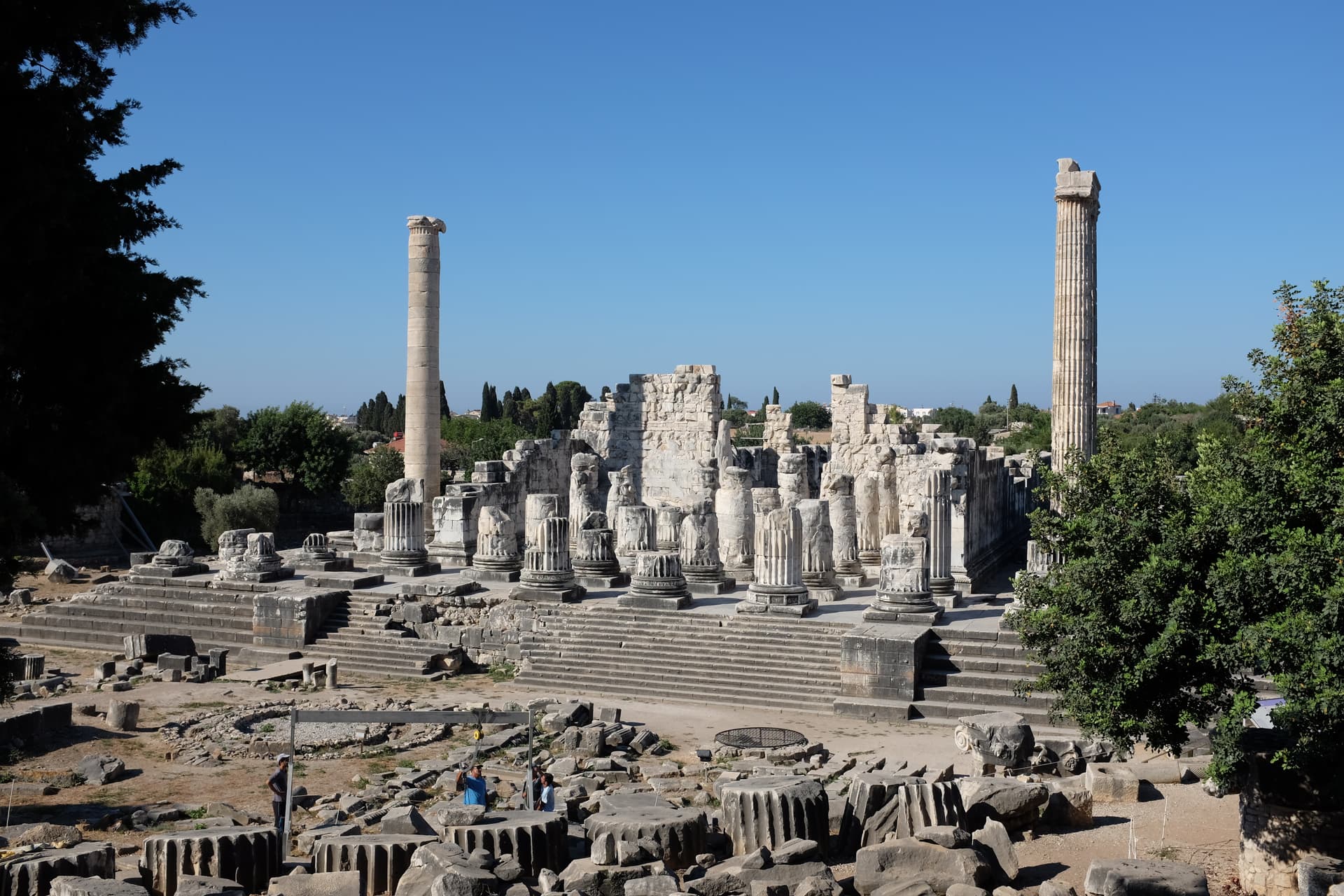
Archaeological research continues. The combined PMD (Priene–Miletus–Didyma) tour is the standard modern visitor pattern. The nearby Temple of Apollo at Didyma (17 km south) remains one of the most significant ancient structures in Turkey.
Walk to the southern edge of the site and face south toward Didyma. Even if you cannot walk the full 16.3 km of the Sacred Way, the deliberate act of orienting your body toward the oracle—as thousands of pilgrims did for centuries—changes the quality of attention the ruins receive. In the Great Theatre, climb to the upper tier rather than remaining at the orchestra level.
From the top, the flat plain reveals itself as a formerly submerged landscape; the absence of the sea becomes palpable rather than merely historically noted. At the Bouleuterion, the domed council chamber where citizens debated civic decisions, sit for a few minutes. This is where the city that produced the first philosophers governed itself. The proximity of political deliberation, philosophical inquiry, and oracle consultation in a single civic space is the essential Miletan achievement.
Ancient Greek Religion
HistoricalMiletus maintained prominent temples to Apollo, Athena, and other Olympian deities, and served as the urban gateway to the oracle of Apollo at Didyma—one of the greatest oracular sanctuaries in the ancient Mediterranean. The four-day Sacred Way pilgrimage from Miletus to Didyma was among the most important religious routes of the ancient Aegean world.
Sacred Way processional pilgrimage over four days; sacrifices at the Temple of Apollo Delphinios; Great Didymeia festival (quadrennial) with athletic and dramatic events; oracle consultation at Didyma for civic and personal decisions.
Philosophical and Intellectual Heritage
HistoricalMiletus was the birthplace of Western philosophy as the home of the Milesian School—Thales, Anaximander, and Anaximenes—who first systematically sought rational rather than mythological explanations of the natural world. This tradition is itself a form of sacred inquiry into the nature of things.
Philosophical discussion and teaching in public spaces; mathematical and astronomical inquiry (Thales predicted a solar eclipse in 585 BCE); proto-scientific theorizing about the nature of matter and the structure of the cosmos.
Archaeological Heritage
ActiveMiletus is one of the most extensively excavated Ionian cities, with German archaeological teams working the site since the late 19th century. Major monuments including the Great Theatre, the Faustina Baths, and the Bouleuterion are accessible to visitors.
Ongoing excavations; on-site museum; heritage tourism. The city is included in the UNESCO Tentative List of Turkey.
Perspectives and open questions
Miletus sits at the intersection of three interpretive traditions—the rationalist philosophical, the oracular religious, and the archaeological—and the interest of the site derives partly from how poorly these traditions explain each other.
Scholarly perspective
Classicists and historians of philosophy have consistently identified Miletus as the foundational site of Western rational inquiry, a judgment supported by the coherent program of inquiry that Thales, Anaximander, and Anaximenes represent. Archaeological attention has focused on the Great Theatre, the harbor structures, and the remnants of the grid plan attributed to Hippodamus.
The Sacred Way between Miletus and Didyma has been the subject of significant recent archaeological reconstruction, with research demonstrating the route was more elaborately marked and formally structured than previously understood. Miletus's role as a colonial mother-city—founding over ninety daughter cities, from Abydos to Trapezus—gives it an influence on the ancient world that exceeds what the ruins alone suggest.
Living and traditional perspectives
No surviving indigenous tradition continues. Ancient sources—Herodotus, Strabo, Pliny, Thucydides—preserve considerable information about Milesian history, and the relationship between Miletus and the Didyma oracle is documented in inscriptions as well as literary sources. The Branchidae, the hereditary priestly family that served the Didyma oracle, had close Milesian ties; their eventual fate under Alexander the Great (who reportedly had their descendants massacred in Central Asia for collaborating with the Persians) illustrates the depth of the Miletus–Didyma religious-political entanglement.
Alternative interpretations
Miletus appears in spiritual travel literature primarily through its connection to the Didyma oracle and the Sacred Way, which has been proposed as one of the great sacred landscape routes of the ancient world. In discussions of the oracular tradition stretching from Delphi to Didyma, Miletus represents the urban gateway—the human community that mediated between seekers and the divine.
Some writers on the philosophy of sacred geography have noted the significance of a city that generated the first explicit rationalism while maintaining one of antiquity's most active oracular systems.
Open questions
The precise extent of the early Mycenaean and Bronze Age settlement remains uncertain. The full program and organization of the Sacred Way—including all its way stations and the precise protocol of the processional—is still being reconstructed archaeologically. The mechanism of the Didyma oracle, and in particular the role of the Branchidae and the sacred spring, is not fully understood.
How Milesian philosophers personally related to the oracle tradition—whether Thales consulted it, whether the Milesian school's rationalism was in dialogue with or indifferent to the sanctuary—is not documented.
Plan your visit
Access and arrival
Located near the village of Balat in Aydın Province. Approximately 90 km from Kuşadası, 40 km from Didim, 100 km from Bodrum. No direct public transport; accessible by car or organized PMD day tour from Kuşadası, Bodrum, or İzmir. Site hours approximately 09:00–18:00 in summer. Entrance fee approximately €6 (may have changed; confirm before visiting). The Miletus Museum is located on site. Mobile phone signal is generally available at the site.
The road to the site passes through Balat village; parking is available at the site entrance.
Didim town (40 km south) and Kuşadası (90 km north) offer the nearest accommodation options. Balat village has limited local options.
Respectful visit
No religious requirements. Sturdy, closed footwear is strongly recommended for the uneven ancient terrain. Bring sun protection and water, as the site has limited shade and no café facilities.
Permitted throughout the site.
None appropriate.
Stay on designated paths. Do not climb on ancient structures. Respect any roped-off excavation areas.
The site has limited shade; visit early morning in summer. Terrain is uneven with exposed ancient masonry; sturdy footwear is essential. Do not climb on ancient structures.
Location
Map loads as you approach this section.
Pilgrim reflections
A portrait of encounter, not a score
Pilgrims describe what they felt, how present they could become, and whether the place would shape a journey. There are no stars and no ranking of traditions.
No reviewed reflections yet
The first pilgrims can help describe the character of being here.
Share a reflection
Available after an account-backed “Been there.” Every reflection is reviewed before publication.
Nearby sacred places
Explore other sacred places in the region. Proximity does not establish access or travel time; check each place’s guidance.


References
Sources consulted for this page. Source categories describe the publication, not a guarantee that every claim is verified. Traditional accounts and outside interpretations may differ.
- 01Miletus | Ancient Greek City, Turkey, & Map — Encyclopaedia BritannicaencyclopediaAuthoritative encyclopedia entry on Miletus
- 02Miletus - Turkish Archaeological News — Turkish Archaeological NewsacademicArchaeological news and excavation updates
- 03The Temple of Apollo at Didyma — World History EncyclopediaacademicDetailed academic treatment of the sacred way and oracle
- 04Reimagining Didyma's Sacred Way — Turkish Archaeological NewsacademicCovers the pilgrimage route connecting Miletus and Didyma
- 05Miletus - Wikipedia — Wikipedia contributorsencyclopediaComprehensive historical overview with citations
- 06Ancient Greek City of Miletus — World History EduacademicOverview of history, philosophers, and decline
- 07Miletus - History and Facts — History HitSource contextHistory and visitor context
- 08Miletus Archaeological Site - Sacred Destinations — Sacred DestinationsspiritualCovers sacred significance and religious sites within Miletus
- 09Didyma - World Pilgrimage Guide — Sacred SitesspiritualCovers the sacred pilgrimage route from Miletus to Didyma
- 10Miletus of Turkey: A Local's Guide to an Ancient Wonder — Memphis ToursguidePractical visitor guide with access and timing information
Share a photo
Help visitors recognize Miletus. Every submission is reviewed before publication.