Miletus Stoa
Part ofMiletus
Where Apollo's city met the sea, and philosophy first asked what the world is made of
Understand sacred places, explore living traditions, and learn how to engage respectfully with Pilgrim Map.
Access has not been verified. Check current local guidance before planning a visit.
Aydın, Turkey
Read the sources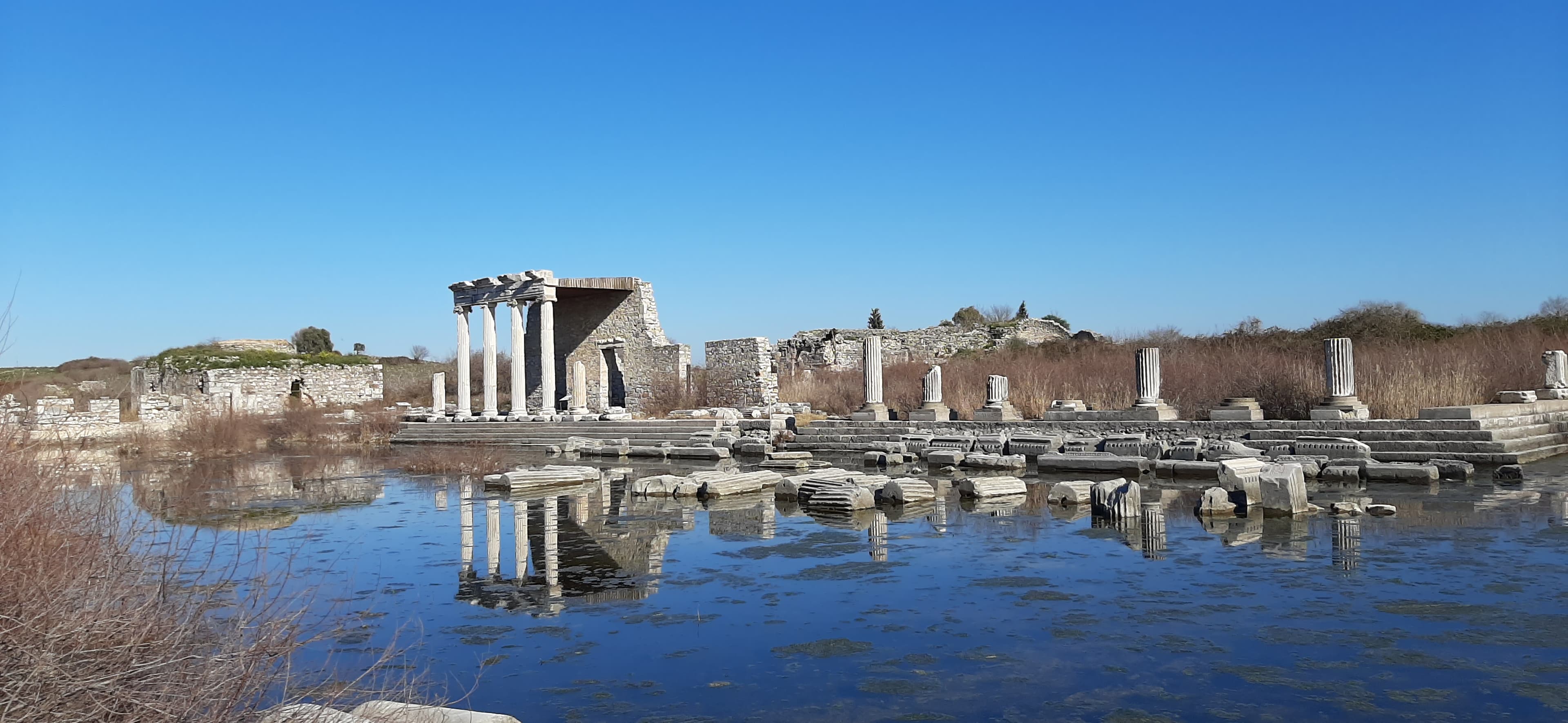
Image of Miletus Stoa. Image source
Visit essentials
A quick read before you go
- Duration
- 2–3 hours for Miletus alone; a full day if combining with Didyma (16 km S) and the Miletus…
- Access
- Near Balat village, approximately 30 km south of Söke and 90 km south of Aydın, in Didim…
Overview
Miletus, the city that gave the world its first philosophers—Thales, Anaximander, and Anaximenes—and founded over 90 colonies from the Black Sea to Egypt, now lies partly submerged in marshy Aegean lowland. Its harbours are silted and its theatre stands above fields.
The fragmentary stoas retain a spatial logic revealed by excavation. The city centered religious and civic life on Apollo Delphinios's sanctuary, while the great Lion Harbour stoa received sea-arriving pilgrims into a processional landscape. The Delphinion, a walled temenos of Apollo Delphinios as sailors' patron and divine city founder, held worship, treaties inscribed on sanctuary walls, and ceremonies fusing civic and divine authority.
From there, the four-day Sacred Way procession departed for Apollo's oracle at Didyma, 16 kilometres south, where Roman emperors, Greek city-states, and ordinary individuals consulted the god's prophetic voice. Miletus's stoas were the colonnaded corridors where this sacred movement began—architecture as ceremonial threshold rather than enclosure.
Why this place is sacred
Miletus occupied a position that was geographically and theologically liminal. The city stood on a peninsula surrounded by three harbours — a landscape of edges, of water meeting land on multiple sides, of arrival and departure. Liminal landscapes in sacred geography are places where the ordinary rules of experience loosen, where the threshold between human and divine becomes thinner.
Miletus enacted this liminality in its very plan: every major approach to the city involved crossing water, and the great stoa of the Lion Harbour created a ceremonial gateway that converted arrival from a practical event into a ritual one. The colonnades of the stoa — stone columns in measured rhythm — transformed the experience of entering the city into a processional movement, each column marking a step from the sea's undifferentiated space into the ordered sacred city.
The Apollo Delphinios cult gave Miletus its divine patron in the form most suited to a maritime city: Apollo in his dolphin aspect, protector of sailors, his very name preserving the Greek word for dolphin. The Delphinion sanctuary was the city's civic-religious centre, its treaty inscriptions on the walls making it simultaneously a legal archive and a place of worship.
The Sacred Way procession to Didyma — four days, with athletic competitions and sacrifices at stations along the route — was the year's central religious event, the moment when all of Miletus's civic, commercial, and spiritual energies converged into a single directed movement toward the oracle. Walking the route from the Lion Harbour stoa to the Delphinion today recapitulates, in fragmentary form, the beginning of that movement.
Civic-religious sanctuary of Apollo Delphinios, embarkation point for the Sacred Way pilgrimage to the Oracle of Apollo at Didyma.
Mycenaean settlement from c. 1450 BC; destroyed by Persia 494 BC and rebuilt on a Hippodamian grid; Apollo Delphinios sanctuary from 6th century BC; Lion Harbour stoa (Hellenistic, c. 100 m); Ionic Stoa associated with Faustina Baths (Roman imperial period); Byzantine episcopal see; abandoned and partly submerged as harbour silted. Now an open-air archaeological site.
Experience and orientation
Miletus is best visited with a site map from the on-site museum, collected before you set out. The layout is not immediately legible without it — the silted harbours and marshy lower areas have erased the visual relationship between the monuments that once made the city's spatial logic obvious. Begin at the Lion Harbour area. Even fragmentary, the harbour stoa's scale communicates the ceremonial intent — a structure designed to greet arrivals from the sea at the grandest possible register.
The Delphinion sanctuary, a short walk north, is the site's spiritual centre: an open-air temenos bounded by stoa foundations on three sides, its treaty inscription walls now bare but once covered with the city's legal and religious commitments. Stand in the centre of the temenos.
The absence of a roofed building as focal point — the sanctuary was open to the sky — means that Apollo's presence was addressed upward, toward light and air, consistent with his solar and oracular character. The great theatre, cut into the hill, holds its scale. This was where the city assembled before the Sacred Way procession departed — the gathering place before the threshold.
From the theatre, the relationship between city and surrounding landscape becomes visible: the marshy plain that was once the harbour, the low hills beyond, the sense of a peninsula that once had water on multiple sides. The Ionic Stoa associated with the Faustina Baths complex is the most complete surviving stoa structure, its columns still standing in Roman-period form.
It marks the shift from the sacred precincts of the Delphinion to the civic infrastructure of the Roman city — bath, stoa, and market in sequence.
Collect a site map at the on-site museum at Balat village before touring. The monuments are spread over several hundred metres. Some lower areas flood seasonally; check conditions locally. Allow 2–3 hours for Miletus alone, a full day if combining with Didyma (16 km south) via the Sacred Way route.
Context and lineage
Miletus was mythologically founded by Miletos, son of Apollo — a claim that made the city itself a divine instantiation rather than merely a human settlement. The god's son founded the city; the city founded the Delphinion in the god's honour; the Sacred Way carried the god's worshippers to his oracle 16 kilometres south. This mythological architecture gave Miletan civic life a theological coherence: everything returned to Apollo, and Apollo expressed himself through Miletus.
The historical city began as a Mycenaean settlement around 1450 BC, was colonised by Greek Ionians around 1000 BC, and was destroyed by Persia in 494 BC following the failed Ionian Revolt — an event that ended Miletus as a great power but not as a city. The rebuilt Miletus, planned on a Hippodamian grid by the city's own urban theorist Hippodamos, became a model for Greek city planning throughout the Mediterranean.
Mycenaean → Ionian Greek → Persian destruction (494 BC) → rebuilt Hellenistic city → Roman provincial city → Byzantine episcopal see → abandoned (harbour silted, 7th–13th century CE) → open-air archaeological site under German Archaeological Institute and Turkish Ministry of Culture.
Traditions and practice
The Delphinion received animal sacrifices to Apollo Delphinios, particularly from sailors before departures and after safe returns. Bronze and terracotta votives accumulated in the temenos; the sanctuary walls were inscribed with civic treaties and decrees, making the space simultaneously a divine precinct and a legal archive.
The four-day Sacred Way procession — departing Miletus with the full civic community, stopping at sacred stations along the 16.3 km route, arriving at Didyma with athletic competitions (boxing, wrestling, foot-racing) — was the city's central sacred event. At Didyma, the oracle's prophētis received Apollo's messages and delivered them to the assembled pilgrims. The Roman-period Ionic Stoa bore an inscription recording its dedication by an imperial representative, indicating that civic bathing culture was also formally connected to imperial cult obligations.
No active religious practice. Heritage walking tours following portions of the Sacred Way between Miletus and Didyma are offered by some Turkish archaeological tourism operators.
Begin at the Lion Harbour area and understand yourself as arriving by sea, in the position of an ancient merchant or pilgrim receiving the city's ceremonial welcome. Walk north toward the Delphinion; move through the stoa foundations into the open temenos. Stand in the centre and consider the open sky above — Apollo is addressed upward here, not inward. Then walk to the theatre and stand in the upper rows.
This is where the city gathered before the Sacred Way procession departed. The view from the theatre over the marshy former harbour grounds — where ships once anchored, where pilgrims arrived, where the Sacred Way began — is the site's most historically resonant perspective. If you have time, drive or walk the 16 km to Didyma and stand in the oracle sanctuary's adyton. The two sites are not complete without each other.
Apollo Delphinios Cult
HistoricalThe Delphinion was Miletus's civic-religious heart — the god understood as the city's divine founder and protector. The sanctuary's inscription walls, the treaty archive, and the Sacred Way procession made Apollo's authority coextensive with Miletan civic life.
Animal sacrifice; sailors' votive dedications; treaty inscriptions; civic religious ceremonies; four-day Sacred Way procession to Didyma.
Didyma Oracle Pilgrimage
HistoricalThe Sacred Way from Miletus's Lion Harbour to the Oracle at Didyma was one of antiquity's great pilgrimage routes, involving four days of procession, sacrifice, and athletic competition before the divine oracle was consulted.
Four-day processional; harbour arrival ceremonies; athletic competitions; consultation of Apollo's oracle.
Archaeological Heritage
ActiveOver 125 years of continuous German Archaeological Institute excavation have made Miletus one of the most documented ancient Greek cities, with ongoing research still producing significant findings.
Academic excavation; open-air museum visits; heritage pilgrimage walks along the Sacred Way.
Perspectives and open questions
Miletus is readable as the birthplace of rational philosophy, as an Apollonian sacred city, as a lost oracle culture, and as a site where the Western tradition's tendency to separate the rational from the sacred first emerged from a culture that held them together.
Scholarly perspective
Miletus is one of the most thoroughly excavated ancient Greek cities. The German Archaeological Institute has maintained excavations since 1899 and the scholarly record is extensive. The Delphinion is understood as the civic-religious centre of the polis, and the Sacred Way to Didyma is recognised as one of antiquity's most important oracle pilgrimage routes. The city's intellectual legacy — Thales, Anaximander, Anaximenes, Hippodamos — gives it unique significance in the history of Western thought.
Living and traditional perspectives
The Carian and pre-Greek populations who preceded the Ionian colonists at Miletus left little surviving religious record. The Mycenaean material suggests Bronze Age cult presence, but the nature of pre-Greek sacred practice at this location is largely unknown. The layering of cultures is archaeologically visible but incompletely documented.
Alternative interpretations
Sacred geography scholars, including Martin Gray, highlight the Miletus–Didyma axis as one of the ancient world's most powerful oracle corridors. The Apollo-dolphin symbolism resonates with researchers interested in ancient marine spirituality and cetacean-human relationships. The question of how Milesian rational philosophy emerged from a festival and oracle culture rather than in opposition to it is a live intellectual question about the origins of Western reason.
Open questions
The exact nature of the prophetic process at Didyma — how the prophētis received and transmitted Apollo's messages — remains unclear. The pre-Greek sacred use of the Miletus peninsula is largely undocumented. The relationship between the Milesian Apollo cult and wider Near Eastern solar deity traditions remains debated.
Plan your visit
Access and arrival
Near Balat village, approximately 30 km south of Söke and 90 km south of Aydın, in Didim district of Aydın Province. Regular dolmuş (minibus) services from Söke. Nearest large city: Bodrum (~100 km SW) or Kuşadası (~70 km NW). The site has a small on-site museum in Balat with a site map — collect this before touring.
Didim/Didyma town (16 km S) has hotels. Söke (30 km N) has accommodation. The site itself has no visitor facilities beyond the small museum.
Respectful visit
No dress code. Sun protection and sturdy footwear essential.
Permitted throughout.
None appropriate.
Stay on marked paths; some areas seasonally inaccessible due to flooding. Do not climb on ancient theatre seating blocks.
Some lower areas of Miletus flood seasonally, particularly in winter and early spring. Check conditions locally before visiting. The site map at the Balat museum is essential — without it, the layout is disorienting.
Location
Map loads as you approach this section.
Pilgrim reflections
A portrait of encounter, not a score
Pilgrims describe what they felt, how present they could become, and whether the place would shape a journey. There are no stars and no ranking of traditions.
No reviewed reflections yet
The first pilgrims can help describe the character of being here.
Share a reflection
Available after an account-backed “Been there.” Every reflection is reviewed before publication.
Nearby sacred places
Explore other sacred places in the region. Proximity does not establish access or travel time; check each place’s guidance.



References
Sources consulted for this page. Source categories describe the publication, not a guarantee that every claim is verified. Traditional accounts and outside interpretations may differ.
- 01Delphinion (Miletos) — Pleiades — Pleiades Ancient Places GazetteeracademicAuthoritative ancient places database; Delphinion coordinates and description
- 02A Walk Through Ancient Miletus — Delphinion — Foundation of the Hellenic WorldacademicGreek scholarly foundation's reconstruction of Miletus; Delphinion sanctuary and stoas detailed
- 03Miletus, Delphinion (Building) — Perseus Digital Library — Perseus / Tufts UniversityacademicClassical studies reference database; architectural description
- 04Miletus — Wikipedia — Wikipedia contributorsencyclopediaComprehensive historical overview; GPS coordinates cited as 37°31.8'N 27°16.7'E
- 05Miletus Archaeological Site — Sacred Destinations — Sacred DestinationsguideSpiritual travel framing; visitor experience and sacred context
- 06Miletus — Turkish Archaeological News — Turkish Archaeological NewsSource contextCurrent excavation news and site description
- 07Miletus: An Ionian Greek City and Archaeological Site in Turkey — Ancient History SitesacademicDetailed archaeological site survey including stoa structures
- 08Miletus Ancient Site — Slow Travel Guide — Slow Travel GuideguidePractical visitor guide; flooding warning; museum map advice
- 09Didyma — World Pilgrimage Guide — Sacred Sites / Martin GrayspiritualSacred geography perspective; Miletus–Didyma Sacred Way pilgrimage context
Share a photo
Help visitors recognize Miletus Stoa. Every submission is reviewed before publication.