Priene
The Hellenistic city frozen in its grid — where Alexander the Great left his name in stone above the Maeander plain
Understand sacred places, explore living traditions, and learn how to engage respectfully with Pilgrim Map.
Access has not been verified. Check current local guidance before planning a visit.
Aydın, Turkey
Read the sources
Visit essentials
A quick read before you go
- Duration
- Two to four hours for the main monuments on the central and upper terraces.
- Access
- Near Güllübahçe village, approximately 15 km southwest of Söke (Aydın Province), and around 70…
Overview
Priene holds a stillness larger sites rarely achieve. While Ephesus receives hundreds of thousands of visitors along restored marble pavements, Priene sits quieter on a steep hillside—harder to reach, less photographed, and more present. Its strict Hippodamian grid presses intersecting streets onto Mount Mycale's slope, with terraces for the theatre, Athena sanctuary, bouleuterion, and agora in civic order.
The plan remains unobscured: walk Theatre Street south from the lion's-head fountain, then west along Athena Street, through logic unchanged since the fourth century before the common era.
The Temple of Athena Polias was designed by Pytheos, who also co-designed the Mausoleum at Halikarnassos and wrote a theoretical treatise on this building. It became its time's canonical expression of the Ionic order. After crossing the Hellespont and first engaging Persian forces at the Granicus, Alexander the Great arrived in 334 BCE, contributed to construction, and left an inscription scholars read as one of antiquity's great acts of patronage and propaganda.
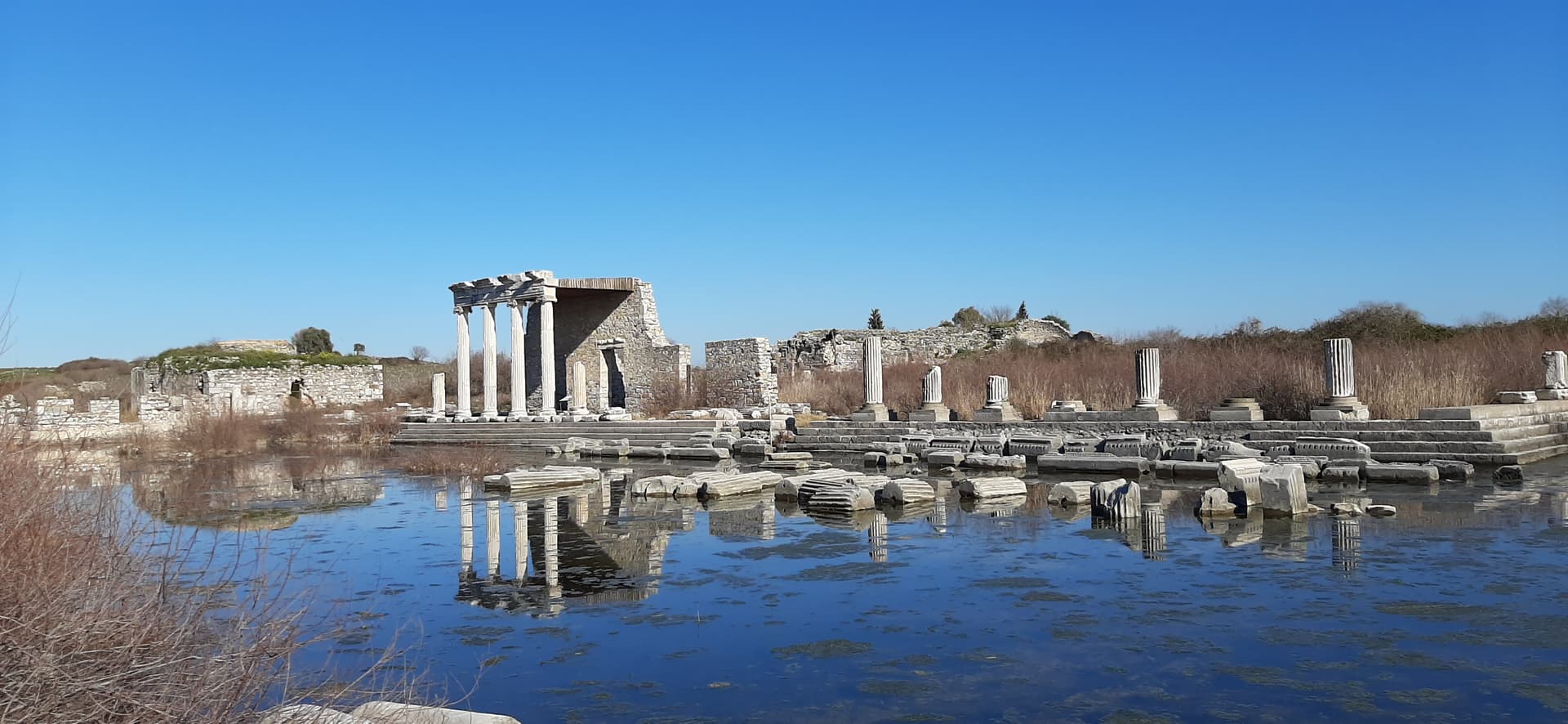
Five of the original eleven long-side columns have been re-erected above the wide Maeander plain, with the mountain directly behind them. This is among western Anatolia's most compositionally powerful archaeological views, where human ambition toward permanence meets deep time.
Why this place is sacred
The sacred quality of Priene is inseparable from its civic ambition. In the ancient Greek city, the temple of the patron deity was not placed outside the city gates as a separate precinct; it was the city's highest point, its organizing principle, the building toward which every street ultimately oriented.
At Priene, the Temple of Athena Polias occupied the uppermost terrace of the north-facing hillside, with the theatre immediately below it, the agora further down, and the gymnasium and stadium at the lowest levels. This arrangement encoded a hierarchy that moved from divine to intellectual to civic to physical — a ladder of human value expressed in stone and topography.
The temple carried an unusual weight of authority. Pytheos's theoretical writing on Ionic proportion gave it a canonical status in architectural theory. Alexander the Great's inscription placed it within the narrative of the defining military and cultural transformation of the Hellenistic age.
The presence at the same site of sanctuaries to Demeter and Kore, and of a third-century BCE complex for Egyptian deities — Isis, Serapis, Anubis, Harpocrates — positioned Priene as a cosmopolitan religious meeting ground, a place where the major spiritual currents of the Hellenistic eastern Mediterranean converged in one grid-city of perhaps four to five thousand souls.
What makes the site feel numinous now is precisely its completeness within its abandonment. No mosque was built over the temple; no Byzantine church was raised inside the theatre. The harbour silted, the city emptied, and the hillside held the form of a Hellenistic world in suspension. Walking here is not an act of imagination supplementing ruins: the city is substantially there.
Primary cult site and city-organizing sanctuary for Athena Polias, patron and protector of the Ionian city of Priene, with secondary sanctuaries for Demeter, Kore, Zeus, and the Egyptian deities.
Founded by Ionian settlers in the early first millennium BCE; relocated to its current terraced hillside c. 350 BCE; Temple of Athena constructed and endowed by Alexander the Great from 334 BCE; the city flourished through the Hellenistic and early Roman periods as a religious, civic, and commercial centre. Gradual decline as the Maeander River delta silted the harbour; the city was effectively abandoned by the thirteenth century CE without significant overbuilding.
Now a well-preserved archaeological park on the UNESCO Tentative List since 2018, with a formal World Heritage nomination initiated in September 2025.
Experience and orientation
Arriving at Priene from Güllübahçe village, you approach the site from below, entering through the eastern gate where the main Athena Street begins its climb. The first quality you notice is the incline: this is a city built for people who walked uphill as a daily fact of life. The stones underfoot are original; wear is visible. The street channels rain water in its central gutter. Houses open off side lanes, their door sills still in place.
Move at a deliberate pace. The urge to reach the Athena temple quickly is worth resisting. Pass through the agora — the square colonnaded space where civic life centred — and notice how the city's logic is embedded in the geometry: everything at right angles, every block proportioned to the same module, yet the strict grid somehow accommodating a hillside that rises thirty metres from one end of the city to the other.
The theatre, carved into the rock above the agora, holds its stone seats and preserves five proedria thrones at the front for dignitaries. Sit in the upper rows if the sun allows: from here the roofless stage building frames a view of the Maeander plain below, a river valley so silted now that the sea is invisible — but in antiquity this theatre audience looked out over a working harbour.
The Temple of Athena occupies the highest civic terrace. The five re-erected columns are best approached from below, so they rise as you climb. Their scale resolves from abstract to physical only when you stand among them. The column drums were not drums in the usual sense of flat circular sections: they are long tapering shafts cut to Pytheos's proportions, their flutes still crisp.
The plinth inscription in Alexander's name survives in the Berlin museum; what you stand before is the building that inscription commissioned. Behind the temple, the cliff of Mount Mycale rises sharply. In clear weather, the outline of Samos is visible across the strait.
Across the site, the sanctuary of Demeter and Kore sits on a higher secondary terrace, quieter and more enclosed — a feminine precinct distinct from the civic masculine space of the agora below. The Egyptian deity sanctuary between Theatre Street and Athena Street is marked by inscribed bases; its location on a main commercial street suggests a cosmopolitan community comfortable with Hellenistic religious pluralism.
Allow three to four hours at minimum. The bouleuterion — the council chamber with its horseshoe-shaped rows of seats — deserves particular attention as one of the best-preserved examples of a Hellenistic civic assembly space.
Enter from the east via the main site gate near Güllübahçe village. The main Athena Street runs the length of the city east-west. The Temple of Athena is in the upper northwest; the theatre is above the agora on the central slope; the gymnasium and stadium are at the lower southeastern end. Wear sturdy footwear — all paths are on a significant slope with uneven stone surfaces.
Context and lineage
The original Priene was an ancient Ionian foundation of around the tenth century BCE, one of the twelve cities of the Ionian League. Its position near the coast of the Maeander delta was geographically advantageous until the river's silting behaviour became a long-term threat to the harbour. The city was relocated in its entirety around 350 BCE — a planned urban refounding on a new hillside site below Mount Mycale that afforded better drainage and a more defensible position.
This relocated city was designed from scratch on the Hippodamian grid principle, the orthogonal system of streets and regular insulae developed by the fifth-century BCE theorist Hippodamos of Miletos.
Within twenty years of the refounding, Alexander the Great arrived in 334 BCE following his Granicus victory and funded the completion of the Temple of Athena Polias, leaving a dedicatory inscription that began with the formula identifying him as the donor. This inscription — the original stone is now in the British Museum — is one of the most significant epigraphic documents of Alexander's campaigns, linking his divine patronage directly to the city's patron goddess.
It gave Priene a connection to the defining figure of the Hellenistic age that no amount of subsequent history could erase.
The city's philosopher-sage, Bias of Priene, predated all this by two centuries: he was one of the Seven Sages of archaic Greece, celebrated for the maxim that most men are bad. His birthplace gives Priene a second layer of intellectual distinction beyond its architecture.
Ancient Ionian foundation (c. 1000 BCE) → relocated Hellenistic city (c. 350 BCE) → Alexander's patronage (334 BCE) → Seleucid and Pergamene rule → Roman province of Asia → gradual decline through Byzantine period → abandonment by 13th century CE → German archaeological excavations from 1895 → UNESCO Tentative List 2018 → formal nomination process from September 2025
Traditions and practice
The primary ritual life of Priene centred on the Temple of Athena Polias, where state sacrifices, votive dedications, and civic ceremonies honoured the city's patron goddess. A copy of the Athena Parthenos is attested in the naos; civic oaths and ceremonies of state were conducted in the temple precinct. The sanctuary of Demeter and Kore, established soon after the city's refounding, supported Eleusinian-influenced mystery rites concerned with grain, fertility, and the underworld.
The Egyptian deity sanctuary — active from the third century BCE — hosted Isis mysteries and Serapis healing cult practices. Agonistic festivals were held in the theatre and stadium, combining athletic and musical competition within a religious framework typical of Hellenistic civic life.
No active religious ceremonies are held at Priene. The site functions as an archaeological park with regulated visitor access. Ongoing Turkish and international archaeological research continues at the site, and the formal UNESCO nomination process initiated in 2025 is expected to bring increased conservation activity.
Move through the site from east to west, following the incline upward as ancient residents did on days of festival. At the Temple of Athena, stand below the re-erected columns and allow the scale to register without hurrying toward a photograph. The five columns are more powerful when experienced in sequence — approach, arrival, enclosure, prospect — than captured from a single angle.
Walk to the rear of the temple podium where the cliff face of Mount Mycale rises immediately behind; notice how the sanctuary is held between mountain and plain, between the vertical and the horizontal. At the bouleuterion, sit for a moment in the council seats and consider what it meant for a city of four thousand people to have a dedicated assembly chamber of this quality.
At the Demeter sanctuary above the main grid, the enclosure is markedly quieter — a different register from the civic spaces below. The stadium at the lower end of the site is often overlooked; its full length of athletics track, set in the hillside, gives the best sense of the city's lower elevation and its former relationship to the harbour.
Ancient Greek — Worship of Athena Polias
HistoricalThe Temple of Athena Polias was Priene's primary sacred site and its city-organizing monument, designed by the architect Pytheos and funded by Alexander the Great. Its canonical Ionic architecture made it the reference building for the order in antiquity.
State sacrifices, votive offerings, civic oaths and processions; the naos housed a copy of the Athena Parthenos.
Ancient Greek — Demeter and Kore sanctuary
HistoricalA sanctuary for Demeter and Kore established in the decades following the city's fourth-century BCE refounding, supporting mystery cult traditions influenced by the Eleusinian model.
Mystery cult rites associated with grain, fertility, and the relationship between the living and the dead.
Egyptian mystery cults — Isis, Serapis, Anubis, Harpocrates
HistoricalA third-century BCE complex positioned between Theatre Street and Athena Street, documenting the penetration of Egyptian religious practice into Ionian Asia Minor within a generation of Alexander's death.
Isis mysteries, Serapis healing cult, votive dedications.
Archaeological and scholarly heritage
ActivePriene is the international reference site for Hellenistic Hippodamian urbanism, continuously studied since Theodor Wiegand's 1895 excavations. A UNESCO World Heritage nomination is in process.
Ongoing excavation, conservation, and scholarly research; heritage tourism.
Perspectives and open questions
Priene is read differently depending on whether one approaches it as an architectural historian, a student of Alexander's campaigns, a seeker of Ionian spiritual geography, or someone simply drawn to the sensation of inhabiting an intact but abandoned world.
Scholarly perspective
Priene represents the finest surviving example of Hippodamian grid planning in the ancient world, and its Temple of Athena Polias is the canonical Ionic temple — the building on which Pytheos wrote a treatise and which Vitruvius cited as the reference exemplar of the Ionic order. The extraordinary preservation of the urban fabric results from the city's gradual abandonment without significant subsequent occupation: it provides archaeologists with a near-complete cross-section of a medium-sized Hellenistic polis.
The presence of Egyptian deity cults in a third-century BCE Ionian city confirms the speed with which Hellenistic religious cosmopolitanism spread following Alexander's campaigns. The formal UNESCO nomination process, initiated in September 2025, recognises Priene as a site of universal outstanding value for urban heritage.
Living and traditional perspectives
In the ancient Ionian tradition, Priene was primarily the city of Athena Polias — a city whose identity, legitimacy, and protection rested in the divine patronage of the goddess. Alexander the Great's inscription formalised a connection that the Ionian tradition would have understood as evidence of divine election: the conqueror who claimed descent from Achilles and Heracles was drawn to this goddess's city.
The memory of Bias, whose wisdom was recorded by Diogenes Laertius and cited for centuries, gave the city a second kind of authority — the philosopher-sage as the city's spiritual ancestor.
Alternative interpretations
Some researchers who study the sacred geography of the Aegean identify a deliberate triangular relationship between Priene, Miletus, and Didyma — three major sites positioned within a landscape formed by the Maeander River's delta — as an intentionally organised sacred territory, with each site expressing a different dimension of Ionian religious life: the city-goddess at Priene, the civic and commercial sanctuary at Miletus, and the oracle at Didyma.
The ridge of Mount Mycale, rising behind Priene and associated with the Battle of Mycale (479 BCE, one of the decisive victories of the Persian Wars), carries its own mythic weight in Ionian memory.
Open questions
The precise circumstances of the city's fourth-century BCE relocation — what prompted it, who organised it, what became of the population during the transition — are not fully documented. The original cult statue in the Athena naos (attested as a copy of the Athena Parthenos) has not survived. The full ritual calendar integrating the four known sanctuary traditions — Athena, Demeter, Zeus, and the Egyptian deities — has never been reconstructed.
Why the Egyptian cult complex was positioned on a main commercial street rather than in a more private location remains a genuinely open question.
Plan your visit
Access and arrival
Near Güllübahçe village, approximately 15 km southwest of Söke (Aydın Province), and around 70 km south of İzmir. Dolmuş services connect Söke to Güllübahçe. By car: well-signposted from the Söke–Milas road. Entry fee applies (check current prices). The site involves significant uphill walking on uneven stone surfaces.
No accommodation at the site. Söke offers the nearest range of hotels and guesthouses, approximately 15 km east. Kuşadası (40 km northwest) provides wider options including beach resort accommodation, with easy access to Priene and the other Maeander delta sites.
Respectful visit
No dress requirements. Practical footwear for steep stone paths is essential.
Photography is permitted throughout the site. No flash or drone use without advance permission from the Ministry of Culture.
Not applicable to this archaeological site.
Do not touch, climb, or sit on architectural remains. Protective barriers around key monuments must be respected. Removing any material from the site — including sherds, tile fragments, or small stones — is illegal under Turkish cultural heritage law.
The hillside paths are steep and uneven; do not visit in open sandals or without some physical preparation for the climb. Shade is limited on the upper terraces in summer; carry water. Some architectural remains are protected by barriers that must not be crossed.
Location
Map loads as you approach this section.
Pilgrim reflections
A portrait of encounter, not a score
Pilgrims describe what they felt, how present they could become, and whether the place would shape a journey. There are no stars and no ranking of traditions.
No reviewed reflections yet
The first pilgrims can help describe the character of being here.
Share a reflection
Available after an account-backed “Been there.” Every reflection is reviewed before publication.
Nearby sacred places
Explore other sacred places in the region. Proximity does not establish access or travel time; check each place’s guidance.



References
Sources consulted for this page. Source categories describe the publication, not a guarantee that every claim is verified. Traditional accounts and outside interpretations may differ.
- 01Priene - Wikipedia — Wikipedia contributorsencyclopediaComprehensive historical and archaeological overview
- 02Archaeological Site of Priene - UNESCO World Heritage Centre — UNESCOofficialUNESCO Tentative List entry (2018); formal nomination initiated September 2025
- 03Priene: An Ionian Hellenistic City near Mount Mycale, Turkey — Ancient History SitesacademicDetailed architectural and historical analysis
- 04Priene – Turkish Archaeological News — Turkish Archaeological NewsacademicArchaeological news and site updates
- 05Temple of Athena Polias (Priene) - Wikipedia — Wikipedia contributorsencyclopediaArchitecture, inscription, and history of the temple specifically
- 06Temple of Athena Polias at Priene – Alexander the Great structures — alexander-the-great.orgacademicDetailed treatment of Alexander's patronage of the temple
- 07Ruins Of Priene – Exploring The Ancient Greek City Of Ionia — Egypt Tours PlusguideVisitor-focused overview including the Egyptian deity sanctuary
- 08Priene Turkey Guide 2026: Athena Temple and Hippodamian Grid — Ancient TravelguideUpdated 2026 visitor guide
Share a photo
Help visitors recognize Priene. Every submission is reviewed before publication.