Midas Tumulus
The Great Mother's throne cut from living rock on the Phrygian plateau — misnamed a tomb, understood as a temple
Understand sacred places, explore living traditions, and learn how to engage respectfully with Pilgrim Map.
Access has not been verified. Check current local guidance before planning a visit.
Eskişehir, Turkey
Read the sources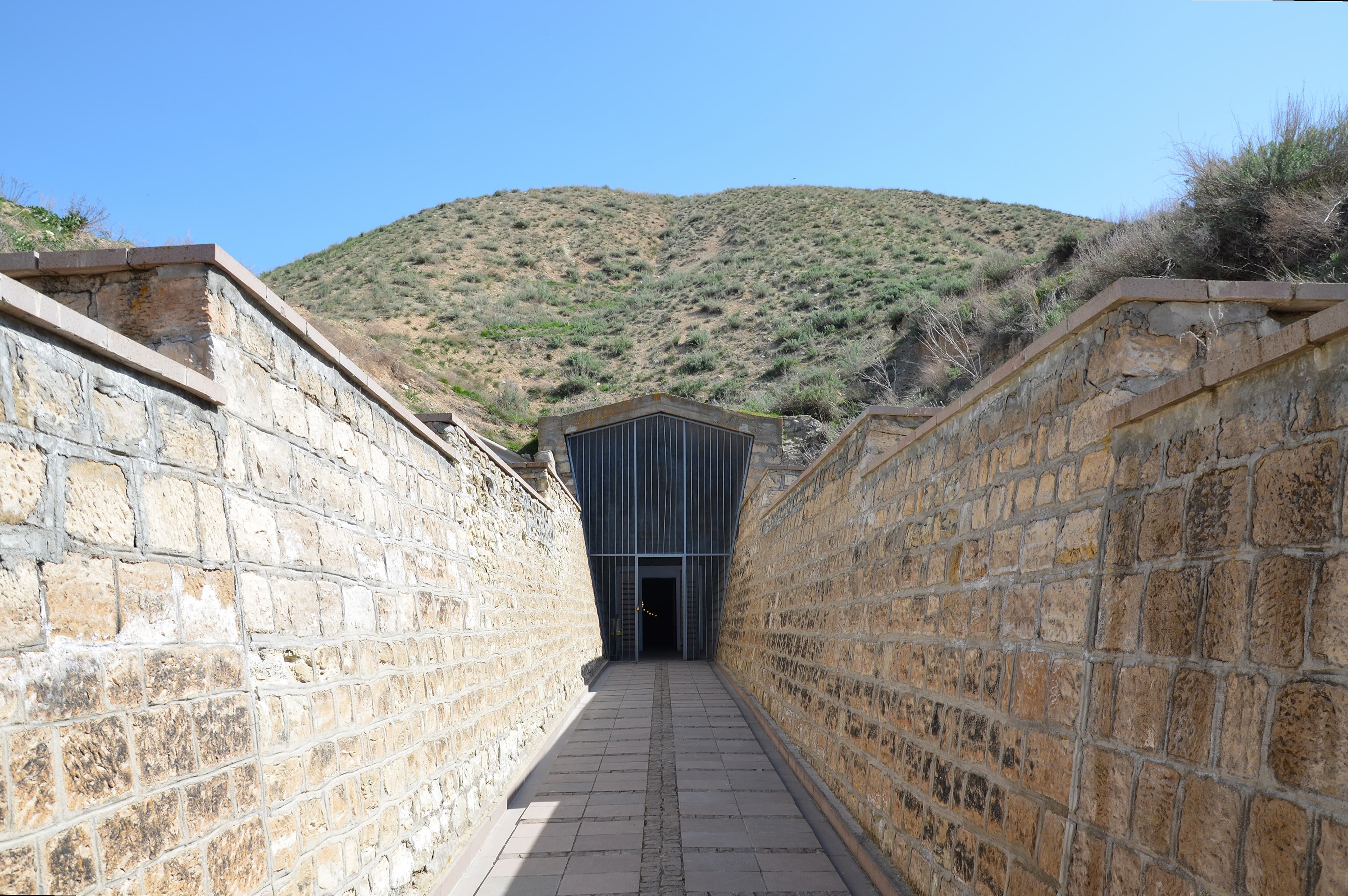
Image of Midas Tumulus. Image source
Visit essentials
A quick read before you go
- Duration
- Two to three hours for the main monument and acropolis; a full day for thorough exploration of…
- Access
- Located near Yazılıkaya village, Han district, approximately 66 km south of Eskişehir and 51 km…
Overview
In the volcanic tuff highlands south of Eskişehir, the Phrygians built their most extravagant outdoor temple without using a single dressed stone. They found a natural cliff face rising from the valley floor, carved its surface from top to bottom with an interlocking geometry of diamonds and panels and vegetal patterns, and at its base cut a stepped niche for the effigy of Matar Kubileya — the Mother of the Mountain, the goddess whose body the rock already was.
The monument is nearly six stories tall and reads at a distance as a vast decorated door, though it opens onto nothing that can be entered. An inscription in Old Phrygian runs along the upper edge, naming Ates as the dedicant and Midas as king and 'wanax' — a word borrowed from Mycenaean Greek to mean something between lord and divine ruler. The dedication is to Midas; the monument is to the goddess.
Both are still here, undisturbed by the two and a half millennia since the craftsmen put down their chisels. Dozens of smaller carved facades and niches extend through the Yazılıkaya valley, creating not a single monument but an entire sacred landscape — the most concentrated surviving testimony to Phrygian religious feeling anywhere on earth.
Why this place is sacred
Phrygian theology held that Cybele — Matar Kubileya, Mother of the Mountain — was not merely associated with rock but was present within it. The volcanic tuff formations of the Phrygian plateau, with their weathered faces and sudden vertical drops, were not raw material waiting to be transformed into sacred space; they already were sacred space.
The carvings at Yazılıkaya and the Midas Monument elaborated what was already present — they drew the eye to the divine, gave the goddess a face, oriented the visitor toward her niche. This understanding of landscape as inherently sacred rather than made-sacred through human construction gives the site a quality different from temple architecture. The mountain is the goddess; the carving is the act of recognition.
For a visitor who takes time to walk the valley, to stand before each of the smaller facades and feel the cumulative weight of the carved presences, the experience approaches what the ancient worshippers sought: not encounter with a representation but encounter with the thing itself, wearing stone as its costume.
Open-air sanctuary and major festival site for the Phrygian cult of Matar Kubileya (Cybele); associated with royal legitimacy through the dedication inscription naming Midas as king
Active Phrygian cult site from approximately 8th through 4th centuries BCE; declined with the Phrygian kingdom's dissolution under Persian and then Hellenistic rule; Cybele cult survived and spread to Greece and Rome but the highland sanctuary itself was not maintained; rediscovered by modern archaeology; now an open-air heritage site within a national park
Experience and orientation
The approach to the Midas Monument does not announce itself dramatically from the road. The landscape is open plateau, scattered with juniper and dry grass, unremarkable until the track drops into the valley and the scale of the carved cliff face suddenly becomes visible ahead.
Give yourself the walk from the valley entrance rather than driving to the monument base — the approach past successive smaller carved niches and rock-cut stairways, each one a miniature version of what lies ahead, is itself part of the site's meaning. It establishes the density of sacred attention that characterized this place: every available rock surface was carved, inscribed, or shaped.
When you reach the main facade, the geometric carving covers every centimeter from the valley floor to nearly twenty meters above your head. The pattern is precise and complex — diamonds within diamonds, interlocking borders, vegetal terminals — achieved in stone so hard that the original toolmarks are still readable in close focus.
At the base, the stepped niche is empty of its effigy but still retains the spatial logic that once held it: the cleared area before it would have been the zone of festival gathering. The acropolis above requires a climb, but rewards it with 360-degree views across the Phrygian Valley and visibility to more carved rock faces on distant cliff sides. The sense of a landscape entirely devoted to a single religious purpose becomes fully comprehensible from this height.
Enter the valley from the main track and walk toward the monument rather than driving directly to it. After the main facade, climb to the acropolis for the panoramic view and to locate the secondary carved faces. Allow at minimum two hours; a thorough valley exploration takes a full day. Good footwear is essential — the approach paths are rocky and the acropolis involves some scrambling.
Context and lineage
Phrygian cosmology held that Cybele — Matar Kubileya — was born from the rock itself. The volcanic tuff formations of the Phrygian highlands were naturally understood as her body, and the Yazılıkaya plateau was the most prominent of these sacred landforms in the region. The main monument's inscription dedicates it to Midas as 'wanax' (lord), suggesting the monument served a dual purpose: honoring the goddess and asserting royal legitimacy derived from her favor.
Ates, the named dedicant, may have been a priest, a noble, or a secondary royal figure. The dedication was likely made after the reign of Midas himself — possibly after the Cimmerian destruction of Gordion (c. 696 BCE) as an act of cultural memory and religious continuity.
Phrygian sacred landscape from approximately 8th–4th centuries BCE; part of a broader network of Cybele cult sites across the Phrygian Valley; later assimilated into Greek and Roman Cybele worship which carried Phrygian religious traditions across the Mediterranean world
Traditions and practice
Phrygian festivals dedicated to Matar Kubileya were multi-sensory events: the aulos (reed pipe) and tympanum (frame drum) created ecstatic sonic environments; processions moved through the landscape toward the monument; the goddess's effigy was displayed in the niche during festival gatherings. The stepped altar on the acropolis above the main facade served for animal sacrifice. The dozens of smaller niches throughout the valley may have functioned as individual dedications or as way-stations along procession routes.
No organized religious practices currently take place at the site. Occasional visitors drawn to goddess spirituality or interested in Neopagan traditions make informal visits. The site custodian provides a brochure titled 'Highlands of Phrygia.' Archaeological survey work continues periodically.
Walk the full valley from entrance to main facade without rushing past the smaller niches. At each carved face, pause to register what the Phrygians saw: the natural rock already bearing the goddess's presence, the carving as act of clarification rather than creation. At the main facade, stand far enough back to see the full seventeen-meter height before approaching closely enough to read the geometric patterns.
At the niche, stand in the space that would have been the zone of gathering during festivals. The acropolis views are essential for understanding the site as a landscape rather than a single monument — climb it if you are able.
Phrygian Cybele Cult
HistoricalThe Midas Monument is the largest surviving Phrygian rock-cut Cybele sanctuary, representing the peak of Phrygian outdoor religious architecture. The Mother Goddess (Matar Kubileya) was understood as present within the rock itself; the carved facades drew out and formalized that presence for festival gatherings.
Festivals with ecstatic music (aulos, tympanum), processions through the valley, display of the goddess effigy in the carved niche, sacrifice at the stepped altar on the acropolis above
Archaeological and Heritage Scholarship
ActiveThe Midas Monument and Yazılıkaya valley are central to scholarship on Phrygian epigraphy, religious iconography, and rock-cut monument traditions. The Phrygian Monuments Project maintains ongoing documentation.
Archaeological survey; epigraphic study; heritage documentation; academic publication
Perspectives and open questions
The Midas Monument is understood differently by those who approach it as archaeology, as religious phenomenology, or as evidence of goddess spirituality in the ancient world.
Scholarly perspective
The scholarly consensus is clear: the Midas Monument is a Phrygian open-air sanctuary dedicated to Matar Kubileya (Cybele), the most elaborate example of this monument type in Anatolia. The Old Phrygian inscription identifies the dedicant as Ates and the honoree as Midas as king ('wanax'). The monument dates to approximately the 6th century BCE, likely after the Cimmerian destruction of the Phrygian kingdom. It is not a tomb, despite its popular name.
The site is central to understanding Phrygian epigraphy and religious practice.
Living and traditional perspectives
No surviving indigenous Phrygian tradition. The Cybele cult that originated in Phrygia survived the kingdom's dissolution, traveled to Greece (introduced ca. 6th century BCE), and became one of the major mystery religions of the Roman Empire. The Phrygian highlands that gave birth to Cybele are present in later Roman cult practice as an origin geography — the goddess who came from the rocks and mountains of Anatolia.
Alternative interpretations
Writers in the goddess spirituality tradition identify the Yazılıkaya/Midas Monument landscape as one of the primary surviving physical expressions of the ancient Mediterranean Mother Goddess tradition, placed in direct continuity with Çatalhöyük's seated goddess figurines, Minoan snake goddesses, and the Roman Magna Mater. This interpretive line draws power from the site's genuine antiquity and the Phrygian theological understanding of landscape as divine body.
Open questions
The precise ritual use of the many smaller niches throughout the valley remains uncertain. Whether pilgrimage routes connected Yazılıkaya to Gordion or to other Phrygian cult sites is unresolved. The relationship between the royal inscription naming Midas and the religious purpose of the monument — whether one was primary and the other secondary — cannot be determined from current evidence.
Plan your visit
Access and arrival
Located near Yazılıkaya village, Han district, approximately 66 km south of Eskişehir and 51 km north of Afyonkarahisar. Best reached by private car; take the D665 south from Eskişehir toward Seyitgazi, then follow secondary roads to Han/Yazılıkaya. No reliable public transport to the site; taxis are possible from Seyitgazi (approximately 30 km away). Good hiking shoes essential.
Seyitgazi (approximately 30 km north) offers modest accommodation. Eskişehir (66 km north) provides the full range of city accommodation. Afyonkarahisar to the south is also an option. Most visitors approach as a day trip from either Eskişehir or Afyonkarahisar.
Respectful visit
No formal requirements. Practical hiking clothing and good footwear are essential. The valley can be exposed and windy.
Freely permitted throughout the open-air site. The afternoon light on the north-facing main facade can be challenging; morning visits offer better illumination of the carved surface.
No formal tradition. Some informal visitors leave small objects at the niche. If you wish to leave something, keep it minimal and natural — nothing that will damage or accumulate at the carved surface.
Do not climb or touch the carved rock faces. Stay on marked paths near the monument. Do not remove any fragments — even small rock chips can contain tool-mark evidence.
Do not touch or climb the carved rock faces; the tuff is fragile and the carvings are irreplaceable. Stay on marked paths near the monument base. The acropolis approach requires care on loose rock.
Location
Map loads as you approach this section.
Pilgrim reflections
A portrait of encounter, not a score
Pilgrims describe what they felt, how present they could become, and whether the place would shape a journey. There are no stars and no ranking of traditions.
No reviewed reflections yet
The first pilgrims can help describe the character of being here.
Share a reflection
Available after an account-backed “Been there.” Every reflection is reviewed before publication.
Nearby sacred places
Explore other sacred places in the region. Proximity does not establish access or travel time; check each place’s guidance.


References
Sources consulted for this page. Source categories describe the publication, not a guarantee that every claim is verified. Traditional accounts and outside interpretations may differ.
- 01Tumulus MM — Expedition Magazine, Penn Museum — Penn MuseumacademicPenn Museum's account of the Gordion tumulus excavation under Rodney Young
- 02Gordion Archaeological Project — Penn Museum — Penn MuseumacademicOngoing Penn Museum project; covers excavation history and context
- 03Yazılıkaya (Midas City) — Livius — Jona LenderingacademicDetailed scholarly overview of the Phrygian site at Han/Eskişehir
- 04Midas City — Phrygian Monuments — Phrygian Monuments ProjectacademicSpecialist resource on Phrygian rock-cut monuments
- 05Eskişehir Midas Yazılıkaya Archaeological Site — Turkish Museums — Turkish MuseumsofficialOfficial Turkish museum database entry
- 06Yazılıkaya, Eskişehir — Wikipedia — Wikipedia contributorsencyclopediaOverview of village and archaeological site
- 07Midas (Yazilikaya) site — All About Turkey — All About TurkeyguidePractical visitor overview
- 08The Mysterious Midas City — Ancient Origins — Ancient OriginsguideGeneral audience overview with good summary of inscriptions
Share a photo
Help visitors recognize Midas Tumulus. Every submission is reviewed before publication.