Avdalaz Castle
A Phrygian fortress carved from living volcanic rock in a valley once sacred to the mother goddess
Understand sacred places, explore living traditions, and learn how to engage respectfully with Pilgrim Map.
Access has not been verified. Check current local guidance before planning a visit.
Afyonkarahisar, Turkey
Read the sources
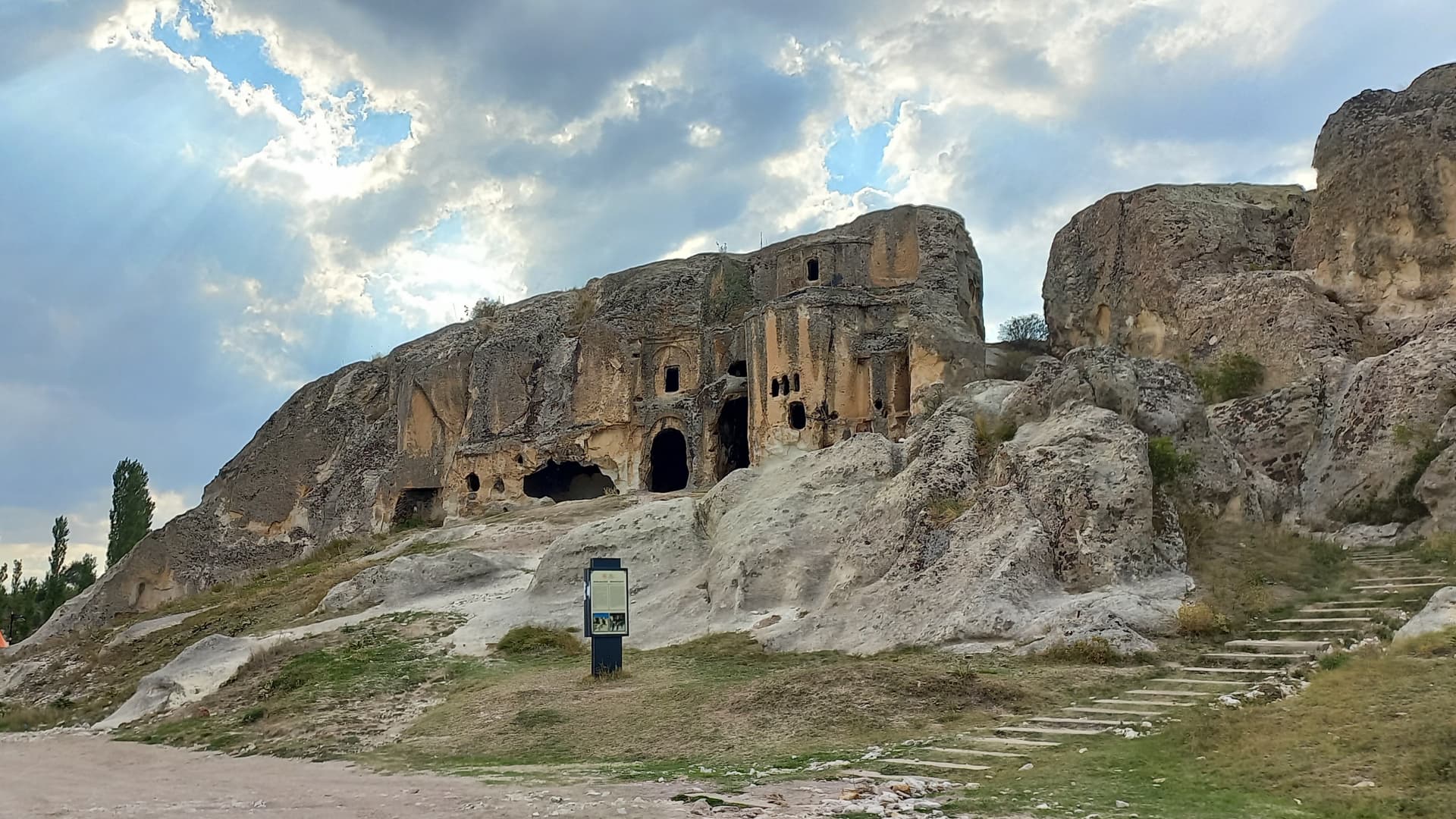
Image of Avdalaz Castle. Image source
Visit essentials
A quick read before you go
- Duration
- 1–2 hours for the fortress alone; allow a half to full day to combine with the Byzantine…
- Access
- Located approximately 1.5 km north of Ayazini village, İhsaniye district, Afyonkarahisar…
Overview
The Phrygians revealed rather than constructed Avdalaz, carving rooms, passages, stairs, and cisterns from volcanic tuff in western Anatolia's sacred hills. They understood rock not as raw material but as divine address: Kybele, mother goddess of fertility and abundance, dwelt within stone, making each chamber both shelter and devotion. The fortress rises in interconnected storeys above a cliff-walled approach valley 1.5 kilometres north of Ayazini.
Rock-face stairs link multiple floors; a rectangular stepped cistern collects water at the upper entrance, burial chambers hold the dead beside the living below, and loopholes face the valley in a vertical, internal, geological plan. Romans and Byzantines later adapted the complex. Early Christians seeking refuge during suppression found physical safety in a landscape already sacred.
Ayazini's nearby rock-cut church, shaped with equal care from the same stone, shows a changed theology but continuing conviction that these rocks deserved habitation and sanctification. Today the long-distance Phrygian Way connects Avdalaz with the valley's major monuments; the narrowing approach still lets the fortress reveal itself suddenly through openings in the rock face.
Why this place is sacred
Phrygian sacred geography was not organized around temples and altars in the Greek sense. The divine inhabited the landscape directly — and the landscape here was volcanic tuff, soft enough to carve yet permanent enough to endure. Kybele was the rock. To quarry chambers from a hillside was to enter her body; to shelter within was to inhabit the sacred.
The Phrygian Valley developed as one of the great sacred terrains of Anatolia precisely because its geology supported this theology. Avdalaz, rising above a narrow approach valley, is one expression of it — a fortress whose rooms and passages are also, in the Phrygian imagination, inhabited by the divine presence encoded in stone. The cisterns, the burial chambers, the loopholes opening onto sky — all participate in a sacred architectural vocabulary that runs throughout the valley.
When Byzantine Christians sought refuge in these same hills, they did not erase this sacred character. The place name Ayazini derives from Byzantine Greek 'hagios' — holy, sanctified, saintly. The word they chose to describe these rock formations was the same word applied to saints and sacred sites. The holiness perceived was continuous even where the theology changed.
The rock-cut church carved nearby during the Byzantine period is evidence not of Christianity replacing Phrygian religion but of Christianity absorbing an existing sacred topography.
Defensive fortress and multi-story residential complex; carved from volcanic tuff by the Phrygians from approximately the 8th century BCE. The surrounding landscape served the broader Phrygian cult of Kybele.
From Phrygian fortified settlement to Roman reuse, then Byzantine Christian refuge and eventually abandoned monument. The site's modern life is as a hiking and heritage destination on the Phrygian Way.
Experience and orientation
Walk toward Avdalaz from Ayazini village along the cliff-walled valley path. The walls close in. The stone above you is the same volcanic tuff that becomes, further along, the fortress itself — you are already inside the approach. When the carved openings appear in the rock face, they appear suddenly, at different heights, as if the hill has eyes.
The stairs carved into the face are steep and worn smooth. Take them carefully; the Phrygians who cut them were not building for casual visitors. Inside, allow your eyes to adjust. The rooms chain together — you move from one to the next through openings cut to a human scale, never quite comfortable for someone not accustomed to this architecture.
The mezzanine spaces, the storage niches, the loopholes opening onto the valley below: this is domestic and military simultaneously, the logic of people who lived inside their fortifications and organized their lives around the rock's possibilities.
At the upper level, the stepped cistern is worth pausing at. It is a practical object — water collection was survival — but it is also carved with the same precision as everything else here, because precision was what volcanic tuff invited and what the Phrygians delivered. Look out from the upper openings over the valley and surrounding agricultural plain. The view is wide. The position was chosen for a reason.
Burial chambers occupy the lower level. This vertical organization of the fortress — cistern at the top, burials at the base — is not accidental. The Phrygians built their relationship to life and death into the architecture's elevation.
Approach from Ayazini village via the valley path to the northwest. The cliff-walled valley path is also accessible from the eastern village road. Wear sturdy footwear; the carved stairs are steep and uneven. Allow at least an hour at the fortress alone, more if combining with the Byzantine rock-cut church and tombs at Ayazini village.
Context and lineage
The Phrygians established their presence in this region during the Iron Age, from approximately the 8th century BCE, though the broader landscape shows signs of human occupation extending back some 6,000 years. The fortress at Avdalaz was carved from volcanic tuff — the same soft, workable stone that defines the Phrygian Valley's sacred topography.
Romans and Byzantines subsequently adapted the existing structures rather than building anew, inheriting both the physical form and, in the Byzantine case, the sense of sanctity the valley carried.
The modern village name Ayazini, derived from Byzantine Greek 'hagios' (holy), reflects the Christianization of a settlement that had long been regarded as sacred. The village today preserves both the Avdalaz fortress to the north and a finely carved Byzantine rock-cut church at its center, each representing a distinct layer of the same deep occupation.
Phrygian (c. 8th century BCE) → Roman → Byzantine Christian (active as 'Metropolis', settlement name during Byzantine period) → Seljuk and Ottoman periods (largely abandoned) → Modern heritage site on the Phrygian Way
Traditions and practice
The Phrygians used the rock mass as a defensive and residential complex, with carved cisterns, storage niches, and burial chambers integrated into the same structure. The broader Phrygian Valley included Kybele veneration at carved rock façades and niches; Avdalaz participated in this sacred geography as a fortified high place. During the Byzantine period, the valley served as a refuge for early Christians, who carved a church from the same volcanic tuff at nearby Ayazini.
Heritage tourism and hiking on the Phrygian Way long-distance trail. An annual tourism festival is held in Ayazini village.
Begin the approach from the village through the cliff-walled valley path rather than the eastern road — the gradual narrowing of the walls primes the encounter. At the fortress entrance, pause before climbing. Notice the scale of the carved openings relative to your own body. Inside the chambers, move slowly between rooms; the chain-room architecture reveals itself step by step, not all at once. At the stepped cistern, consider what it would mean to depend on rain collected here.
At the burial level, sit for a moment. The combination of domestic, military, and funerary functions in one continuous rock mass is the site's central statement: for the Phrygians, these were not separate categories of life.
If conditions allow, return as the light shifts — the carved openings change quality dramatically between morning and afternoon sun.
Phrygian
HistoricalThe Phrygians used this volcanic tuff mass as a multi-story fortress and settlement from approximately the 8th century BCE. The broader landscape was sacred to Kybele, the mother goddess believed to inhabit the living rock, making every carved chamber here an act of settlement within the divine.
Defensive fortification, rock-cut habitation, water collection in carved cisterns, food storage, burial in rock-cut chambers at the base level.
Byzantine Christian
HistoricalDuring periods of early Christian suppression, the carved rock structures of Ayazini — renamed Metropolis in Byzantine sources — provided refuge. A church carved entirely from rock survives nearby. The place name Ayazini (from 'hagios', holy) reflects Christian sanctification of a pre-existing sacred landscape.
Christian worship in rock-cut church; monastic habitation; use of carved chambers as dwellings during periods of refuge.
Archaeological/Scholarly
ActiveAvdalaz is a documented heritage monument within the Phrygian Valley, a region on Turkey's UNESCO Tentative List. It is studied as part of the multi-period sacred landscape of western Anatolia and represents one of the best-preserved multi-story rock-cut fortresses in the region.
Archaeological documentation, conservation, guided heritage tourism as part of the Phrygian Way trail network.
Perspectives and open questions
Avdalaz Castle sits at the convergence of several interpretive traditions: Phrygian sacred geography, Byzantine Christian refuge history, and the modern project of documenting and protecting the Phrygian Valley's archaeological landscape.
Scholarly perspective
Archaeologists and historians situate Avdalaz within the wider Phrygian Valley rock-cut settlement tradition, interpreting it as a multi-period defensive and residential complex primarily of Phrygian origin. The broader Phrygian Valley — on Turkey's UNESCO Tentative List as 'Mountainous Phrygia' (2022) — is understood as a sacred terrain organized around the cult of Kybele, whose theological premise (the goddess inhabiting volcanic rock) gave the entire landscape religious significance. Avdalaz is one node in this network rather than an isolated monument.
Living and traditional perspectives
No living community maintains a direct ritual connection to Avdalaz. The Phrygian religious tradition that gave the site its original sacred meaning ended in antiquity. The Byzantine name Ayazini ('holy') preserves the area's sacred character in etymology if not in practice.
Alternative interpretations
The Phrygian Valley, including Avdalaz and the surrounding rock monuments, features in esoteric and neo-pagan traditions as one of the great sacred landscapes of Anatolia — a terrain where the mystery cults of the ancient world, centered on the Earth Mother, were at their most architecturally expressive. Some visitors approach Avdalaz within this framework, treating the valley as a living landscape of goddess energy.
Open questions
The full extent of the fortress's carved chambers has not been systematically documented. The precise relationship between Avdalaz and the adjacent Ayazini settlement — whether the fortress served primarily military, administrative, or ritual functions — remains partially understood. Individual chambers have not been precisely dated.
Plan your visit
Access and arrival
Located approximately 1.5 km north of Ayazini village, İhsaniye district, Afyonkarahisar Province. The village is reached via highway D.665 (Afyonkarahisar–Eskişehir), approximately 27 km north of Afyonkarahisar. The cliff-walled valley path to the fortress begins at the village's northern edge. On the Phrygian Way long-distance hiking trail. A vehicle is needed to reach Ayazini; mobile signal may be limited in the valley. Check local conditions with the İhsaniye district municipality or the Afyonkarahisar Museum before visiting.
No accommodations at the site. Afyonkarahisar city (approximately 27 km south) offers the nearest range of hotels. Simple guesthouses may be available in İhsaniye or nearby villages; check locally.
Respectful visit
No specific dress requirements. Practical hiking clothing is appropriate; sturdy footwear is strongly recommended for steep carved stairs.
Permitted throughout the site.
Not applicable.
Do not damage or inscribe rock surfaces. Some chambers may be unsafe due to structural fragility — exercise caution before entering. Stay clear of any areas marked as closed.
Some carved chambers may be structurally fragile; enter with caution and test footing before weight-bearing. The stairs are steep and have no railings. Do not add graffiti or inscribe rock surfaces.
Location
Map loads as you approach this section.
Pilgrim reflections
A portrait of encounter, not a score
Pilgrims describe what they felt, how present they could become, and whether the place would shape a journey. There are no stars and no ranking of traditions.
No reviewed reflections yet
The first pilgrims can help describe the character of being here.
Share a reflection
Available after an account-backed “Been there.” Every reflection is reviewed before publication.
Nearby sacred places
Explore other sacred places in the region. Proximity does not establish access or travel time; check each place’s guidance.


References
Sources consulted for this page. Source categories describe the publication, not a guarantee that every claim is verified. Traditional accounts and outside interpretations may differ.
- 01Avdalaz Kalesi - Vici.org — Vici.org contributorsacademicArchaeological heritage database entry with coordinates
- 02Ayazini | Turkish Archaeological News — Turkish Archaeological NewsacademicArchaeological news and site documentation
- 03Ayazini, İhsaniye - Wikipedia — Wikipedia contributorsencyclopediaMain encyclopedic overview of the settlement and its history
- 04Rock-Cut Church and Cave Settlement of Ayazini — The Art of WayfaringguideDetailed travel-focused account of the settlement including Avdalaz
- 05The Phrygian Valley | The Art of Wayfaring — The Art of WayfaringguideRegional context for Phrygian sacred landscape
- 06Türkiye's Phrygian Valley: Time capsule of civilizations, mythology — Daily SabahSource contextCultural overview of Phrygian religious significance
- 07Avdalaz Castle Phrygian Valley - Visitor Reviews — SafarwayguideVisitor information and reviews
Share a photo
Help visitors recognize Avdalaz Castle. Every submission is reviewed before publication.