Aslantaş–Yılantaş
Twin Phrygian tombs rising from a valley of the dead — lion-guarded thresholds at the edge of the ancient world
Understand sacred places, explore living traditions, and learn how to engage respectfully with Pilgrim Map.
Access has not been verified. Check current local guidance before planning a visit.
Afyonkarahisar, Turkey
Read the sources
Visit essentials
A quick read before you go
- Duration
- Allow 1–2 hours for the Göynüş Valley monuments themselves.
- Access
- Located approximately 1.5 km west of the D-665 highway (Afyonkarahisar–Eskişehir road), near…
Overview
Phrygians made Göynüş Valley in modern Afyonkarahisar Province a living-dead threshold. More than forty tombs cut into volcanic tuff walls and floor form the largest known Phrygian necropolis. Its greatest monuments, Aslantaş (Lion Stone) and Yılantaş (Snake Stone), are living-rock tombs bearing lions sacred to Cybele, the Great Mother of Phrygian sacred geography.
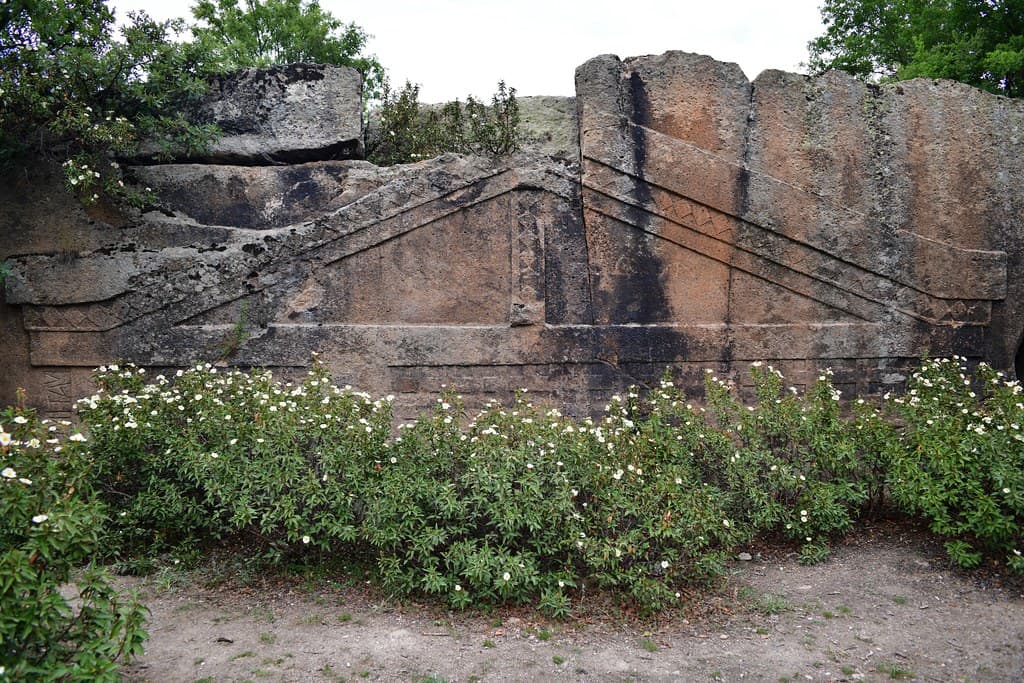
Late-eighth- or early-seventh-century BC Aslantaş is an eleven-meter tuff cube with triangular roof, small chamber, and two crisp rampant façade lions; a basal niche may have held Cybele's image. Yılantaş was originally somewhat larger but partly destroyed, perhaps by earthquake. Its intact lion head and remnants allow partial reconstruction of carvings that included snakes.
Beyond burial, both placed the dead under the wild-nature goddess's protection and made the valley a convergence of divine/human and living/ancestral worlds.
Why this place is sacred
The Göynüş Valley's sacredness was not built from a single monument or event. It accumulated. Over the eighth and seventh centuries BC, the Phrygian aristocracy chose this specific valley — its volcanic geology, its geological enclosure, its quality of light and shadow — as the appropriate terrain for their dead. More than forty tombs, ranging from simple chambers to elaborately carved facades, form a necropolis whose density makes the valley itself feel like a different kind of space.
Aslantaş and Yılantaş sit within this larger sacred geography, but they exceed it in scale and in the directness of their symbolism. The rampant lions on Aslantaş's façade are not decorative — they are the primary symbolic statement. In Phrygian sacred language, lions flanked Cybele because they were her power expressed in animal form: sovereignty over the wild, protection of the dead, the authority that makes predators pause.
A tomb guarded by lions is a tomb under the goddess's personal protection. The niche at the monument's base — which may have held a cult image — suggests that this was also a place of living worship, not only post-mortem commemoration. People came here while alive to make offerings to the dead and, through the dead, to the goddess whose lions kept the valley.
The volcanic tuff geology adds its own dimension: this stone was formed by ancient eruption, shaped by forces that operated long before human habitation. The Phrygians worked it because it was workable, but they worked it into forms that claimed the landscape's authority — the lions rising from rock that is itself a kind of frozen energy.
Aristocratic Phrygian funerary monuments serving as tombs, markers of dynastic prestige, and possibly active sites of goddess veneration through the lion imagery and the niche for a cult image at the base of Aslantaş.
After the collapse of Phrygian political authority in the late seventh century BC, the valley likely retained local significance. The monuments survived because they were too large to quarry easily, and the valley too remote for intensive subsequent development. The site is now under conservation study as part of the Phrygian Valley cultural heritage zone.
Experience and orientation
The approach to Aslantaş is important. The valley floor is open, and the monument announces itself from several hundred meters away — a geometric interruption in a landscape of natural curves. As you get closer, the carved detail clarifies: the triangular gabled roof, the flat front face, the two lions rearing on their hind legs with their forepaws raised, carved in a style that holds something of Hittite influence.
At the base, the small entrance to the interior chamber is low — designed for the dead, not the living. The interior is dark and simple: a flat-ceilinged chamber barely large enough to stand in, carved directly from the rock. Return outside and stand at the base of the niche. The carving here is less dramatic, more intimate. If this held a cult image, worshippers would have stood where you are standing.
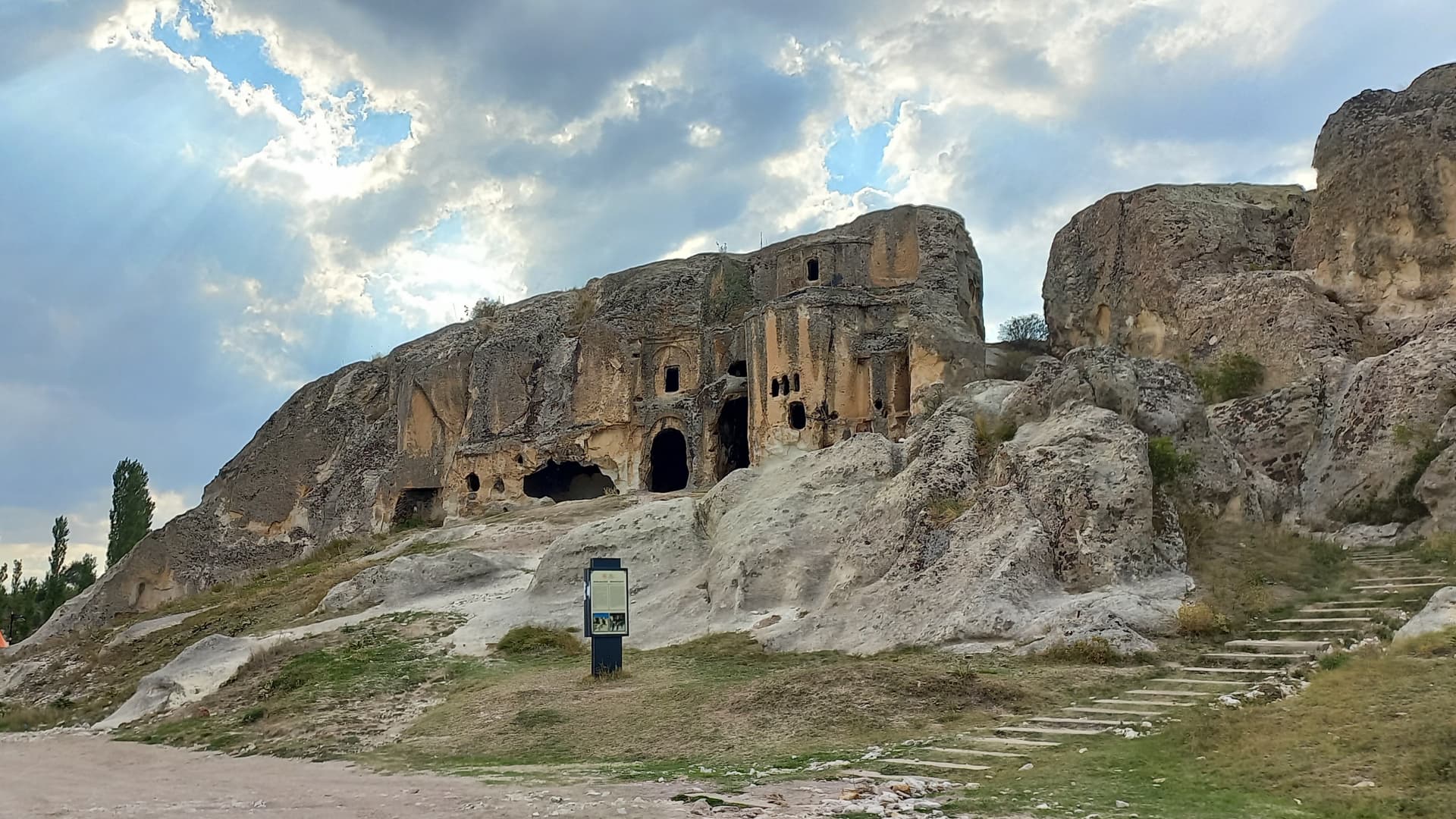
The scale of the monument above — eleven meters of carved stone — would have been behind the offering, not facing it. Walk south approximately 750 meters to Yılantaş. The contrast is significant: Yılantaş is larger in its original conception but now partly collapsed, its former extent implied by the surviving lion head and the scattered tuff blocks around it. The sense of ruin here is different from Aslantaş's completeness. One monument survived; the other did not.
The valley held both.
Approach from the D-665 highway turnoff near Kayıhan village, approximately 11 km east of İhsaniye. A dirt track leads approximately 1.5 km to the valley. Aslantaş is visible from the approach. Yılantaş is approximately 750 meters south of Aslantaş along the valley floor.
Context and lineage
No specific founding myth or dedicatory inscription survives for either monument. Their placement within the Göynüş Valley — the Phrygian necropolis of greatest density and extent — suggests they were built for persons of high political or religious standing, possibly ruling families from a nearby Phrygian settlement. The valley's name, Göynüş, is modern Turkish; its ancient Phrygian name is unknown.
The lion imagery on both monuments connects them to the broader Phrygian sacred tradition centered on Cybele, whose primary animal was the lion. Whether the persons buried here were themselves priests of the goddess, nobility who claimed her protection, or both, cannot be determined from the physical evidence alone. Aslantaş has been dated to the late eighth or early seventh century BC on architectural grounds — Hittite-influenced features appear in the molding style.
Yılantaş appears to have been somewhat later and larger, its snake imagery giving it a name that distinguished it from its neighbor in later memory even as the original Phrygian names were lost.
Phrygian aristocratic funerary tradition (8th–7th c. BC) → post-Phrygian abandonment → rediscovery by Western scholarship (19th c.) → conservation study and heritage designation (20th–21st c.)
Unknown Phrygian noble(s)
Original occupants of the tomb chambers; identity entirely unknown, status inferred from the monumental scale of the architecture
W. M. Ramsay
British archaeologist who conducted the earliest Western documentation of the Phrygian Valley monuments in the late nineteenth century, establishing the scholarly framework for their study
E. Haspels
Dutch scholar whose comprehensive twentieth-century survey of Phrygian monuments remains a foundational reference for understanding these sites in context
Traditions and practice
The Phrygian funerary tradition involved the preparation and entombment of noble dead in these elaborately carved chambers, accompanied by objects and possibly by ritual acts at the façade. The niche at the base of Aslantaş, and comparable niches at other Phrygian monuments, suggests an ongoing practice of offering-making after burial — worshippers returning to maintain a relationship with the ancestral dead and, through the lion imagery, with Cybele herself.
Whether libations were poured, food deposited, or some other form of offering was made cannot be reconstructed from the physical evidence; basin carvings at related Phrygian sites suggest liquid offerings were common.
No religious practices are observed at the site. The area is part of the broader Phrygian Valley cultural heritage zone, and the Phrygian Way long-distance hiking trail passes through the valley.
Stand before Aslantaş at a distance first — fifty meters or more — and take in the complete form before approaching. The relationship between the triangular roof, the flat-faced body, and the two lions is clearest at this distance. Then approach slowly and let the scale shift. At the base of the monument, find the small entrance to the chamber and look in without entering — the contrast between the exterior drama and the interior simplicity is striking.
Spend time with the lion reliefs themselves: notice the quality of the carving, the stylized musculature, the way the paws are raised — not in aggression but in a kind of permanent gesture of protection.
Then walk south to Yılantaş and spend equivalent time with the surviving lion head and the scattered blocks — reading the original monument through its ruin requires more imagination, but the exercise of imagining a complete monument from fragments is itself a form of encounter with Phrygian space.
Phrygian Funerary and Ancestral Veneration
HistoricalThe Göynüş Valley was the Phrygians' most important funerary landscape. Aslantaş and Yılantaş are its most monumental expressions — aristocratic tombs whose lion imagery placed the dead under the protection of Cybele.
Rock-cut tomb construction for noble dead; possible ongoing offerings at tomb facades; the lion imagery suggests the goddess was invoked both in burial rites and in subsequent ancestral veneration
Archaeological Heritage
ActiveThe Phrygian Valley, including these monuments, is under conservation study and is part of Turkey's UNESCO Tentative List as 'Mountainous Phrygia.' Academic stone deterioration studies document ongoing conservation concerns for the volcanic tuff carvings.
Archaeological survey; conservation monitoring; cultural heritage management; Phrygian Way trail designation
Perspectives and open questions
Aslantaş and Yılantaş have been interpreted as tombs, as goddess shrines, as political statements of Phrygian aristocratic power, and as evidence of the deep connection between lion symbolism and the concept of divine protection over death.
Scholarly perspective
Academic consensus places these monuments firmly in the Phrygian aristocratic funerary tradition of the eighth and seventh centuries BC, noting Hittite architectural influences in the molding and roof treatment of Aslantaş. The lion imagery is understood as both apotropaic — warding off harm from the dead — and theologically connected to Cybele, whose sacred animals were lions.
The Göynüş Valley necropolis, with its forty-plus tombs, is recognized as the largest Phrygian cemetery known; Aslantaş and Yılantaş are its most monumental expressions. The possible dual function as funerary monument and goddess shrine (suggested by the base niche) is debated: the evidence is suggestive rather than conclusive.
Living and traditional perspectives
No surviving Phrygian text describes these monuments directly. In the broader Phrygian religious tradition, the lion was not merely a heraldic animal but a living extension of Cybele's authority — her companions, her guardians, the animals that ran beside her chariot. Placing lions on a tomb was placing the tomb under her direct protection. The dead, in this understanding, were not abandoned to some impersonal afterlife but handed to the goddess whose lions kept the valley.
Alternative interpretations
Some researchers interpret the concentrated density of lion-monument tombs in the Göynüş Valley as evidence that this was an outdoor temple complex rather than merely a necropolis — a landscape where the dead were understood to dwell in the continuing presence of Cybele, making the valley itself a kind of permanent sanctuary. This reading blurs the distinction between funerary space and sacred space in a way that may be more true to Phrygian cosmology than the modern archaeological categories allow.
Open questions
The identity of the individuals buried in these tombs is entirely unknown. The original extent of Yılantaş's carvings before its collapse — including the snake imagery that gave it its name — cannot be fully reconstructed. Whether the valley served any living cult function beyond ancestral veneration, and whether seasonal festivals were held here, remains an open question.
Plan your visit
Access and arrival
Located approximately 1.5 km west of the D-665 highway (Afyonkarahisar–Eskişehir road), near Kayıhan village. İhsaniye town is 11 km west; Afyonkarahisar city is approximately 30 km south. No entrance fee. The approach track from D-665 is navigable by car in dry conditions but may require a high-clearance vehicle in wet weather. Mobile signal may be unreliable in the valley — note the approach route before leaving the highway. The nearest reliable services are in İhsaniye.
No accommodation near the site. İhsaniye (11 km west) has basic options. Afyonkarahisar (30 km south) offers a full range of accommodation and is the most practical base for visiting multiple Phrygian Valley sites.
Respectful visit
No requirements. Practical outdoor clothing and sturdy footwear for uneven valley terrain.
Freely permitted throughout the site.
Not an established current practice. The ancient niche may draw visitors inclined to leave something — resist the impulse, as any disturbance of the monument affects its preservation.
Do not touch or lean against the carved surfaces — the volcanic tuff is susceptible to damage. Do not climb the monuments. Do not remove any stone material, however small.
The volcanic tuff is fragile — do not touch or lean against the carved surfaces. The valley is exposed; carry water and sun protection. The approach track from D-665 may require a high-clearance vehicle in wet conditions.
Location
Map loads as you approach this section.
Pilgrim reflections
A portrait of encounter, not a score
Pilgrims describe what they felt, how present they could become, and whether the place would shape a journey. There are no stars and no ranking of traditions.
No reviewed reflections yet
The first pilgrims can help describe the character of being here.
Share a reflection
Available after an account-backed “Been there.” Every reflection is reviewed before publication.
Nearby sacred places
Explore other sacred places in the region. Proximity does not establish access or travel time; check each place’s guidance.


References
Sources consulted for this page. Source categories describe the publication, not a guarantee that every claim is verified. Traditional accounts and outside interpretations may differ.
- 01Aslantaş-Yılantaş - Wikipedia — Wikipedia contributorsencyclopediaCore factual overview with location details
- 02Göynüş Valley, Aslantaş and Yılantaş — Turkish Archaeological NewsacademicDetailed description of monuments and valley significance
- 03Göynüş (former Köhnüş) Valley - Phrygian Monuments — PhrygianMonuments.comacademicSpecialist Phrygian monuments database
- 04Analysis of Stone Deterioration Types Observed on Phrygian Valley Monuments — ResearchGateacademicAcademic study on conservation concerns for these monuments
- 05Aslantaş and Yılantaş - Cultural Inventory — Kulturenvanteri.comofficialTurkish cultural inventory listing
- 06The Lion- and the Snake stone in Phrygian Valley — Alaturka.infoguideTourist guide with good descriptions
- 07The Phrygian Valley — Art of WayfaringguideVisitor's guide with broader Phrygian Valley context
- 08Aslantaş-Yılantaş Ören Yeri Map — MapcartaSource contextCoordinates source: 39.048°N, 30.523°E
Share a photo
Help visitors recognize Aslantaş–Yılantaş. Every submission is reviewed before publication.