Maltaş
A Phrygian temple that descends nine meters into the earth — and an inscription that says it was made for the Mother Goddess
Understand sacred places, explore living traditions, and learn how to engage respectfully with Pilgrim Map.
Access has not been verified. Check current local guidance before planning a visit.
Afyonkarahisar, Turkey
Read the sources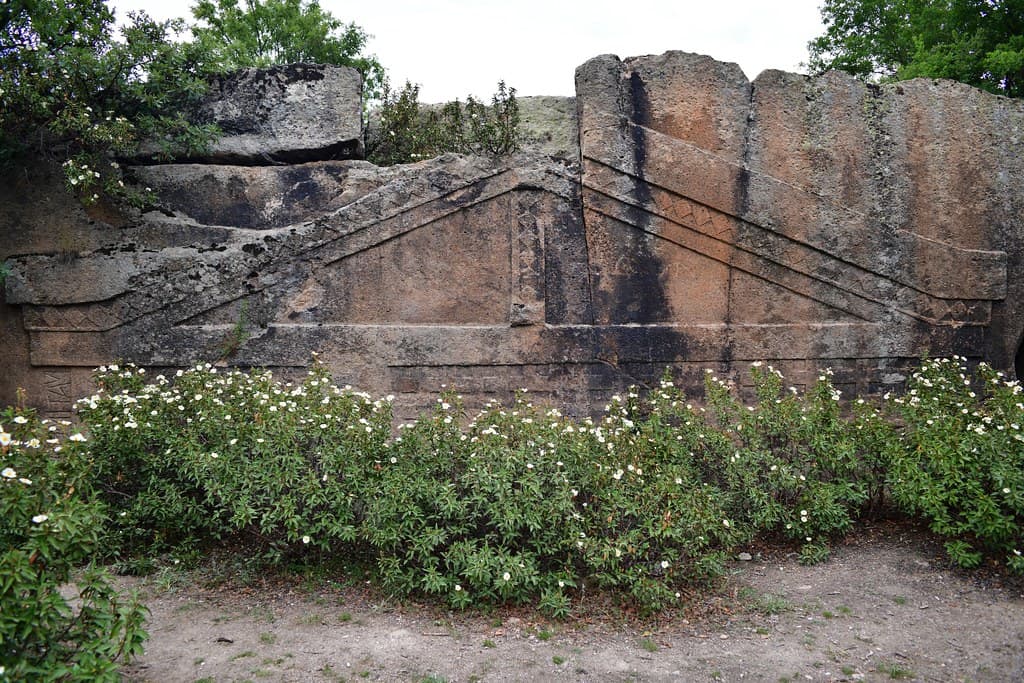
Image of Maltaş. Image source
Visit essentials
A quick read before you go
- Duration
- 30–60 minutes at the monument itself.
- Access
- Located in Göynüş Valley, İhsaniye district, Afyonkarahisar Province, approximately 750 meters…
Overview
At the surface, Maltaş is a modest carved rock facade on the Akkuşyuvası heights, with roughly three meters visible above ground—less imposing than nearby lion-monuments and less dramatic in relief than Arslankaya or Midas City. Its triangular gabled roof, central niche, and geometric frame belong to Phrygian sacred vocabulary, but scholars documented it for decades without understanding what lay beneath.
Four excavations—Albert Gabriel in 1936, C.H.E. Haspels in 1950, C. Brixhe in 1970, and the Turkish Ministry of Culture in 2021—were obstructed by groundwater. The 2021 rescue excavation first penetrated seven meters underground and reclassified the monument: not a shaft tomb or simple rock face, but a temple complex whose sacred axis descends through nine meters of carved volcanic tuff to the water table. An underground-niche inscription says in Phrygian that it was '…made for the Mother-Goddess.'
Maltaş is not funerary; it is a prayer going down.
Why this place is sacred
The Phrygian understanding of Cybele placed her within the earth rather than above it. She was the mountain, the fertile valley, the dark soil, the water that moved through underground channels. Other goddess traditions built temples as houses on the surface of the earth; the Phrygians built one that went through the surface and kept going. The nine-meter shaft at Maltaş represents this theology made physical.
At the point where earlier excavators stopped — the groundwater level — the monument reaches what may have been understood as the goddess's most intimate domain: the place where stone gives way to water, where the solid world becomes liquid, where boundaries dissolve. The inscription's formulation — '…made for the Mother-Goddess…' — suggests a dedicatory act: someone caused this to be built as an act of offering.
Not a temple where offerings were brought, but a structure that was itself the offering: a permanent architectural conduit between the human world above and the goddess's world below. The Göynüş Valley context deepens this. Maltaş sits within the same necropolis that holds Aslantaş, Yılantaş, and dozens of other tombs. The dead are already here, in the ground.
A temple whose axis descends toward groundwater, in a valley full of noble dead, in the landscape of a goddess whose symbols are the earth and the mountain: the layering is intentional. This was a place where the membrane between worlds was understood to be structurally thin.
Phrygian temple complex dedicated to Cybele (the Mother Goddess), with a sacred shaft descending nine meters to groundwater — functioning as a permanent conduit between the surface world and the underground domain of the earth goddess.
Classified as a shaft monument of uncertain function from its first modern documentation by W.M. Ramsay in 1881. Multiple excavation attempts stopped at groundwater. The 2021 rescue excavation reached seven meters underground and discovered the inscribed dedication, fundamentally revising the monument's classification from ambiguous shaft to active temple complex.
Experience and orientation
Walk approximately 750 meters south from Aslantaş along the Göynüş Valley floor. Maltaş will appear on the Akkuşyuvası rock heights to your right — carved stone rising from the plateau edge, visible but not immediately dramatic. The façade is recognizably Phrygian: the triangular gabled roof, the central niche, the geometric frame. But the above-ground portion is only three meters of a nine-meter monument. Most of what makes Maltaş significant is invisible from the surface.
The 2021 excavation left the underground sections partially exposed but may have protective fencing around the excavation area. Do not attempt to enter the shaft. Instead, stand before the façade and consider the specific act of theological imagination that this monument represents. The niche at surface level was the visible address of the goddess — the face she presented to worshippers approaching from above.
The shaft below was something else: a permanent downward prayer, an architectural descent toward the water table, a conduit designed to remain open indefinitely. The monument was not built so that a priest could descend into it annually. It was built so that the connection between the surface world and the underground world would be maintained by the stone itself, continuously, without human mediation. Stand at the niche for a while before moving on.
The surrounding Göynüş Valley — the other tombs visible on the valley walls, the open plateau sky above — makes the vertical axis of this monument more apparent. Everything else in the necropolis is horizontal: chambers cut into the cliff face, facades facing outward across the valley floor. Only Maltaş goes down.
Located on the Akkuşyuvası heights approximately 750 meters south of Aslantaş within the Göynüş Valley. Accessible from the same approach route via the D-665 highway near Kayıhan village. The excavation area may be fenced — observe from a respectful distance.
Context and lineage
Maltaş was built in the seventh century BC and dedicated to the Mother Goddess by a person or community whose identity is not recorded in the surviving inscription. W.M. Ramsay first described the monument's visible facade in 1881, noting its temple-like character. His interpretation was essentially correct but unconfirmed for over a century. Albert Gabriel excavated in 1936, stopping when he reached groundwater at around five meters; C.H.E. Haspels excavated again in 1950 with the same result; C.
Brixhe in 1970 also stopped at the water level. Each excavation contributed to the record without resolving the fundamental question of what the shaft was for. The 2021 Turkish Ministry of Culture rescue excavation changed everything. Penetrating to seven meters, the team found an inscribed underground niche with a Phrygian text identifying the monument as having been made for the Mother Goddess — confirming both its sacred function and its Cybele dedication.
The full depth of the shaft, which reaches nine meters, has not yet been fully excavated. The deepest portions remain below the current water table.
Phrygian (7th c. BC) → post-Phrygian abandonment → first modern documentation (Ramsay, 1881) → four successive excavations (1936, 1950, 1970, 2021) → reclassification as temple complex (2021) → Phrygian Way heritage designation
Unknown Phrygian dedicant
The person who commissioned the monument's construction and whose dedication to the Mother Goddess is recorded in the underground inscription — identity unknown
W. M. Ramsay
First described the monument in 1881 and correctly identified its temple-facade character, though the underground sections were unknown at that time
Albert Gabriel
Conducted the first excavation in 1936, reaching approximately five meters before being stopped by groundwater
C.H.E. Haspels
Excavated in 1950, again stopped by groundwater; contributed to the typological record of Phrygian shaft monuments
C. Brixhe
Excavated in 1970, the third attempt to penetrate the shaft; also stopped at the water level
Turkish Ministry of Culture rescue excavation team (2021)
Conducted the rescue excavation that first reached the underground inscription and fundamentally revised the monument's classification from ambiguous shaft to temple complex
Traditions and practice
The dedicatory inscription's formulation — the monument made for the Mother Goddess — suggests that the shaft itself was the primary offering, not a container for secondary offerings. This distinguishes Maltaş from votive shrines where worshippers brought objects: here, the architectural act of construction was the devotional act.
Secondary practices likely included offerings placed in the above-ground niche and possibly liquid libations channeled into the shaft — a practice that would complete the vertical logic of the monument, sending liquid offerings downward toward the groundwater where the goddess's underground domain was understood to begin.
The monument's location within the Göynüş Valley necropolis suggests it may also have functioned in the context of ancestral veneration, connecting the surface cult of the dead with the underground domain of the earth goddess.
No religious practices are observed at the site. The excavation area may have protective fencing. The monument is accessible to visitors as part of the Phrygian Valley heritage landscape.
Approach Maltaş as the second monument in a Göynüş Valley sequence, after spending time at Aslantaş to the north. This pairing is important: Aslantaş presents itself fully above ground — a complete statement in stone. Maltaş is the inverse. Stand before the facade and let the proportion register: three meters visible, nine meters deep. Then spend time with the niche. At Aslantaş, the niche may have held a cult image that was addressed from outside.
At Maltaş, the deepest address was made underground, in an inscribed chamber that no worshipper could easily access. The monument's logic is not about access — it is about permanence. The shaft was designed to remain open forever, maintaining a connection that human presence was not required to sustain.
If you are visiting the Göynüş Valley as a full sequence — starting at Arslankaya, moving through Aslantaş, arriving at Maltaş — this vertical quality at the sequence's end becomes a structural point about Phrygian sacred architecture overall: it oriented toward depth, not height.
Phrygian Cybele / Mother Goddess Cult
HistoricalMaltaş is confirmed by its own inscription as a temple made for the Mother Goddess — an active sacred site where the Phrygian earth goddess was addressed through a permanent architectural descent toward the underground domain she was understood to inhabit.
Dedicatory construction as devotional act; possible liquid libations channeled into the shaft; offerings at the surface niche; possibly integrated into seasonal cult observances tied to the agricultural cycle
Archaeological Heritage
ActiveThe 2021 excavation established Maltaş as the deepest known Phrygian shaft monument and confirmed its temple function, requiring a fundamental revision of Phrygian sacred architecture typology. The site is under ongoing scholarly and conservation attention.
Rescue excavation; ongoing academic study and publication; conservation management within the Phrygian Valley heritage zone
Perspectives and open questions
Maltaş was misunderstood for nearly a century — classified, debated, and excavated without resolution. The 2021 discovery refocused the scholarly conversation on the specific theology it represents: the idea that sacred connection with the earth goddess required architectural descent, not merely surface veneration.
Scholarly perspective
The 2021 rescue excavation fundamentally revised the monument's typological classification. Before 2021, Maltaş was grouped with Phrygian shaft monuments — a category that included potential tombs and features of ambiguous function. The discovery of the inscribed dedication to the Mother Goddess in the underground niche resolves the function question and requires a reevaluation of the monument's place within Phrygian sacred architecture typology.
The nine-meter depth — the deepest shaft monument known in the Phrygian corpus — is now understood as theologically intentional, not merely as a technical feature. The question of whether additional chambers or inscriptions exist below the 2021 excavation depth remains open.
Living and traditional perspectives
In Phrygian cosmology, Cybele governed the earth's interior — the roots of mountains, the underground channels of water, the fertility that rose from soil. A permanent shaft descending toward groundwater was not merely a symbolic gesture but a literal architectural approach to her domain. The inscribed dedication in the underground niche was not placed there to be read by human worshippers but to be present for the goddess herself — an offering made in her own house.
Alternative interpretations
The shaft has been interpreted by some researchers as a form of oracular or divination device — a well-shaft into which questions might be posed to the earth goddess, with responses perhaps received through changes in the water level, sounds from below, or the behavior of flames or incense smoke lowered into the shaft. This reading is speculative but not incompatible with the broader Mediterranean tradition of chthonic oracle sites.
Open questions
The full depth and nature of the shaft's terminus remains unexcavated. Whether additional chambers or inscriptions lie below the 2021 excavation level is unknown. The identity of the person or community who dedicated the monument has not been established. The complete Phrygian text of the underground inscription has not been published in full in accessible sources.
Plan your visit
Access and arrival
Located in Göynüş Valley, İhsaniye district, Afyonkarahisar Province, approximately 750 meters south of Aslantaş on the Akkuşyuvası heights. Access via the same D-665 highway approach near Kayıhan village. No entrance fee or formal visitor facilities. Mobile signal is unreliable in the valley — plan your route from İhsaniye. The nearest services are in İhsaniye (approximately 11 km west).
No accommodation near the site. İhsaniye (11 km west) has basic options. Afyonkarahisar (approx. 30 km south) is the recommended base for exploring multiple Phrygian Valley sites.
Respectful visit
No requirements. Practical outdoor clothing for walking the valley terrain.
Photography permitted. The facade is best photographed in the morning or late afternoon light when the carved gable casts shadow that clarifies the forms.
Not an established current practice.
Do not enter or disturb any fencing around the excavation area. Do not touch the carved stone surfaces. Do not attempt to access the shaft.
Do not approach or enter any excavation barriers at the shaft opening. Do not attempt to descend into the monument. The shaft reaches the water table and is both archaeologically sensitive and physically dangerous.
Location
Map loads as you approach this section.
Pilgrim reflections
A portrait of encounter, not a score
Pilgrims describe what they felt, how present they could become, and whether the place would shape a journey. There are no stars and no ranking of traditions.
No reviewed reflections yet
The first pilgrims can help describe the character of being here.
Share a reflection
Available after an account-backed “Been there.” Every reflection is reviewed before publication.
Nearby sacred places
Explore other sacred places in the region. Proximity does not establish access or travel time; check each place’s guidance.



References
Sources consulted for this page. Source categories describe the publication, not a guarantee that every claim is verified. Traditional accounts and outside interpretations may differ.
- 01Maltaş Temple Revealed — ArkeonewsacademicDetailed report on 2021 rescue excavation findings
- 02Göynüş (former Köhnüş) Valley - Phrygian Monuments — PhrygianMonuments.comacademicSpecialist Phrygian monuments database with Maltaş details
- 03Mountainous Phrygia - UNESCO World Heritage Centre — UNESCOofficialUNESCO Tentative List entry covering the broader Phrygian Valley region
- 04Göynüş Valley, Aslantaş and Yılantaş — Turkish Archaeological NewsacademicValley context including Maltaş location
- 05Analysis of Stone Deterioration Types Observed on Phrygian Valley Monuments — ResearchGateacademicConservation study including Maltaş
- 06Phrygian Temple Found Beneath the Famous Maltas Monument in Turkey — Ancient OriginsSource contextCovers the major 2021 archaeological discovery
- 07Excavations reveal Phrygian monument in western Turkey — Daily SabahSource contextTurkish mainstream news coverage of excavation
- 082,700-year-old temple with 'sacred cave' discovered in Turkey — and it may honor the 'mother goddess' — Live ScienceSource contextRelated Phrygian temple discovery context
Share a photo
Help visitors recognize Maltaş. Every submission is reviewed before publication.