Kızıldağ Monuments
A volcanic summit where an Iron Age king sat in stone audience with his storm god
Understand sacred places, explore living traditions, and learn how to engage respectfully with Pilgrim Map.
Access has not been verified. Check current local guidance before planning a visit.
Karaman, Turkey
Read the sources
Visit essentials
A quick read before you go
- Duration
- Half-day including approach drive and 1–2 hour summit hike.
- Access
- Located on the Konya-Karaman provincial border.
Overview
In the cosmology of Luwian-speaking peoples who inherited Hittite sacred geography, mountains were literal dwellings of storm deities, where thunderclouds, lightning, rain, and destructive power became visibly present. Kızıldağ, the 'Red Mountain,' rises as an unmistakable volcanic cone from the agricultural plain south of Konya.
King Hartapu, ruler of an Iron Age Luwian state from his capital at Türkmen-Karahöyük, made the summit his sacred mountain with a fortress, rock-cut throne, and inscriptions naming his titles and divine relationship: 'Great King Hartapu, beloved of the mighty Storm God.' A nearly life-sized king remains carved seated on his throne, facing the landscape he once governed—an unusually direct encounter with ancient Anatolian royal religion.
Why this place is sacred
Luwian religion understood the Storm God — Tarḫunzas — as the supreme deity: lord of weather, guarantor of agricultural fertility, patron of royal military power. Mountains, especially dramatic and isolated ones, were his natural residence. A volcanic cone rising abruptly from the flat Konya plain carries this theology with it whether or not anyone inscribes it.
The red volcanic rock, the panoramic dominance over the landscape, the exposure to sky and wind and weather at the summit — these are the qualities that make a mountain sacred in this tradition, and Kızıldağ possesses all of them. What Hartapu added was formalization: the fortress, the inscriptions, the carved throne transformed the mountain's inherent sacred quality into a declared royal sanctuary. His inscriptions explicitly dedicate the site 'to the celestial Storm-God, the divine Great Mountain and every god.'
The divine Great Mountain in this text is almost certainly Karadağ itself — the larger volcanic massif immediately to the south, visible from Kızıldağ's summit. King and sacred mountain are in direct relationship, with the inscribed throne as the point of meeting.
A royal mountain sanctuary and peak fortress of King Hartapu, Iron Age Luwian ruler (c.8th century BC), dedicated to the Storm God Tarḫunzas and the Divine Great Mountain. The Throne Relief functioned as the king's permanent, stone-bodied presence at his sacred summit.
Hartapu's kingdom and its capital at Türkmen-Karahöyük were absorbed into Assyrian-influenced power dynamics during the 8th century BC. The Kızıldağ sanctuary fell out of royal use but the inscriptions survived in the volcanic rock. The site was documented by early travellers and scholars in the modern period; J. David Hawkins's epigraphic study of the Luwian inscriptions established the scholarly record.
The 2019 discovery of a new Hartapu inscription at Türkmen-Karahöyük — identifying it as his capital city — transformed Kızıldağ from an isolated monument into the understood peak sanctuary of a known Iron Age kingdom.
Experience and orientation
The approach to Kızıldağ is across the Konya plain — flat, agricultural, enormous. The mountain's volcanic cone rises from this flatness with a distinctness that explains why it was chosen: it is visible from very far away, and as you drive toward it the red volcanic rock becomes more dramatic. The access road from the village of Adakale is unpaved; the hike to the summit area requires some effort, but the summit itself is not technically difficult.
The volcanic terrain is distinctive — red and dark rock rather than the pale limestone of most Turkish archaeological sites — and the fortress walls, though fragmentary, still define the upper enclosure. The Throne Relief is the central experience.
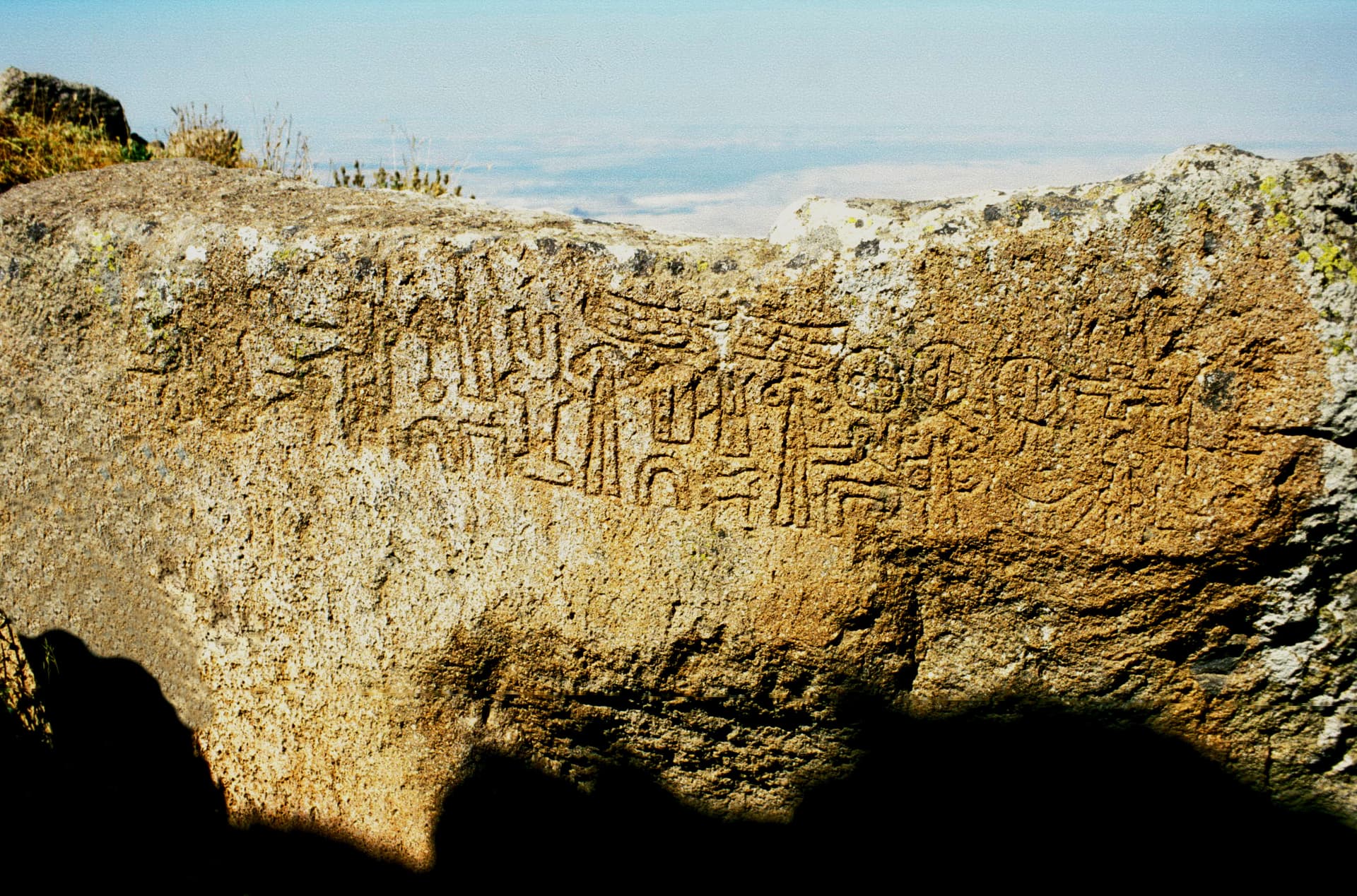
It is carved directly into the rock face of the summit fortress: a nearly life-sized king seated on a throne, holding a staff in one hand and a bowl in the other, with Luwian hieroglyphic inscriptions identifying him as 'Great King Hartapu.' The carving has the directness of rock art rather than the finish of temple sculpture — this is an image cut into a mountain with the intention of lasting forever, and it has.
From beside the relief, the view across the Konya plain is immense, and the Karadağ massif to the south anchors the southern horizon. Give yourself time at the summit to sit with the view and the silence. The quality of exposure — sky all around, landscape below, wind — is precisely what made this a place where a king would come to commune with a storm deity. The experience is not mediated or reconstructed; it is uninterrupted.
The summit fortress contains the Throne Relief, additional rock-cut inscriptions, and a step monument. Explore the full perimeter of the fortress walls before leaving. The view south to Karadağ is the key landscape orientation — the two volcanic mountains formed a related sacred pair in Hartapu's religious world.
Context and lineage
Hartapu identified himself as 'Great King, beloved of the mighty Storm-God' and 'son of Mursili, Great King, Hero' — positioning himself within the lineage of Hittite imperial legitimacy even centuries after the empire's collapse. He founded a settlement at Kızıldağ's foot and built the peak sanctuary as the religious crown of his kingdom. The inscriptions at the summit celebrate his conquests and the favour of the Storm God, transforming the volcanic mountain into the declared cosmological centre of his realm.
The discovery in 2019 that Türkmen-Karahöyük, a large mound on the Konya plain, was his capital has contextualised Kızıldağ as the mountain sanctuary overlooking a real Iron Age city — the relationship between capital and sacred peak that was standard in the Hittite-Luwian political-religious tradition.
The Kızıldağ monuments belong to the Neo-Hittite tradition — the network of Iron Age Luwian-speaking successor states that preserved Hittite cultural, religious, and political forms after the empire's collapse around 1200 BC. Hartapu's state, centred on the Konya plain, was one of the later and geographically most central of these states. The Kızıldağ-Karadağ monument group is the main surviving evidence of its royal religion.
Traditions and practice
Mountain sanctuary rituals in the Luwian tradition involved royal visits, offerings to the Storm God and the mountain deity, proclamation inscriptions asserting conquest and divine favour, and possibly seasonal festivals at the peak. The throne relief suggests the summit served as a royal audience space — a place where the king publicly enacted his relationship with the divine in a setting visible to subjects on the plain below.
Heritage tourism and occasional academic research visits. The 2019 Türkmen-Karahöyük discovery has increased scholarly interest in the full Hartapu monument group, which includes Kızıldağ, Karadağ, and the capital site on the plain. No active religious use of the summit.
Begin the approach from the village of Adakale in the morning before heat builds. The hike to the summit area takes roughly 45–60 minutes depending on your route through the volcanic terrain. Approach the Throne Relief slowly — resist the impulse to immediately photograph it. Spend time with the figure itself: the proportions, the quality of the carving, the weathering of 2,800 years on exposed volcanic stone.
Then read the surrounding inscriptions (even if you cannot read Luwian, the hieroglyphic characters are visually expressive) and let the view to Karadağ in the south anchor your spatial understanding of what Hartapu's sacred landscape looked like. The dried Hotamış Lake basin, visible to the northeast, was once a seasonal body of water — another element of the landscape that held sacred resonance in this tradition. Sit at the summit for as long as you can before descending.
The wind and exposure are not inconveniences; they are the conditions Hartapu chose for his dialogue with the Storm God.
Neo-Hittite / Iron Age Luwian Royal Religion
HistoricalKızıldağ was the peak sanctuary of Iron Age Luwian King Hartapu, dedicated to the Storm God Tarḫunzas and the Divine Great Mountain. The Throne Relief and inscriptions functioned as a permanent royal religious declaration — Hartapu's stone presence at his sacred summit.
Royal mountain rituals; offerings to the Storm God and the mountain deity; inscription proclamations of conquest and divine favour; possibly seasonal peak sanctuary festivals.
Archaeological Research and Heritage Tourism
ActiveThe 2019 Türkmen-Karahöyük discovery has transformed Kızıldağ from an isolated monument into the sacred mountain of a known Iron Age capital. Scholarly interest in the full Hartapu monument group has increased significantly.
Epigraphic study; landscape archaeology; heritage visits by scholars and travellers interested in the Neo-Hittite world.
Perspectives and open questions
Kızıldağ has been interpreted through the lenses of political history, religious geography, and geological dramatics — and the site's significance has grown substantially since the 2019 capital discovery transformed its context.
Scholarly perspective
Kızıldağ is recognised as a key Iron Age Luwian site — the peak sanctuary of King Hartapu and the religious counterpart to his capital at Türkmen-Karahöyük. The 2019 survey by Weeden and Osborne confirmed the capital's identity, which means Kızıldağ is now understood within a complete picture of an Iron Age kingdom: a known city, a known king, a known sacred mountain, and a known network of related monuments (Karadağ, Burunkaya inscription, Topada inscription).
Scholars date the monuments to the 8th century BC, revising earlier proposals that placed Hartapu in the immediate post-Empire period. J. David Hawkins's epigraphic work established the Luwian hieroglyphic readings that underpin the scholarly record.
Living and traditional perspectives
No surviving local religious tradition is connected to the site. The surrounding communities are Turkish-Muslim with no documented connection to pre-Islamic practices at the mountain.
Alternative interpretations
Volcanic peaks in ancient Anatolian religion were understood as axis mundi points — places where sky and earth met most directly, where storm deities were most present. Kızıldağ's combination of geological drama (red rock, volcanic form), landscape dominance (visible across the Konya plain), and the presence of a carved royal figure in permanent stone audience creates a site where this axis mundi quality remains perceptible.
The 'Divine Great Mountain' language in Hartapu's inscriptions supports readings of Karadağ/Kızıldağ as a cosmological centre of his kingdom's worldview.
Open questions
The full extent of Hartapu's kingdom and its relationship to Assyrian expansion in the 8th century BC remains debated. The precise identity of 'Mursili' named as Hartapu's father — whether an Hittite imperial ancestor or a local Neo-Hittite dynast — is unresolved. Additional monuments may remain undiscovered in the volcanic terrain.
Plan your visit
Access and arrival
Located on the Konya-Karaman provincial border. Access via the village of Adakale (Konya Province) to the north. Nearest city: Karaman (~40km south) or Konya (~80km north). Unpaved road from Adakale plus hiking required. 4WD recommended.
Karaman city (~40km south) has hotels and full services. Çumra (Konya Province) has basic accommodation closer to the site. Konya city is the most practical regional base.
Respectful visit
Outdoor and hiking clothing; sun protection essential on the exposed volcanic summit. Sturdy footwear for volcanic rock terrain.
Photography permitted. The relief photographs well in morning or late afternoon light when shadows bring out the carved detail.
Not applicable — no active religious use.
Do not touch or lean against the Throne Relief or any inscribed surfaces. Do not remove rocks or any material from the summit. Protected under Turkish cultural heritage law.
Exposed volcanic summit with no shade or water. Summer temperatures on the rock can be extreme. Carry sufficient water for the hike. The unpaved access road from Adakale benefits from a 4WD vehicle. Loose volcanic rock on some ascent routes requires careful footing.
Location
Map loads as you approach this section.
Pilgrim reflections
A portrait of encounter, not a score
Pilgrims describe what they felt, how present they could become, and whether the place would shape a journey. There are no stars and no ranking of traditions.
No reviewed reflections yet
The first pilgrims can help describe the character of being here.
Share a reflection
Available after an account-backed “Been there.” Every reflection is reviewed before publication.
Nearby sacred places
Explore other sacred places in the region. Proximity does not establish access or travel time; check each place’s guidance.

References
Sources consulted for this page. Source categories describe the publication, not a guarantee that every claim is verified. Traditional accounts and outside interpretations may differ.
- 01Hittite Monuments — KızıldağacademicSpecialized Hittite monuments reference database
- 02Hartapu and the Land of Maša. A New Look at the KIZILDAĞ-KARADAĞ GroupacademicPeer-reviewed academic paper on the Kızıldağ-Karadağ monument group
- 03City of Hartapu: Results of the Türkmen-Karahöyük Intensive Survey ProjectacademicCambridge peer-reviewed survey linking Kızıldağ to Türkmen-Karahöyük capital
- 04Kızıldağ: Rock relief and inscriptions of Hartapu, overlooking the dried Hotamış LakeacademicResearchGate figure from peer-reviewed publication showing site layout
- 05The Hartapu (Harttapus) Hittite Monument at KızıldağguideDetailed visitor account and historical overview
- 06Ḫartapus — WikipediaencyclopediaGeneral encyclopedia entry on Hartapu with scholarly citations
- 07Kızıldağ — Hartapu Monument — Vici.orgencyclopediaArchaeological Atlas of Antiquity entry
Share a photo
Help visitors recognize Kızıldağ Monuments. Every submission is reviewed before publication.