Boncuklu Höyük
The village before Çatalhöyük — where ancestors were kept in the floor and community was first invented
Understand sacred places, explore living traditions, and learn how to engage respectfully with Pilgrim Map.
Access has not been verified. Check current local guidance before planning a visit.
Konya, Turkey
Read the sources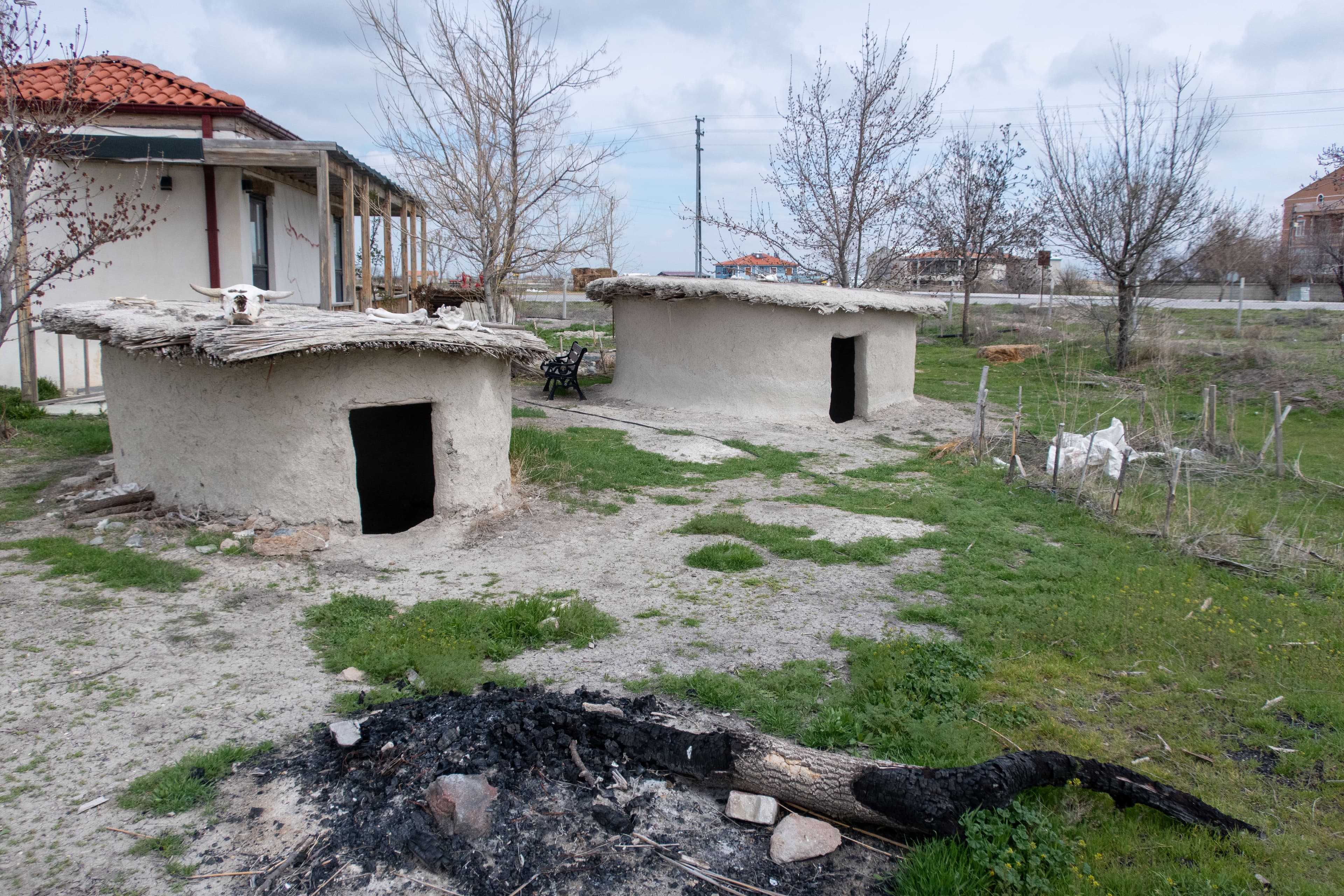
Image of Boncuklu Höyük. Image source
Visit essentials
A quick read before you go
- Duration
- 1–2 hours for the site itself.
- Access
- Located on the Konya Plain near Hayıroğlu village, approximately 40 km east of Konya city and…
Overview
The flat, well-watered, fertile Konya Plain in Central Anatolia let mobile foragers slow and settle. Around 8300 BCE, that commitment formed Boncuklu Höyük, the plain's earliest known village. Its name means 'beaded mound,' and excavations show personal adornment mattered: beads, pierced ears and lips, and small decorative objects accompanied the dead.
Residents buried relatives beneath plastered house floors. When someone of particular significance died, the skull was sometimes removed, painted with red ochre, and carried to a communal building to be curated, displayed, and perhaps consulted as continuing ancestral presence. The living walked above the dead; community memory was housed in bone. Boncuklu immediately preceded Çatalhöyük and seeded practices the larger settlement developed for another millennium and a half.
Its modest oval houses and community, perhaps numbering only dozens, make those practices especially intimate.
Why this place is sacred
The spiritual quality of Boncuklu Höyük is legible in its most fundamental spatial arrangement: the dead are not elsewhere. They are underneath. In a community without writing, without preserved mythology, this architectural choice speaks a theology. The living floor of the house was also the ceiling of the grave. Every domestic act — cooking, sleeping, receiving visitors — took place in immediate physical relationship with buried kin.
But the skull curation practices go further. At Boncuklu, skulls were not simply left in place with the rest of the skeleton. Some were removed after burial, treated with red ochre, and brought into communal buildings — spaces that served the whole community rather than a single household. Here the ancestors became collective, their presence no longer belonging to a single family but to the social group as a whole.
The skull in its communal setting was an argument: that the dead persist as social actors, that ancestry is a form of authority, that community identity has roots that go literally into the earth beneath you.
The site also documents rites of passage through body modification. Pierced ears and lower lips, presumably for decorative or symbolic adornment, point to social thresholds being marked on the body — entry into adulthood, perhaps, or particular social roles. These gestures locate the spiritual not in an external sacred space but in the body and the house.
Boncuklu's thinness is quiet. It lacks the monumental scale of nearby sites and the elaborate visual program of Çatalhöyük. What it offers instead is the earliest legible version of a worldview that would shape the Neolithic across thousands of miles: that place, ancestry, and the management of the dead are the foundations of community life.
A permanent village on the Konya Plain occupied by Pre-Pottery Neolithic forager-cultivators transitioning from mobile to sedentary life; the communal buildings served as spaces for collective ancestor veneration practices.
Occupied approximately 8300–7800 BCE, Boncuklu Höyük preceded Çatalhöyük by roughly a thousand years and is thought to represent the founding population or direct cultural antecedents of that later, larger settlement. Archaeological evidence suggests that the skull curation and intramural burial practices characteristic of both sites were established at Boncuklu first, then carried forward into the Çatalhöyük tradition.
Experience and orientation
Boncuklu Höyük is not yet structured for casual tourism. There is no visitor center in the conventional sense, and the site lacks the interpretive infrastructure of nearby Çatalhöyük. This can be experienced as a limitation or as a form of access: the site is genuinely, quietly present in its landscape without an interpretive apparatus between you and it.
The Konya Plain is flat and open. Arriving at the low mound that marks the site, the visual field is wide — agricultural land, distant hills, the particular quality of light on an interior plateau. The mound itself is modest: Boncuklu was a small community, and the accumulation of its occupation layers does not produce dramatic topography.
What you are looking at is the compressed sediment of 500 years of human life, the oval mud-brick outlines of houses, the layered floors, the infant and child burials that researchers have documented cutting through plastered surfaces.
If local guides are available, engage one. The site's significance is largely invisible without interpretive context — the oval house plans, the burial distributions, the communal building locations are recoverable by trained eyes but require guidance for most visitors. Arriving with prior reading about the skull curation practices will transform what might otherwise appear as a modest earthen mound into something that demands sustained attention.
The proximity to Çatalhöyük (approximately 9 km) makes a combined visit natural. The contrast is instructive: Boncuklu is the seed, smaller and more intimate, while Çatalhöyük is the elaborated form. Visiting them in chronological order — Boncuklu first — makes the developmental logic of Konya Plain Neolithic culture perceptible.
No formal visitor facilities confirmed as of the time of writing. Local guides associated with Konya's tourist infrastructure can arrange access and provide interpretation. Verify current access arrangements before visiting, as the site is in active excavation.
Context and lineage
No written mythology survives from the Pre-Pottery Neolithic. The community that built Boncuklu Höyük left behind only material evidence: the outlines of their oval mud-brick houses, the plastered floors repeatedly renewed over generations, the burials cut into those floors, and the post-holes and artifact distributions of their communal buildings. What this evidence implies about belief is inferential.
The placement of the dead beneath the domestic floor in a space where the living continued to walk, cook, and gather is not a neutral logistical choice. Across the Neolithic world, this practice appears repeatedly, in contexts that suggest the living wished to maintain proximity to, and relationship with, their dead.
At Boncuklu, the additional practice of skull curation — removing select skulls, treating them with ochre, carrying them to communal buildings — suggests that ancestry was understood as an active social force, not a static memory.
Boncuklu Höyük is the probable cultural ancestor of Çatalhöyük. The skull curation practices, intramural burial traditions, and oval-to-rectangular architectural evolution documented across both sites suggest a direct community lineage or at minimum a shared cultural tradition on the Konya Plain spanning from approximately 8300 to 5600 BCE.
Professor Douglas Baird
Lead excavator; discoverer of the site
Professor Andrew Fairbairn
Co-director of excavations
Traditions and practice
Boncuklu's most distinctive practices involved the dead. Bodies — particularly infants and children — were interred beneath the plastered floors of houses, often accompanied by beads, stone tools, and animal bone. In some cases, after the flesh had decomposed, skulls were removed from their interment, treated with red ochre, and brought to communal buildings — structures used by the whole community rather than a single household.
These skull displays may have served as anchors for collective identity, keeping community memory literally present in physical form. Body piercing at the ears and lower lip was practiced, likely as a marker of social status or rites of passage. Beadwork and personal adornment appear to have been significant, consistent with the site's name: 'beaded mound.'
No active religious or spiritual tradition uses the site. International archaeological fieldwork continues under the joint direction of the University of Liverpool and the University of Queensland, with annual excavation seasons and associated laboratory analysis.
Arrive knowing something about the skull curation practices before you visit — without that context, the subtle landscape of the low mound may not yield its significance. Walk the perimeter of the mound slowly. Notice the agricultural plain on all sides; this is the same landscape that fed the community, providing the wild and early-domestic plants that the site's archaeobotanical record documents. Look for the subtle surface evidence of test trenches and covered excavation areas.
If you have the opportunity to speak with a researcher or local guide, ask about the house plan — the oval outline of the earliest domestic architecture here, and how it differs from the rectangular forms that dominated later Neolithic building. Sit with the fact that you are standing above a community whose members walked daily above their buried family members. What does it mean to live on top of your ancestors?
What is carried — in the body, in the community — when the dead are that close?
Pre-Pottery Neolithic (Aceramic Neolithic)
HistoricalBoncuklu Höyük is the earliest village in Central Anatolia, predating Çatalhöyük by roughly 1,000 years. It represents the transitional moment between mobile foraging and permanent settlement on the Konya Plain, and establishes the ancestor veneration practices that later communities would elaborate.
Intramural burial under house floors, especially infants and children; skull removal, ochre treatment, and display in communal buildings; grave goods including beads, stone tools, and animal bones; body piercing at ears and lower lips as rites of passage markers; earliest known ceramics on the Anatolian plateau.
Archaeological Heritage
ActiveOngoing international research project since 2006 investigating the origins of the Neolithic farming transition in Central Anatolia; the project has fundamentally reframed understanding of the Çatalhöyük cultural sequence by establishing its Boncuklu precursor.
Annual fieldwork seasons; laboratory analysis at Liverpool, Queensland, and partner institutions; public outreach and school education programs; publication of peer-reviewed research.
Perspectives and open questions
Boncuklu Höyük invites interpretation at the intersection of archaeology, cognitive anthropology, and the phenomenology of grief. Its skull curation practices are among the most discussed ritual behaviors in Neolithic studies — pointing simultaneously toward ancestral veneration, community identity formation, and what it means to manage the presence of the dead within the social world.
Scholarly perspective
Excavations since 2006 by the University of Liverpool and University of Queensland have established Boncuklu as the earliest village in Central Anatolia (c. 8300 BCE) and a direct cultural precursor to Çatalhöyük. The skull curation practices — removal, ochre treatment, communal display — parallel similar behaviors at contemporary PPNB sites in the Levant (Ain Ghazal, Jericho), suggesting a broad Neolithic cultural horizon in which ancestor veneration through skull modification was widespread.
The site's excavations also confirmed the earliest known ceramics on the Anatolian plateau — an unexpectedly early pottery tradition for a Pre-Pottery Neolithic community. Archaeobotanical evidence documents the transition from wild to domesticated plant use. Bioarchaeological study of the burials has illuminated rites of passage through body modification.
Living and traditional perspectives
No oral tradition survives from Boncuklu's occupants. The site is documented and interpreted through Turkish national heritage frameworks, with the excavation project maintaining an educational and outreach dimension in cooperation with local Konya institutions.
Alternative interpretations
The skull curation practices at Boncuklu and sites across the Neolithic Near East have attracted significant attention from researchers interested in ancient ancestor communion — the idea that keeping and working with the physical remains of the dead was a form of active relationship, not merely memorial.
In some interpretations, the ochre-treated skull in its communal building functioned less like a relic and more like a conversation partner: a condensed point of ancestral presence that the living could address, consult, and draw identity from.
Open questions
The precise relationship between Boncuklu's founding population and the community that eventually established Çatalhöyük remains unresolved: was it the same lineage, a descendant community, or an independent group that inherited similar cultural practices? The function of the communal buildings where skulls were displayed — whether they served as meeting houses, ritual spaces, or both — is not yet fully understood. How the community decided which individuals' skulls warranted curation and which did not remains an open question.
Plan your visit
Access and arrival
Located on the Konya Plain near Hayıroğlu village, approximately 40 km east of Konya city and about 9 km northeast of Çatalhöyük. A car is essential; no direct public transport serves the site. From Konya, take the road toward Çumra and then follow local roads toward Hayıroğlu. No formal visitor center has been confirmed; check with the University of Liverpool's Boncuklu Project (liverpool.ac.uk) or Visit Karatay (visitkaratay.com) for current access arrangements.
Mobile signal is unreliable in this rural area; download maps before departing Konya. No information was available at time of writing on current admission arrangements.
Konya city (40 km) has a full range of accommodation. For combined Çatalhöyük visits, Çumra (approximately 15 km from the site) has basic facilities.
Respectful visit
No dress requirements. Comfortable outdoor clothing appropriate to the season; the Konya Plain is exposed to wind and sun with few natural shelters.
Permitted during non-excavation periods. During active dig seasons, respect any restrictions communicated by the excavation team, and do not photograph researchers or exposed burial material without permission.
Not applicable.
Do not enter active excavation areas or trenches. Do not disturb surface material of any kind. The site's integrity depends on visitors observing these boundaries.
Access may be restricted during active excavation seasons. The site lacks formal fencing or visitor infrastructure; exercise care around any test trenches or excavation areas. Contact the University of Liverpool's Boncuklu Project or Visit Karatay for current access arrangements before traveling.
Location
Map loads as you approach this section.
Pilgrim reflections
A portrait of encounter, not a score
Pilgrims describe what they felt, how present they could become, and whether the place would shape a journey. There are no stars and no ranking of traditions.
No reviewed reflections yet
The first pilgrims can help describe the character of being here.
Share a reflection
Available after an account-backed “Been there.” Every reflection is reviewed before publication.
Nearby sacred places
Explore other sacred places in the region. Proximity does not establish access or travel time; check each place’s guidance.


References
Sources consulted for this page. Source categories describe the publication, not a guarantee that every claim is verified. Traditional accounts and outside interpretations may differ.
- 01Boncuklu Höyük - Wikipedia — Wikipedia contributorsencyclopediaGood overview with key details on chronology and excavation
- 02The Boncuklu Project | Department of Archaeology, Classics and Egyptology | University of Liverpool — University of LiverpoolofficialOfficial project page from excavation institution
- 03Boncuklu Höyük: The earliest ceramics on the Anatolian plateau — ResearchGate / SpringeracademicPeer-reviewed study on pottery origins
- 04Boncuklu - Biblical Archaeology Society — Biblical Archaeology SocietyacademicPeer-reviewed overview of the excavation project
- 05Neolithic Turkey: investigating the transition to settled and farming lifestyles on the Konya Plain — The PastacademicScholarly feature on the Konya Plain Neolithic sequence
- 06Boncuklu Höyük Ancient Village or Settlement : The Megalithic Portal — The Megalithic PortalSource contextGPS coordinates and brief overview
- 07Boncuklu Höyük | Visit Karatay — Visit KaratayguideLocal tourism information
- 08Boncuklu Hoyuk (2025) - All You Need to Know BEFORE You Go — TripAdvisorguideVisitor reviews and practical access information
Share a photo
Help visitors recognize Boncuklu Höyük. Every submission is reviewed before publication.