Çatalhöyük
UNESCO World Heritage site where nine thousand years of household life, ancestor burial, and figurine-making meet the ongoing debate about the goddess
Understand sacred places, explore living traditions, and learn how to engage respectfully with Pilgrim Map.
Access has not been verified. Check current local guidance before planning a visit.
Konya, Turkey
Read the sources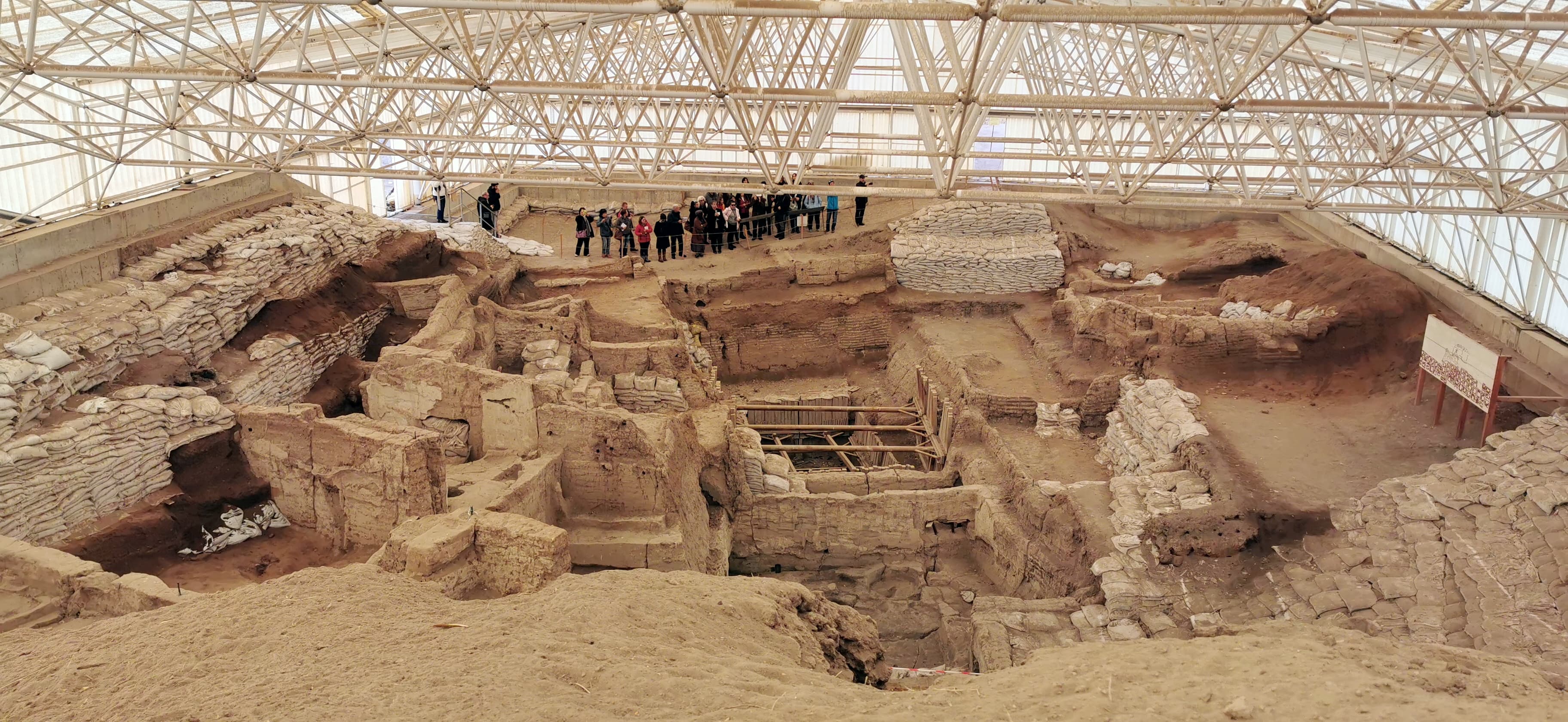
Image of Çatalhöyük. Image source
Visit essentials
A quick read before you go
- Duration
- 2–3 hours for a thorough visit including the visitor center, excavation viewing areas, and…
- Access
- Located 41 km southeast of Konya city center, near the town of Çumra.
Overview
From roughly 7500 to 5600 BCE, a community on the southern Konya Plain built a streetless settlement of shared-wall houses entered from roofs by ladder and hatch. People slept and worked on raised platforms above generations of family dead, interred in baskets and sometimes painted with red ochre. White-plastered walls held geometric designs, hunting scenes, mounted wild-bull skulls, and great vulture wings, then were entirely replastered and repainted, burying images layer upon layer like memory.
Hundreds of clay and stone figurines were found, many female. A large seated figure flanked by two leopards became a global icon after James Mellaart published his 1960s discoveries and Marija Gimbutas incorporated them into her influential prehistoric-matriarchal-religion theory. Later scholarship has challenged, revised, and partly dismantled that theory. What remains is a community's extraordinary attention to its dead, animals, images, and domestic symbolic space; whether that constitutes religion in a recognizable sense remains open.
Why this place is sacred
The spiritual quality of Çatalhöyük is inseparable from its spatial organization. In this settlement, you did not leave your house to encounter the sacred — the sacred was built into the floor beneath you. Family members were buried under the raised sleeping and working platforms that occupied the main rooms. Generation after generation of the same household's dead accumulated below the floor over which the living continued to eat, sleep, and gather. The ancestors were not elsewhere; they were underfoot.
This closeness carries a theological implication that the community appears to have understood: to live in this house is to remain in relationship with those who preceded you here.
The painted walls extend this logic upward. Geometric patterns, hunting scenes, and the mounted skulls of wild aurochs (bucrania) were plastered into the walls and rebuilt repeatedly. The images were not static decorations but accumulating layers — buried under each new coat of plaster, preserved in the same way the bodies were preserved in the floor. The house itself was a kind of stratigraphy: layer upon layer of lived life, painted meaning, and ancestral presence.
The figurines — several hundred found across the site, in a range of materials, representing both female and male forms as well as animals — complicate any single interpretation. The most famous, the large seated female figure flanked by leopards now known as the Seated Woman of Çatalhöyük, was found in a grain bin, not a temple or shrine.
Its context speaks not of priestly display but of domestic life — the sacred woven into the ordinary rather than elevated above it.
For contemporary goddess spirituality practitioners, all of this coheres into evidence of a world before patriarchy, a culture organized around the generative female principle, a civilization whose traces prove that things were not always as they are now. For archaeologists, it is considerably more ambiguous. What survives is material; what it meant to the people who made it is inference.
But the depth of that ambiguity is itself part of what makes Çatalhöyük one of the world's most generative sacred sites — a place where the question remains genuinely open.
A Neolithic settlement organized around household-based social units, with the dead buried beneath house floors and the domestic interior serving as the primary arena for symbolic expression including wall paintings, figurine production, and the mounting of wild animal skulls.
Occupied across 18 levels for approximately 1,900 years (c. 7500–5600 BCE), Çatalhöyük grew to house several thousand residents at its peak. The Eastern mound contains the primary Neolithic sequence; the Western mound carries a later Chalcolithic occupation. After abandonment, the site was buried and forgotten until the 1950s survey work that led to Mellaart's excavations. UNESCO World Heritage inscription in 2012 formalized its global significance.
The ongoing relationship with the contemporary goddess spirituality community represents a new chapter in the site's active meaning-making.
Experience and orientation
Çatalhöyük is, by the standards of prehistoric sites, genuinely well-equipped for visitors. The visitor center opened in 2023 with interactive displays, a café, and a bookshop. The main excavation areas are accessible via sheltered viewing platforms that allow close inspection of excavated walls and floor surfaces without threatening the material. A replica Neolithic house — built to the specifications that archaeology has recovered — is available for visitors to enter.
Enter the replica house and let your body do the interpretive work. The ceiling is low; the room compresses inward. The ladder through the roof hatch is the only way in. There are no windows. The main platforms where people slept and worked occupy much of the floor area. Beneath your feet in the actual Neolithic original, there would be burials.
Notice how the scale of the room — the height of the ceiling, the proximity of the walls — changes what it means to share a space with someone. Notice what it would mean to carry your dead down through that roof hatch.
At the main excavation area, the sheltered viewing provides clear sight lines into the exposed house interiors. Take time here. The layering is visible: plaster surfaces above other plaster surfaces, the outlines of burial cuts visible in the floor matrix, the bucrania mounting positions in the walls. The painted wall fragments — though most are visible only in the visitor center rather than in situ — communicate something about the ambition of this community's visual imagination.
Goddess spirituality practitioners visit regularly and sometimes arrange group ceremonies here. Site managers have formally engaged this community in what the Çatalhöyük Research Project calls 'multivocal interpretation' — acknowledging that a site can be simultaneously an archaeological puzzle and a sacred space for living practitioners. Whichever frame you bring, the site accommodates.
Begin with the visitor center and interpretive displays before moving to the excavation areas. The replica house is located adjacent to the main site and should not be missed. Allow 2–3 hours for a thorough visit. The site is closed on Mondays and opens at 09:00.
Context and lineage
No written mythology survives from Neolithic Çatalhöyük. The community that built and repeatedly rebuilt this settlement for nearly two thousand years left behind a dense and varied material record — wall paintings, figurines, bucrania, burial platforms, red ochre, plaster — but no narrative key. What archaeology can infer is that the household was the primary social and spiritual unit.
There was no evidence of temples, no separate priesthood class visible in differential burial goods, no single public monument that concentrated sacred meaning. Instead, every house was, in some sense, its own temple: a painted interior above, the ancestral dead below, the wild animals of the hunt present in mounted skulls and painted scenes.
The worldview implied is one in which the sacred pervades the domestic rather than transcending it — not a god above the house, but ancestry, animal power, and geometric order woven into every plastered wall and swept floor.
Çatalhöyük's cultural predecessors on the Konya Plain include Boncuklu Höyük (c. 8300 BCE), some 9 km to the north — the earliest known village in the region, where the ancestor veneration practices later elaborated at Çatalhöyük appear in their earliest form. The site's abandonment around 5600 BCE coincides with the broader shift from Neolithic to Chalcolithic culture across Anatolia.
James Mellaart
First excavation director; discoverer of wall paintings and figurines
Marija Gimbutas
Interpreter of Neolithic goddess religion
Ian Hodder
Second excavation director
Traditions and practice
Çatalhöyük's Neolithic community buried their dead beneath the raised platforms inside houses, often with grave goods including baskets, stone tools, and ornaments, and sometimes with applications of red ochre. Multiple generations of family members were interred in the same household floor, the earlier burials reopened and rearranged to accommodate new ones. Wall paintings were created and then periodically covered by fresh plaster — images buried, like the dead, within the structure of the house.
Bucrania — the skulls and horn cores of wild aurochs — were mounted in walls and on pillars, sometimes decorated with clay or plaster. Hundreds of figurines, primarily of clay, were produced across the settlement's history; these represent female bodies, male bodies, animals, and hybrid forms. Their find contexts are overwhelmingly domestic and midden (rubbish deposit) rather than shrine or temple.
Contemporary goddess spirituality practitioners visit regularly, treating the site as a place of pilgrimage connected to a proposed pre-patriarchal religion. Some groups arrange ceremonial visits, including meditations near the Seated Woman figurine replica and ceremonies honoring what practitioners call the Great Mother. The Çatalhöyük Research Project formally engaged these practitioners in interpretive dialogue during the 1993–2018 excavation phase. Archaeological conservation and heritage management continue under UNESCO World Heritage protocols.
Begin outside, at the perimeter, and orient yourself to the mound's scale before entering. What you are looking at is not a dramatic hill; it is a compression of 1,900 years of mud-brick construction and rebuilding, the accumulated residue of a civilization's domestic life. Walk the sheltered excavation viewing area slowly. Look for the burial cuts visible in floor matrices — the places where a family opened the floor to receive another member.
When you reach the replica house, enter and stand still for several minutes. Let the ceiling height register. Look up through the roof hatch. Imagine carrying someone through that opening to bury them beneath where you are now standing. If you have a particular relationship to questions of goddess religion or prehistoric spirituality, hold those questions lightly here — the site will not answer them definitively, and that openness is part of its gift.
Neolithic Domestic Spirituality
HistoricalÇatalhöyük is one of the world's most richly documented Neolithic spiritual complexes, providing foundational evidence for household-based symbolic practice, ancestor veneration through intramural burial, and a visual culture of considerable complexity involving wall paintings, figurines, and animal remains.
Intramural burial beneath plastered house floors; use of red ochre in burials; wall painting with hunting scenes, geometric designs, and animal imagery; periodic replastering of walls and burial of images; production and deposition of clay and stone figurines; mounting of aurochs bucrania in walls and pillars.
Contemporary Goddess Spirituality
ActiveFollowing Mellaart's discoveries and Gimbutas's theoretical synthesis, Çatalhöyük became a globally significant pilgrimage site for neopagan, Wiccan, and feminist spirituality communities seeking material evidence of prehistoric matriarchal religion. The Çatalhöyük Research Project formally acknowledged this community's relationship to the site.
Pilgrimage visits; ceremonies honoring the Great Mother; meditation near the Seated Woman figurine replica; group gatherings at the site by spiritual communities.
Archaeological Heritage
ActiveUNESCO World Heritage Site (2012); one of the most intensively studied prehistoric sites in the world; foundational to global understanding of Neolithic social organization, symbolic thought, and the origins of religious practice.
Archaeological conservation and site management under UNESCO protocols; visitor interpretation through the visitor center and guided programs; ongoing post-excavation research and publication.
Perspectives and open questions
Çatalhöyük is one of the most interpreted and argued-over sites in the history of archaeology. Every major question it raises — about gender, religion, social organization, and the origins of symbolic thought — has been answered differently by different generations of scholars and by the communities of meaning-seekers who have found in it a mirror for their own questions.
Scholarly perspective
Current archaeological consensus, established through the 1993–2018 excavation phase led by Ian Hodder, significantly revises the early interpretations of Mellaart and Gimbutas. The site shows no evidence of temples, no identifiable priestly class, and no systematic gender hierarchy in burial goods or spatial organization — male and female burials are treated with comparable elaboration. The figurines represent a wide range of subjects, not exclusively female; their find contexts are overwhelmingly domestic and refuse-related rather than shrine-related.
Scholarly interpretation now emphasizes household-based, decentralized spirituality, in which each house served as its own sacred environment. The goddess religion interpretation is not disproven — absence of evidence is not evidence of absence — but it is substantially less supported by the material record than Mellaart and Gimbutas proposed. The site's significance as a document of early sedentism, social organization, and symbolic thought remains undiminished.
Living and traditional perspectives
No oral tradition survives from the Neolithic occupants. Modern Turkish heritage authorities treat Çatalhöyük as a national and global treasure of the first importance. The UNESCO World Heritage inscription in 2012 formalized its status as property of humanity as a whole.
Alternative interpretations
For goddess spirituality practitioners worldwide — Wiccan, neopagan, feminist spirituality, and related communities — Çatalhöyük is evidence of something that matters deeply: that a world organized around the feminine principle once existed, that patriarchy has not always been the default condition of human civilization, that alternatives are not utopian fantasies but historical facts. The Seated Woman figurine has become an icon of this movement, reproduced in millions of copies and carried into practices of personal devotion.
The Çatalhöyük Research Project's formal engagement with this community through 'multivocal interpretation' represents an unusual and thoughtful acknowledgment that sacred sites are not owned by any single interpretive tradition.
Open questions
The meaning and function of the figurines remains genuinely unresolved. Whether a centralized belief system existed or only household-level practice is debated. The significance of vulture imagery in wall paintings — which some interpret as evidence of sky burial or death-cult practice — remains without definitive explanation. The cosmological significance of the bucrania — why wild cattle skulls specifically, why mounted in walls and pillars — is not established.
The reason for the settlement's eventual abandonment after 1,900 years of continuous occupation is not fully understood.
Plan your visit
Access and arrival
Located 41 km southeast of Konya city center, near the town of Çumra. Accessible by car via the Konya–Çumra road (follow signs to Çatalhöyük from Çumra). Organized tours from Konya are available through local operators. Admission charged (approximately 5 EUR for foreign visitors at last known pricing — verify current rates at catalhoyuk.com or the Ministry of Culture ticketing system). Visitor center, café (opened October 2024), and bookshop on-site. Mobile phone signal is generally available in this accessible area.
Site open Tuesday–Sunday 09:00–17:00.
Konya city (41 km) offers a full range of hotel accommodation. Çumra (15 km) has basic guesthouses. Some visitors stay in Konya and make a half-day excursion to the site.
Respectful visit
No dress requirements. Comfortable outdoor footwear is strongly recommended due to uneven terrain across the excavation area. Sun protection and water are advisable in warmer months.
Photography is permitted throughout the site and visitor center. Personal photography for non-commercial use has no known restrictions.
Goddess spirituality practitioners sometimes leave symbolic offerings at the site. The current policy of site management on offerings should be confirmed directly with the site, as practices may have evolved. Offerings should not be placed on or near excavated structural material.
Stay on marked paths and viewing platforms. Do not touch excavated structures, floor surfaces, or any exposed material. The site is closed on Mondays. Entry is by admission fee; current pricing should be confirmed via the Çatalhöyük Research Project website (catalhoyuk.com) or at the visitor center.
The site is closed on Mondays. Terrain is uneven around excavation areas; wear suitable footwear. Goddess spirituality groups wishing to conduct ceremonies should check current site management policies, as protocols for ceremonial visits may have evolved.
Location
Map loads as you approach this section.
Pilgrim reflections
A portrait of encounter, not a score
Pilgrims describe what they felt, how present they could become, and whether the place would shape a journey. There are no stars and no ranking of traditions.
No reviewed reflections yet
The first pilgrims can help describe the character of being here.
Share a reflection
Available after an account-backed “Been there.” Every reflection is reviewed before publication.
Nearby sacred places
Explore other sacred places in the region. Proximity does not establish access or travel time; check each place’s guidance.


References
Sources consulted for this page. Source categories describe the publication, not a guarantee that every claim is verified. Traditional accounts and outside interpretations may differ.
- 01Çatalhöyük - Wikipedia — Wikipedia contributorsencyclopediaComprehensive article with full citation list
- 02Neolithic Site of Çatalhöyük - UNESCO World Heritage Centre — UNESCOofficialOfficial UNESCO World Heritage listing (2012)
- 03History of the Excavations | Çatalhöyük Research Project — Çatalhöyük Research ProjectofficialOfficial excavation project website
- 04Çatalhöyük - World History Encyclopedia — World History EncyclopediaencyclopediaPeer-reviewed encyclopedia article
- 05Archaeologists from Stanford find an 8,000-year-old 'goddess figurine' in central Turkey — Stanford ReportacademicStanford University press release on figurine discovery
- 06Mellaart, Gimbutas, Goddesses, and Çatalhöyük: early assumptions and recent perspectives on the Çatalhöyük finds — ResearchGateacademicScholarly review of competing interpretations
- 07New insights on commemoration of the dead through mortuary and architectural use of pigments at Neolithic Çatalhöyük, Turkey — Scientific Reports (Nature)academicPeer-reviewed study on pigment use in burials and architecture
- 08A Visitor's Guide to Çatalhöyük: Excavations and History | PlanetWare — PlanetWareguidePractical visitor information
Share a photo
Help visitors recognize Çatalhöyük. Every submission is reviewed before publication.