Fushimi Inari-taisha
Ten thousand vermilion gates ascending sacred Mount Inari
Understand sacred places, explore living traditions, and learn how to engage respectfully with Pilgrim Map.
Access has not been verified. Check current local guidance before planning a visit.
Kyoto, Kyoto Prefecture, Japan
Read the sources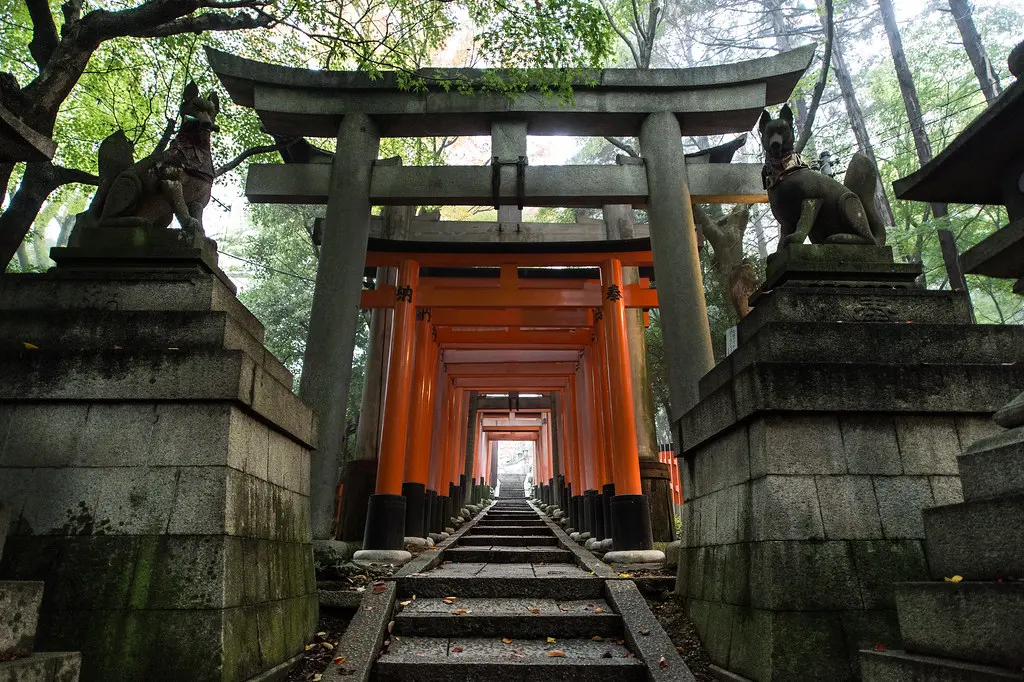
Image of Fushimi Inari-taisha. Image source
Visit essentials
A quick read before you go
- Duration
- 30 minutes to 1 hour for the main shrine area.
- Access
- 5 minutes from Kyoto Station via JR Nara Line to JR Inari Station (150 yen).
Overview
At Fushimi Inari-taisha, accumulated hope takes physical form in thousands of vermilion torii donated over several centuries by prospering individuals and businesses or those seeking prosperity. Their orange-red tunnels climb sacred Mount Inari. Fox statues guard the route as ancient messengers of Inari Okami, linked first to protecting rice from rodents and, over 1,300 years, to wider abundance.
Inari worship now extends to roughly one-third of Japan's Shinto shrines—over 30,000—and Fushimi is their mother shrine, where the Hata clan first enshrined the deity in 711 CE. The shrine never closes: before crowds, dawn turns the gates gold-red; at midnight, lanterns punctuate darkness. The 4-kilometer mountain trail takes two to three hours, rising from the commercial lower shrine through forest and smaller shrines into centuries of devotional stillness.
Why this place is sacred
The thinness here is constructed as much as discovered. Mount Inari was recognized as sacred ground long before the first torii gate was erected, home to the deity who governs rice—and by extension, survival itself in agricultural Japan. But the gates transform that inherent sacredness into something visitors can walk through, literally passing through the accumulated prayers of generations. Each vermilion gate was donated by someone.
The writing on every post records names and dates, creating a forest of human intention. The lower gates are massive, donated by major corporations. As one ascends, they become smaller, more modest, more numerous. The effect is immersive in a way that few sacred sites achieve: you are not observing sacredness but moving through it. The vermilion color itself carries meaning—traditionally believed to ward off evil and symbolize life force. Walking beneath it is protective passage.
The fox statues that appear throughout are not decorative but functional: messengers who carry prayers to Inari. Some hold keys in their mouths, symbolizing access to rice granaries and abundance. Others hold jewels or scrolls. Their watchful presence adds to the sense of being accompanied through sacred terrain. By the time one reaches the summit, having passed through so many gates, so many smaller shrines, so much accumulated devotion, the transition from ordinary consciousness is complete.
The shrine was founded in 711 CE to enshrine Inari Okami, deity of rice and agricultural abundance, on the sacred slopes of Mount Inari.
During the Edo period, as Japan's economy grew beyond pure agriculture, Inari worship expanded to include commerce and business prosperity. The practice of donating torii gates as expressions of gratitude or petitions began in this era and has continued ever since, creating the famous tunnel-like paths that define the shrine today.
Why pilgrims come
Prosperity in work and business
The shrine identifies Inari Ōkami with business, industry, household safety and the performing arts. These particular associations explain why merchants and workers bring their hopes here.
How devotees visit
Worshippers pray to Inari for their enterprises. The shrine’s annual programme includes a ceremony of thanksgiving and prayer for business prosperity; some devotees also dedicate torii gates.
These are religious traditions and devotional practices, not promises of an outcome. Follow the community’s current guidance.
Experience and orientation
The experience of Fushimi Inari unfolds in stages. The main shrine at the mountain's base draws crowds—especially during New Year when over 2.7 million visitors come for Hatsumode. Here are the formal worship halls, the souvenir shops, the bustling energy of one of Japan's most popular religious sites. But the shrine's true character reveals itself on the mountain. The Senbon Torii—the famous double corridor of gates—begins just past the main shrine, immediately transforming the atmosphere. Light shifts to vermilion.
The gates create a tunnel effect, each one close enough to the next to merge into continuous passage. At first, the experience is almost overwhelming—so many gates, so much vermilion, the camera-wielding crowds. Then the path branches. The less-traveled routes grow quieter. Smaller shrines appear, tended by devotees who ring bells and light incense. Fox statues multiply, their eyes watching from every angle.
The Yotsutsuji intersection, about halfway up, offers views across Kyoto—a moment to pause, to recognize how far one has traveled, both physically and otherwise. Beyond this point, fewer visitors continue. The gates become smaller, more intimate. Forest closes in. The sound of the city fades. The summit trail loops past numerous small shrines, each with its own character, its own offerings, its own accumulated presence. The descent completes the pilgrimage, returning through layers already walked but experienced differently now.
Begin at the main shrine for formal worship, then proceed to the Senbon Torii. For the full experience, continue past Yotsutsuji intersection to the summit—the round trip takes 2-3 hours. Early morning (before 8 AM) or evening offers dramatically different atmospheres than midday. The shrine is open 24 hours; night visits are particularly atmospheric for those comfortable with dark mountain trails.
Context and lineage
According to the Yamashirokoku Fudoki, the name Inari derives from 'ine ga narimashita'—rice has grown. The Hata clan, immigrants from the Korean Peninsula who brought advanced agricultural techniques to Japan, enshrined Inari Okami on the three peaks of Mount Inari on the first Day of the Horse in February 711 CE. That day is commemorated annually in the Hatsuuma Festival, the shrine's most sacred annual observance.
The fox messengers have been associated with Inari since the beginning, originally because foxes protected rice paddies from crop-destroying rodents. Over time, the practical protective role merged with spiritual significance, and the foxes became recognized as divine messengers carrying prayers between human and divine realms.
Fushimi Inari-taisha leads a network of over 30,000 affiliated shrines—approximately one-third of all Shinto shrines in Japan.
Inari Okami
The primary deity, kami of rice, agriculture, harvests, and prosperity. One of the most widely worshipped deities in Japan.
The Hata Clan
The immigrant clan who founded the shrine in 711 CE and introduced advanced agricultural techniques to the region
Kukai (Kobo Daishi)
The monk who requested the shrine's relocation in 816 CE, connecting Inari worship to Shingon Buddhism
Traditions and practice
The Hatsuuma Festival, held on the first Day of the Horse in February, commemorates the original enshrinement of Inari Okami in 711 CE. This is the shrine's most sacred annual observance. Visitors receive 'Shirushi no Sugi,' cedar branches blessed as tokens of the deity's protection. The practice of donating torii gates emerged during the Edo period, allowing devotees to express gratitude for answered prayers or petition for future prosperity.
Gates are inscribed with the donor's name and the date, creating permanent participation in the shrine's sacred geography.
The shrine receives over 2.7 million visitors during the first three days of January for Hatsumode, the New Year pilgrimage. The Hitakisai fire ritual in November burns over 100,000 wooden tablets inscribed with prayers, sending them to Inari. Throughout the year, visitors worship at the main shrine, purchase omamori for prosperity and protection, donate ema (wooden prayer tablets), and climb Mount Inari through the torii gates. Torii gate donations continue, with prices starting around 400,000 yen for the smallest gates.
Begin with formal worship at the main shrine. The Omokaru-ishi stone divination at Okusha offers a personal ritual: lift the stone while making a wish—if it feels lighter than expected, the wish will be granted. Then begin the mountain ascent, understanding that you are walking through the accumulated prayers of generations. Take time at the smaller shrines along the way. If visiting during Hatsuuma Festival in February, receive the blessed cedar branches.
Shinto (Inari Worship)
ActiveFushimi Inari-taisha is the head shrine of Inari Okami, one of the most widely worshipped deities in Japan. The shrine leads a network of over 30,000 affiliated shrines—roughly one-third of all Shinto shrines nationwide. Inari worship encompasses rice agriculture, general prosperity, business success, and family safety.
Daily worship continues at the main shrine. The Hatsuuma Festival in February commemorates the original 711 CE enshrinement. Hatsumode (New Year pilgrimage) brings over 2.7 million visitors in January. The mountain pilgrimage through thousands of torii gates connects devotees to Inari's dwelling place. Torii gate donations create lasting participation in the shrine's sacred geography.
Perspectives and open questions
Fushimi Inari-taisha can be experienced as pilgrimage, as living folk religion, as architectural wonder, or simply as one of the world's most visually striking sacred spaces.
Scholarly perspective
Historians recognize Fushimi Inari-taisha as the origin point of Inari worship, founded by the immigrant Hata clan in 711 CE. The shrine's development reflects the evolution of Inari from a purely agricultural deity to a patron of commerce during the Edo period's economic growth. The torii gate donation practice emerged in this era and has created the shrine's distinctive appearance.
The network of 30,000+ affiliated shrines represents one of the most successful propagations of a single kami's worship in Japanese religious history.
Living and traditional perspectives
Within Shinto understanding, Inari Okami is a living deity who continues to bless devotees with abundant harvests, business success, and prosperity. Mount Inari is the deity's actual dwelling place, and pilgrimage up the mountain is approach toward divine presence. The fox messengers are not symbols but spiritual beings who carry prayers to Inari. Each torii gate is a sacred offering that creates passage between human and divine realms. Walking through them is walking through accumulated blessing.
Alternative interpretations
Some visitors approach Fushimi Inari as a power spot for manifesting abundance and success. The thousands of gates are sometimes understood as creating an energy vortex that amplifies intention. The fox spirits carry associations with magic and transformation in broader East Asian spirituality, adding dimensions beyond pure Shinto interpretation.
Open questions
The precise nature of worship at Mount Inari before the formal establishment of the shrine in 711 CE, if any, is unknown. The original ritual practices of the Hata clan's Inari worship are not fully documented. Some esoteric practices within Inari worship remain unpublished.
Plan your visit
Access and arrival
5 minutes from Kyoto Station via JR Nara Line to JR Inari Station (150 yen). The shrine entrance is immediately outside the station. Also accessible via Keihan Railway to Fushimi-Inari Station. No entrance fee.
The shrine's proximity to Kyoto Station makes any Kyoto accommodation convenient. For the earliest morning visits, staying in the Fushimi area allows walking to the shrine before trains begin running.
Respectful visit
No specific dress code. Comfortable walking shoes are strongly recommended for the mountain trail, which includes steep sections and many stairs.
Permitted throughout. Be mindful of other visitors and worshippers—this is an active pilgrimage site, not simply a tourist attraction.
Monetary offerings at offering boxes. Ema (prayer tablets) and omamori (protective charms) available at the main shrine. Torii gate donations are possible for those wishing to contribute more substantially.
Stay on designated paths. Do not enter areas marked as private or restricted. Carry out all trash. Maintain quiet on the mountain trails.
The mountain trail involves significant climbing with many steps—comfortable walking shoes are essential. The lower shrine area is extremely crowded during midday and during New Year. Early morning or evening visits offer dramatically better experiences.
Current practical details
Address
68 Fukakusa Yabunouchichō, Fushimi Ward, Kyoto, 612-0882, Japan
Phone
Hours
Hours, fees, and access can change — verify on the official source before you travel. Practical details last checked Jun 2026.
Location
Map loads as you approach this section.
Pilgrim reflections
A portrait of encounter, not a score
Pilgrims describe what they felt, how present they could become, and whether the place would shape a journey. There are no stars and no ranking of traditions.
No reviewed reflections yet
The first pilgrims can help describe the character of being here.
Share a reflection
Available after an account-backed “Been there.” Every reflection is reviewed before publication.
Nearby sacred places
Explore other sacred places in the region. Proximity does not establish access or travel time; check each place’s guidance.


References
Sources consulted for this page. Source categories describe the publication, not a guarantee that every claim is verified. Traditional accounts and outside interpretations may differ.
- 01Fushimi Inari Taisha Official Website — Fushimi Inari TaishaofficialOfficial shrine website with authentic ritual and visitor information
- 02Japan National Tourism Organization - Fushimi Inari Taisha — JNTOofficialOfficial Japanese government tourism resource
- 03Shinto Inari - Hatsuuma Festival — Shinto InarispiritualReligious organization documentation
- 04Fushimi Inari-taisha - Wikipedia — Wikipedia contributorsencyclopediaComprehensive overview with citations
- 05Japan Guide - Fushimi Inari Shrine — Japan GuideguideEstablished travel resource with practical information
- 06Inari shrine - Wikipedia — Wikipedia contributorsencyclopediaBackground on Inari worship tradition
Pilgrim glossary
- Torii
- The traditional Japanese gate marking the entrance to a Shinto sacred area.
Share a photo
Help visitors recognize Fushimi Inari-taisha. Every submission is reviewed before publication.