Kurama-dera Temple
Where Tengu dwell in ancient cedars and cosmic energy descends from Venus to Earth
Understand sacred places, explore living traditions, and learn how to engage respectfully with Pilgrim Map.
Access has not been verified. Check current local guidance before planning a visit.
Kyoto, Kyoto Prefecture, Japan
Read the sources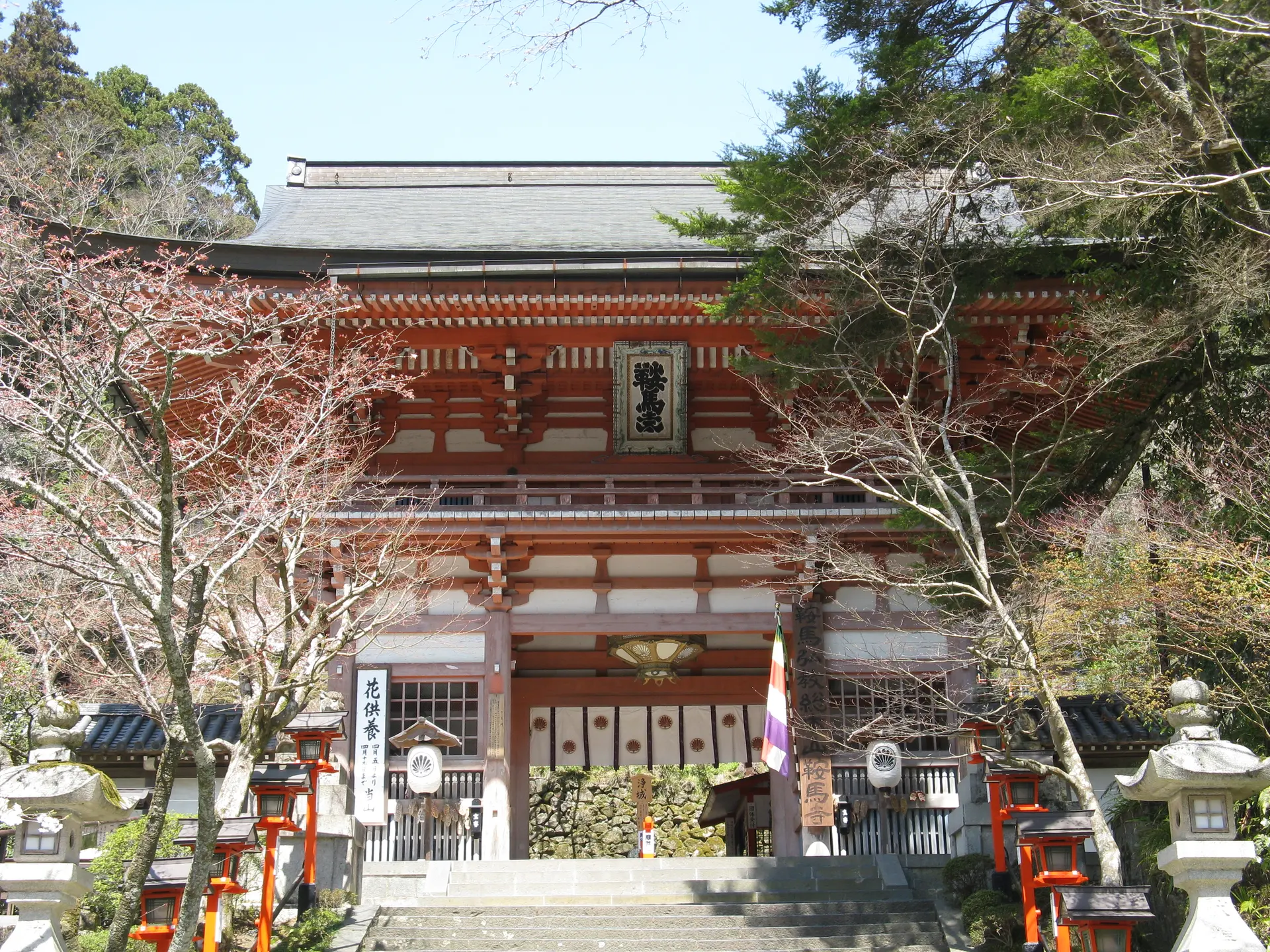
Visit essentials
A quick read before you go
- Duration
- Two to three hours for the temple exploration alone.
- Etiquette
- Kurama-dera is an active temple with regular worship.
Overview
Some mountains are simply mountains. Kurama is not one of them. For over 1,250 years, pilgrims have climbed through forests of ancient cedar, their twisted roots covering the path like fingers reaching from below, and reported encounters with something beyond the ordinary.
Kurama-dera sits partway up the mountain and has served as the headquarters of its own Buddhist sect since 1949. Its sacred landscape brings together Tengu tradition—shape-shifting guardians of forests and thresholds whose king, Sojōbō, trained the young Ushiwakamaru who became Yoshitsune—and Kurama-kokyo teaching that Mao-son descended from Venus via meteorite 6.5 million years ago. Practitioners raise their arms at the Kongoryuka triangle before the main hall to receive divine energy from above.
Whether taken as literal tradition or potent myth, the mountain's atmosphere invites attention.
In 1922, Mikao Usui undertook a 21-day meditation retreat near the summit beneath a sacred tree and received the transmission that became Reiki. Practitioners worldwide consider Kurama the birthplace of their healing tradition.
Why this place is sacred
Kurama-dera was founded in 770 CE to guard Kyoto's northern spiritual frontier. In East Asian geomancy, the north is the direction of demons and malevolent spirits, and Bishamonten, guardian of the northern quarter, was enshrined here so ritual could hold back what threatened the capital.
The mountain's power is understood to predate the temple. Mount Kurama sits on a ryuketsu, a dragon hole where concentrated life energy rises from the earth. Ancient cedars, some centuries old, are said to house the Tengu who derive from Mao-son, whose meteorite remains are enshrined at Okunoin Mao-den near the summit.
Kurama-kokyo teaching synthesizes these elements through the Sonten trinity, the universal soul manifesting as Bishamonten's light and wisdom, Senju Kannon's love and compassion, and Mao-son's power and life force. At the Kongoryuka triangle, which marks the spot where Mao-son descended, practitioners position themselves between earthly energy rising from below and cosmic energy descending from above.
For practitioners, this energy is objectively present and receivable with the proper attitude. Whether one shares that framework or not, the mountain creates conditions where something registers: attention shifts, the forest's silence feels pregnant rather than empty, and the climb becomes pilgrimage.
In 770 CE, the monk Gantei, following a vision in which his master Jianzhen instructed him to seek a mountain radiating divine light north of Kyoto, encountered Bishamonten on this peak. The temple he established served to protect the newly established capital from spiritual threats emanating from the north. For the imperial court, Kurama-dera functioned as a guardian post on the city's most vulnerable spiritual frontier.
For its first four centuries, the temple operated independently. In the 12th century, it became subordinate to Shoren-in within the Tendai sect. During this period, the temple attracted visits from Emperor Shirakawa, Fujiwara no Michinaga, and other Heian nobility. The legends of Yoshitsune and the Tengu crystallized during this era.
The radical shift came in 1947, when Abbot Shigaraki Koun established Kurama-kokyo as an independent sect, formally separating from Tendai in 1949. This new school synthesized Buddhist doctrine with local mountain beliefs and Shinto elements, recognizing Mao-son as a cosmic deity and teaching the Sonten trinity as the ultimate reality. What had been a Tendai temple became the headquarters of something new, rooted in this specific mountain's spiritual geography.
Reiki's arrival in 1922 added another dimension. Though Mikao Usui's experience predates the temple's independence, it has become woven into Kurama's identity. Practitioners from around the world now pilgrimage here, walking the same paths where Usui meditated for 21 days before receiving his transmission.
Experience and orientation
The approach to Kurama-dera begins at Nio-mon Gate, where the choice presents itself: the gentle cable car ride, or the 30-minute climb through the forest. Those seeking encounter rather than convenience choose the path. Almost immediately, the world changes. Massive cedar trees close overhead. The path, in places, is more root than stone, the exposed woody fingers of trees centuries old creating an organic staircase that seems alive underfoot.
The Tengu are said to dwell here. Visitors report a quality of watchfulness, as though the forest were attentive rather than passive. Whether this reflects the accumulated weight of centuries of belief, some property of old-growth forest, or the presence of actual spirits, the effect is consistent enough to take seriously.
At the Kongoryuka triangle before the main hall, visitors stand with arms raised facing the Honden. Whether or not they accept the temple's framework of cosmic energy, many report tingling, warmth, or a sense of opening; the experience seems to affect skeptics and believers similarly.
For Reiki practitioners, the path to Osugi Gongen near the summit carries particular power. Beneath the trees, they describe a direct connection to their tradition's source.
The crossing from Kurama to Kibune, a 3.9-kilometer trail over the mountain, offers a different quality. Here the path leads through even denser forest, past sub-shrines and sacred spots, to emerge at Kifune Shrine on the far side. Those who make this crossing often describe it as moving through different worlds, the ordinary suspended for the duration of the hike.
Approach Kurama as pilgrimage, not a day trip. Although the temple can be visited in two hours, the mountain rewards more time.
Consider walking up rather than taking the cable car, even if you ride down. The forest path offers the mountain's true introduction; let the cedars teach you their pace.
For the deepest experience, continue across the mountain to Kibune rather than turning back after the temple. Allow three to four hours for the full journey, ending at Kifune Shrine and perhaps the healing waters of the onsen.
Context and lineage
The Chinese monk Jianzhen, known in Japan as Ganjin, had founded Toshodai-ji in Nara and trained disciples in the Buddhist teachings. After his death, he appeared in a dream to his disciple Gantei, instructing him to travel north of the new capital and seek a mountain that radiated divine light.
Gantei followed a white horse into Kurama Valley. There, in vision, he encountered Bishamonten, the guardian of the north. He established Kurama-dera at that spot in 770 CE, creating a temple to protect the recently founded capital from the spiritual dangers emanating from the northern direction.
But the mountain already held power. According to Kurama-kokyo teaching, 6.5 million years ago, long before any human settlement, Mao-son descended from Venus via meteorite. This cosmic being, appearing with a long beard, great nose, wings, and a halo of leaves, came to guide humanity's spiritual evolution. The Tengu who inhabit the mountain proceed from this primordial deity. His meteorite remains are enshrined at Okunoin Mao-den near the summit.
The legend of Yoshitsune adds another layer. After the Heiji Rebellion of 1160, the infant son of the defeated Minamoto clan was sent to Kurama-dera by the victorious Taira clan to become a harmless monk. Named Ushiwakamaru, the boy was raised at the temple from age 7 to 16. But he did not become a monk. Each night, he slipped away to Sojo-gatani valley, where Sojōbō, king of all Tengu, trained him in swordsmanship, tactics, and supernatural techniques.
He left the mountain to join his brother's rebellion and became Japan's greatest military commander.
In March 1922, Mikao Usui climbed Kurama seeking enlightenment. He fasted and meditated for 21 days at Osugi Gongen, beneath a sacred tree said to incarnate Mao-son. Near the end of this retreat, he experienced profound spiritual transmission, receiving the ability to channel universal life force energy. One month later, he founded the Usui Reiki Healing Method Society in Tokyo.
For nearly 180 years, Kurama-dera operated as an independent temple. From the 12th century until 1949, it was subordinate to Shoren-in within the Tendai sect. During the Heian period, emperors and nobles made pilgrimages here, adding courtly patronage to the mountain's spiritual power.
The establishment of Kurama-kokyo in 1947 marked a radical departure. Abbot Shigaraki Koun recognized that this mountain's spirituality exceeded the bounds of orthodox Tendai Buddhism. He formalized the veneration of Mao-son, declared the unity of the Sonten trinity, and positioned Kurama-dera as headquarters of a new school that honored the mountain's unique character.
Reiki practitioners have added a global dimension to the temple's following. Mikao Usui is not venerated at the temple itself, but his 1922 retreat has drawn practitioners from around the world who seek connection to their tradition's origin point. This international pilgrimage layer exists alongside the continuing Japanese devotion to the Sonten and the Tengu.
Mao-son
deity
The cosmic being who, according to Kurama-kokyo teaching, descended from Venus 6.5 million years ago to guide humanity's spiritual evolution. Appears as a figure with a long beard, great nose, wings, and a halo of leaves. He is eternally 16 years old due to atmospheric differences between Venus and Earth. Part of the Sonten trinity representing power and life force.
Bishamonten
deity
The guardian of the north, one of the Four Heavenly Kings in Buddhism. Gantei's founding vision featured this deity, who was enshrined here to protect Kyoto from spiritual threats. Part of the Sonten trinity representing light and wisdom.
Senju Kannon
deity
The Thousand-Armed Avalokiteshvara, bodhisattva of compassion. Part of the Sonten trinity representing love and compassion.
Sojōbō
deity/spirit
The king of all Tengu in Japan, who makes his home on Mount Kurama. According to legend, he trained the young Yoshitsune in martial arts and supernatural techniques. He appears as a daitengu with a red face, long nose, and yamabushi garb.
Gantei
historical
Disciple of the Chinese monk Jianzhen who founded Kurama-dera in 770 CE after following his master's dream instruction to seek a mountain radiating divine light north of Kyoto.
Minamoto no Yoshitsune
historical/legendary
One of Japan's most legendary warriors, who according to tradition was raised at Kurama-dera from age 7 to 16 and secretly trained by the Tengu king Sojōbō. His extraordinary martial abilities are attributed to this supernatural instruction.
Mikao Usui
historical
Founder of Reiki, who received his spiritual transmission during a 21-day meditation retreat on Mount Kurama in March 1922. One month after his experience at Osugi Gongen, he established the Usui Reiki Healing Method Society.
Shigaraki Koun
historical
Abbot who established Kurama-kokyo as an independent Buddhist sect in 1947, separating the temple from Tendai in 1949. He synthesized Buddhism, Shinto, and local mountain beliefs into the unique teaching of the Sonten trinity.
Traditions and practice
The temple has hosted esoteric Buddhist rituals since its founding in 770 CE. Originally, these centered on Bishamonten as protector of the north, maintaining the spiritual defense of the capital. During the centuries of Tendai affiliation, practices included protection ceremonies, esoteric rites, and mountain asceticism influenced by Shugendo.
The Kurama Fire Festival originated in 940 CE when the deity Yuki Daimyojin was transferred to nearby Yuki-jinja. Each October 22, enormous pine torches are carried through the streets in one of Kyoto's Three Great Eccentric Festivals, culminating in the descent of sacred mikoshi from the mountain.
The Takekiri-e bamboo cutting ceremony has been performed for over a millennium. On June 20, warrior monks in Heian period costume compete to cut large bamboo stalks representing serpents. The team that finishes first predicts a better harvest for their region, either the eastern or western provinces.
Daily worship of the Sonten trinity continues at the main hall. The temple teaches that receiving Sonten's divine energy allows practitioners to live sincerely, cultivate inner peace, and fulfill their purpose.
The practice of standing at the Kongoryuka triangle with arms raised, facing the main hall, is central to contemporary Kurama-kokyo practice. This posture is believed to open the practitioner to cosmic energy from above while grounded in the earth energy of the ryuketsu below.
The Wesak Festival is celebrated on the May full moon, honoring the Buddha's birth, enlightenment, and death. Various monthly and seasonal observances maintain the temple's ritual calendar throughout the year.
Ring the temple bell once, gently, to make a wish. The bell's voice carries your intention into the mountain.
At the Kongoryuka triangle, stand at the center facing the main hall. Raise your arms. Whether you take the temple's teaching literally or approach it as contemplative practice, open yourself to what this posture invites. Many report sensations they did not expect.
Walk the mountain rather than taking the cable car, at least one direction. The tree-root path, the Kinonesando, offers encounter with the mountain's living presence. Let your pace match the forest's rhythm.
If Reiki is your practice, spend time at Osugi Gongen and at Okunoin Mao-den. Sit in meditation where Usui sat. You are not recreating his experience but connecting with its source. Let yourself receive.
Consider the full crossing from Kurama to Kibune. This transforms a temple visit into a pilgrimage through the mountain. End at Kifune Shrine, dedicated to the water kami, and if you wish, complete the journey at Kurama Onsen for purification and restoration.
Kurama-kokyo Buddhism
ActiveKurama-kokyo is the independent Buddhist sect headquartered at Kurama-dera since 1949. Founded by Abbot Shigaraki Koun in 1947, it synthesizes Buddhism, Shinto, and local mountain beliefs into a unique teaching centered on the Sonten trinity. The trinity, comprising Bishamonten, Senju Kannon, and Mao-son, represents the universal soul of the cosmos in three aspects: light and wisdom, love and compassion, and power and life force. The cosmic deity Mao-son, believed to have descended from Venus 6.5 million years ago, distinguishes this teaching from other Buddhist schools.
Daily worship of the Sonten trinity takes place at the main hall. Practitioners stand at the Kongoryuka triangle with arms raised to receive divine cosmic energy. Circumambulation of the mountain, meditation at power spots, and participation in seasonal festivals constitute regular practice. The teaching emphasizes that receiving Sonten's divine energy enables practitioners to live sincerely and fulfill their purpose.
Tengu and Mountain Spirit Veneration
ActiveMount Kurama is considered the legendary home of Sojōbō, king of all Tengu in Japan. These shape-shifting mountain spirits, manifesting as Daitengu with red faces and long noses or as Karasu Tengu with crow beaks, guard the forests and mountains. They dwell in the ancient sugi cedars whose twisted roots cover the mountain paths. According to legend, Sojōbō trained the young Yoshitsune in swordsmanship and supernatural techniques. In Kurama-kokyo teaching, the Tengu derive from Mao-son.
Reverence for Tengu imagery appears throughout the temple grounds. Walking the tree-root paths of the Kinonesando is understood as moving through Tengu territory. The valley of Sojo-gatani, where Yoshitsune is said to have trained, holds particular significance. Visitors honor the Tengu not through specific rituals but through respectful presence in their domain.
Reiki Spiritual Practice
ActiveMount Kurama is widely considered the birthplace of Reiki. In March 1922, Mikao Usui undertook a 21-day meditation and fasting retreat on this mountain. Near the summit at Osugi Gongen, beneath a sacred tree incarnation of Mao-son, he received spiritual transmission and enlightenment that enabled him to channel healing energy. One month later, he founded the Usui Reiki Healing Method Society in Tokyo. Reiki practitioners worldwide consider Mount Kurama a primary pilgrimage destination.
Practitioners pilgrimage to Kurama to connect with Reiki's source. Meditation at the summit and at Osugi Gongen, walking the mountain paths Usui walked, and personal Reiki practice on the mountain constitute common activities. Some practitioners undertake their own multi-day retreats in the tradition of Usui's original experience.
Tendai Buddhism (historical)
HistoricalFrom the 12th century until 1949, Kurama-dera was subordinate to Shoren-in within the Tendai sect. The original objects of worship were Bishamonten and the Thousand-Armed Kannon. The temple served as a guardian of northern Kyoto, protecting the capital from spiritual threats. During this period, the temple attracted visits from Emperor Shirakawa, Fujiwara no Michinaga, and other Heian nobility.
Bishamonten worship, esoteric Buddhist rituals, and protection ceremonies for the capital characterized this period. The temple functioned within the broader Tendai institutional framework while maintaining its distinctive role as guardian of the north.
Shugendo Mountain Asceticism
HistoricalMount Kurama has historical connections to Shugendo, the syncretic tradition combining esoteric Buddhism, Shinto, and Taoism practiced by yamabushi mountain ascetics. The Tengu themselves are often depicted in yamabushi garb, and Sojōbō appears as a yamabushi master. Kurama-kokyo teaching was, according to some sources, inspired and created from several traditions including Shugendo. Legend holds that Aikido founder Morihei Ueshiba learned martial arts from a yamabushi on this mountain.
Mountain pilgrimages, ascetic training in the forests, meditation at power spots, and martial arts training under spiritual guidance characterized Shugendo practice on Kurama. The crossing from Kurama to Kibune follows routes that yamabushi would have walked.
Perspectives and open questions
Kurama-dera's own teaching, scholarly historical analysis, and Reiki practitioners' experiences offer distinct insights that do not resolve neatly into one another.
Scholarly perspective
Historians view Kurama-dera as a significant example of Japanese mountain temple development. The founding in 770 CE positioned the site at the spiritual frontier of the new Heian capital, part of the geomantic system protecting Kyoto from the north. The Yoshitsune legends crystallized during the Heian period and reflect broader patterns of Japanese hero mythology and warrior culture.
The temple's 1949 independence from Tendai represents an unusual case of modern sect formation, with Kurama-kokyo synthesizing Buddhist doctrine, Shinto elements, and local mountain beliefs into a unique teaching. Scholars note parallels with Shugendo's syncretic approach while recognizing the specific innovations of Mao-son theology and Sonten doctrine.
The Tengu traditions connect to broader patterns of mountain spirit veneration across Japan, with Kurama serving as the legendary seat of Sojōbō, their king. These beliefs interweave with Shugendo practice, where yamabushi mountain ascetics dressed in garb similar to how Tengu are depicted.
Living and traditional perspectives
Within Kurama-kokyo teaching, Mount Kurama is not merely sacred by human designation but objectively powerful. The mountain sits on a ryuketsu, a concentration point of earth energy. Mao-son descended from Venus 6.5 million years ago and remains present, his meteorite enshrined at Okunoin Mao-den. The Tengu proceed from this cosmic being and continue to guard the mountain.
The Sonten trinity, the universal soul appearing as Bishamonten, Senju Kannon, and Mao-son, represents ultimate reality accessible through practice at this site. The energy at the Kongoryuka triangle is not metaphor but actual force, receivable by those who approach with proper attitude. This teaching does not ask practitioners to believe something they cannot experience but to experience what the mountain offers.
Alternative interpretations
For Reiki practitioners worldwide, Mount Kurama is the origin point of their healing tradition. Mikao Usui's 21-day retreat in 1922, culminating in spiritual transmission at Osugi Gongen, represents the moment when universal life force energy became accessible through the specific techniques he subsequently taught. Some Reiki lineages emphasize the mountain's position on global energy lines and draw connections to Sanat Kumara traditions found in Theosophy.
The Mao-son legend, with its descent from Venus 6.5 million years ago, resonates with certain New Age cosmologies. Some practitioners frame Kurama as a dimensional portal or anchor point for extraterrestrial spiritual guidance. These interpretations extend beyond the temple's own teaching but arise from genuine experiences visitors report.
Open questions
Genuine mysteries remain at Kurama. What exactly did Mikao Usui experience during his 21-day retreat that enabled the development of Reiki? The traditional account is vivid but lacks historical documentation from the period itself.
How did the Tengu legends develop, and what do they encode about the historical practices of mountain ascetics on Kurama? The line between mythology and preserved memory of actual Shugendo training remains unclear.
What is the actual nature of the cosmic energy that visitors report experiencing at the Kongoryuka triangle? Scientific measurement has not confirmed it, yet the consistency of reports across different belief systems suggests something worth attending to, even if we lack vocabulary for it.
What practices did Yoshitsune actually learn at Kurama that made him such an extraordinary warrior? The legend points to supernatural instruction, but this may encode more mundane realities of military training at mountain temples during the Heian period.
Plan your visit
Access and arrival
Most visitors stay in central Kyoto and travel to Kurama as a day trip. The village of Kurama offers limited ryokan accommodations for those who wish to spend more time with the mountain. Kurama Onsen includes overnight facilities. For those making Kurama part of a longer pilgrimage, Kibune village on the far side of the mountain also offers traditional ryokan.
Respectful visit
Comfortable hiking clothes with sturdy footwear are essential for the mountain trails. The tree-root paths and the crossing to Kibune require shoes with good grip. Layers accommodate the cooler temperatures at elevation. Modest clothing is appropriate for a temple, but no formal dress code exists.
Photography is not permitted inside the main hall or of the main hall from outside. General photography on the grounds and trails is allowed. Avoid flash during any ceremonies. Be mindful of photographing worshippers without their consent.
Small monetary offerings may be placed at the main hall's offering box. Do not leave litter on the mountain. The offerings here are simple: attention, reverence, and leaving no trace.
Do not step across the Kongoryuka triangle's hexagonal stone pattern; crossing it is considered spiritually harmful and disrespectful to the practice of those for whom this spot is central. Remain on designated paths. Do not climb on or touch the ancient trees. Respect closed areas. The Reihoden museum closes on Mondays and from December 12 through the end of February.
The Kurama Fire Festival on October 22 draws enormous crowds. If you attend, prepare for intense crowding, limited transportation, and the possibility that you may not see the central rituals clearly. The experience is powerful but not conducive to contemplation.
The mountain trails require appropriate footwear. The tree-root paths can be slippery when wet. Allow adequate time and physical preparation for the crossing to Kibune.
Current practical details
Address
1074 Kuramahonmachi, Sakyo Ward, Kyoto, 601-1111, Japan
Phone
Hours
Hours, fees, and access can change — verify on the official source before you travel. Practical details last checked Jun 2026.
Location
Map loads as you approach this section.
Pilgrim reflections
A portrait of encounter, not a score
Pilgrims describe what they felt, how present they could become, and whether the place would shape a journey. There are no stars and no ranking of traditions.
No reviewed reflections yet
The first pilgrims can help describe the character of being here.
Share a reflection
Available after an account-backed “Been there.” Every reflection is reviewed before publication.
Nearby sacred places
Explore other sacred places in the region. Proximity does not establish access or travel time; check each place’s guidance.


References
Sources consulted for this page. Source categories describe the publication, not a guarantee that every claim is verified. Traditional accounts and outside interpretations may differ.
- 01Kuramadera Temple — Japan National Tourism OrganizationofficialOfficial tourism authority information
- 02Kurama-dera — Wikipedia contributorsacademicComprehensive overview with citations on temple history and Kurama-kokyo sect
- 03Kurama-dera — Discover KyotoguideDetailed visitor information and historical context
- 04Sōjōbō — Wikipedia contributorsacademicPrimary source for Tengu king mythology
- 05Mikao Usui — Wikipedia contributorsacademicBiographical information on Reiki founder
- 06Kurama Fire Festival — Wikipedia contributorsacademicFestival history and rituals
- 07Takekiri eshiki — Wikipedia contributorsacademicBamboo cutting ceremony details
- 08Kurama-dera temple: a mystical and spiritual place north of Kyoto — Japan ExperienceguidePractical visitor information and historical overview
- 09Great Tengu of Mount Kurama, Kyoto — Sara KuehnacademicScholarly perspective on Tengu mythology and temple history
- 10Kurama — Japan GuideguideComprehensive practical visitor information
- 11Minamoto no Yoshitsune — Wikipedia contributorsacademicHistorical context for Yoshitsune legends
- 12Shugendō — Wikipedia contributorsacademicBackground on mountain asceticism traditions
Pilgrim glossary
- Kannon
- The bodhisattva of compassion, central to many East Asian pilgrimage routes.
- Mikoshi
- A portable Shinto shrine carried during festivals to bring a deity into the community.
- Tendai
- A Japanese Buddhist school based on the Lotus Sutra, foundational to many later traditions.
Share a photo
Help visitors recognize Kurama-dera Temple. Every submission is reviewed before publication.