Daihōon-ji
Kyoto's oldest standing wooden hall, raised in 1227 and still in daily Shingon use
Understand sacred places, explore living traditions, and learn how to engage respectfully with Pilgrim Map.
Access has not been verified. Check current local guidance before planning a visit.
Kyoto Prefecture, Japan
Read the sources
Station 16 of 33
New Saigoku Kannon PilgrimageVisit essentials
A quick read before you go
- Duration
- 60–90 minutes including the Reihōden treasure museum
- Access
- Kyoto City Bus #50, #101, #102, or #203 to Kamishichiken bus stop and a three-minute walk; or…
Overview
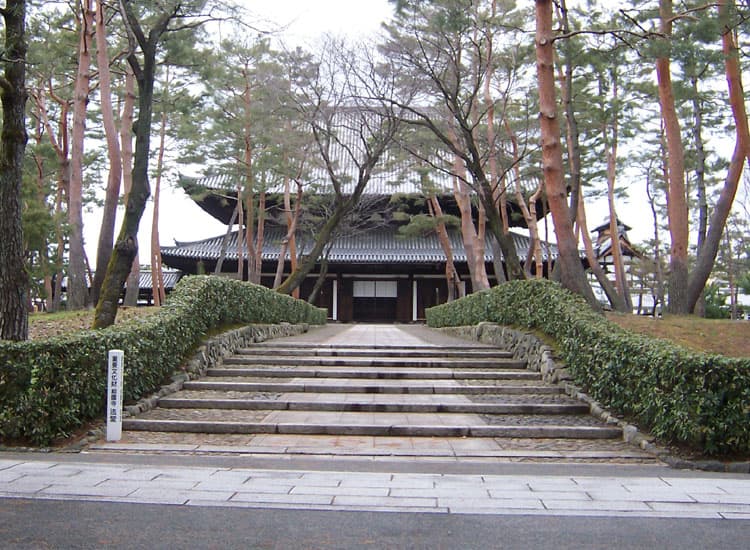
In quiet streets northwest of central Kyoto, Daihōon-ji's Hondō, completed in 1227, is central Kyoto's oldest surviving wooden building. It endured the Ōnin War of 1467–1477, which burned nearly all medieval Kyoto. Founded by Gikū in 1220, the temple has remained a Shingon (Chizan-ha) devotional house for eight centuries.
Its popular name, Senbon Shakadō, refers to the principal Shaka image—Shakyamuni, the historical Buddha—while pilgrimage centers on Jōkei's Six Kannon and Kaikei's Ten Great Disciples. Now sheltered in the Reihōden treasure house, these are among Japan's most-studied 13th-century sculptures and still receive offerings from the lineage that commissioned them.
A folk layer accompanies formal Buddhism. The story of Okame—the carpenter's wife who saved construction and took her life so her husband would receive credit—made the temple a focus of women's memorial devotion; Okame masks return at Setsubun in early February. On December 7th and 8th, Daikon-daki serves simmered radishes inscribed with Sanskrit characters to ward off winter illness and commemorate the Buddha's awakening.
Eight centuries of footsteps and carvings made within a generation of the hall embody visible continuity. Pilgrimage is one layer: Kannon devotion stands neither above nor below the older Shaka focus, both honored here without interruption.
Why this place is sacred
Few buildings in Japan carry such a particular kind of accumulated time. The 1227 Hondō was raised one year after Hōnen's death, in a Kyoto still recovering from the Genpei wars, and has remained continuously in use through the destruction of nearly every other medieval building around it. The Ōnin War's flames reached its precincts and stopped. Subsequent fires bypassed it.
Within its walls, six wooden Kannon by Jōkei and ten standing disciples by Kaikei have received daily offering for nearly the same span. The combination — original architecture, original sculpture, continuous practice — is rare even in Kyoto.
Founded in 1220 by the monk Gikū as a Shingon devotional centre dedicated to Shaka Nyorai, with esoteric programmes around the Six Kannon mandalic grouping.
The temple has remained Shingon Chizan-ha through eight centuries; the folk Okame tradition emerged from medieval carpentry legend and now centres Setsubun observances; the Daikon-daki festival appears to have stabilised in the Edo period and continues annually.
Experience and orientation
The approach is unceremonial. Daihōon-ji sits among low Kyoto townhouses, accessed by a side gate rather than a grand approach. The 1227 hall reveals itself gradually — first its tile roof above the precinct wall, then its full breadth as you cross the inner gate. Photography is not permitted inside; visitors are asked to put cameras away on entering.
Within, the air carries the particular mineral coolness of long-aged wood, and the Six Kannon stand in their ranks at sculptural eye-level. The Reihōden museum, separately ticketed, allows extended viewing of the same images and Kaikei's Ten Great Disciples.
December 7 and 8 transform the temple. Steam from the Daikon-daki cauldrons fills the courtyard from morning. Visitors queue, some patiently in cold rain, for a bowl of simmered radish blessed by Sanskrit-inscribed prayer. The act commemorates Shakyamuni's enlightenment and is held to protect against the winter's illnesses. Setsubun in early February brings the Okame masks; cherry blossom in early April brings the temple's distinctive Okame-zakura, a weeping cherry that blooms earlier than most.
Approach via Kyoto City Bus (#50, #101, #102, or #203) to Kamishichiken bus stop and walk three minutes; or take the Keifuku Randen line to Kitano-Hakubaichō and walk ten minutes. The temple is in northwest Kyoto, between Imadegawa-dōri and the Kamishichiken geisha quarter. Allow 60–90 minutes including the Reihōden museum.
Context and lineage
Tradition gives the earliest origins to Emperor Yōmei in the sixth century, but the documented re-founding is the 1220 act of Gikū. The Okame story — central to the temple's folk identity — narrates that during construction, the master carpenter mistakenly cut a donor's pillar short. His wife Okame quietly suggested the use of bracket-arms (tosugumi) to compensate, and the fault was hidden in the finished structure. The hall was raised on 26 December 1227.
Okame had already taken her own life days before the raising, so that no one would say a great hall in central Kyoto owed its survival to a woman's counsel. The temple has enshrined Okame masks during Setsubun in her memory ever since.
Shingon Buddhism, Chizan-ha branch — a major sub-school within Shingon centred on Chishaku-in in eastern Kyoto.
Gikū
founding monk (1220)
Nagai Hida-no-Kami Takatsugu
master carpenter of the 1227 hall
Okame
the carpenter's wife of the legend; subject of continuing memorial devotion
Kaikei
Kamakura-period sculptor of the Ten Great Disciples (Important Cultural Properties)
Jōkei
Kamakura-period sculptor of the Six Wooden Kannon (National Treasures)
Traditions and practice
Shingon morning liturgy; Setsubun bean-throwing accompanied by Okame mask dance; the Daikon-daki festival on December 7–8 in which Sanskrit-inscribed daikon are simmered and distributed to commemorate Shakyamuni's awakening and ward off illness; annual memorial services for Okame.
Visitors may enter the National Treasure hall during open hours for quiet veneration, walk through the Reihōden museum to view the Kaikei and Jōkei sculptures at close range, and receive goshuin pilgrimage stamps at the temple office.
First-time visitors may simply sit briefly in the hall before approaching the museum — the time-quality of the building takes a few minutes to register. December 7–8 is the year's most distinctive day for those who are in Kyoto then; February's Setsubun is the same intensity in a different key.
Shingon Buddhism (Chizan-ha)
ActiveFounded in 1220 by the monk Gikū during the Kamakura period; the main hall completed in 1227 is the oldest surviving wooden structure in central Kyoto. Famous for housing some of the finest Kamakura-period Buddhist sculpture by master carvers Kaikei and Jōkei.
Perspectives and open questions
Daihōon-ji's significance is held simultaneously by art historians, by Shingon practitioners, and by the lay devotees of Kyoto's townspeople tradition. These framings rarely conflict here; they overlay one another in a way characteristic of long-running Japanese temples.
Scholarly perspective
Architectural historians treat the 1227 Hondō as the indisputable oldest surviving wooden building in central Kyoto and one of the most important Kamakura-period architectural survivals in Japan. Kaikei's Ten Great Disciples and Jōkei's Six Kannon are among the most-studied 13th-century sculpture in the country.
Living and traditional perspectives
Kyoto townspeople treat the temple as a year-round protective space, with the Okame-mask tradition forming a folk-devotional layer overlapping the formal Buddhist programme. The Daikon-daki has the character of a neighbourhood festival as much as a temple rite.
Alternative interpretations
Some Shingon teachers read the temple's Shaka–Six-Kannon devotional pairing as a complete maṇḍala of compassionate response (Kannon) and historical Buddha (Shaka).
Open questions
The original carpenter's identity behind the Okame story is partly legendary; the precise donor and patron history of the 1227 hall is still being clarified by historical-document scholarship.
Plan your visit
Access and arrival
Kyoto City Bus #50, #101, #102, or #203 to Kamishichiken bus stop and a three-minute walk; or Keifuku Randen line to Kitano-Hakubaichō Station, ten-minute walk. Located between Imadegawa-dōri and Kamishichiken in northwest Kyoto.
Numerous Kyoto city-centre hotels are within a 15-minute taxi or 30-minute bus ride; nearby ryokan and machiya rentals exist in the Imadegawa area for those wishing to walk.
Respectful visit
Smart casual; remove hats indoors; in December, dress for Kyoto winter — the queue moves slowly outdoors.
Permitted in open precincts; prohibited inside the National Treasure hall and the Reihōden museum.
Incense, candles, monetary saisen, daikon donations during the December festival.
Quiet observation during services | No food or drink inside hall structures
Photography is prohibited inside the National Treasure hall and the Reihōden. December's Daikon-daki involves a cold outdoor queue; dress warmly.
Current practical details
Address
1034 Mizomaechō, Kamigyo Ward, Kyoto, 602-8319, Japan
Phone
Hours
Hours, fees, and access can change — verify on the official source before you travel. Practical details last checked Jun 2026.
Location
Map loads as you approach this section.
Pilgrim reflections
A portrait of encounter, not a score
Pilgrims describe what they felt, how present they could become, and whether the place would shape a journey. There are no stars and no ranking of traditions.
No reviewed reflections yet
The first pilgrims can help describe the character of being here.
Share a reflection
Available after an account-backed “Been there.” Every reflection is reviewed before publication.
Nearby sacred places
Explore other sacred places in the region. Proximity does not establish access or travel time; check each place’s guidance.


References
Sources consulted for this page. Source categories describe the publication, not a guarantee that every claim is verified. Traditional accounts and outside interpretations may differ.
- 01大報恩寺 official site — Daihōon-jiofficialAuthoritative source for sect, treasures, and visitor information.
- 02大報恩寺(千本釈迦堂) — 京都市公式 京都観光Navi — Kyoto City Tourism BureauofficialCity tourism record.
- 03Tokyo National Museum — The Buddhist Sculptures of Daihōon-ji, Kyoto: Masterpieces by Kaikei and Jōkei — Tokyo National MuseumacademicMuseum catalogue confirming sculpture attributions and ICP/National Treasure status.
- 04大報恩寺(千本釈迦堂) — 多言語解説文データベース — MLIT (Ministry of Land, Infrastructure, Transport and Tourism)officialGovernment-curated multilingual heritage interpretation.
- 05大報恩寺 — Wikipedia (Japanese) — Wikipedia contributorsacademicSource for coordinates, founding history, Okame legend, treasure listings.
Pilgrim glossary
- Kannon
- The bodhisattva of compassion, central to many East Asian pilgrimage routes.
- Shingon
- An esoteric Japanese Buddhist school emphasizing ritual, mantra, and mandala practice.
Share a photo
Help visitors recognize Daihōon-ji. Every submission is reviewed before publication.