Tachiki-Kannon An’yō-ji
An 800-step climb to Kūkai's yakuyoke Kannon, founded in his 42nd unlucky year
Understand sacred places, explore living traditions, and learn how to engage respectfully with Pilgrim Map.
Access has not been verified. Check current local guidance before planning a visit.
Shiga Prefecture, Japan
Read the sources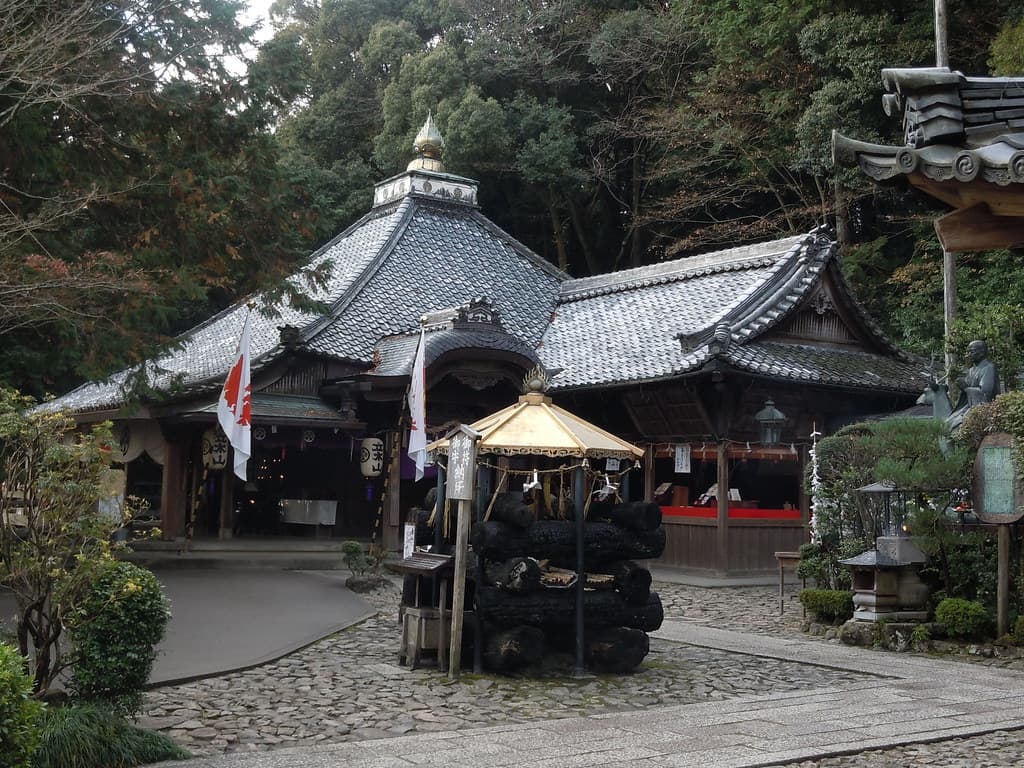
Image of Tachiki-Kannon An’yō-ji. Image source
Station 20 of 33
New Saigoku Kannon PilgrimageVisit essentials
A quick read before you go
- Duration
- 2–3 hours including the ascent, time at the precinct, and the descent
- Access
- JR Ishiyama Station then Keihan Bus to 'Tachiki Kannon-mae' (around 25 minutes) at the foot of…
Overview
Tachiki Kannon—formally An'yō-ji—stands on a cliff above the Seta River south of Lake Biwa. Pilgrims enact yakuyoke by walking roughly 800 stone steps; a gentler 90-minute alternate path serves those who cannot manage them. Both reach the same main hall and its principal Sho Kannon. The prayer is somatic: the ascent itself is the rite.
Tradition says that in 815, during his own male yakudoshi at age 42, Kūkai saw a shining sacred tree across the fast Seta River. A white deer carried him over, revealed itself as Kannon, and vanished. Kūkai carved the standing-tree Sho Kannon at his own height, then Bishamonten and Kōmokuten from the remaining wood, founding the temple as his personal yakuyoke. That 42nd-year act still anchors its specialty.
Founded as Shingon under Kūkai, An'yō-ji is now Pure Land (Jōdo-shū); reliable sources report both lineages without conflict. Across that change, pilgrims in calendar yakudoshi years—men 25, 42, 61; women 19, 33, 37—continue to climb as a personal warding act and receive yakuyoke ofuda from the temple office.
Why this place is sacred
Few Japanese pilgrimage temples build their devotional act so directly into bodily exertion. The 800 steps are not separate from the rite — they are the rite. The climb is consciously undertaken in life-stages defined by the East Asian calendar, particularly during yakudoshi years considered inauspicious. The temple has held this function for twelve centuries, longer than most modern Japanese institutions, and the founder's own age at founding (42, male yakudoshi) is the cornerstone of the practice.
The ascent transforms a calendar concern into a discrete, completed act.
Founded in 815 CE by Kūkai (Kōbō Daishi) at age 42 as a Shingon yakuyoke (warding-off-misfortune) temple dedicated to Sho Kannon carved from a sacred standing tree.
The temple's affiliation has shifted from Shingon at founding to Jōdo-shū (Pure Land) in the present; the yakuyoke tradition has remained continuous across both sectarian periods.
Experience and orientation
Most pilgrims meet the steps as the day's central feature. The ascent is steep, paved in old stone, and shaded by the temple's mountain canopy; birdsong replaces road noise within the first few minutes. There is no quick way up. Visitors who undertake the climb in summer should carry water and start early; in winter, after snow, the steps are dangerous and the gentler path is strongly preferred.
At the top, the precinct opens cliffside above the Seta River. The main hall houses the Sho Kannon (a hibutsu, secret-image, in present practice). Pilgrims pause to recite a brief prayer or nembutsu, light incense, and proceed to the temple office for a yakuyoke ofuda. The view itself functions as part of the rite — the act of turning from the climb to the valley below tends to settle whatever life concern brought the pilgrim.
Many visitors report arriving with a particular issue and leaving having committed it to the climb.
JR Ishiyama Station then Keihan Bus to 'Tachiki Kannon-mae' (around 25 minutes), at the foot of the steps. By car, fifteen minutes from the Seta-Higashi IC of the Meishin Expressway. Open daily 9:00–16:00; parking for around 50 cars. Allow 2–3 hours for the full ascent and descent.
Context and lineage
Tradition holds that Kūkai, in 815, was travelling along the Seta River when he saw a sacred tree shining on the far bank. The river was running too fast to ford. A white deer appeared and carried him across; the deer revealed itself as Kannon and vanished.
Kūkai carved the Sho Kannon directly from the standing tree at his own height (5 shaku 3 sun, approximately 1.6 m), and additional Bishamonten and Kōmokuten figures from the remaining wood, plus a self-portrait. He founded the temple as his personal yakuyoke — the warding act of his own 42nd unlucky year.
Currently Pure Land (Jōdo-shū); founded as Shingon under Kūkai. Both lineages are reported in temple history.
Kūkai (Kōbō Daishi)
founder, 815 CE; age 42 at founding, in his own yakudoshi year; carver of the Sho Kannon, Bishamonten, and Kōmokuten from the standing tree
The white deer
manifestation of Kannon in the founding legend
Successive Jōdo-shū abbots
stewards of the present-day Pure Land affiliation
Traditions and practice
Yakuyoke prayer ceremonies tied to the climber's calendar age — particularly during yakudoshi (unlucky) years for men (25, 42, 61) and women (19, 33, 37). Daily nembutsu chanting and Pure Land services. Fire and water purification of pilgrim stamps takes place at the temple office.
Pilgrims climb the 800 stone steps as their own yakuyoke act, recite a short prayer or nembutsu at each kannon-dō, and may receive a yakuyoke ofuda from the temple office. Goshuin pilgrim stamps are issued for the New Saigoku, Saigoku, and other regional circuits.
First-time visitors should plan for early-morning arrival to avoid heat and crowds; carry water; pause at the small wayside shrines as they appear. The climb itself is the practice — there is no need to hurry. At the top, allow time at the cliffside hand-washing basin and the main hall before descending.
Pure Land Buddhism (Jōdo-shū)
ActiveCurrently affiliated with the Jōdo (Pure Land) sect; specialises in yakuyoke (warding-off-misfortune) prayers tied to Kūkai's traditional age (42, considered the male inauspicious year).
Shingon (founding tradition)
HistoricalFounding tradition attributes the temple to Kūkai, age 42 in 815 — the unlucky-year founding is the basis for the temple's continuing yakuyoke speciality.
Perspectives and open questions
Tachiki Kannon is read differently by art historians, by Pure Land practitioners, and by Shingon adherents who preserve the founding-by-Kūkai narrative. The temple itself accommodates all three readings.
Scholarly perspective
Art-historical work generally accepts the temple's continuous role from the early Heian period as a Kannon and yakuyoke centre; the precise dating of the principal sculpture depends on temple tradition rather than independent stylistic analysis.
Living and traditional perspectives
Throughout the Lake Biwa region, Tachiki-san is the canonical destination for yakudoshi pilgrimages; locals refer to it simply as 'Tachiki-san'.
Alternative interpretations
Shingon adherents preserve the founding-by-Kūkai narrative even though the temple now operates within Jōdo-shū. The white-deer story is read as a manifestation of Kannon's compassionate response — the bodhisattva crossing the river to bring the founder to the carving site.
Open questions
The original Kūkai-attributed Sho Kannon is hibutsu (secret); independent dating has not been published, so the relationship of the present-day icon to the 815 carving rests on temple tradition rather than direct material evidence.
Plan your visit
Access and arrival
JR Ishiyama Station then Keihan Bus to 'Tachiki Kannon-mae' (around 25 minutes) at the foot of the steps. By car, fifteen minutes from the Seta-Higashi IC of the Meishin Expressway. Approximately 50 parking spaces available.
Lake Biwa hotels in Ōtsu and ryokan in nearby Ishiyama provide convenient overnight options.
Respectful visit
Sturdy walking shoes; layered clothing; bring water especially in summer.
Permitted in the open precincts; not permitted of the inner sanctum.
Incense, candles, monetary saisen, yakuyoke prayer slips.
The 800-step climb is unsuitable for some visitors | Open daily 9:00–16:00
The climb is unsuitable for some visitors; the gentler 90-minute alternate path is strongly recommended for pilgrims with reduced mobility. Mid-summer afternoons carry heat-exposure risk on the stone steps; snowy or icy days make the steps hazardous.
Current practical details
Address
Japan, 〒520-0865 Shiga, Otsu, Ishiyamanangōchō, 奥山1231
Phone
Hours
Hours, fees, and access can change — verify on the official source before you travel. Practical details last checked Jun 2026.
Location
Map loads as you approach this section.
Pilgrim reflections
A portrait of encounter, not a score
Pilgrims describe what they felt, how present they could become, and whether the place would shape a journey. There are no stars and no ranking of traditions.
No reviewed reflections yet
The first pilgrims can help describe the character of being here.
Share a reflection
Available after an account-backed “Been there.” Every reflection is reviewed before publication.
Nearby sacred places
Explore other sacred places in the region. Proximity does not establish access or travel time; check each place’s guidance.


References
Sources consulted for this page. Source categories describe the publication, not a guarantee that every claim is verified. Traditional accounts and outside interpretations may differ.
- 01厄除 立木観音 official site — An'yō-jiofficialTemple's own site, authoritative for ritual calendar, history page, and access information.
- 02Tachiki Kannon (Tachikizan Anyo-ji Temple) — Biwako Otsu Travel Guide — Otsu Tourism AssociationofficialOfficial municipal travel record.
- 03立木観音 — Japan Tourism Agency multilingual database — MLIT / Japan Tourism AgencyofficialGovernment-curated heritage interpretation.
- 04安養寺 (大津市石山南郷町) — Wikipedia (Japanese) — Wikipedia contributorsacademicSource for coordinates, sect, founding tradition.
Pilgrim glossary
- Kannon
- The bodhisattva of compassion, central to many East Asian pilgrimage routes.
- Bodhisattva
- An enlightened being who postpones full nirvana to help others toward awakening.
- Shingon
- An esoteric Japanese Buddhist school emphasizing ritual, mantra, and mandala practice.
- Pure Land
- A Buddhist tradition focused on rebirth in Amida Buddha's western paradise through devotional practice.
Share a photo
Help visitors recognize Tachiki-Kannon An’yō-ji. Every submission is reviewed before publication.