Hiyoshi Taisha
Where mountain deity and monkey messengers guard against misfortune
Understand sacred places, explore living traditions, and learn how to engage respectfully with Pilgrim Map.
Access has not been verified. Check current local guidance before planning a visit.
Otsu, Shiga Prefecture, Japan
Read the sources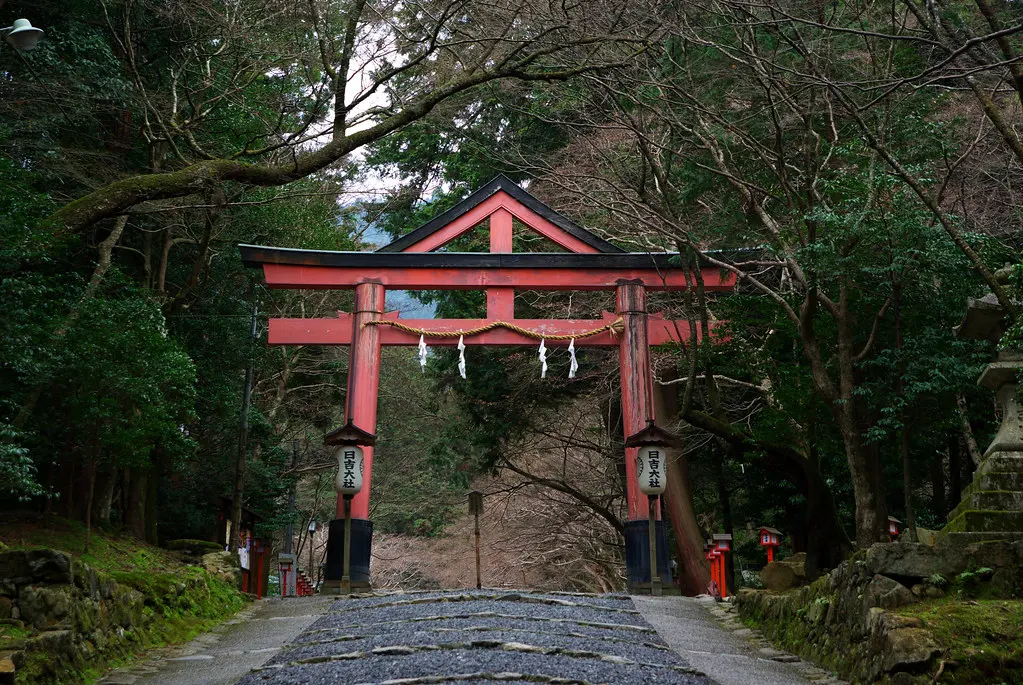
Image of Hiyoshi Taisha. Image source
Visit essentials
A quick read before you go
- Duration
- 1-2 hours to explore the main shrines and grounds.
- Access
- 20-minute walk from Hieizan-Sakamoto Station (JR Kosei Line) or 10-minute walk from…
Overview
Hiyoshi Taisha stands where sacred Mount Hiei meets human settlement, enshrining Oyamakui, who has dwelt on the mountain since before recorded history. For over 2,100 years, pilgrims have sought protection from illness, misfortune, and spiritual dangers flowing from the northeast. Monkey messengers carved into architecture and shown on protective charms are divine intermediaries, not decoration; their name, Masaru, means both monkey and victory over evil.
Hiyoshi Taisha heads approximately 3,800 Hiyoshi, Hie, and Sanno shrines across Japan, the country's seventh largest shrine network. Its forested hillside holds two National Treasure main halls and approximately 3,000 maple trees that turn the complex to living fire each November. For eight centuries, the Sanno Festival has reenacted divine union and birth through mikoshi processions and rituals culminating in boats crossing Shiga's waters. This is living rather than museum religion, where ancient protection remains available to seekers.
Why this place is sacred
The sacred geography here is layered. Mount Hiei rises behind the shrine, a mountain understood since ancient times as the home of kami. The shrine complex sits at the boundary between that wild sacred mountain and the human world below. For those familiar with East Asian spiritual geography, the position carries additional weight: the shrine guards the northeast of what was once the imperial capital, the kimon or demon gate direction from which evil spirits were believed to approach.
Enryaku-ji temple, founded on the summit in 788 CE, reinforced this protective function from the Buddhist side. The wild monkeys that inhabit the mountain and appear throughout the shrine are not incidental—they have been understood as divine messengers since time beyond memory, their very name adapted into prayers for victory over misfortune. The distinctive Sanno torii gates, with their triangular gables suggesting mountain peaks, mark thresholds between ordinary and sacred space.
Within this geography, the two main halls—Nishi Hongu and Higashi Hongu—anchor different aspects of the divine presence. The eastern hall enshrines the original mountain deity; the western, a kami relocated when emperors moved their capital. Together they create a spiritual complex that has accumulated power through over two millennia of continuous worship.
The site served as the dwelling place and worship point for the mountain deity Oyamakui no kami, with formal enshrinement dating traditionally to 90 BCE under Emperor Sujin.
When Saicho founded Enryaku-ji on Mount Hiei in 788 CE, the shrine became deeply intertwined with Tendai Buddhism. For nearly a thousand years, Shinto and Buddhist elements merged in the syncretic Sanno-Shinto tradition. This ended dramatically in 1868 when the Meiji restoration mandated separation of religions. Hiyoshi Taisha was at the forefront of this purging, destroying its Buddhist elements. What remains is purely Shinto, though the memory of the syncretic period persists.
Experience and orientation
The approach to Hiyoshi Taisha passes through the distinctive Sanno torii, its triangular gable unlike any other shrine gate design, marking the transition into sacred space. The complex is extensive, spreading across forested hillside in a way that rewards unhurried exploration. Paths wind between subsidiary shrines, stone lanterns, and massive trees. At the corners of the Romon gate, monkey sculptures stand guard—these are the Masaru, the divine messengers whose presence pervades the shrine.
The two main halls, both designated National Treasures, demonstrate the distinctive Hie-zukuri architectural style that originated here. Standing before them, one senses the accumulated presence of over two thousand years of worship. For those who visit in autumn, the experience transforms. Approximately 3,000 maple trees create cascades of red and gold, and evening illuminations cast the colors into otherworldly relief. The combination of ancient architecture and living fire creates an atmosphere that visitors describe as transcendent.
During the Sanno Festival in April, the shrine becomes theater for divine drama—mikoshi bearers carrying portable shrines through rituals celebrating sacred marriage and birth, their movements connecting to ceremonies performed here for nearly a millennium.
Enter through the Sanno torii and take time with the Romon gate's monkey guardians. The East and West Main Halls deserve unhurried attention. Allow the paths between subsidiary shrines to unfold naturally—getting slightly lost here is part of the experience. If visiting during autumn illuminations, arrive before sunset to see the transition from daylight to artificial light.
Context and lineage
According to the Kojiki, the kami Oyamakui has resided on Mount Hiei from ancient times. In the seventh year of Emperor Sujin's reign—traditionally dated to 90 BCE—this deity was formally enshrined at the mountain's foot, establishing what would become the Higashi Hongu (Eastern Main Hall). Centuries later, when Emperor Tenji moved the capital to Omi Province in 668 CE, he relocated the kami from Omiwa Shrine in Yamato to create the Nishi Hongu (Western Main Hall).
The shrine's protective function expanded dramatically in 788 CE when the monk Saicho founded Enryaku-ji on the summit above. For the next thousand years, the shrine and temple worked together—the mountain deity protecting the Buddhist establishment, the monks honoring the kami—until the Meiji restoration forcibly separated them.
The shrine leads the Sanno faith, a network of approximately 3,800 Hiyoshi, Hie, and Sanno shrines across Japan—the seventh largest shrine network in the country.
Oyamakui no kami
The mountain deity who has resided on Mount Hiei since prehistoric times, enshrined as the primary kami of the Eastern Main Hall
Emperor Sujin
Traditionally credited with the formal enshrinement of Oyamakui in 90 BCE
Saicho (Dengyo Daishi)
Founder of Enryaku-ji temple in 788 CE, whose establishment transformed Hiyoshi Taisha into the guardian shrine of Tendai Buddhism
Traditions and practice
The Sanno Festival originated in the late 11th century and remains one of the three major Lake Biwa festivals. Over three days in April, rituals reenact divine marriage and birth. On the 12th, two mikoshi descend from Mount Ushio, representing the union of deities. On the 13th, the violent shaking of the portable shrines represents the birth of a divine prince.
On the 14th, seven mikoshi are placed on boats for the Awazu no Goku ritual, crossing the waters in ceremonial procession. Historically, the festival was held on the Day of the Monkey in the fourth lunar month, linking it to the shrine's divine messengers.
Daily worship continues at both main halls. The Sanno Festival (April 12-14) draws visitors from across Japan. Autumn illuminations in November showcase the approximately 3,000 maple trees in dramatic nighttime display. Protective omamori featuring the monkey motif are popular with visitors seeking the shrine's famous protection against misfortune.
For those seeking the shrine's protective blessing, worship at both main halls and consider obtaining an omamori featuring the Masaru monkey. If visiting during the Sanno Festival, the evening events on April 12th and the mikoshi boats on April 14th are particularly powerful. Autumn visitors should plan for evening illuminations.
Shinto
ActiveHiyoshi Taisha leads the Sanno faith, a network of approximately 3,800 shrines across Japan. The shrine enshrines Oyamakui no kami, the mountain deity of Mount Hiei, and has served as spiritual guardian of the northeast direction—the demon gate—for over two millennia. The monkey messengers (Masaru) are considered divine protectors against evil.
Daily worship at the Nishi Hongu and Higashi Hongu continues uninterrupted. The Sanno Festival (April 12-14) reenacts divine marriage and birth through mikoshi processions. Protective omamori featuring the monkey motif offer the shrine's famous protection against misfortune.
Sanno-Shinto (historical)
HistoricalFrom 788 CE until 1868, Hiyoshi Taisha existed within a syncretic tradition that merged Shinto and Tendai Buddhism. The shrine was known as Sanno Gongen, and the mountain deities were identified with Buddhist figures. This tradition ended abruptly during the Meiji restoration's separation of religions.
Historical practices combining Shinto and Buddhist elements are no longer performed in their original form.
Perspectives and open questions
Hiyoshi Taisha can be approached as ancient protective shrine, architectural treasure, or case study in the complex relationship between Shinto and Buddhism in Japanese history.
Scholarly perspective
Historians recognize Hiyoshi Taisha as one of Japan's most significant shrines, with documented history spanning over 2,100 years and mention in the Kojiki. The shrine exemplifies the complex relationship between Shinto and Buddhism during the medieval syncretic period—and its dramatic purging of Buddhist elements in 1868 makes it a key case study in the Meiji-era separation of religions. The National Treasure architecture represents the distinctive Hie-zukuri style that originated here.
Living and traditional perspectives
Within Shinto tradition, Hiyoshi Taisha is the dwelling place of Oyamakui no kami, the mountain deity who has protected this land since before human memory. The monkeys are not symbols but actual divine messengers—Masaru—who ward off evil and bring victory. The shrine's position guarding the northeast protects against spiritual threats from the kimon (demon gate) direction. The Sanno Festival does not merely commemorate but actually reenacts divine marriage and birth, renewing cosmic order.
Alternative interpretations
Some visitors approach the shrine as a power spot where the protective energy of the mountain deity and monkey messengers can be accessed for personal transformation and protection. The dramatic autumn colors add to perceptions of spiritual intensity.
Open questions
The precise nature of worship at this site before formal enshrinement in Emperor Sujin's reign remains unknown. The original practices of the syncretic Sanno-Shinto tradition, destroyed in 1868, are largely lost—only fragments survive in historical records.
Plan your visit
Access and arrival
20-minute walk from Hieizan-Sakamoto Station (JR Kosei Line) or 10-minute walk from Sakamoto-hieizanguchi Station (Keihan Railway Ishiyama Sakamoto Line). Approximately 10 km from central Kyoto.
Day trip from Kyoto is feasible. For deeper immersion, ryokan in Sakamoto district or Otsu city provide options.
Respectful visit
Modest dress appropriate for shrine visits. Comfortable walking shoes essential due to extensive grounds with hills and stairs.
Generally permitted in public areas. Standard shrine photography etiquette applies—be mindful of worshippers and avoid photographing people without permission.
Monetary offerings may be made at offering boxes before the main halls. Omamori (protective charms) and other sacred items are available for purchase.
Admission fee required (300 yen adults, 150 yen children). Guided tours require advance reservation for groups over 10.
The grounds are extensive with significant walking on hills. Comfortable shoes are essential. During autumn peak season and the Sanno Festival, crowds can be substantial.
Current practical details
Address
5-chōme-1-1 Sakamoto, Otsu, Shiga 520-0113, Japan
Phone
Hours
Hours, fees, and access can change — verify on the official source before you travel. Practical details last checked Jun 2026.
Location
Map loads as you approach this section.
Pilgrim reflections
A portrait of encounter, not a score
Pilgrims describe what they felt, how present they could become, and whether the place would shape a journey. There are no stars and no ranking of traditions.
No reviewed reflections yet
The first pilgrims can help describe the character of being here.
Share a reflection
Available after an account-backed “Been there.” Every reflection is reviewed before publication.
Nearby sacred places
Explore other sacred places in the region. Proximity does not establish access or travel time; check each place’s guidance.


References
Sources consulted for this page. Source categories describe the publication, not a guarantee that every claim is verified. Traditional accounts and outside interpretations may differ.
- 01Hiyoshi Taisha Shrine Official Website — Hiyoshi TaishaofficialOfficial shrine website
- 02Japan National Tourism Organization - Sanno Festival — JNTOofficialOfficial Japanese government tourism resource
- 03Japan Tourism Agency - Hiyoshi Taisha — Ministry of Land, Infrastructure, Transport and TourismofficialOfficial government documentation
- 04Shiga Biwako Tourism - Sanno Festival — Shiga Prefecture TourismofficialRegional tourism authority
- 05Metropolitan Museum of Art - Sanno Hiyoshi Festivals — Metropolitan Museum of ArtofficialHistorical documentation of festival traditions
- 06Hiyoshi Taisha - Wikipedia — Wikipedia contributorsencyclopediaComprehensive historical overview with citations
- 07Kansai Odyssey - Hiyoshi Taisha — Kansai OdysseyguideDetailed architectural and historical information
Pilgrim glossary
- Torii
- The traditional Japanese gate marking the entrance to a Shinto sacred area.
- Mikoshi
- A portable Shinto shrine carried during festivals to bring a deity into the community.
- Tendai
- A Japanese Buddhist school based on the Lotus Sutra, foundational to many later traditions.
Share a photo
Help visitors recognize Hiyoshi Taisha. Every submission is reviewed before publication.