Kültepe-Kanesh
The mound where Anatolia's oldest written words still sleep beneath the earth
Understand sacred places, explore living traditions, and learn how to engage respectfully with Pilgrim Map.
Access has not been verified. Check current local guidance before planning a visit.
Kayseri, Turkey
Read the sources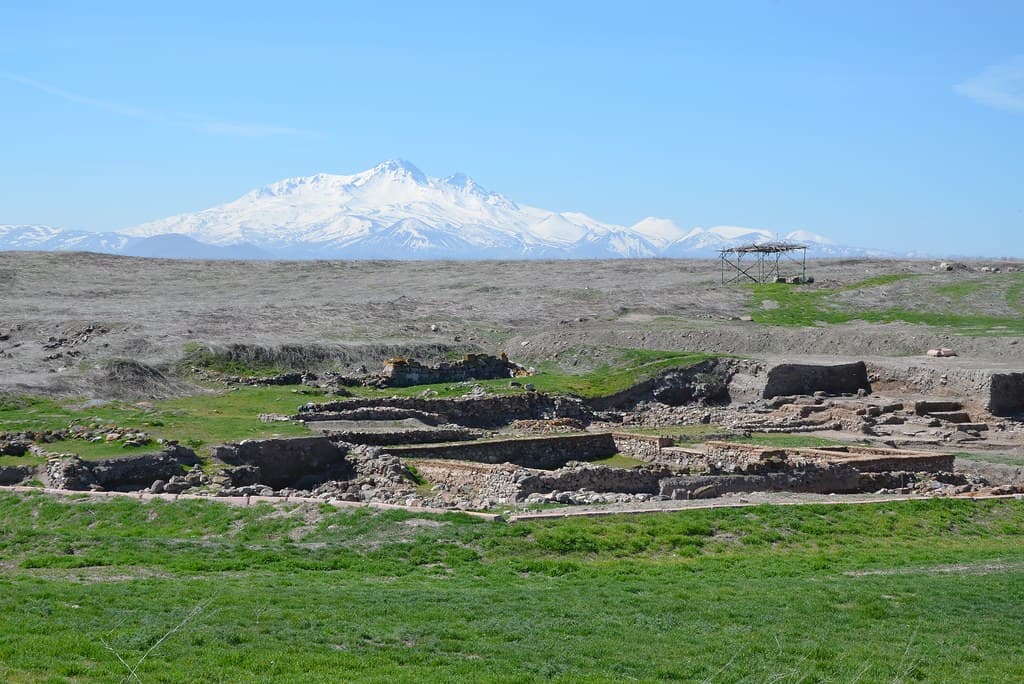
Image of Kültepe-Kanesh. Image source
Visit essentials
A quick read before you go
- Duration
- 1–2 hours at the excavation site; 2–3 hours at the Kayseri Archaeological Museum.
- Access
- Located 20 km northeast of Kayseri city centre on the road toward Boğazlıyan.
Overview
At Kültepe-Kanesh, words number 23,500, inscribed on clay tablets by Assyrian merchants in the centuries around 1900 BCE, when a thriving karum trading colony occupied the lower city outside the Kanesh kings' palace mound. The tablets preserve commercial transactions, legal disputes, religious obligations, and personal letters—including a wife reproaching her silent husband. Rather than divine pronouncements or dynastic records, they carry ordinary human life because clay baked hard when the city burned.
The site is on UNESCO's Tentative World Heritage List, yet its meaning exceeds classification: here Anatolia enters recorded history and a civilization's spoken language first took surviving physical form. The mound remains a large active excavation, worked continuously since 1948, with most tablets still underground.
Why this place is sacred
Kültepe-Kanesh's sanctity is not the sanctity of temples or royal burials—though those exist here too, on the upper mound. It is the sanctity of the threshold between silence and speech: the moment when human experience in Anatolia first generated durable words. The Assyrian merchants who lived in the karum below the Kanesh palace were not priests or scribes in the court tradition; they were commercial people maintaining practical archives.
Yet in doing so they created something no one intended to create—an archive of ordinary life. They wrote about late shipments of tin and textiles, about unfaithful business partners, about the gods they feared and the oaths they swore. Their prayers and commercial obligations intertwined in the same tablet, because for them the sacred and the economic were not separate registers of existence. Walking the mound at Kültepe means standing above this buried civilization.
The tablets documented here have already transformed scholarly understanding of Bronze Age Anatolia; most of them remain unexcavated, which means the full story is still forming.
Upper mound: royal palace city of the Kanesh kingdom. Lower city (karum): Assyrian merchant colony for the tin and textile trade between Assur in Mesopotamia and Anatolian markets.
From Neolithic and Early Bronze Age settlement on the mound through the flourishing Assyrian karum period (ca. 1950–1750 BCE) and subsequent Hittite-period occupation, to abandonment, and then to the longest continuous excavation in Turkish archaeological history, running since 1948.
Experience and orientation
The mound at Kültepe rises 21 meters above the surrounding plain and extends across an area of roughly 550 by 500 meters—a significant mass of accumulated human history. When you stand at its base, the scale of what is underground registers differently than a museum case does.
Excavation trenches have revealed portions of the lower karum, where the merchant houses and archive rooms once stood; active dig areas are fenced, but the open areas allow a sense of the urban fabric that existed here. The mound itself, when walked around, impresses by its sheer volume. The ground is full. The primary intellectual and emotional encounter with Kanesh happens in Kayseri, at the Archaeological Museum.
Here, original cuneiform tablets—some still sealed inside their clay envelopes—are displayed alongside cylinder seals, palace ceramics, bronze figurines, and jewelry from the mound. The tablets are small, palm-sized objects whose minute wedge impressions, when you lean close, resolve into individual strokes made by a specific hand four thousand years ago. That proximity—the physical immediacy of an ancient person's writing—is what makes Kanesh extraordinary.
Pair the museum visit with time at the site to let the buried scale ground what the museum displays.
Visit the Kayseri Museum before the excavation site. Reading the tablet inscriptions (in translation labels) and seeing the merchant-house layouts in museum diagrams will make the mound's silence eloquent rather than blank.
Context and lineage
The Kanesh kingdom preceded the Hittites on the Anatolian plateau and maintained a palace on the upper mound from at least the third millennium BCE. Around 1950 BCE, Assyrian merchants from the city of Assur in northern Mesopotamia established a karum—a regulated trading colony—in the lower city. They imported tin and textiles from Assur and exported Anatolian silver and gold, managing a trade network that extended across nearly two thousand kilometers.
Their archive rooms held thousands of tablets: commercial ledgers, contracts, correspondence, legal records, religious texts. When the karum was destroyed by fire around 1750 BCE, the tablets baked hard in the heat and survived. The palace on the upper mound continued to be occupied into the Hittite period, adding further layers to the site's depth.
Neolithic and Early Bronze Age Anatolian settlement → Kanesh royal kingdom (3rd millennium BCE) → Assyrian karum colony phase (ca. 1950–1750 BCE) → Hittite-period occupation → abandonment → systematic excavation from 1948 to present
Traditions and practice
The Assyrian merchants maintained their religious obligations to the god Assur even while living in Anatolia. Their tablets record prayers, references to divine favor sought before trading expeditions, oaths sworn in the names of Assur and local Anatolian deities, and formal invocations that appear alongside commercial tallies. Religious obligation was not separate from commercial life—a failed shipment might prompt both practical accounting and religious petition.
Alongside Assur, the merchants honored local Kanesh deities, adapting to the sacred landscape of their host city. The Kanesh royal palace on the upper mound had its own religious practices, evidenced by divine imagery on seal impressions; the nature of these ceremonies is partially reconstructed from the tablets.
No active religious practices occur at the site, which functions as a secular archaeological excavation. The Kayseri Museum maintains the primary public engagement with the site's finds.
At the site: walk the perimeter of the mound and allow the physical mass of buried occupation to register. Try to identify from visible excavation trenches where the karum's merchant houses once stood. At the Kayseri Museum: read the translated excerpts of tablet correspondence posted near the displays. Spend time with the sealed tablet envelopes—letters that were addressed, enclosed, and never opened by their intended recipient.
The experience of reading correspondence that was sealed four thousand years ago and is only now being read carries an unusual intimacy.
Assyrian Merchant Community Religion
HistoricalThe Assyrian karum housed a merchant community that maintained systematic religious obligations to the god Assur alongside engagement with local Anatolian deities, documented in an archive unprecedented in Bronze Age Anatolia.
Prayer and offerings to Assur; observance of Assyrian religious calendar; oaths in divine names in commercial contracts; marriage and legal contracts with divine witnesses.
Kanesh Royal Court Religion
HistoricalThe Kanesh palace on the upper mound maintained royal religious traditions—predating the Hittites—evidenced by divine imagery on seal impressions and references in the merchant tablets.
Royal religious ceremonies; divine kingship rituals; sacrifice and libation.
Archaeological and Scholarly Heritage
ActiveThe longest continuously running excavation in Turkish archaeology, producing the foundational dataset for Bronze Age Anatolian studies and the history of writing in the region.
Continuous excavation since 1948; cuneiform tablet publication and translation; museum display in Kayseri and Ankara; UNESCO tentative listing process.
Perspectives and open questions
Kültepe-Kanesh is exceptional in that its most significant dimension—the cuneiform archive—has changed what historians know rather than what visitors experience on-site. Its significance is primarily textual and epistemological.
Scholarly perspective
Kültepe-Kanesh is universally recognized as the most important source of Bronze Age written documentation in Anatolia, and the karum tablets have fundamentally reshaped understanding of early Anatolian history, Assyrian commercial networks, the origins of writing in the region, and the social structure of Bronze Age trading communities. UNESCO's tentative listing reflects global consensus. The ongoing excavations continue to yield new tablets—including sealed archives that have not yet been translated—meaning the scholarly story of Kanesh is actively evolving.
Living and traditional perspectives
No living religious tradition connects directly to the site. The Assyrian community in the modern world (Syriac Christian descendants of ancient Assyria) has a complex relationship with Kanesh as evidence of their ancient ancestors' far-ranging trade networks, though the religious context of the ancient Assyrian merchants differs significantly from modern Syriac Christianity.
Alternative interpretations
The sheer volume of the buried city—most of the lower karum remains unexcavated—invites speculation about what other archives remain. Some researchers have proposed that the full extent of the Kanesh tablet archive, when finally excavated, may contain historical information about early Anatolian civilization comparable in scope to what the Dead Sea Scrolls yielded for Judaean history.
Open questions
The full extent of the buried lower city remains unknown. The identities and dynastic succession of the Kanesh kings are only partially reconstructed from the tablets. The religious pantheon of pre-Hittite Kanesh is incompletely documented. The cause of the karum's destruction around 1750 BCE has not been definitively established.
Plan your visit
Access and arrival
Located 20 km northeast of Kayseri city centre on the road toward Boğazlıyan. By dolmuş (shared minibus) from Kayseri's central bus station toward Kültepe/Yeşilyurt direction. By car: approximately 30 minutes from Kayseri city centre or Kayseri airport (Erkilet Airport). Kayseri is served by Turkish Airlines and Pegasus Airlines from Istanbul and Ankara with frequent daily flights.
Kayseri city offers extensive accommodation options from budget to mid-range hotels. As a major Anatolian city with an international airport, Kayseri is a comfortable base for visiting Kültepe and day trips to Cappadocia.
Respectful visit
No dress requirements. Practical outdoor clothing and sturdy footwear for the mound terrain.
Photography permitted at the site. Tablet photography at the Kayseri Museum may require prior permission for publication use; check with museum staff.
Not applicable.
Do not enter active excavation trenches. Do not remove any material from the site. Stay on designated visitor paths.
Do not enter active excavation trenches or touch any exposed archaeological material. The terrain around the mound is uneven; wear appropriate footwear.
Location
Map loads as you approach this section.
Pilgrim reflections
A portrait of encounter, not a score
Pilgrims describe what they felt, how present they could become, and whether the place would shape a journey. There are no stars and no ranking of traditions.
No reviewed reflections yet
The first pilgrims can help describe the character of being here.
Share a reflection
Available after an account-backed “Been there.” Every reflection is reviewed before publication.
Nearby sacred places
Explore other sacred places in the region. Proximity does not establish access or travel time; check each place’s guidance.

References
Sources consulted for this page. Source categories describe the publication, not a guarantee that every claim is verified. Traditional accounts and outside interpretations may differ.
- 01Archaeological Site of Kültepe-Kanesh - UNESCO World Heritage Centre — UNESCOofficialOfficial UNESCO tentative listing documentation
- 02Kultepe - Britannica — Encyclopaedia BritannicaencyclopediaAuthoritative reference on site history and significance
- 03New evidence for international trade in Bronze Age central Anatolia: recently discovered bullae at Kültepe-Kanesh — Antiquity JournalacademicPeer-reviewed archaeological evidence for Bronze Age trade
- 04Kültepe Excavations Reveal Remains Predating Karum Kanesh - Biblical Archaeology Society — Biblical Archaeology SocietyacademicCoverage of recent excavation findings predating the Assyrian colony
- 05Kültepe - Wikipedia — Wikipedia contributorsencyclopediaComprehensive overview of site history, archaeology, and tablets
- 06Kültepe (Kanesh Karum) - Cappadocia History — Cappadocia HistoryguideDetailed regional coverage of site and historical context
- 07Archaeological Site of Kültepe-Kanesh: UNESCO Tentative Site Travel Guide — World Heritage SiteguideTravel guide with heritage context
- 08Kültepe Kanesh Karum - Ancient Trade Capital of Cappadocia — Wow CappadociaguideVisitor-oriented coverage of site and local context
Share a photo
Help visitors recognize Kültepe-Kanesh. Every submission is reviewed before publication.