Konchogsum Lhakhang, Bumthang
A temple of the Three Jewels, rebuilt from fire, where an eighth-century bell once rang loud enough to reach Tibet
Understand sacred places, explore living traditions, and learn how to engage respectfully with Pilgrim Map.
Access has not been verified. Check current local guidance before planning a visit.
Pedtsheling_Tamzhing, Bumthang, Bhutan
Read the sources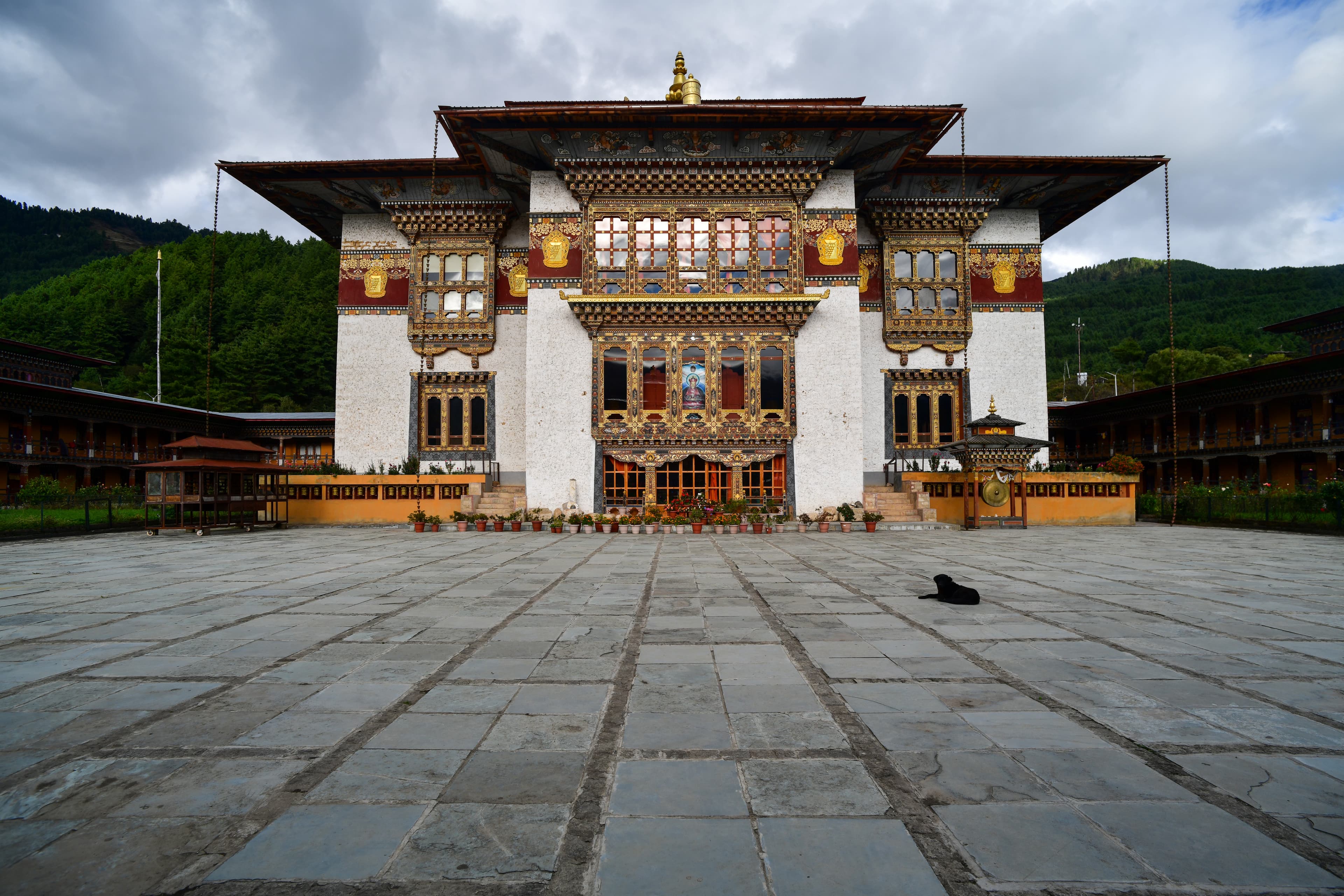
Image of Konchogsum Lhakhang, Bumthang. Image source · CC-BY-SA-4.0
Visit essentials
A quick read before you go
- Duration
- 30 minutes to 1 hour
- Access
- Located in the Choekhor Valley, Bumthang.
Overview
Konchogsum Lhakhang's irreplaceable bronze bell was cast in the eighth century and inscribed in a script predating most surviving Bhutanese epigraphy. It is said to have produced a sound so penetrating that it carried across the mountains to Tibet. Tibetan soldiers who came to take it found it too heavy; when they dropped and cracked it, tradition understood the break as the bell resisting removal.
King Trisong Detsen built the temple on Guru Rinpoche's instructions. Konchogsum means the Three Jewels, represented by its three main statues: Buddha, Dharma, and Sangha. In 1039, treasure revealer Bonpo Dragtshel discovered hidden texts (terma) that Guru Rinpoche had buried here. Pema Lingpa found the temple ruined and restored it in the late fifteenth century. Fire destroyed it again in February 2010; a new temple was rebuilt and consecrated by November 2014.
Across twelve centuries of building, ruin, and rebuilding, the broken, irreplaceable bell remains the temple's oldest resident and most enduring teaching.
Why this place is sacred
The bell is broken. This is not a flaw in its preservation but the central fact of its significance. It broke because it was too heavy to steal and too sacred to surrender. The crack is a record of attempted theft, of weight, of gravity's refusal to release something that belonged to this particular ground.
Around the bell, the temple has come and gone repeatedly. Guru Rinpoche instructed its construction. Time ruined it. Pema Lingpa restored it. Time ruined it again. Fire consumed it in 2010. Within four years it was rebuilt. The bell sat through each destruction, its silence during the rebuilding years as eloquent as its original sound.
The tradition says the bell's chimes once reached Tibet. Whether this is acoustically possible matters less than what the claim reveals: a belief that sacred sound can traverse distance, that a single bell in the Bumthang Valley could connect Buddhist communities across the Himalayas through vibration alone. The bell no longer rings.
But the claim persists, and the bell persists, and the temple around it persists through its own repeated destruction — each element insisting on continuity in its own way.
Built on Guru Rinpoche's instructions by King Trisong Detsen in the eighth century to house the Three Jewels.
From eighth-century founding through terma discovery (1039), Pema Lingpa's restoration (late 15th century), fire destruction (2010), and reconsecration (2014). Each cycle of destruction and rebuilding demonstrates the Buddhist teaching of impermanence while the bell's persistence demonstrates something that impermanence cannot fully account for.
Experience and orientation
Konchogsum Lhakhang is easily reached from Bumthang town, set in the Choekhor Valley alongside the area's other major temples. The building visitors encounter today is new — consecrated in 2014 after the devastating fire of 2010. The construction is traditional Bhutanese temple architecture, carefully executed, but fresh. It smells of recent woodwork.
Inside, the three statues representing the Three Jewels hold their positions. The murals are newly painted but follow traditional iconographic programs. And then there is the bell. Ancient, inscribed, cracked, heavy. It does not match the newness around it. It comes from a different order of time entirely.
The inscription on the bell's interior is among the earliest epigraphic evidence from the Bumthang region — a tangible link to the eighth century that no fire has been able to erase. Looking at it, touching is not permitted, the visitor encounters an object that has outlasted every structure built to contain it.
Enter and greet the three statues. Then find the bell. Let the contrast between new temple and ancient bronze register. Consider the bell's crack — not as damage but as story. If you can read the eight-century inscription, you are in the company of a very few. If you cannot, you are in the company of everyone who has stood here wondering what it says.
Context and lineage
Guru Rinpoche instructed King Trisong Detsen of Tibet to build this temple in the eighth century. It was named Konchogsum — the Three Jewels — for its three main statues. The bronze bell, cast at the temple's founding, bore an inscription and produced a sound that, according to tradition, could be heard as far as Tibet. When a Tibetan army came to seize it, the soldiers found the bell so heavy they dropped it, cracking it permanently.
Connects to the earliest period of Buddhism in Bhutan through Guru Rinpoche and Trisong Detsen. The terma discovery tradition links it to the Nyingmapa treasure-revelation lineage through both Bonpo Dragtshel and Pema Lingpa.
Guru Rinpoche (Padmasambhava)
Gave instructions for the temple's construction; buried terma texts at the site
King Trisong Detsen
Built the temple on Guru Rinpoche's instructions
Bonpo Dragtshel
Terton who discovered terma texts hidden by Guru Rinpoche
Pema Lingpa
Discovered the temple in ruins and restored it
Traditions and practice
The temple's practice centers on the Three Jewels — Buddha, Dharma, Sangha — represented by the three main statues. The bronze bell, though no longer rung, is venerated as a relic. Terma texts discovered here across the centuries have contributed to the region's liturgical traditions.
Regular worship resumed after the 2014 reconsecration. The rebuilt temple serves both as a place of practice and as a testament to the Bumthang community's commitment to restoring what fire destroys.
Visit the bell and sit with it. Consider what it means for an object to survive every building constructed around it. The three statues offer a meditation on the fundamentals of Buddhist refuge — Buddha, Dharma, Sangha — in their simplest form.
Vajrayana Buddhism
ActiveFounded on Guru Rinpoche's direct instructions, the temple represents the earliest stratum of Buddhism in Bumthang. Its name invokes the most fundamental concept in Buddhist practice.
Worship of the Three Jewels, veneration of the ancient bell, daily monastic rituals
Perspectives and open questions
Konchogsum Lhakhang can be understood through its founding, its bell, or its repeated destruction and rebuilding — and each reading leads to a meditation on what persists.
Scholarly perspective
The bronze bell's eighth-century inscription provides some of the earliest epigraphic evidence from the Bumthang region, making it significant for the study of early Buddhist presence in Bhutan. The terma discoveries here across centuries link the site to the broader treasure-revelation tradition central to Nyingmapa Buddhism.
Living and traditional perspectives
The Three Jewels — Buddha, Dharma, Sangha — are the foundation of all Buddhist practice. A temple named for them and housing their statues offers the most fundamental form of refuge. The bell's persistence through fire and ruin is understood as a sign that the dharma itself cannot be destroyed.
Alternative interpretations
The legend of the bell whose sound reached Tibet proposes a conception of sacred sound as connective tissue between Buddhist communities. The bell's crack, caused by attempted theft, can be read as the imprint of a relationship between Bhutan and Tibet inscribed in bronze.
Open questions
The full content and implications of the eighth-century bell inscription remain subjects of scholarly inquiry. Whether the bell's sound could genuinely carry across the Himalayan ranges speaks to questions about acoustics, landscape, and the boundary between physical fact and sacred meaning.
Plan your visit
Access and arrival
Located in the Choekhor Valley, Bumthang. A short drive from Bumthang (Jakar) town. Easily combined with visits to Jampa Lhakhang and Kurje Lhakhang.
Hotels and guesthouses in Bumthang (Jakar) town
Respectful visit
Shoulders and knees covered.
Ask permission inside the temple. Do not use flash near the bell or statues.
Butter lamp offerings welcome.
Do not touch the bell or statues | Walk clockwise | No flash photography | Maintain silence inside
Do not touch the bell or the statues. The temple is relatively new but the objects within it are ancient and irreplaceable.
Current practical details
Address
HPPQ+6P9, Jakar, Bhutan
Hours, fees, and access can change — verify on the official source before you travel. Practical details last checked Jun 2026.
Location
Map loads as you approach this section.
Pilgrim reflections
A portrait of encounter, not a score
Pilgrims describe what they felt, how present they could become, and whether the place would shape a journey. There are no stars and no ranking of traditions.
No reviewed reflections yet
The first pilgrims can help describe the character of being here.
Share a reflection
Available after an account-backed “Been there.” Every reflection is reviewed before publication.
Nearby sacred places
Explore other sacred places in the region. Proximity does not establish access or travel time; check each place’s guidance.


References
Sources consulted for this page. Source categories describe the publication, not a guarantee that every claim is verified. Traditional accounts and outside interpretations may differ.
- 01Könchogsum Lhakhang - WikipediaencyclopediaComprehensive overview
- 02Könchogsum Lhakhang - Bumthang Dzongkhag Administration — Government of BhutanSource contextOfficial source
- 03Konchogsum Lhakhang - Bhutan Cultural Atlas — CLCSSource contextScholarly cultural resource
- 04Konchogsum Lhakhang - Tour Bhutan — Tour BhutanguideVisiting details
- 05Konchogsum Lhakhang - Lonely Planet — Lonely PlanetguideTravel guide overview
Pilgrim glossary
- Sangha
- The community of Buddhist practitioners, traditionally monks and nuns.
- Dharma
- The teachings of the Buddha; also the universal law underlying them.
Share a photo
Help visitors recognize Konchogsum Lhakhang, Bumthang. Every submission is reviewed before publication.