Kurje Monastery
The cave where Guru Rinpoche left his body imprint in stone, bringing Buddhism to Bumthang
Understand sacred places, explore living traditions, and learn how to engage respectfully with Pilgrim Map.
Access has not been verified. Check current local guidance before planning a visit.
Dawathang_Dorjibi_ Kashingtsawa, Bumthang, Bhutan
Read the sources
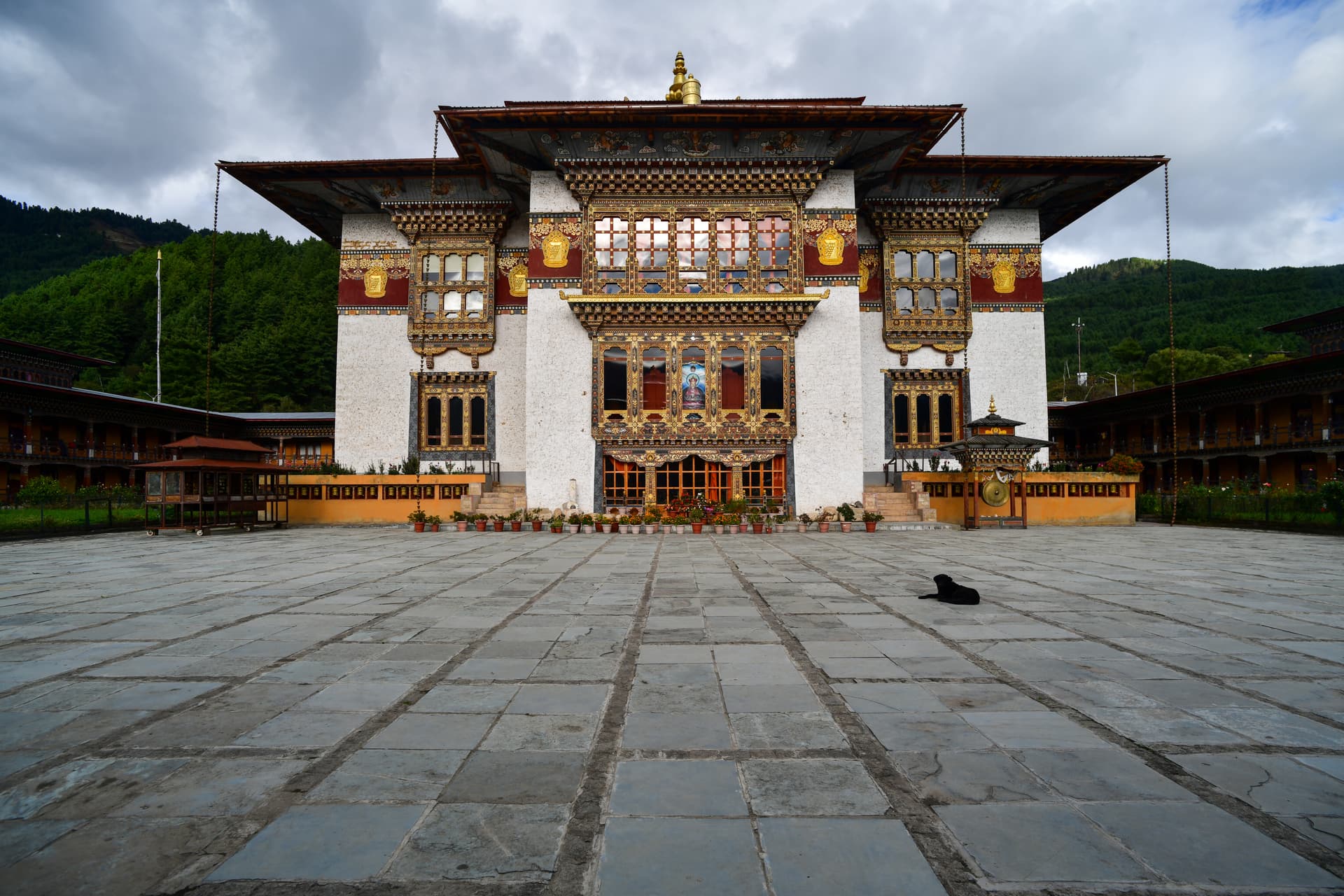
Image of Kurje Monastery. Image source · CC-BY-SA-4.0
Visit essentials
A quick read before you go
- Duration
- 1-2 hours for a thorough visit including circumambulation of the 108 stupas
- Access
- Located in the Choekhor Valley, Bumthang.
Overview
The name tells the story. Kur means body. Jey means imprint. In 810 CE, the king of Bumthang fell gravely ill after offending the local deity Shelging Karpo. Guru Rinpoche was invited to heal him. The guru entered a cave in the red cliff above the valley, meditated, subdued the deity, and restored the king's life force. When he emerged, his body had left its shape in the cave wall — an impression that remains visible today.
This event is understood as the moment Buddhism arrived in Bumthang. The body imprint is not a relic in the usual sense — it is not something the guru left behind but something the stone received. The cave was enclosed in a temple in 1652 by Mingyur Tenpa, the penlop of Trongsa. A second temple was added in 1900 by Ugyen Wangchuck, who would become the first king of Bhutan. A third was dedicated in 1990.
Together, the three temples create a complex that spans the transition from regional governance to monarchy, from Guru Rinpoche's founding act to the modern state.
One hundred and eight stupas line the hillside. A large cypress tree behind one of the temples is believed to be a terma — a hidden treasure left by Padmasambhava. The burial chortens of the first three kings stand before the complex, placing the remains of Bhutanese temporal authority in the shadow of its spiritual origin. Everything here radiates outward from the cave and the imprint within it.
Why this place is sacred
The body imprint in the cave at Kurje raises a question that cannot be answered by either belief or skepticism. If one accepts the tradition, then stone became plastic in the presence of a particular quality of human consciousness, and the resulting impression is a permanent record of that encounter.
If one does not accept the tradition, one must still account for the imprint, the twelve centuries of veneration it has sustained, and the civilization-shaping events that followed from Guru Rinpoche's meditation here.
The thinness is not in the question's resolution but in the question itself. Standing before the imprint, the visitor is not asked to believe or disbelieve but to attend. The stone is there. The shape is there. The tradition that connects this cave to the introduction of Buddhism in an entire region is there.
Something happened here that left a mark — literally — and the three temples built around the cave over four centuries are the successive responses of a culture to that mark.
The burial of the first three kings at this site adds another dimension. By placing their remains here, the monarchy acknowledged that its authority derives from the same ground as Guru Rinpoche's meditation — that temporal power is secondary to and continuous with the spiritual event that gave Bumthang its Buddhist character.
Cave where Guru Rinpoche meditated in 810 CE to subdue a local deity and heal King Sindhu Raja, establishing Buddhism in Bumthang.
From cave meditation site to enclosed temple (1652) to expanded complex with royal temple (1900) to three-temple complex with royal burial grounds (1990). Each addition responded to the original event without displacing it.
Experience and orientation
Kurje Lhakhang occupies a hillside in the Choekhor Valley, visible from the road that connects Bumthang's major temples. The approach reveals the three temples in ascending scale — the oldest and smallest built tight against the cliff, the second larger and more ornate, the third a modern construction of considerable size.
The first temple, Guru Lhakhang, is the heart of the site. Built in 1652, it encloses the cave where Guru Rinpoche left his body imprint. The interior is dim and charged with the weight of twelve centuries of veneration. The imprint itself is behind sacred figures — visible but set back, requiring the visitor to look past the devotional apparatus to the rock face itself.
Outside, 108 stupas line the hillside, each whitewashed and maintained. A path connects them, creating a circumambulation route. The sacred cypress tree stands behind one of the temples, its roots and branches understood as a living terma. Before the complex, three chortens mark the burial places of the first three kings — Ugyen Wangchuck, Jigme Wangchuck, and Jigme Dorji Wangchuck.
The atmosphere at Kurje is one of layered significance. Each element — cave, temples, stupas, tree, burial chortens — connects to the others, and all connect back to the body imprint in the cave.
Begin at the first temple. Spend time in the dim interior and find the body imprint behind the figures. Then move to the second and third temples, noticing how each generation expanded the complex without altering its center. Walk the 108 stupas as a circumambulation. Stand before the royal burial chortens and consider the relationship between spiritual and temporal authority in Bhutan. Return to the cave.
Context and lineage
In 810 CE, King Sindhu Raja of Bumthang fell gravely ill after offending the local deity Shelging Karpo. He invited Guru Rinpoche to heal him. The guru entered a cave in the red cliff, meditated, subdued the deity through spiritual power, and restored the king's life force. When he rose from meditation, his body had left its imprint in the cave wall.
This event marks the introduction of Buddhism to the Bumthang region and is the foundational sacred narrative of the site.
The site connects the earliest introduction of Vajrayana Buddhism to Bumthang (Guru Rinpoche, 8th century) to the establishment of the Bhutanese monarchy (Ugyen Wangchuck, early 20th century), with the body imprint serving as the constant point around which both spiritual and temporal authority orient.
Guru Rinpoche (Padmasambhava)
Left his body imprint in the cave after subduing the deity Shelging Karpo
King Sindhu Raja
King of Bumthang whose illness prompted Guru Rinpoche's visit
Mingyur Tenpa
Penlop of Trongsa who built the first temple enclosing the cave in 1652
Ugyen Wangchuck
First King of Bhutan who built the second temple in 1900 and whose remains rest at the site
Traditions and practice
Pilgrimage to the body imprint cave is the central devotional act. Circumambulation of the complex and its 108 stupas is practiced by both local devotees and pilgrims from across Bhutan. The annual Kurje Tshechu features masked dances (cham) performed by monks.
Regular monastic worship in all three temples. Continuous pilgrimage. The site is one of the most visited sacred places in Bhutan.
Circumambulate the 108 stupas slowly, using them as a walking meditation. In the first temple, sit with the body imprint for as long as you are able. The experience deepens with time. If visiting during the Kurje Tshechu, attend the masked dances with the understanding that they are not performances but enactments of dharmic narratives.
Vajrayana Buddhism
ActiveThe foundational sacred site of Buddhism in Bumthang. Guru Rinpoche's body imprint is the origin event of the dharma in this region.
Pilgrimage, circumambulation of 108 stupas, annual Kurje Tshechu, veneration at the body imprint cave
Perspectives and open questions
Kurje Lhakhang is the foundational sacred site of Buddhism in Bumthang, and its significance radiates across the religious, political, and cultural life of Bhutan.
Scholarly perspective
The three-temple complex provides a built record of Bumthang's religious history from the 17th century to the present. The body imprint cave, while not verifiable by historical method, is the origin point of a religious tradition that shaped an entire region. The royal burials at the site document the relationship between spiritual and temporal authority in modern Bhutan.
Living and traditional perspectives
Within the Buddhist tradition, the body imprint is understood as evidence that Guru Rinpoche's realization was so complete that even stone responded to his presence. The imprint is not a miracle in the sense of an exception to natural law but a demonstration of what consciousness can do when it has been fully liberated.
Alternative interpretations
The body imprint invites a question about the relationship between awareness and matter that neither materialist science nor devotional Buddhism fully addresses. The impression exists. Its origin is the question that gives the site its power.
Open questions
The nature of the deity Shelging Karpo — whether a personification of pre-Buddhist religion, a landscape spirit, or something else — remains within the domain of traditional Buddhist narrative rather than historical documentation.
Plan your visit
Access and arrival
Located in the Choekhor Valley, Bumthang. A short drive from Bumthang (Jakar) town.
Hotels and guesthouses in Bumthang (Jakar) town
Respectful visit
Shoulders and knees covered. Remove shoes in all temples.
Generally not permitted inside the temples or near the body imprint.
Butter lamp offerings welcome at each of the three temples.
Do not touch the body imprint | Walk clockwise | No photography inside temples | Royal burial grounds are restricted | Maintain reverent silence, especially near the cave
The body imprint must not be touched. The royal burial chortens are not publicly accessible. Photography inside the temples may be restricted.
Current practical details
Address
HPPJ+V38, Jakar, Bhutan
Hours
Hours, fees, and access can change — verify on the official source before you travel. Practical details last checked Jun 2026.
Location
Map loads as you approach this section.
Pilgrim reflections
A portrait of encounter, not a score
Pilgrims describe what they felt, how present they could become, and whether the place would shape a journey. There are no stars and no ranking of traditions.
No reviewed reflections yet
The first pilgrims can help describe the character of being here.
Share a reflection
Available after an account-backed “Been there.” Every reflection is reviewed before publication.
Nearby sacred places
Explore other sacred places in the region. Proximity does not establish access or travel time; check each place’s guidance.


References
Sources consulted for this page. Source categories describe the publication, not a guarantee that every claim is verified. Traditional accounts and outside interpretations may differ.
- 01Kurjey Lhakhang - WikipediaencyclopediaComprehensive overview
- 02Kurjay Lhakhang - Bumthang Dzongkhag Administration — Government of BhutanSource contextOfficial source
- 03Kurje Lhakhang - Bhutan Cultural Atlas — CLCSSource contextCultural documentation
- 04Kurjey Lhakhang - Bhutan Pilgrimage — Bhutan PilgrimageguideDetailed spiritual history
- 05Kurje Lhakhang - Breathe Bhutan — Breathe BhutanguideVisitor experience
Pilgrim glossary
- Dharma
- The teachings of the Buddha; also the universal law underlying them.
Share a photo
Help visitors recognize Kurje Monastery. Every submission is reviewed before publication.