Tamshing Monastery
Principal seat of Pema Lingpa's lineage, where a five-hundred-year-old iron chain mail still purifies those who carry it
Understand sacred places, explore living traditions, and learn how to engage respectfully with Pilgrim Map.
Access has not been verified. Check current local guidance before planning a visit.
Pedtsheling_Tamzhing, Bumthang, Bhutan
Read the sources
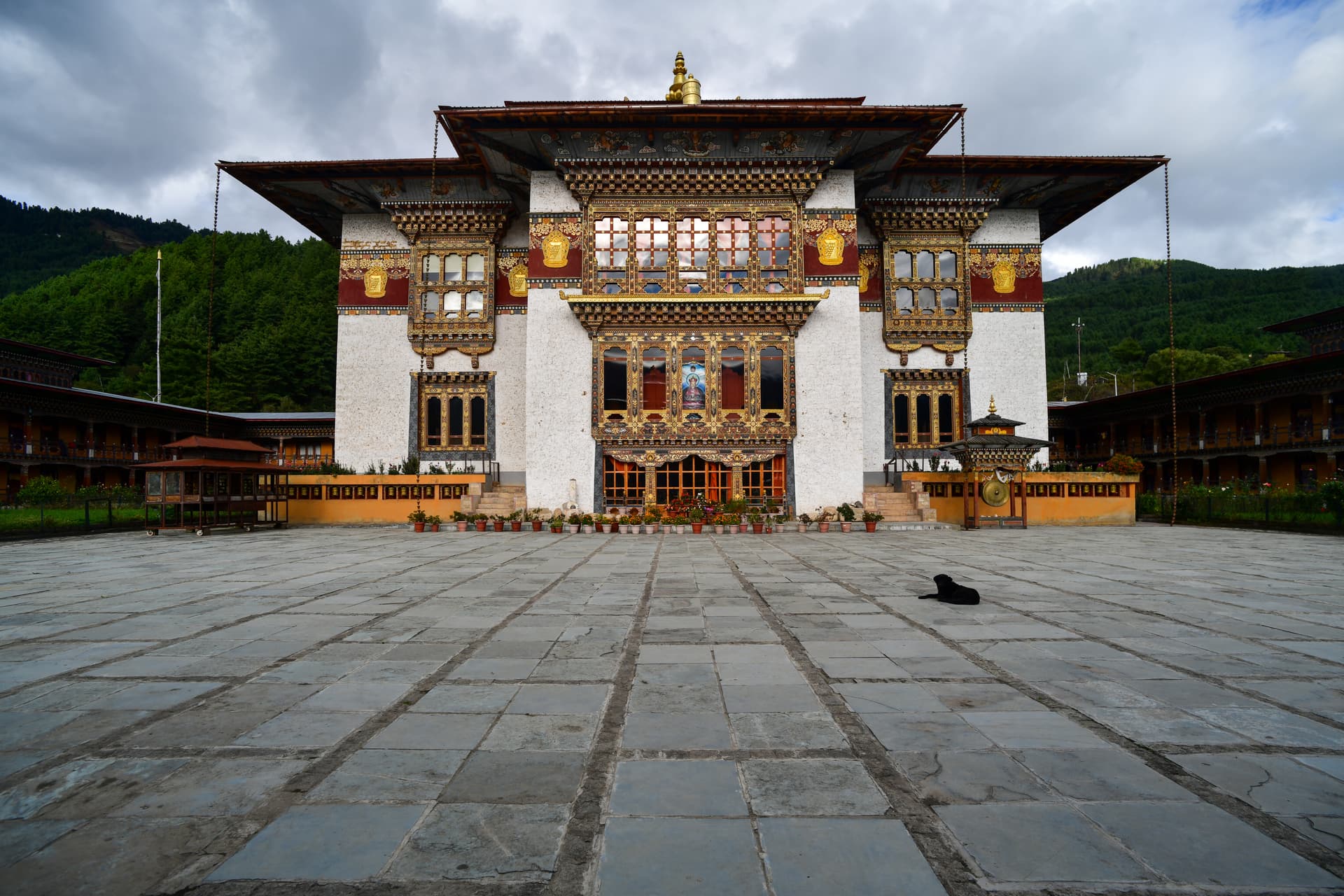
Image of Tamshing Monastery. Image source · CC-BY-SA-4.0
Visit essentials
A quick read before you go
- Duration
- 45 minutes to 1.5 hours.
- Access
- In the Bumthang valley, a short drive or walk from Jakar.
Overview
In the Bumthang valley near Jakar, Tamshing Monastery holds Pema Lingpa's five-hundred-year presence in paint, iron, and unbroken lineage. Founded in 1501 and completed in 1505, it is the principal seat of one of Vajrayana Buddhism's five great treasure revealers (tertons), who received visions directing him to uncover teachings hidden by Guru Rinpoche centuries earlier.
The founding-era wall paintings, among Bhutan's earliest survivors, include Pema Lingpa's own portrait—his face persisting on the walls of his creation for more than five centuries. He embedded texts, small sculptures, and objects attributed to Padmasambhava and Yeshe Tsogyal within the main statue, making it a reliquary.
Pema Lingpa made the iron chain mail at age eight, an act of prodigious craftsmanship by a child who became one of Bhutan's greatest saints. Later blessed with purification prayers, its considerable weight is carried by pilgrims circumambulating the altar; tradition holds that the act dissolves sins. The weight of the iron and the weight of the intention are experienced as the same thing.
Pema Lingpa died here in 1521 at seventy-two. His lineage continues through the 11th speech incarnation, Lhalung Sungtrul Rinpoche, who leads the monastery today. Sacred dances he originated at Tamshing have spread through tsechu festivals across Bhutan.
Why this place is sacred
A terton is someone who finds what has been hidden. Guru Rinpoche, according to the tradition, concealed teachings throughout the Himalayan landscape — in caves, in lakes, in the very earth — to be discovered when the world was ready for them. Pema Lingpa was one of five great revealers across the centuries, and Tamshing is where he established the seat from which these revealed teachings would be transmitted.
The wall paintings date to the founding and have not been replaced. Five hundred years of smoke, weather, and devotion have worked on them. They are not pristine. They are surviving. The founder's own face, painted when the walls were new, looks out from among bodhisattvas and deities with the quiet authority of persistence.
But the chain mail is where the thinness becomes tangible. It is heavy. Iron links woven by an eight-year-old who would become a saint. To carry it while circumambulating the altar is to take onto your body the weight of a tradition and the promise of its purifying power. This is not symbolic. The iron is real, the weight is real, and the circuit around the altar is real.
Whatever happens between the body and the object in that circuit — that is between the pilgrim and the chain mail.
Pema Lingpa embedded relics within the main statue: texts and objects attributed to Padmasambhava and Yeshe Tsogyal. The statue thus contains within its form a hidden treasury — a terma within a terma. The monastery itself becomes a kind of revealed treasure, holding within its walls what was once concealed.
Founded in 1501 by Pema Lingpa as the principal seat of his lineage and as a center for the transmission of teachings revealed from Guru Rinpoche's hidden treasures.
From 16th-century foundation to present-day active Nyingma monastery. The lineage has passed through eleven incarnations of the founder's speech. The sacred dances originated here have spread throughout Bhutan. UNESCO has placed the monastery on its Tentative List.
Experience and orientation
Tamshing is not monumental. It is quiet, set in the green floor of the Bumthang valley, with monks in residence and pilgrims arriving without fanfare. The building's exterior is modest. The significance lies within.
Enter and the wall paintings surround you. They are five centuries old, and their age is visible — colors softened, surfaces marked by time. But the faces are still clear: bodhisattvas, protector deities, and among them, Pema Lingpa himself, looking out from his own creation. The effect is less like visiting a museum than like being received.
The chain mail hangs near the altar. A monk may offer it to you, or you may ask. It is heavier than you expect. The iron links settle onto your shoulders and back, and you begin the circumambulation — walking clockwise around the altar with the weight of five hundred years distributed across your body. The tradition says this act cleanses accumulated sins.
Whether or not you hold that belief, the experience is unmistakable: the body registers something that the mind alone cannot process.
After the circuit, the chain mail is returned, and the weight lifts. You stand lighter in a room painted by a saint, surrounded by relics embedded within a statue that contains traces of Padmasambhava himself. The intimacy of the encounter is the point. This is not spectacle. It is proximity.
Ask to carry the chain mail if it is not offered. The circumambulation is clockwise around the altar. Allow time for the wall paintings — they reward slow, close looking. The monastery is best experienced in the morning, when the light enters the temple most fully.
Context and lineage
Pema Lingpa (1450-1521) received visions directing him to reveal treasures (terma) hidden by Guru Rinpoche in the Bhutanese landscape. He founded Tamshing as his principal seat and created sacred dances to teach Buddhism through movement. The iron chain mail he made at eight years old was blessed for purification. He died at Tamshing in 1521 at age seventy-two.
Tamshing is the principal seat of the Pema Lingpa lineage within the Nyingma tradition. The lineage has continued through eleven incarnations of the founder's speech, maintaining unbroken transmission for over five centuries.
Pema Lingpa
Treasure revealer (terton), founder of Tamshing in 1501, creator of sacred dances and the iron chain mail
Lhalung Sungtrul Rinpoche
11th speech incarnation of Pema Lingpa, current spiritual leader of Tamshing
Traditions and practice
The sacred dances originated by Pema Lingpa — teaching Buddhism through movement and mask — form the centerpiece of the annual Tamshing Tsechu and have been adopted by festivals throughout Bhutan. Pilgrims carry the iron chain mail during circumambulation of the altar. Daily monastic worship continues under the current incarnation.
Active monastic community under Lhalung Sungtrul Rinpoche. Daily worship, monastic education, and reception of pilgrims and visitors. Conservation of the wall paintings is an ongoing concern.
Carry the chain mail during circumambulation — the physical experience is central to the site. Attend the Tamshing Tsechu if timing permits. Spend time with the wall paintings, particularly looking for Pema Lingpa's portrait among the figures.
Nyingma
ActivePrincipal seat of the Pema Lingpa lineage, housing relics from the founder and maintaining sacred dances he originated.
Chain mail circumambulation, sacred dances, daily monastic worship, pilgrimage
Perspectives and open questions
Tamshing can be understood as a terton's seat, as a living link to the hidden treasure tradition, and as a place where art, iron, and dance carry the weight of five centuries of unbroken practice.
Scholarly perspective
UNESCO's tentative listing recognizes Tamshing's outstanding universal value. The wall paintings are studied as among the earliest and most significant in Bhutanese art history. The Rubin Museum has published scholarly analysis of the temple's iconographic program.
Living and traditional perspectives
Within the Nyingma tradition, Tamshing is where Pema Lingpa's vision of accessible Buddhism — through dance, visual art, and embodied ritual — is most fully realized. The chain mail is not a relic in the passive sense; it is an active instrument of purification, its power renewed with each circumambulation.
Alternative interpretations
The terma tradition connects Tamshing to a broader Vajrayana understanding of time: teachings are hidden when the world is not ready and revealed when conditions ripen. Tamshing is a node in this network of hidden and revealed wisdom, its very existence a form of revealed treasure.
Open questions
The full inventory of relics embedded by Pema Lingpa within the main statue has not been publicly disclosed. Some scholars believe additional terma may remain undiscovered in the surrounding landscape.
Plan your visit
Access and arrival
In the Bumthang valley, a short drive or walk from Jakar. Bumthang is accessible by road (approximately 10-11 hours from Thimphu via Trongsa) or by domestic flight to Bathpalathang Airport.
Hotels and guesthouses in Jakar, the main town of Bumthang.
Respectful visit
Modest clothing covering arms and legs. Shoes removed before entering.
May be restricted inside to protect the wall paintings. Ask before photographing.
Butter lamp offerings welcome.
Shoes removed before entering | Handle chain mail with care and reverence | Do not touch wall paintings | Clockwise circumambulation | Keep noise to a minimum
The chain mail is heavy. Those with back or shoulder conditions should consider carefully. Handle the chain mail with reverence. Do not touch the wall paintings.
Current practical details
Address
HPQQ+442, Jakar, Bhutan
Hours
Hours, fees, and access can change — verify on the official source before you travel. Practical details last checked Jun 2026.
Location
Map loads as you approach this section.
Pilgrim reflections
A portrait of encounter, not a score
Pilgrims describe what they felt, how present they could become, and whether the place would shape a journey. There are no stars and no ranking of traditions.
No reviewed reflections yet
The first pilgrims can help describe the character of being here.
Share a reflection
Available after an account-backed “Been there.” Every reflection is reviewed before publication.
Nearby sacred places
Explore other sacred places in the region. Proximity does not establish access or travel time; check each place’s guidance.


References
Sources consulted for this page. Source categories describe the publication, not a guarantee that every claim is verified. Traditional accounts and outside interpretations may differ.
- 01Tamzhing Monastery - Wikipedia — VariousencyclopediaHistory, Pema Lingpa, architecture
- 02Tamzhing Monastery - UNESCO World Heritage Centre — UNESCOSource contextUNESCO tentative listing and heritage significance
- 03Tamzhing Lhakhang - Bhutan Pilgrimage — Bhutan PilgrimageguideSpiritual significance, chain mail, rituals
- 04Tamshing Temple - Rubin Museum Project Himalayan Art — Rubin MuseumacademicScholarly analysis of wall paintings and art
- 05Tamshing Monastery - Rigzin Pema Lingpa Foundations — Peling FoundationSource contextFoundation perspective on living heritage
- 06Tamshing Lhakhang - Treasury of Lives — Treasury of LivesacademicBiographical and institutional history
Share a photo
Help visitors recognize Tamshing Monastery. Every submission is reviewed before publication.