Shinshō-ji
A port temple where the sea answers
Understand sacred places, explore living traditions, and learn how to engage respectfully with Pilgrim Map.
Access has not been verified. Check current local guidance before planning a visit.
Muroto, Kochi Prefecture, Japan
Read the sources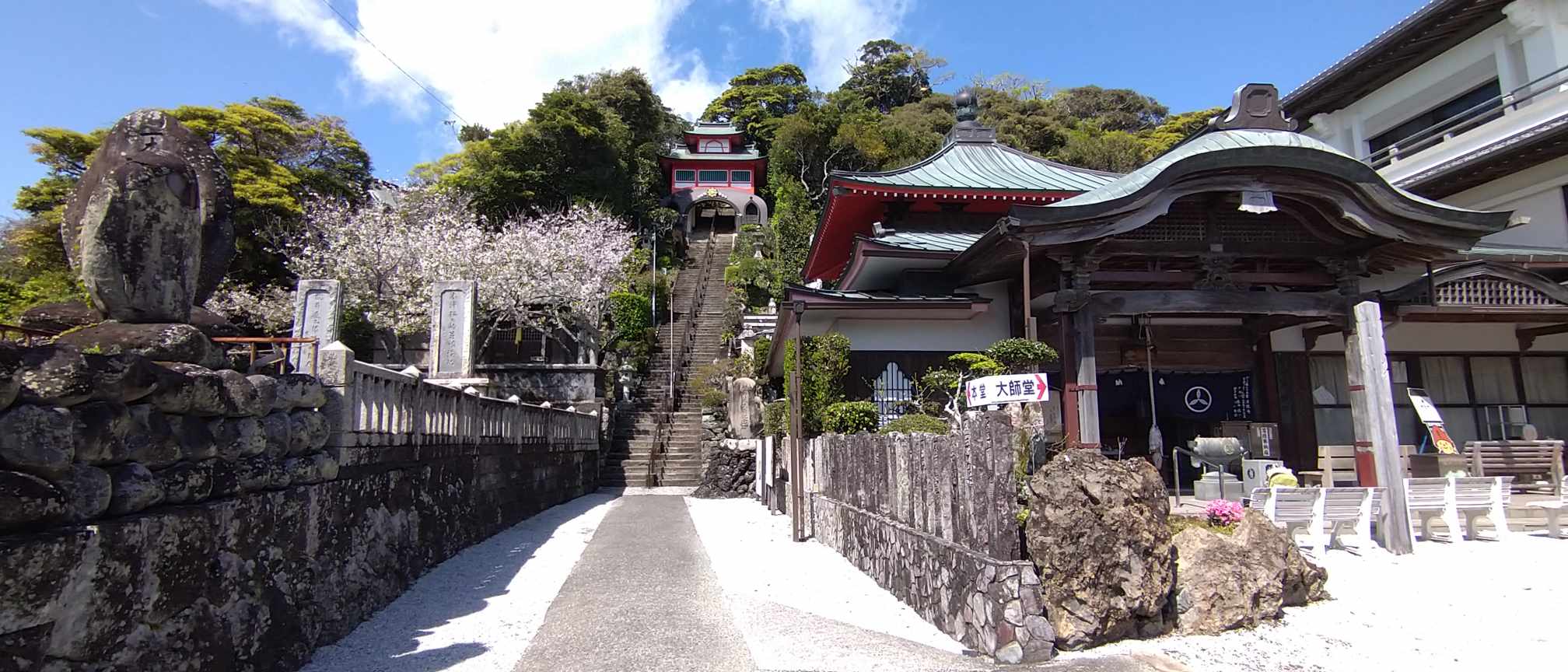
Image of Shinshō-ji (津照寺). Image source · CC0
Station 25 of 88
Shikoku 88 Temple PilgrimageVisit essentials
A quick read before you go
- Duration
- Thirty to forty-five minutes for the full pilgrim ritual at both halls plus the nōkyō stamp.
- Access
- By car: roughly 100 kilometres from Kōchi City along Route 55 to Muroto and Murotsu, with…
Overview
Shinshō-ji is a small mountain temple above Murotsu's working Pacific port. Its stone stair passes a Niōmon halfway up, with boat horns and gulls joining pilgrims' breath. Temple tradition says ninth-century Kūkai, later Kōbō Daishi, saw the forested mountain as Jizō Bosatsu's wish-granting jewel, carved a Jizō, and consecrated a temple of what became Shingon Buddhism. In 1602, first Tosa daimyō Yamauchi Kazutoyo was caught in a Cape Muroto storm.
A monk took his ship's helm, brought it safely to Murotsu, then vanished at the temple, where the Jizō was found drenched. The honzon has since been Kajitori Jizō, Helmsman or Steering Jizō. On the Tosa discipline, shugyō, section of the eighty-eight-temple Shikoku Pilgrimage, visitors bow at Niōmon, ascend to Main Hall, light one candle and three incense sticks, leave a fudasho-fuda, chant Heart Sutra and Jizō mantra, then repeat at Daishi-dō. Fishermen seek Kajitori Jizō's protection at sea.
Unlike mountain-shaded or rural circuit temples, Shinshō-ji opens through pines to port and salt air; pilgrims describe an attention-focusing ordeal, sudden harbor view, and descent with a sense of maritime protection.
Why this place is sacred
The thinness of this site is partly architectural. The staircase from the port begins at sea level and rises steeply through cedar, with the Niōmon gate set partway up rather than at base or summit. Pilgrims pass under the gate already breathing hard, then continue upward to the Main Hall and Daishi-dō. The vertical sequence reads as a gradient of thresholds rather than a single boundary.
Below is the boat-noise and concrete of Murotsu port; above is the closed acoustic of the temple courtyard, where the sea is suddenly distant and present at once. Maritime light gives Shinshō-ji a sensory quality unusual among the eighty-eight temples. From the upper precincts the harbour spreads to the south, the Pacific to the east, and the air carries salt and diesel along with incense. The Kajitori Jizō legend belongs to that maritime layer.
Whatever the historical specifics of the 1602 storm, the meaning of the story has held: at this exact spot, a Jizō Bosatsu is believed to have stepped out of his sculpted form, taken the helm of a foundering ship, and returned. Centuries of fishermen have prayed here on that basis. The temple's continuity has not been seamless. After the Meiji-era anti-Buddhist disruptions of the 1870s, Shinshō-ji fell into dereliction and was reopened in 1883.
The original purpose, as held by tradition, was double: a Shingon ritual centre established by Kūkai during his ascetic period in the Muroto region, and a maritime sanctuary for the small port at its foot. Both purposes remain visible. Pilgrims do the orthodox Shingon ritual at the halls; fishing families bring different prayers, often privately, with the same Jizō.
The Muroto Sanzan, the three temples of the cape, holds Shinshō-ji as the central station between Hotsumisaki-ji at the cape itself and Kongōchō-ji on the western promontory. Pilgrims who walk the three on a single day describe a particular concentration of presence here: the smallest of the three, lowest in altitude, but tethered most directly to the human work of the sea.
An esoteric Shingon ritual centre, traditionally established by Kūkai during his ninth-century training in the Muroto region, paired from early on with the role of sea-protective shrine for Murotsu port.
Through the medieval and early-modern periods Shinshō-ji received patronage from successive Tosa rulers, the Chōsokabe and later the Yamauchi clans. The 1602 Kajitori Jizō episode reshaped the temple's public identity, fusing maritime folk devotion with formal Shingon practice. After Meiji-era confiscations the temple was abandoned for roughly a decade, then reopened in 1883. Today it functions as a working Shingon temple, an active pilgrimage station, and a continuing focus of local fishing-community devotion.
Experience and orientation
Most pilgrims arrive at Shinshō-ji from Hotsumisaki-ji, seven kilometres back along the coast, or by car from Kōchi City along Route 55. The temple is reached by a steep stone staircase rising directly from the port. Counts of the steps differ between accounts; what is consistent is the way the climb concentrates attention. Bow at the foot of the staircase, the henro convention before any temple gate.
As the steps rise, fishing-boat horns and the ordinary sound of harbour work stay close. Roughly halfway up stands the Niōmon, the gate of guardian kings, set unusually mid-flight. Pass through it slowly. Above the Niōmon the staircase continues to the upper precinct, where the Main Hall and Daishi-dō stand. The Main Hall enshrines Jizō Bosatsu, here as Kajitori Jizō. At the saisen-bako, the offering box, place a small monetary offering.
Light one candle from a fresh flame, never from another pilgrim's, and three sticks of incense. Drop a fudasho-fuda name slip into the box. Chant the Heart Sutra in full, then the Jizō Bosatsu mantra. Close with the gohōgō to Kōbō Daishi: namu daishi henjō kongō. Move to the Daishi-dō and repeat the sequence with the Kōbō Daishi mantra.
Take the nōkyōchō, the pilgrim stamp book, to the nōkyō office for the temple seal and calligraphy before five in the afternoon. Half a day in spring or autumn allows for a full ritual at both halls, time to take in the harbour view from the upper precinct, and the descent back to sea level. Walking henro often pause at the foot of the staircase before continuing toward Kongōchō-ji, four kilometres further on the cape.
The unusual sensation here is that the salt and engine noise of Murotsu never disappear during ritual. Sea-light is a constant; the working port stays audible. The result is not a removal from the world but a concentrated layering: orthodox temple practice taking place inside a maritime soundscape that has nourished it for centuries.
From Kōchi City, drive roughly 100 kilometres along Route 55 to Muroto, following signs for Murotsu and Temple 25. Parking is at the foot of the staircase. Walking henro typically arrive on the cape road from Hotsumisaki-ji.
Context and lineage
By temple tradition, Kūkai recognised in the small forested mountain above Murotsu the shape of a wish-granting jewel held by Jizō Bosatsu. He carved a Jizō honzon, consecrated the site, and integrated it into the early network of Shingon ritual centres along the Tosa coast. The temple receives more concrete documentary visibility from the medieval period onward.
The transforming legend belongs to 1602: Yamauchi Kazutoyo, newly installed as the first Tosa daimyō, was caught in a sudden storm rounding Cape Muroto. A monk appeared on the ship, took the helm, and steered the vessel safely into Murotsu harbour. The monk disappeared at Shinshō-ji, where the Jizō statue was found dripping wet. From that night onward, the principal image has been called Kajitori Jizō, the Helmsman.
Shingon Buddhism, the esoteric tradition Kūkai brought to Japan from Tang China in the early ninth century. Shinshō-ji is one of the eighty-eight stations of the Shikoku Pilgrimage, the circuit retracing his steps. The Tosa stretch in which it sits is traditionally read as the dōjō of shugyō, the place of discipline.
Kūkai (Kōbō Daishi)
Traditional founder of Shinshō-ji and of Japanese Shingon esoteric Buddhism
Yamauchi Kazutoyo
First daimyō of Tosa han
Chōsokabe clan
Medieval rulers of Tosa Province
Traditions and practice
At each hall: bow at the threshold, light one candle from a fresh flame, light three incense sticks, deposit a fudasho-fuda name slip, place a coin in the saisen-bako, ring the bell once if a small bell is provided, and chant. At the Main Hall, the Heart Sutra in full, then the Jizō Bosatsu mantra (Oṃ ka ka kabi sammaei sowaka). At the Daishi-dō, the Heart Sutra again and the mantra to Kōbō Daishi (Namu Daishi henjō kongō).
After both halls, take the nōkyōchō to the nōkyō office for the temple stamp.
Resident clergy maintain a daily morning service. Local fishing families and ship-owners continue to offer prayers and small donations to Kajitori Jizō, particularly before voyages and during storm seasons. Pilgrim supplies (osamefuda slips, incense, candles) are sold at the nōkyō office for those who arrive without the standard kit.
If you have not done the henro ritual before, slow each step deliberately. The Heart Sutra is a single sheet on most printed pilgrim cards and takes about three minutes to chant. Light the candle before the incense; do not light from another pilgrim's flame. Ring no bell that has not been provided for visitors. After the ritual, stand for a minute at the upper precinct overlooking the harbour before descending. The view is part of the practice here.
Shingon Buddhism
ActiveShinshō-ji is Temple 25 of the eighty-eight-temple Shikoku Pilgrimage, the circuit retracing Kūkai's steps. It sits inside the Tosa stretch, traditionally read as the dōjō of discipline.
Pilgrim ritual at the Main Hall and Daishi-dō: candle, three incense sticks, fudasho-fuda name slip, Heart Sutra, Jizō mantra at the Main Hall, gohōgō to Kōbō Daishi at the Daishi-dō, nōkyō stamp.
Folk maritime devotion (Kajitori Jizō)
ActiveLocal fishermen, ship-owners, and coastal families continue to venerate the principal Jizō image as Kajitori Jizō, the Helmsman, for protection at sea — a devotional layer running alongside formal Shingon practice.
Offerings and prayers for safe voyages, particularly before fishing trips and during storm seasons.
Perspectives and open questions
Shinshō-ji's documentary record is thinner than larger Shikoku temples; what remains visible is the layering of Kūkai-attributed founding tradition, medieval continuity, and a strikingly enduring maritime devotion.
Scholarly perspective
Modern scholarship treats the Kūkai-as-founder narrative as religious tradition rather than as strictly verifiable history. Continuous existence of the temple from at least the medieval period is accepted, and consolidation as Pilgrimage Temple 25 by the Edo period is well-attested. The Meiji-era abandonment between roughly 1872 and 1883 left documentary gaps that scholars work around.
Living and traditional perspectives
Within Shingon, the site's authority rests on Kūkai's perception of the mountain's jewel-like form and his carving of the Jizō honzon — a paradigmatic act of esoteric consecration in his hagiography. The Kajitori Jizō legend reinforces the temple's claim that its principal image is alive in a particular way, willing and able to act in the world.
Alternative interpretations
Folk readings interpret the Kajitori Jizō episode as evidence that bodhisattvas can take human form to rescue the desperate — a soteriological theme connecting mainstream Mahāyāna teaching to local seafaring belief. The temple sits at the seam where formal doctrine and working-port devotion continue to reinforce each other.
Open questions
The exact original founding date is not securely documented, and whether a pre-Buddhist sea-shrine occupied the small mountain before the temple is unresolved. The exact stair count cited by sources varies.
Plan your visit
Access and arrival
By car: roughly 100 kilometres from Kōchi City along Route 55 to Muroto and Murotsu, with limited free parking at the temple base. By walking henro: about 7 kilometres from Hotsumisaki-ji (T24). Local bus services along Route 55 stop in Murotsu within walking distance.
Murotsu has small ryokan and minshuku catering to walking henro; larger accommodations are available in Muroto City a short drive south. Kongōchō-ji operates a shukubō (temple lodging) within the Muroto Sanzan that can be combined with this visit.
Respectful visit
Modest clothing suitable for a steep climb; sturdy shoes are advisable. Traditional henro wear (white hakui jacket, sedge hat, kongō-zue staff) is welcomed but not required.
Outdoor grounds and exterior architecture are generally fine to photograph. Honzon and main-hall interiors are typically restricted; obey posted signs. Avoid photographing pilgrims at prayer.
One candle, three incense sticks, a fudasho-fuda name slip with date and prayer intention, and a small monetary offering at the saisen-bako. Local devotees of Kajitori Jizō sometimes leave additional simple offerings; these are personal and not required.
The nōkyō office closes at 17:00 sharp; aim to arrive by 16:30. Quiet voices in the halls. Stay on the staircase paths during the climb.
The staircase is steep and has limited shade. In mid-summer afternoons the climb can be punishing; mornings or late afternoon are kinder. The nōkyō office closes at five in the afternoon — arrive by four-thirty to be safe. Photography of the principal image inside the Main Hall is generally not permitted; outer halls and grounds are fine.
Current practical details
Address
2652-イ Murotsu, Muroto, Kochi 781-7102, Japan
Phone
Hours
Hours, fees, and access can change — verify on the official source before you travel. Practical details last checked Jun 2026.
Location
Map loads as you approach this section.
Pilgrim reflections
A portrait of encounter, not a score
Pilgrims describe what they felt, how present they could become, and whether the place would shape a journey. There are no stars and no ranking of traditions.
No reviewed reflections yet
The first pilgrims can help describe the character of being here.
Share a reflection
Available after an account-backed “Been there.” Every reflection is reviewed before publication.
Watch deeper
Films, episodes, and recorded talks for visitors who want more context before or after a visit. Speculative and alternative-history entries are labelled as perspectives, not as sources for established claims.
Nearby sacred places
Explore other sacred places in the region. Proximity does not establish access or travel time; check each place’s guidance.

References
Sources consulted for this page. Source categories describe the publication, not a guarantee that every claim is verified. Traditional accounts and outside interpretations may differ.
- 01Houshuzan Shingonin Shinshoji – Shikoku 88 Temple Pilgrimage — Shikoku 88 Reijokai (Official Association)officialOfficial 88 temples association — definitive for founding legend and Kajitori Jizo story
- 02Temple 25, Shinshōji — Tourism SHIKOKU — Shikoku Tourism Promotion OfficeguideRegional tourism authority
- 03Shinshoji – Muroto, Kochi Prefecture, Shikoku — Henro.orgguideCurated English-language henro reference
- 04Customs and Etiquette of the Shikoku Pilgrimage — Henro.orgguideEtiquette reference for hondō/Daishidō ritual
- 05Customs & Manners — SHIKOKU HENRO — Shikoku 88 ReijokaiguideOperating-hours information for nōkyō stamp office
- 06Temple 25, Shinshō-ji — Japan AdventurerguideTravel guide; consistent with official sources
Pilgrim glossary
- Honzon
- The principal Buddhist deity enshrined as a temple's central object of worship.
- Sutra
- A canonical Buddhist scripture, often chanted as part of practice.
- Mantra
- A sound, word, or phrase repeated as part of meditation or ritual.
- Shingon
- An esoteric Japanese Buddhist school emphasizing ritual, mantra, and mandala practice.
Share a photo
Help visitors recognize Shinshō-ji. Every submission is reviewed before publication.